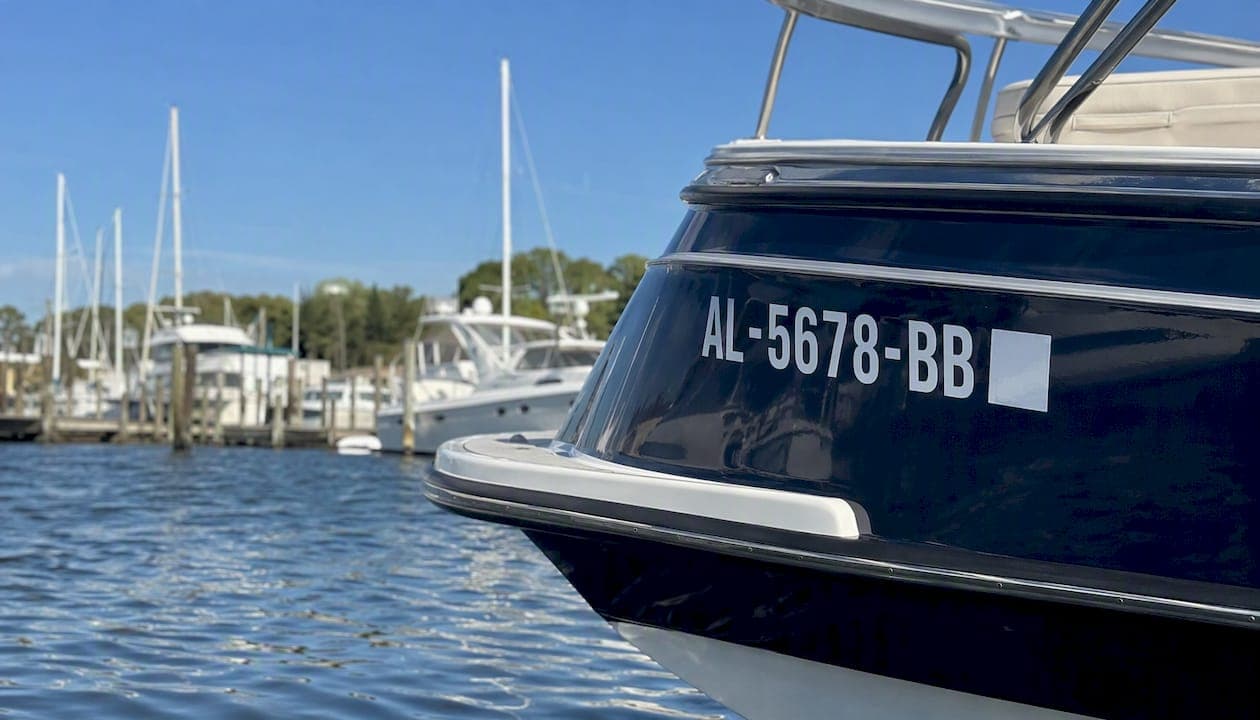
Alabama requires your vessel ID to follow a precise three-part format: the state prefix "AL," up to four numerals, and up to two capital letters, with each part separated by a hyphen or a single space. Characters must be block style, at least 3 inches (76 mm) tall, and readable left-to-right on both sides of the bow. Your current-year validation decal must sit within 6 inches (151 mm) of the registration number, in line with it, on each side of the hull.
Before you launch, run through this quick check:
- Format: AL + up to 4 digits + up to 2 letters (example: AL-1234-AA or AL 3717 ZW)
- Height: Block characters, minimum 3 inches (76 mm)
- Placement: Both sides of the bow, forward half of the vessel, left-to-right
- Decal: Current-year sticker within 6 inches of the number, in line, on each side
- Contrast: Numbers must contrast clearly with the hull color
- Exclusivity: No other numbers on either side of the bow near the registration
If your numbers are faded, peeling, or hard to read, a Marine Police officer can order you to repaint or reaffix them on the spot.
Key Takeaways
Alabama boat registration numbers must follow a strict three-part format, displayed in block characters at least 3 inches high on both sides of the bow, with a current-year decal within 6 inches and in line with the number on each side.
| Point | Details |
|---|---|
| Required format | AL + up to 4 digits + up to 2 letters, separated by a hyphen or space (example: AL-1234-AA). |
| Minimum character height | Block characters at least 3 inches (76 mm) tall, readable left-to-right on both sides of the bow. |
| Decal placement | Current-year validation decal within 6 inches (151 mm) of the registration number, in line, on each side. |
| Special vessel rules | USCG-documented vessels display decal only; racing boats may place the number off the bow if used exclusively for competition. |
| Registrationdecals | Provides marine-grade, state-compliant Alabama decals with an online design tool and 3–5 business day shipping. |
Table of Contents
- What do Alabama's administrative rules actually require?
- Exactly where do the numbers and decal go on your boat?
- Correct and incorrect formatting: what the rules look like in practice
- Best materials and installation tips for numbers that last
- Exceptions: documented vessels, racing boats, and dealers
- How to look up, renew, or replace your Alabama boat registration
- What enforcement actually looks like on the water
- Our perspective on compliance and what actually protects you
- Get compliant Alabama decals shipped in 3–5 business days
- Sources
What do Alabama's administrative rules actually require?
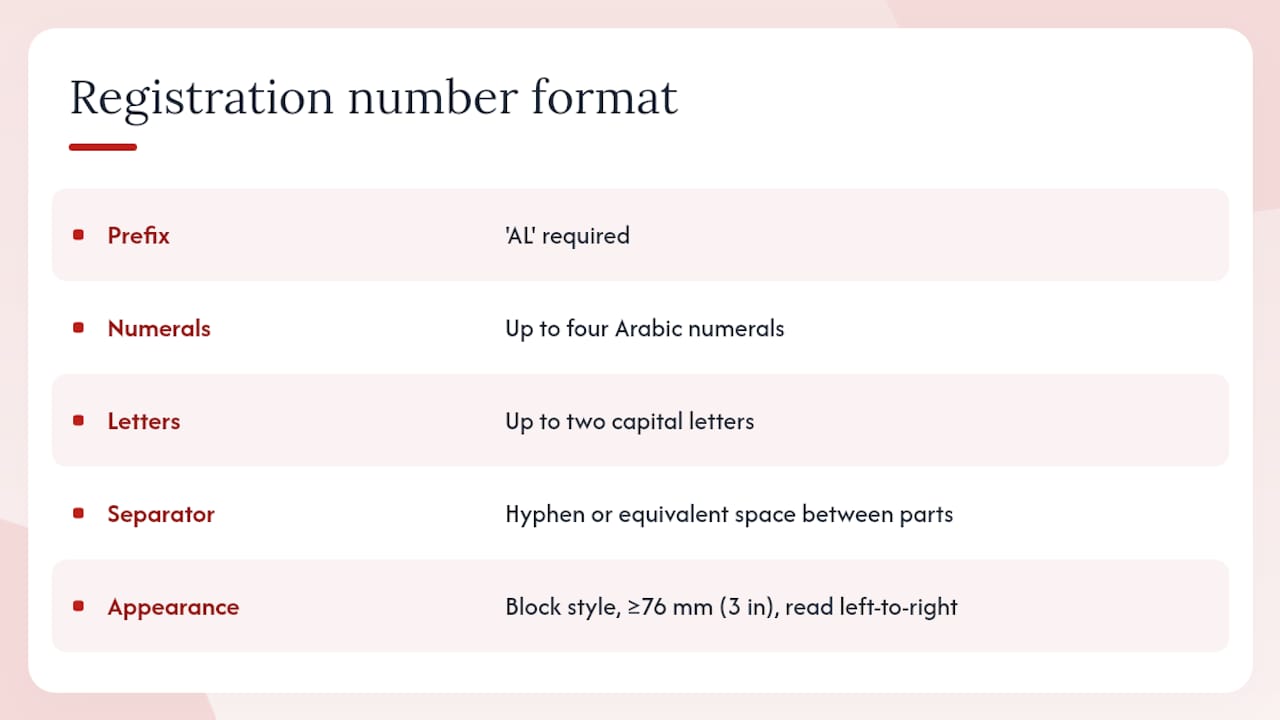
The legal backbone for Alabama boat registration numbers sits in two rules and one statute. Ala. Admin. Code r. 220-6-.01 defines the identification format: the prefix "AL," followed by up to four Arabic numerals, followed by up to two capital letters. A hyphen or equivalent space separates each part. Characters must be block style, at least 76 mm (3 inches) high, and read left-to-right.
Rule 220-6-.03 adds the placement and maintenance layer. Numbers go on both sides of the bow, on the forward half of the vessel. They must contrast with the hull background and remain legible at all times. The validation decal must be placed within 151 mm (6 inches) before or after and in line with the registration number on each side. Marine Police officers have explicit authority to judge legibility and require the owner to repaint or reaffix numbers that no longer meet the standard.
Alabama Code §33-5-11 handles the administrative side: owners must apply for registration through their county probate judge or license commissioner, and the certificate of registration must be kept on board whenever the vessel is underway. Replacement stickers and certificates are available for a prescribed fee with proper documentation.
Exactly where do the numbers and decal go on your boat?
Placement errors are among the most common reasons officers flag vessels during inspections. The rules are specific, so follow them precisely.
- Numbers must appear on both sides of the bow, on the forward half of the vessel.
- They must be readable left-to-right from either side — not mirrored, not reversed.
- The validation decal must be placed within 6 inches (151 mm) of the registration number, in line with it horizontally, on each side.
- No other numbers may appear on either side of the bow. Hull identification numbers, trailer tags, or temporary marks placed near the registration area can trigger an illegibility finding.
For correct placement on your bow, aim for the flattest section of the hull surface. Curved surfaces cause decal edges to lift over time, which accelerates fading and peeling.
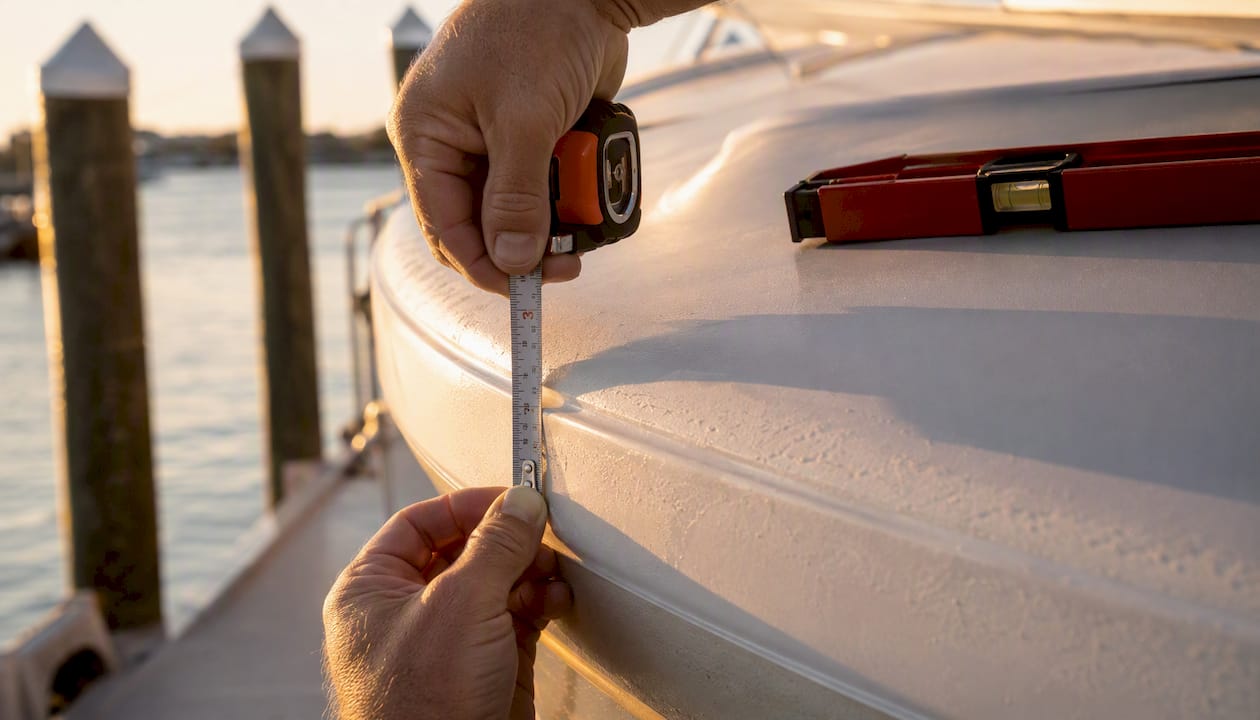
Pro Tip: Use a tape measure and a level before applying. Account for hull curvature — the perceived letter height at eye level from the water must still read as 3 inches. Measure from the installed orientation, not flat on a workbench.
Correct and incorrect formatting: what the rules look like in practice
Getting the format right before you order or paint saves you from redoing the work. Here is what passes and what fails.
Correct examples:
- AL 3717 ZW (space-separated, block letters, 3" height, high contrast)
- AL-3717-ZW (hyphen-separated, same rules apply)
- White characters on a dark navy hull
- Black characters on a white or cream hull
Incorrect examples:
- Script or italic fonts (not block style — fails the legibility standard)
- Characters under 3 inches tall
- Low-contrast combos: dark blue on black, gray on white
- Extra punctuation or symbols between parts (AL.3717.ZW is not permitted)
- A hull ID number or any other numeral displayed near the registration on the bow
The spacing rule is simple: one hyphen or one space between each of the three parts, nothing else. For font guidance, block-style characters with uniform stroke width are the standard. Bold, non-italicized, sans-serif lettering reads cleanly at distance and holds up under enforcement scrutiny. Style is secondary to legibility every time.
Best materials and installation tips for numbers that last
Marine-grade vinyl decals outperform paint for most Alabama boat owners on a practical basis. They apply cleanly, replace easily, and hold up against UV exposure and saltwater. Paint can look sharp on a new hull, but touch-ups after damage or fading require more effort and skill to keep consistent.
Installation steps that matter:
- Clean the hull surface thoroughly with isopropyl alcohol to remove wax, oxidation, and salt residue.
- Let the surface dry completely before applying.
- Position the decal on the flattest area of the bow — avoid seams, rivets, and sharp curves.
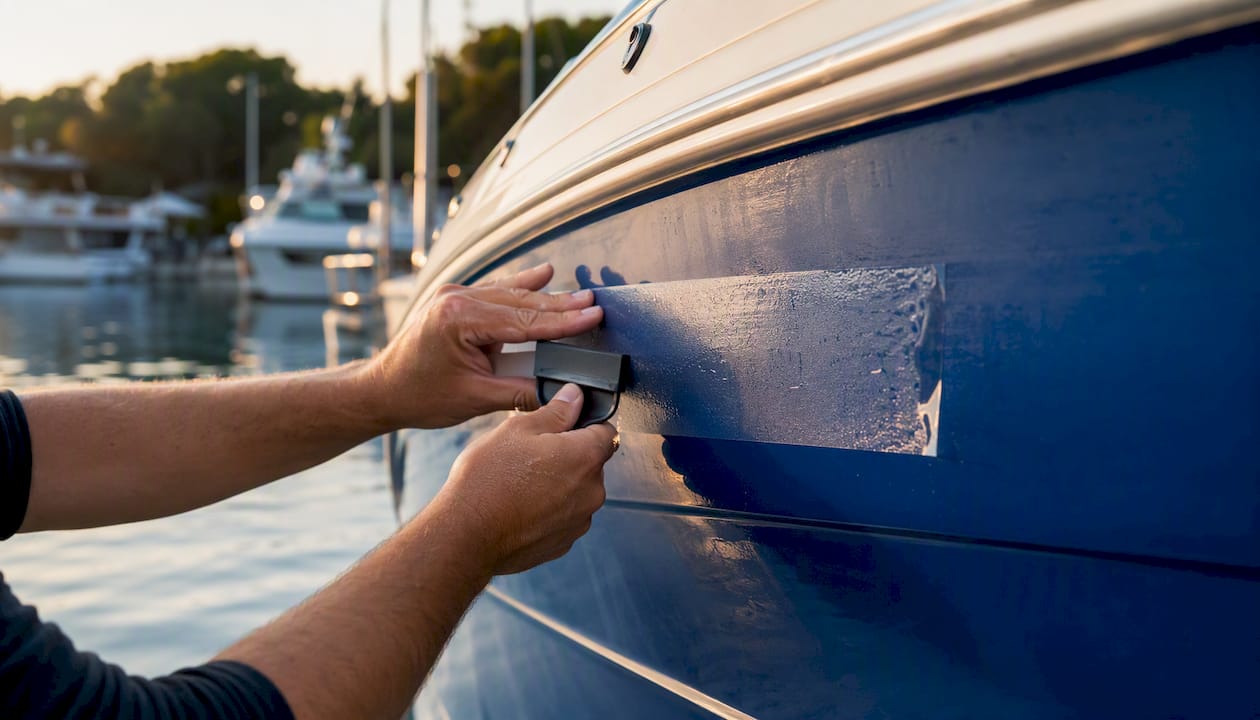
- Press firmly from the center outward to eliminate air bubbles.
- If the decal edge sits near a seam or joint, apply an edge sealant to prevent water seepage underneath.
Maintenance:
- Inspect your numbers annually for fading, lifting edges, or cracking.
- If a Marine Police officer can flag legibility, so can you — replace before they ask.
- Marine vinyl decals made from UV-resistant, saltwater-proof material last significantly longer than standard vinyl in open-water conditions.
Pro Tip: White on dark and black on white are the two contrast combinations that almost never draw an officer's attention. Avoid color-matched or tone-on-tone combinations regardless of how clean they look at the dock.
Registrationdecals provides marine-grade, state-compliant decals along with an online design tool that walks you through Alabama's formatting requirements — AL prefix, correct spacing, and minimum size guidance built in.
Exceptions: documented vessels, racing boats, and dealers
Not every vessel follows the standard bow-number rules. Three categories get different treatment under Alabama's administrative code.
USCG-documented vessels:
- Not required to display Alabama registration numbers on the hull.
- Must still display the current-year validation decal prominently on the forward half of the vessel, on both port and starboard sides.
- The documentation number (the name and hailing port) serves as the vessel identifier instead.
Racing vessels:
- Boats used exclusively for racing competition may omit the registration number from the bow.
- The number must still be displayed conspicuously somewhere else on the vessel.
- This exception applies only to vessels used exclusively for racing — a dual-use boat does not qualify.
Dealers, manufacturers, and rental operators:
- Dealer and manufacturer demonstration boats operate under specific certificate labeling rules rather than standard owner registration.
- Rental boats must carry proper certificates and follow Marine Division guidance on temporary display.
- When ownership transfers or the principal use of a vessel changes, the registration number rules for removal or retention apply immediately.
If you are unsure which category your vessel falls into, the ALEA Marine Patrol registration pages and county probate offices can clarify your specific situation.
How to look up, renew, or replace your Alabama boat registration
Step-by-step for renewals:
- Visit the ALEA boat registration portal for online renewal options and current fee schedules.
- Alternatively, go in person to your county probate judge or license commissioner's office with your current certificate and payment.
- Bring your vessel's hull identification number (HIN), proof of ownership, and any prior registration documents.
- Pay the applicable fee as set under Alabama Code §33-5-11.
- Receive your new certificate and validation decal — apply the decal within 6 inches of your registration number immediately.
For replacement certificates or decals:
- Contact your county probate or license commissioner's office directly.
- Bring documentation showing your current registration (receipts, prior certificates, or ALEA records).
- Replacement fees are set by statute and are limited in amount.
- ALEA Marine Patrol boating forms lists the specific forms county offices use for issuing replacement certificates and stickers.
Additional registration guidance is available through Outdoor Alabama, the state's official conservation resource, which links to ALEA and county office contacts.
What enforcement actually looks like on the water
Alabama Marine Police officers board vessels routinely, and registration display is one of the first things they check. Their authority under Rule 220-6-.03 is broad: if numbers are illegible, improperly spaced, or placed in the wrong location, an officer can order correction on the spot.
Common inspection failures:
- Characters under 3 inches tall
- Low-contrast color combinations
- Script or slanted fonts instead of block characters
- Numbers placed on the stern or mid-hull instead of the bow
- Additional numerals near the registration area creating confusion
Likely outcomes when something is wrong:
- On-the-spot correction order before you can continue operating
- A citation or fine
- Required removal of the vessel from the water until corrected
The practical takeaway: professionally produced, high-contrast marine-grade decals reduce the chance of a discretionary illegibility call. An officer looking at clean, crisp block letters on a contrasting hull has no grounds to act.
Our perspective on compliance and what actually protects you
The compliance rules for Alabama vessel numbers are not complicated, but the enforcement discretion built into Rule 220-6-.03 is worth taking seriously. An officer's judgment about legibility is subjective. That means the margin between a warning and a citation often comes down to how your numbers look, not just whether they technically meet the 3-inch minimum.
Most owners focus on getting the format right and forget about durability. A decal that was compliant when applied but has faded after two seasons on the water is still a violation waiting to happen. Marine-grade vinyl, proper surface prep, and annual inspection close that gap. Paint is a reasonable long-term option on fiberglass hulls, but it requires more skill to apply at the correct height and contrast, and touch-ups after damage rarely match the original finish cleanly.
The owners who never get flagged are the ones who treat their registration display as maintenance, not a one-time task.
Get compliant Alabama decals shipped in 3–5 business days
Alabama's formatting rules are specific, and getting them wrong means redoing the work. Registrationdecals builds its online design tool around state requirements, so when you enter your Alabama registration number, the AL prefix, correct spacing, and minimum size guidance are already built into the template.
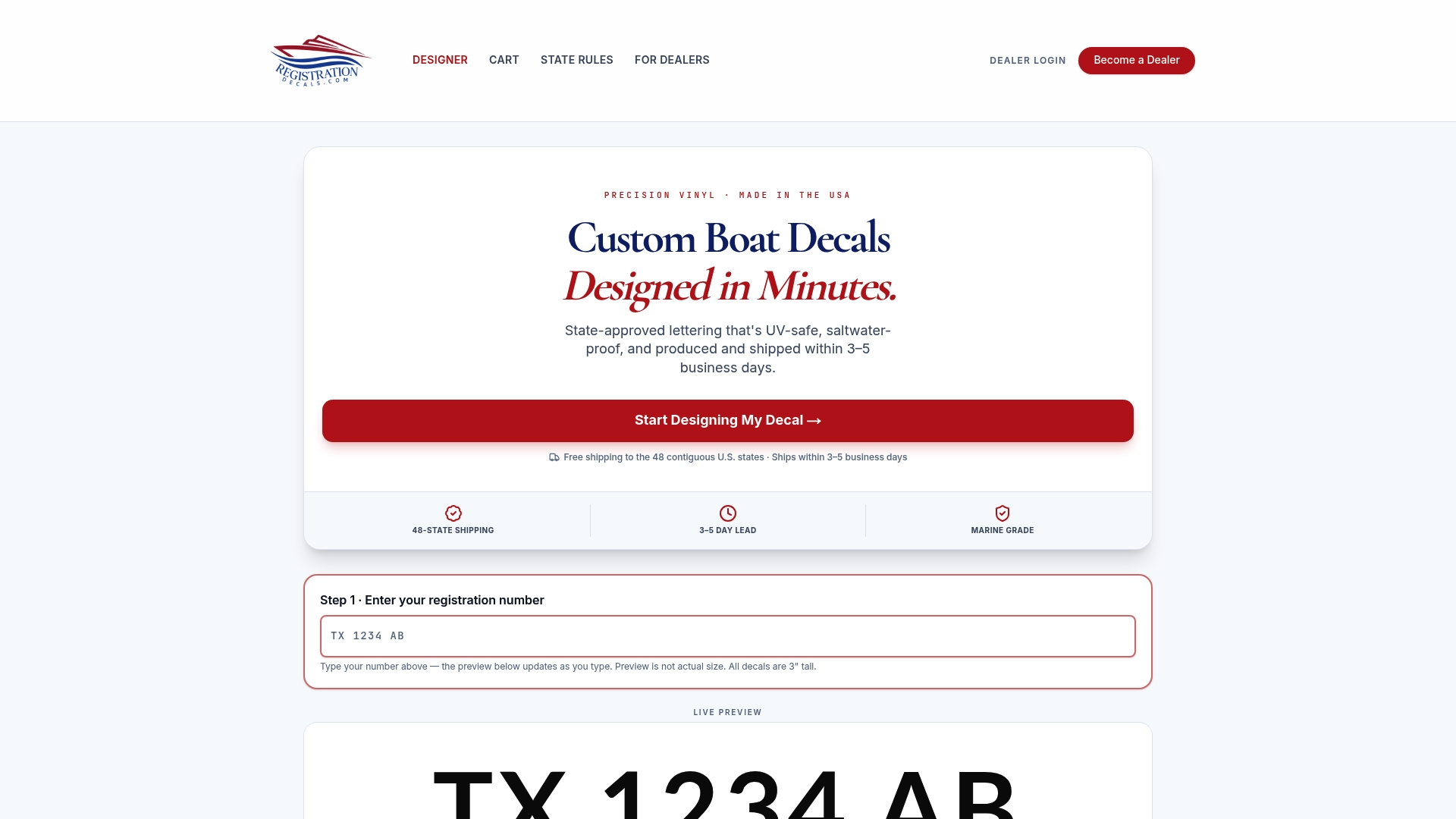
Decals are made from marine-grade vinyl that is UV-resistant and saltwater-proof, built to hold up through Alabama's hot summers and open-water conditions. Orders ship free within the contiguous United States in 3–5 business days. Ordering a spare set at the same time is worth it — replacement decals are inexpensive, and having a backup on hand means you can swap immediately if a decal lifts or fades before renewal. Design and order your Alabama-compliant decals or review the full Alabama regulations page for measurement details and placement diagrams before you order.
Sources
Use these primary sources to verify requirements and complete administrative steps:
- Rule 220-6-.03 - Placement Of Vessel Identification Numbers
- Ala. Admin. Code r. 220-6-.01 - Vessel Identification Numbers
- Alabama Code § 33-5-11 - Certificates of Registration and Numbers Generally
- Boat / Vessel Registration | Alabama Law Enforcement Agency
This article is general information, not a substitute for advice from a qualified lawyer. Consult a qualified legal professional about your own circumstances before acting on anything here.