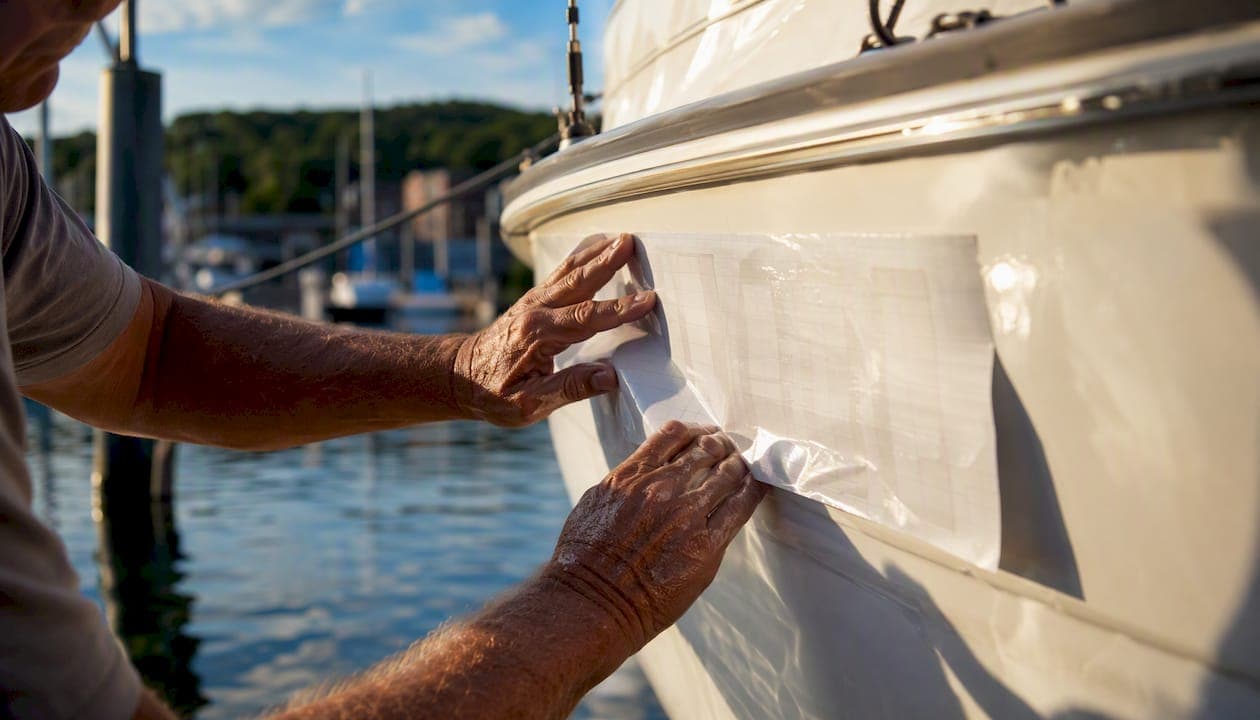
Arkansas requires every motorboat operated on public waters to carry a valid Certificate of Number and display state-issued validation decals. Your registration number must appear on the forward half of both sides of the hull, reading left-to-right, in bold block letters at least 3 inches high, in a color that contrasts with the hull. Validation decals go 3 inches aft of and in line with that number. The Arkansas Department of Finance and Administration (DFA) issues the Certificate of Number, and you must keep the pocket registration card on board whenever the boat is underway and available for inspection.
- Registration is required for any motor-propelled or sail-propelled vessel on Arkansas public waters.
- The "AR" prefix is the state identifier and must always appear as the first two characters of your displayed number.
- Validation decals must be affixed on each side, 3 inches toward the stern from the registration number, in line with it.
- The certificate of number (pocket card) must be on board and available for inspection at all times.
Key Takeaways
Arkansas boat registration and display compliance comes down to five concrete requirements: a valid Certificate of Number, correct AR number format and placement, properly positioned validation decals, HIN verification on file, and county tax documentation in order.
| Point | Details |
|---|---|
| Register within 30 days | Apply at a County Revenue Office within 30 days of purchase; dated proof of purchase covers you until then. |
| Display specs are exact | Bold block letters, at least 3 inches high, forward half of each side, contrasting color, left-to-right on both sides. |
| Decal placement | Validation decals go 3 inches aft of and in line with the registration number on each side. |
| HIN verification required | Bring a pencil rubbing or printed photo of the HIN; DFA will not process registration without it. |
| Registrationdecals | Produces Arkansas-compliant marine-grade vinyl decals with an online design tool and 3–5 business-day production. |
Table of Contents
- How do you register a motorboat in Arkansas?
- Exact rules for displaying your AR registration number and decals
- Fees, registration validity, and replacement basics
- Which boats are exempt from Arkansas registration?
- HIN verification and what ownership documents you need
- What enforcement officers check on the water
- How to order decals that meet Arkansas specs
- Why getting every detail right actually matters
- Get compliant Arkansas decals fast with Registrationdecals
- Sources
How do you register a motorboat in Arkansas?
The registration process starts with a 30-day window. Once you purchase a motorboat, you have 30 days to apply for registration at a County Revenue Office or an Arkansas DFA location. During those 30 days, you can legally operate the boat using dated proof of purchase as a temporary stand-in for the registration card.
What to bring to the revenue office:
- Proof of ownership: current registration from the previous owner or a bill of sale that includes the HIN, year, make, horsepower, and the signatures of both buyer and seller
- HIN verification: a legible pencil rubbing or printed photograph of the Hull Identification Number
- County assessor assessment proof for the vessel
- Proof that personal property taxes were paid by the previous October 10 deadline
- Proof of liability insurance if the engine exceeds 50 HP
- Engine serial number when applicable
The order you assemble these documents matters. Missing county assessor paperwork is the single most common reason DFA rejects a registration application. Confirm your county assessment and tax payment receipt before you drive to the revenue office. New boats from a dealer require a Manufacturer's Statement of Origin instead of a bill of sale.
Pro Tip: Call your County Revenue Office before your visit to confirm current hours and any county-specific documentation requirements. Office hours and staffing vary across Arkansas's 75 counties, and a five-minute phone call prevents a wasted trip.
Exact rules for displaying your AR registration number and decals
Arkansas display rules are specific, and enforcement officers check each element. Getting one detail wrong — wrong height, wrong placement side, wrong decal offset — can result in a citation even if your registration is current.
Registration number display requirements:
- Painted, decaled, or permanently affixed to the forward half of each side of the hull
- Reads left-to-right on both sides
- Letters and numbers at least 3 inches high
- Bold block lettering only
- Color must contrast clearly with the hull background
- Letters and numbers separated by a space or hyphen; no other numbers may appear on either side of the bow
Acceptable formats (both are legal):
- AR 3717 ZW
- AR-3717-ZW
- AR 123 ABC
- AR-123-ABC
The "AR" prefix is the official Arkansas state identifier. It is not the same as the Hull Identification Number, which identifies the physical hull and is stamped or molded into the transom.
Validation decal placement: Affix one decal on each side of the hull, positioned 3 inches toward the stern from the registration number and in line with it horizontally. The decal must not be placed above or below the number line.
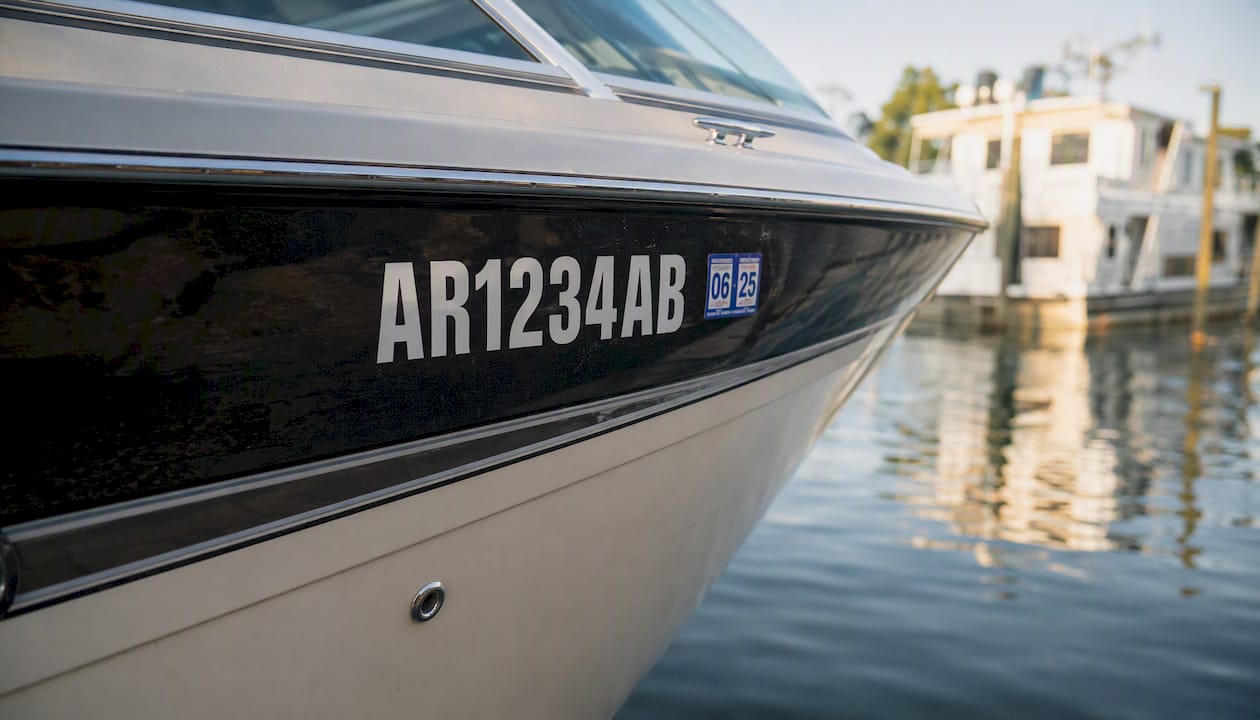
Pro Tip: Before applying decals, hold them against the hull in natural light and confirm the color contrast is visible from at least 10 feet away. A dark hull needs white or bright-colored lettering; a white hull needs dark lettering. This quick check prevents a failed inspection.
Fees, registration validity, and replacement basics
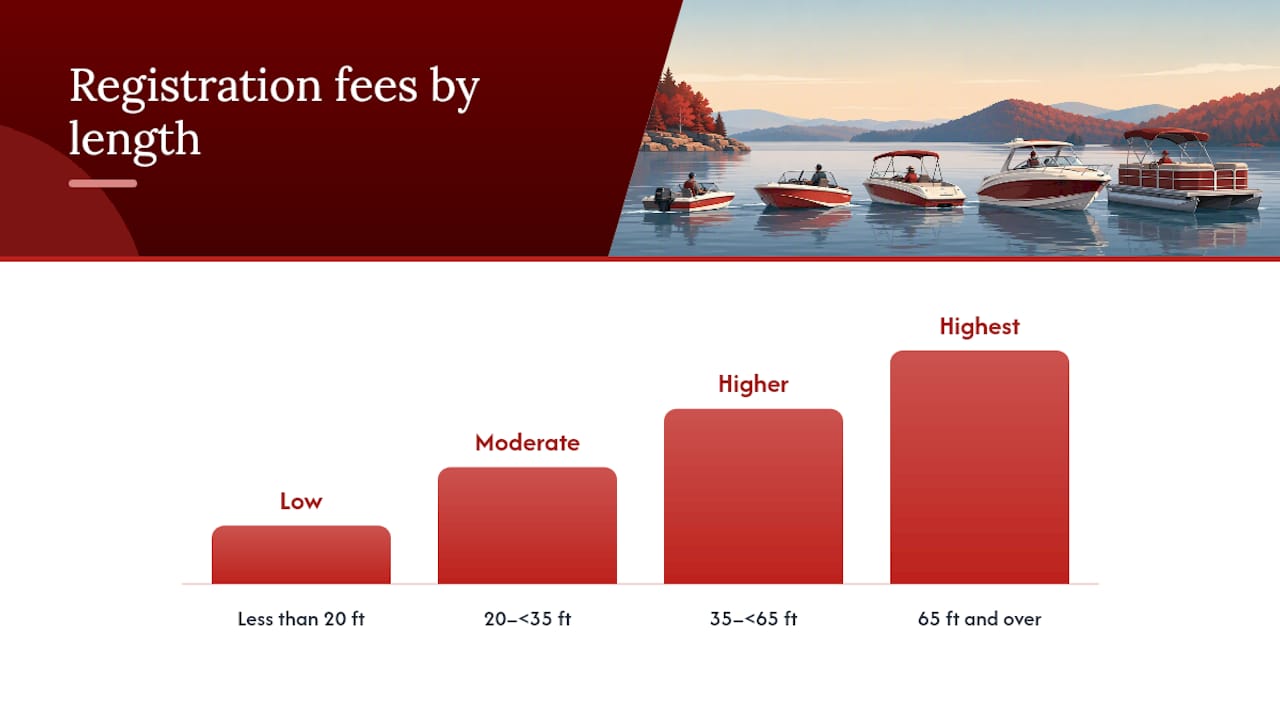
Arkansas boat registrations are valid for 3 years from the date of issue. The DFA fee schedule is based on vessel length:
| Vessel Length | Registration Fee |
|---|---|
| Less than 20 feet | a low fee based on size |
| 20 feet to less than 35 feet | a moderate fee based on size |
| 35 feet to less than 65 feet | a higher fee based on size |
| 65 feet and over | the highest fee bracket based on size |
Replacement registration cards carry a separate replacement fee. Renewals are triggered by the expiration of the 3-year cycle; you will need updated county assessor and tax documentation at renewal, just as you did at initial registration.
One practical note: Arkansas does not charge sales tax on casual person-to-person boat sales for registration purposes. If you bought your boat from a private seller rather than a dealer, you will not owe sales tax at the DFA counter, though you still need the standard ownership and tax documents.
Which boats are exempt from Arkansas registration?
Not every vessel on Arkansas water needs a state Certificate of Number. The AGFC handbook and DFA rules identify three main exemption categories:
- Non-propelled vessels: Canoes, kayaks, rowboats, and any craft without a motor or sail are exempt from registration requirements.
- U.S. Coast Guard documented vessels: Federally documented boats are exempt from state numbering requirements. However, they are not fully exempt from state rules. USCG-documented vessels operating on Arkansas waters still commonly need state-issued validation decals, a point that trips up many documented-vessel owners who assume federal documentation covers everything.
- Out-of-state registered boats: A boat properly registered in another state may operate on Arkansas waters for up to 90 consecutive days without obtaining Arkansas registration. After 90 days, Arkansas registration is required.
For commercial vessels, large charter boats, or any edge case not clearly covered by these three categories, contact the AGFC or DFA directly before operating. The rules for commercial use differ from recreational use, and the cost of getting it wrong outweighs the cost of a phone call.
HIN verification and what ownership documents you need
The Hull Identification Number requirement has been a hard stop at the DFA since 2017. The DFA will not renew or update a registration without verified HIN documentation, per BoatForms guidance. Acceptable forms are a legible pencil rubbing of the HIN or a clear printed photograph.
How to take a proper HIN rubbing or photo:
- Locate the HIN on the starboard side of the transom, at or near the top.
- For a pencil rubbing: place a blank sheet of paper over the HIN plate and rub a soft pencil across it until all 12 characters are clearly visible.
- For a photo: shoot in good light with no glare, frame tightly on the HIN, and print it at a size where each character is readable without magnification.
- Label the rubbing or photo with the vessel make, year, and your name before submitting.
Acceptable proofs of ownership:
- Current registration from the previous owner (with matching HIN)
- Bill of sale signed and dated by both parties, listing the HIN, year, make, and horsepower
- Manufacturer's Statement of Origin for new boats purchased from a dealer
Homemade boats and vessels without a factory HIN require an AGFC inspection before the DFA will register the boat. An AGFC inspector assigns an official HIN, and registration cannot proceed until that number is issued. Schedule the AGFC inspection as early as possible — it is the longest lead-time step in the process for these vessels.
What enforcement officers check on the water
Arkansas Game and Fish Commission officers and other law enforcement can stop any motorboat on public waters for a compliance check. When they do, here is what they look for:
- Certificate of Number: The pocket registration card must be on board and produced on request. A digital copy on your phone is not a substitute for the physical card.
- Visible registration number: Correct placement, size, font, and color contrast on both sides of the forward hull.
- Validation decals: Present on both sides, correctly positioned 3 inches aft of and in line with the registration number.
- HIN presence: The HIN must be physically present on the transom and legible.
- Proof of ownership: Officers may request this if registration status is in question.
- Insurance documentation: Required if the engine exceeds 50 HP.
Penalties for noncompliance range from fines to suspension of vessel operations. If a vessel is abandoned or destroyed, the owner is responsible for notifying DFA to terminate the Certificate of Number, which prevents ongoing registration obligations and potential liability.
How to order decals that meet Arkansas specs
Getting the registration number right on paper is one thing. Getting it right on the hull is where most compliance problems actually happen. Here is what to confirm before you order:
Marine-grade vinyl with UV-stable inks and a pressure-sensitive adhesive rated for saltwater and sun exposure is the right material for any Arkansas hull. Standard craft vinyl fades and lifts within a season on a boat that sees regular water. The Arkansas decal requirements specify a minimum 3-inch letter height, bold block font, and high-contrast color, and your decal supplier needs to match all three.
Measurement checklist before ordering:
- Measure the forward half of each side and confirm there is a clean, flat surface for placement.
- Mark where the registration number will sit, then measure 3 inches aft along the same horizontal line for the decal position.
- Test your chosen color combination against the hull in direct sunlight before finalizing.
Ordering steps:
- Confirm your exact registration number format (AR followed by numbers and letters, with spaces or hyphens).
- Select a font weight that qualifies as bold block lettering.
- Choose a color that contrasts with your hull.
- Request a digital proof or mockup before production.
- Allow 3–5 business days for production plus shipping time.
Pro Tip: On gelcoat hulls, a gloss-finish decal blends more naturally and adheres better than matte. On painted hulls, matte often gives cleaner edges and less peeling at the corners. Ask your supplier which finish they recommend for your specific hull surface.
Marine vinyl decals applied correctly to a clean, dry hull can last several years. For guidance on expected lifespan, marine vinyl decal durability depends heavily on UV exposure, surface prep, and adhesive quality.
Why getting every detail right actually matters
Most boat owners treat registration numbers as a formality. They are not. When a vessel is involved in an accident, a search-and-rescue call, or a theft report, the registration number is the first identifier responders use. A faded, misplaced, or incorrectly formatted number slows that process at exactly the wrong moment.

The display rules exist because they work. Three-inch bold block letters in a contrasting color are readable from a moving patrol boat at distance. The 3-inch decal offset keeps the validation year visible without obscuring the number. These are not arbitrary bureaucratic preferences. They are the result of practical enforcement experience.
Boat owners who invest in quality decals and apply them correctly also avoid the nuisance stops that come from marginal compliance. An officer who can read your number clearly from the water has no reason to pull alongside. That alone is worth the extra few minutes spent measuring placement before you stick anything down.
Get compliant Arkansas decals fast with Registrationdecals
Registrationdecals produces custom AR registration number decals built to meet DFA and AGFC specs: 3-inch minimum height, bold block font, your choice of color for hull contrast, and marine-grade vinyl that holds up to UV exposure and Arkansas lake water. The online design tool at Registrationdecals lets you enter your exact registration number, pick your color and font, and see a preview before you order. Production runs 3–5 business days, and shipping is free across the contiguous United States.
The design tool also accounts for the 3-inch decal offset so you know exactly where each element lands on your hull before the decals arrive. If you have placement questions, customer support can walk you through the measurement steps. For a full breakdown of Arkansas-specific size, color, and placement specs, the Arkansas decal requirements guide covers every rule in one place. Order today and have compliant decals on your hull before your next time on the water.
Sources
The following official and authoritative sources were used to build this guide. Consult them directly to verify current legal language, fee schedules, and office locations:
- Motor Boat Registration – Arkansas Department of Finance and Administration
- Arkansas Boating Laws and Responsibilities (AGFC handbook)
- Displaying the Registration Number and Validation Decals — Boat‑Ed
- Arkansas boat registration — TakeMeFishing
- How to Register a Boat in Arkansas in 2026 | BoatForms
Arkansas does not maintain a public online database for boat registration number lookups. To verify a vessel's registration status, contact the DFA directly or request documentation from the vessel owner.