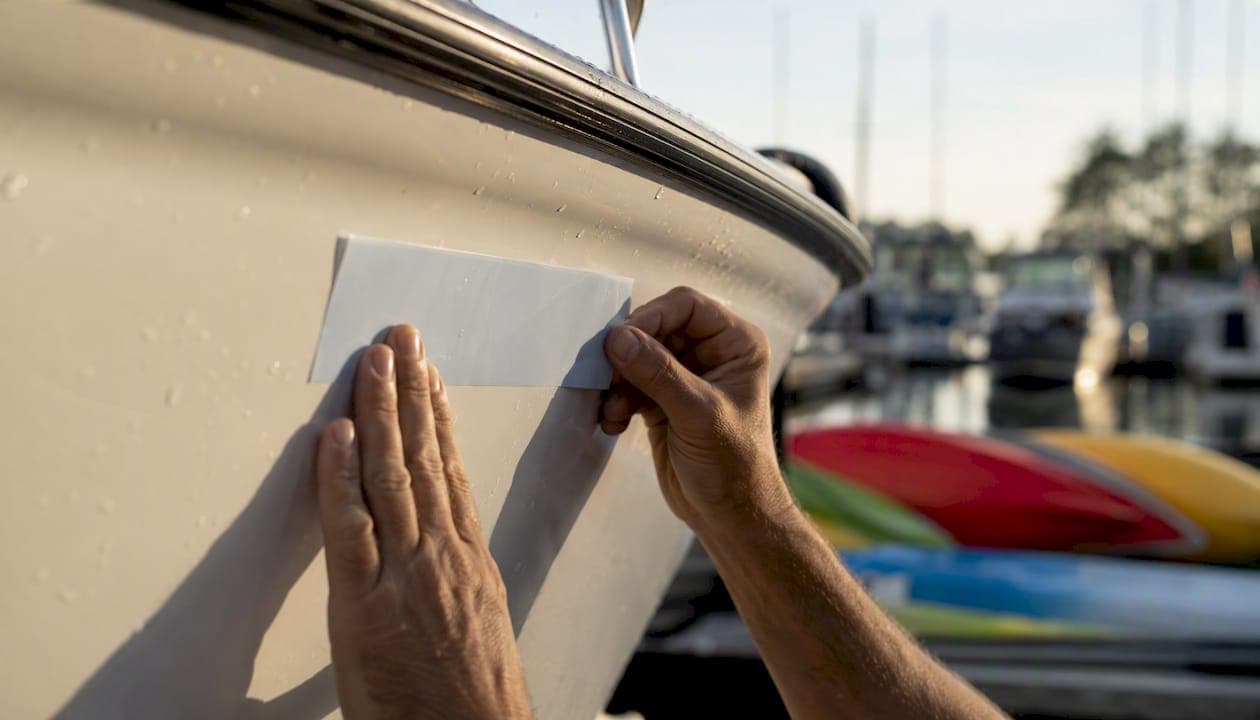
Every registered boat must display its state-issued number on both sides of the forward half in plain vertical block characters at least 3 inches high, reading left to right, in a color that contrasts with the hull, with a space or hyphen between the letter and number groups, and a validation decal placed inline 3 to 6 inches aft of the number, depending on your state. The certificate of number has to stay on board.
Run through this before you launch or face an inspection:
- Numbers on both sides of the bow, forward half only
- Plain block characters, minimum 3 inches tall
- Left to right, contrasting color against the hull
- Space or hyphen between the state prefix, numerals, and suffix
- Validation decal inline, 3 to 6 inches behind the number
- Certificate of number physically on board
| Element | Required Value |
|---|---|
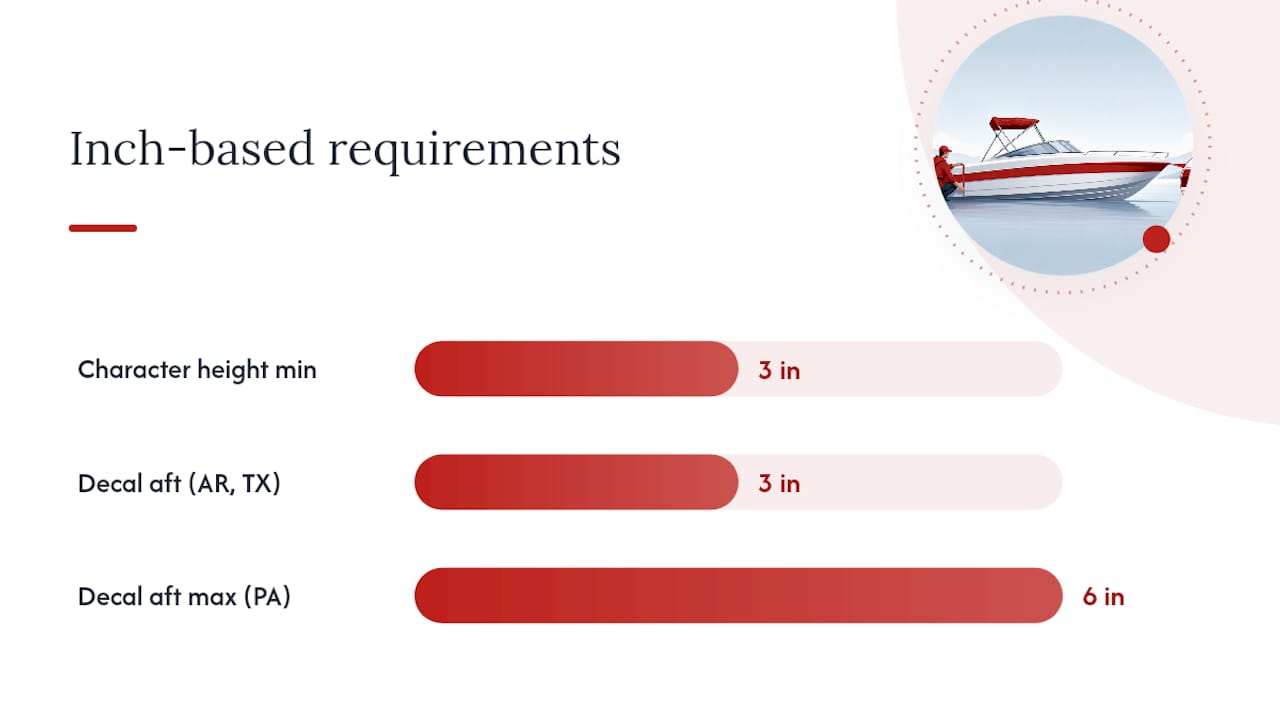
| Character height | 3 inches minimum |
| Placement | Forward half, both sides |
| Font | Plain vertical block characters |
| Spacing | One character width (space or hyphen) |
| Decal distance | 3 to 6 inches aft, inline |
Key Takeaways
Compliant boat registration display comes down to six fixed elements: 3-inch block characters, forward-half placement, contrasting color, correct spacing, a properly placed decal, and the certificate on board.
| Point | Details |
|---|---|
| Federal floor applies everywhere | 33 CFR Part 173 sets the 3-inch minimum and forward-half placement every state builds on. |
| Decal distance varies by state | Arkansas and Texas use 3 inches aft; Pennsylvania allows up to 6 inches. |
| Exceptions exist | Documented vessels, tenders, and racing boats often skip standard numbering rules. |
| Font choice matters most at inspection | Plain vertical block characters pass; decorative or script styles routinely fail. |
| Registrationdecals offers a compliant shortcut | Pre-spaced marine-grade vinyl kits match state formats and ship in 3 to 5 business days. |
Table of Contents
- Where do federal boat registration number requirements come from?
- How do individual states apply the federal rules?
- Are there exceptions to boat registration display rules?
- How do you buy, apply, and verify registration numbers?
- What materials hold up best on boat registration numbers?
- What do enforcement officers check during a registration inspection?
- Where to get compliant, durable registration numbers
- Sources
Where do federal boat registration number requirements come from?
Every state's numbering scheme traces back to the same source: the U.S. Coast Guard's boating safety regulations. 33 CFR Part 173 sets the federal floor, and states can add detail on top of it, but they can't go below it. The rule requires numbers painted on or permanently attached to each side of the forward half of the hull, in plain vertical block characters no smaller than 3 inches, contrasting with the boat's background color, with spacing or hyphens between groups equal to the width of a character.
Numbers must "read from left to right" and be maintained so they're "clearly visible and legible," with the certificate of number carried on board whenever the vessel operates.
That single paragraph of federal code is why a boat registered in Texas and one registered in Maine look almost identical up front: same 3-inch minimum, same forward-half rule, same certificate requirement. The CFR does carve out exceptions. Documented vessels don't carry state numbers at all. Dealers can run temporary placards. And boats with hull shapes that make direct application impractical can mount the characters on a backing plate instead, as long as the plate preserves contrast and legibility.
How do individual states apply the federal rules?
States rarely rewrite the federal baseline; they mostly clarify distances and add local paperwork requirements. A few examples show how much (or how little) varies state to state.
Texas requires the number on each side of the forward half, block characters no shorter than 3 inches, separated by hyphens or equivalent spaces, with the validation decal placed three inches toward the rear of the number.
Arkansas uses nearly identical language, bold block letters at least 3 inches high, but its decal has to sit 3 inches aft of the number, and new owners have just 30 days from purchase to register.
Hawaii adds a legibility test most states skip: numbers must stay readable from at least 100 feet away, with the decal 3 inches aft and inline.
Pennsylvania gives owners more breathing room, letting the validation decal sit anywhere within 6 inches of the number rather than pinning it to an exact distance.
The gap between a 3-inch and 6-inch decal rule sounds trivial until an officer measures your boat against the wrong state's chart.
Before you commit to a layout, confirm your own state's specifics:
- Check your state's DNR, DMV, or wildlife agency boating page directly
- Compare the decal-distance rule against your certificate paperwork
- Note whether your state requires legibility at a set distance (like Hawaii's 100 feet)
- Confirm renewal or replacement timelines shown on your registration card
Are there exceptions to boat registration display rules?
Not every boat on the water needs painted numbers. A handful of common situations fall outside the standard rule:
- USCG-documented vessels typically skip state numbers entirely, though New York and similar states still require a sticker showing documentation status, often placed a set distance from the bow.
- Racing vessels competing under a sanctioned event often qualify for temporary exemptions.
- Small auxiliary tenders under a certain length or horsepower are exempt in several states, particularly hard dinghies used to reach a larger boat.
- Non-powered craft like canoes and paddleboards are unregulated in most states, though a few require registration above a certain length.
- Visiting boaters from another state usually get reciprocity for 60 to 90 days before local registration kicks in, though the exact window depends on where you're boating.
If your boat falls into one of these categories, keep the relevant paperwork, documentation certificate, race entry, or out-of-state registration, on board instead of relying on painted numbers.
How do you buy, apply, and verify registration numbers?
Getting compliant numbers on your hull is a short, mechanical process if you follow it in order.
- Pull your certificate of number and confirm the exact prefix, digits, and suffix issued to you.
- Choose your material. Marine-grade vinyl outlasts paint and holds contrast far better over a season of UV exposure and saltwater.
- Measure the forward half of your hull and mark a level line for the bottom edge of the characters on both sides.
- Apply the decal yourself or have a professional installer handle it, especially on curved or riveted surfaces.
- Place the validation decal at your state's required distance, inline with the number.
- Store the certificate of number on board, in a dry compartment near the helm.
Skip individual peel-and-stick letters if you can avoid it. Pre-spaced decal kits, cut to match your exact registration number, eliminate the crooked spacing and drifting margins that trip up DIY installs. After application, measure character height with a tape measure (it should read 3 inches or more) and check that the gap between groups matches roughly one character's width.
Pro Tip: Mist the hull with soapy water before laying down vinyl. It lets you slide the decal into position without it grabbing prematurely, then squeegee from the center outward to push out air bubbles before the adhesive sets.
Before you leave the dock, snap a photo of both sides of the bow showing the number and decal together. It costs nothing and gives you proof of compliance if an officer asks.
What materials hold up best on boat registration numbers?
Marine-grade vinyl with a permanent marine adhesive is the standard most experienced boaters land on, and for good reason. Painted numbers chip and fade within a season or two on a boat that sees regular sun and salt spray. Domed or raised numbers look sharp but often cost more and can violate the "flat, plain block character" language some states enforce strictly.
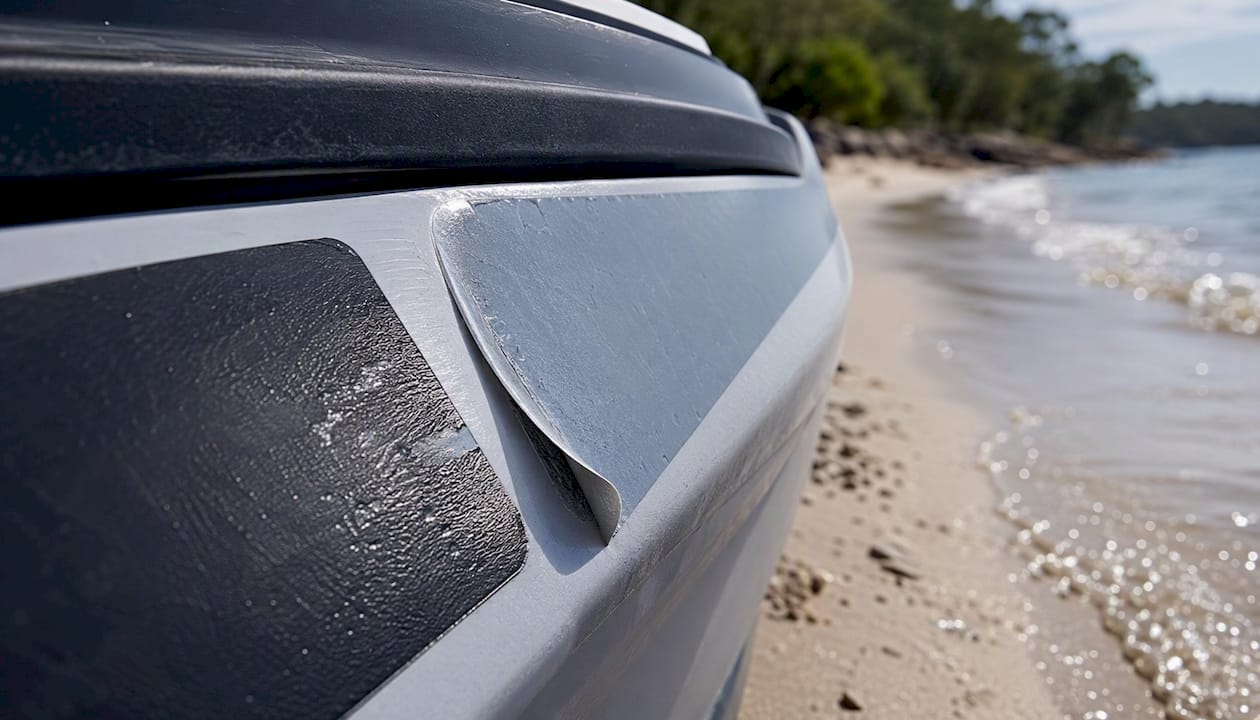
Stick to plain vertical block lettering. Anything decorative, script, italic, or outlined, risks failing a legibility check even if the height is technically correct. Registrationdecals maintains a guide to approved font templates if you want to see exactly what passes muster before you order.
A few maintenance habits keep numbers compliant for years instead of months:
- Rinse salt residue off the decal area regularly to prevent lifting at the edges
- Inspect for fading or cracking each spring before the season starts
- Replace decals showing more than light surface wear rather than waiting for a full failure
- In cold climates, avoid applying new vinyl below 50°F, since adhesive won't bond properly
Pro Tip: Warm the application area with a hair dryer on low heat before installing vinyl in cooler weather. It softens the adhesive just enough to bond correctly without stretching the material out of shape.
What do enforcement officers check during a registration inspection?
Marine patrol officers run through the same short list every time: character height, contrast against the hull, spacing between number groups, decal presence, and whether the certificate of number is actually on board. Miss any one of those and you're looking at a stop.
The fastest way to fail an inspection is a font issue. Officers see decorative or script-style numbers regularly, and those get flagged even when the height is correct. Faded, peeling, or undersized characters after a bad DIY install cause a similar share of citations. So does forgetting the certificate, which happens more often than boaters expect since it's easy to leave in a glove compartment at home instead of the boat itself.
Penalties typically escalate in stages: a verbal warning, a fix-it notice with a short compliance window, then fines if the problem persists. State guides that publish this stage system consistently note that ordinary fines run from modest amounts for a first offense up toward several hundred dollars for repeated or ignored violations. Fix these before you ever get stopped:
- Undersized or mirrored/decorative characters
- Missing or expired validation decal
- Certificate of number left at home
- Numbers placed too far aft of the forward half
A practical closing note
Getting inspection-ready takes ten minutes once you've measured correctly and used a decal that won't peel by midsummer. When state rules get specific, decal distance, legibility distance, documentation handling, treat the issuing agency's own page as the final word over any general guide, including this one.
Where to get compliant, durable registration numbers
Painted numbers and cut-your-own vinyl letters are still options, but they're also where most spacing errors and faded-character citations come from. A pre-spaced, marine-grade decal set solves both problems at once: the characters are already sized and gapped to your state's exact format, and the vinyl itself is built to survive UV exposure and saltwater without lifting at the edges.
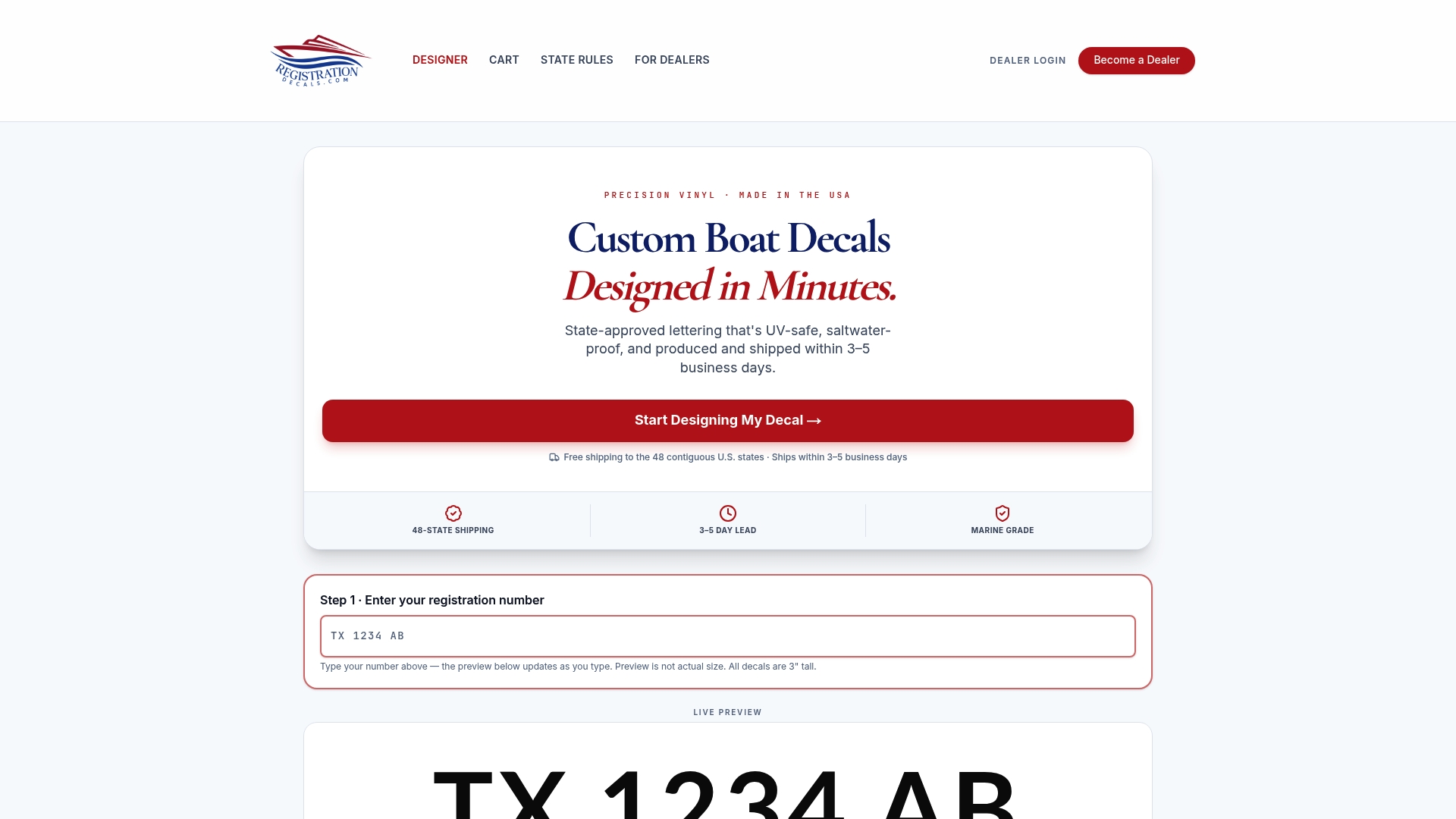
Registrationdecals builds custom sets using UV-resistant, saltwater-proof marine vinyl, designed through an online tool where you enter your exact registration number and pick your color and font. Production runs 3 to 5 business days, with free shipping across the contiguous U.S., and marinas or dealerships needing multiple sets can order through the dealer program. Pull your certificate of number, confirm your exact prefix and digits, then design your matching decal set before your next trip out.
Sources
- SUBCHAPTER S—BOATING SAFETY (33 CFR Part 173) — GovInfo
- Motor Boat Registration – Arkansas Department of Finance and Administration
- Numbering your vessel — DOBOR, Hawaii
- Placement of TX number and decal on vessels — Texas Parks and Wildlife
- Boat Registration Number Display Rules: Size, Placement & Format — BoatRegistrationUSA