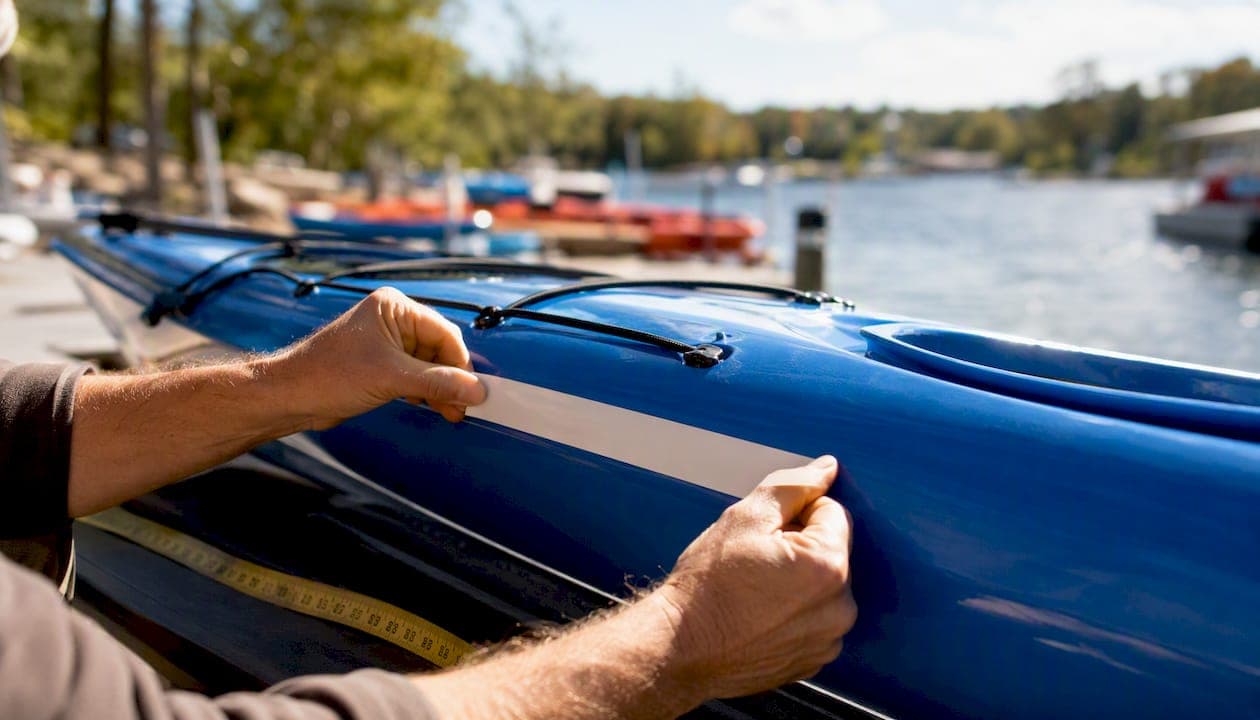
Colorado requires boat registration numbers to be block characters at least 3 inches tall, painted or affixed in a contrasting color, and displayed left to right on both sides of the bow, on the forward half of the vessel. The annual validation decal goes 2 inches to the left of the "C" in the number sequence, in line with the numbers themselves. Colorado Parks and Wildlife (CPW) writes and enforces this rule, and it applies to nearly every motorized vessel on Colorado water.
If you're staring at your hull right now trying to figure out whether your numbers pass, here's the short version:
- Numbers must be at least moderately tall, block style, contrasting color.
- Placement is both sides of the bow, forward half of the vessel.
- The validation sticker sits a short distance left of the "C," lined up with the numbers.
- CPW enforces this under state statute, and violations carry civil fines.
Colorado's rule is specific enough that "close enough" doesn't cut it. A 2.5 inch number, a faded decal, or a sticker placed an inch too far left can technically put you out of compliance, even if the boat is fully registered.
Your actionable next step: walk out to your boat today, hold a tape measure to your existing numbers, and check the color contrast against your hull. If either looks off, you're better off fixing it before the season gets busy rather than after a warden flags it.
Key Takeaways
Colorado boat registration numbers must be 3 inch block characters displayed on both sides of the bow, with validation stickers placed exactly 2 inches left of the "C."
| Point | Details |
|---|---|
| Minimum size and style | Numbers must be block characters at least 3 inches tall, contrasting in color, reading left to right. |
| Sticker placement | Validation decals go 2 inches left of the "C," lined up horizontally with the numbers. |
| Renewal timeline | Registration runs January 1 through December 31; renew up to 45 days before expiration. |
| Fastest compliance fix | Replace faded or undersized numbers with marine-grade vinyl decals rather than repainting. |
| Where to order | Registrationdecals offers Colorado-compliant, marine-grade decals with 3 to 5 day production. |
Table of Contents
- Where Colorado Boat Registration Numbers Actually Go
- Painted Numbers, Vinyl Decals, or Backing Plates: What's Allowed
- How to Order and Apply Compliant Decals
- Registering and Renewing a Boat in Colorado
- Fines and Mistakes That Trigger Them
- A Quick Compliance Checklist Before You Launch
- Order Compliant Colorado Decals in Days, Not Weeks
- Where to Verify Colorado's Boat Registration Rules
- Frequently Asked Questions
- Sources
Where Colorado Boat Registration Numbers Actually Go
The forward-half rule is the one most owners get wrong, not because it's complicated, but because "forward half" isn't always obvious on a boat with a curved or flared bow. CPW's registration guidance is direct about it: numbers go on each side of the bow, within the front half of the vessel's overall length, reading left to right exactly as assigned. No stacking, no vertical orientation, no mirroring.
A few placement specifics worth knowing:
- On most fishing boats and runabouts, the forward half lands somewhere between the bow tip and the windshield or center console.
- Personal watercraft (PWCs) must carry their numbers on a nonremovable portion of the hull, since PWCs don't have a traditional bow surface for a decal.
- Inflatable boats and rafts often need a backing plate, since numbers can't adhere directly to fabric hulls.
- If your bow is flared or oddly shaped, the Colorado Boating Handbook allows the number to move to another forward-half location as long as it's still easily readable from the water.
Spacing matters too. Colorado allows a gap between the prefix letters, the numerals, and the suffix letters equal to the width of the letter "C" or a hyphen, no more, no less. And the validation sticker isn't placed wherever there's room. It goes 2 inches to the left of the "C" prefix, lined up horizontally with the registration numbers, not above or below them.
Pro Tip: Measure twice before you order anything. Wrap a flexible tape measure along the actual curve of your hull rather than eyeballing a straight line. A flared bow can throw off your spacing by half an inch, which is enough to make a sticker look crooked once it's applied.
Painted Numbers, Vinyl Decals, or Backing Plates: What's Allowed
Colorado doesn't mandate one specific material. The Boating Handbook and state code permit painted numbers, permanently affixed decals, or backing plates, depending on your hull. Dealers and manufacturers get a narrower allowance: detachable plates for inventory boats that haven't sold yet. Private owners don't get that option. Your numbers need to be permanent enough that removing them would be obvious.
| Method | Durability | Ease of Application | Best For |
|---|---|---|---|
| Painted numbers | Moderate; fades and chips over seasons | Slow, requires stencils and steady hands | Older hulls, budget projects |
| Marine-grade vinyl decals | High; UV and saltwater resistant | Fast, adheres cleanly with proper prep | Most fiberglass and aluminum hulls |
| Backing plate with decal | High; independent of hull surface | Moderate, requires mounting hardware | Inflatables, fabric hulls, PWCs |
Vinyl wins on most fronts, and it's not close. Painted numbers look fine the first summer, then start chalking and peeling by year two or three at Colorado altitude, where UV exposure is more intense than at sea level. Marine-grade vinyl holds its color and edge far longer, which matters because CPW requires numbers to "remain clearly visible and legible," not just present.
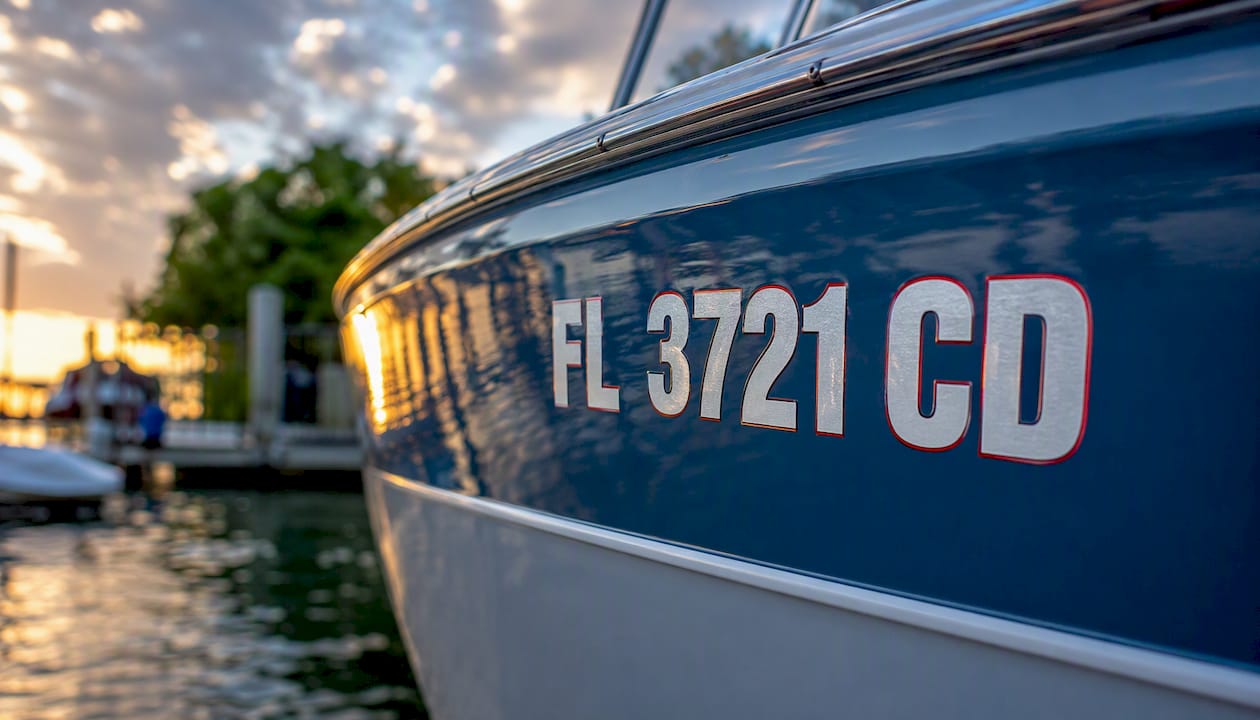
One detail that trips people up: decorative outlines, shadow effects, or drop shadows around your numbers don't count toward the 3 inch height requirement. If your actual solid character is 2.5 inches and the outline pushes it to 3.2 inches, you're still out of compliance. Keep the core character height at 3 inches minimum, outline or not.
Pro Tip: Check your decals every spring before the first launch. Peeling corners, faded contrast, or a sticker that's started lifting at the edges are easy to miss until a warden points it out. A five-minute inspection each April beats a fine in July.
If you're storing your boat outdoors near a marina, ask about materials designed for constant sun exposure. Marine-grade components built for harsh outdoor conditions tend to outperform generic products, whether it's speakers, hardware, or decal vinyl.
How to Order and Apply Compliant Decals
Getting your numbers right isn't just about picking a font you like. It's a short checklist:
- Confirm your assigned registration number matches exactly what's on your CPW registration card.
- Measure your hull's forward-half display area on both sides of the bow.
- Choose a color that contrasts clearly against your hull color (dark numbers on light hulls, light numbers on dark hulls).
- Select a block font that meets Colorado's font requirements and hits the 3 inch minimum height.
- Pick marine-grade vinyl for most hulls, or a backing plate if you're working with an inflatable or PWC.
For placement specifics, a practical measurement guide can save you from misjudging the forward half on an unusual hull shape.
Application itself is straightforward if you prep correctly:
- Clean the hull surface with isopropyl alcohol and let it dry fully; any wax or residue will cause peeling within weeks.
- Use painter's tape to mark your placement line before peeling any backing.
- Apply the decal slowly, using a squeegee from the center outward to push out air bubbles.
- Let it cure for at least 24 hours before launching, especially in cooler months.
- If your hull has heavy texture or curvature, consider professional installation rather than risking bubbles or misalignment.
Before you check out on any decal order, confirm four things: the material spec (marine-grade vinyl, not standard outdoor vinyl), the exact height in inches, the font style, and the production timeline. A vendor that can't answer those clearly isn't worth your money.
Registering and Renewing a Boat in Colorado
First-time registration requires proof of ownership, which can be a bill of sale, a title, a manufacturer's certificate of origin, or in some cases a prior out-of-state registration. If none of that exists, CPW may require a physical inspection or court documentation to establish ownership. Most first-time registrations happen in person or by mail rather than online, since CPW needs to verify these documents before issuing a number.
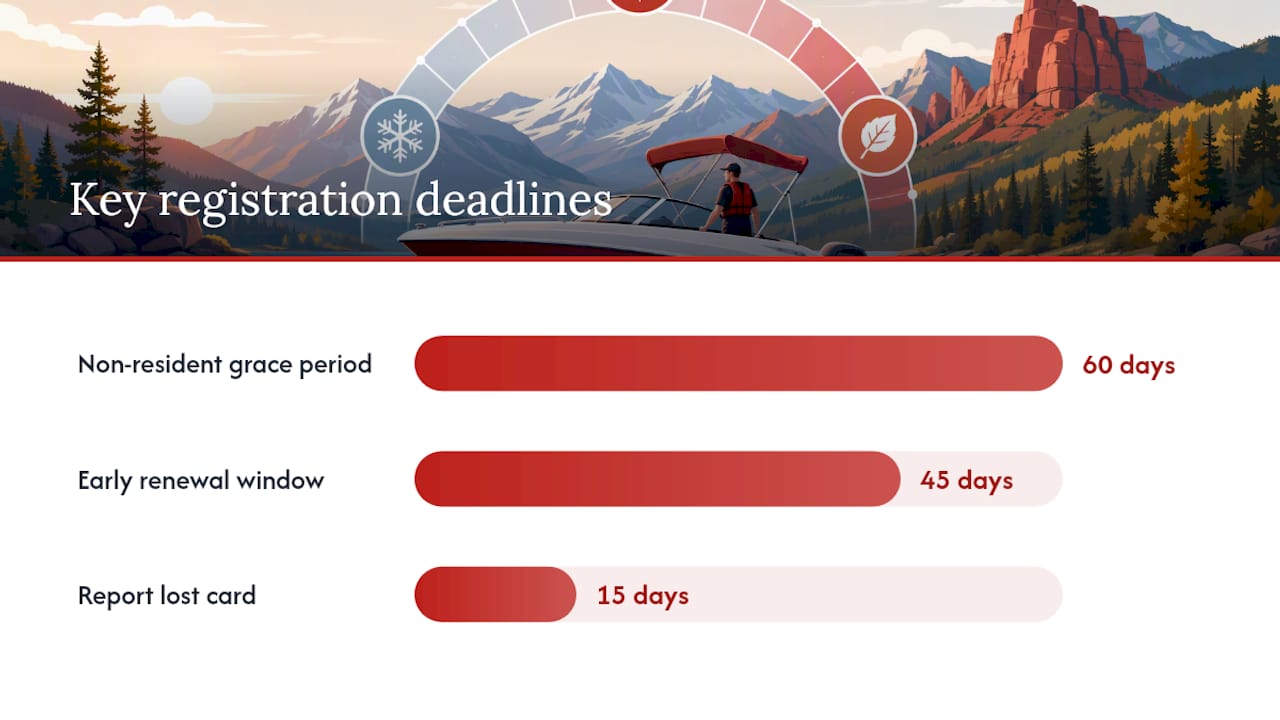
Once you're registered, renewal runs annually from January 1 through December 31. CPW mails renewal notices in November, and you can renew up to 45 days before your registration expires. If you already have an account on CPWShop.com, online renewal is usually the fastest route, though you'll need your existing registration number handy.
Fees scale with boat length. CPW's published bands generally fall into three tiers: under 20 feet, 20 feet up to 30 feet, and 30 feet or greater, with an additional Aquatic Nuisance Species stamp fee tacked on for most motorized vessels.
| Boat Length | Typical Fee Tier | Notes |
|---|---|---|
| Under 20 feet | Lowest tier | Most common for fishing boats and runabouts |
| 20 feet to under 30 feet | Middle tier | Covers most pontoon and ski boats |
| 30 feet or greater | Highest tier | Larger cruisers and houseboats |
Non-residents get a grace period. If you're visiting Colorado with a boat registered in another state, you can operate for up to 60 consecutive days on your home state's registration before Colorado registration becomes necessary. Moving to Colorado permanently is a different situation, and if you're relocating, it's worth checking what changes when you move states since your decal requirements may shift entirely.
Lost or destroyed registration cards need to be reported in writing to CPW within 15 days, and a replacement fee applies. Don't wait on this one. Operating without your registration on board, even if your boat is legitimately registered, is its own violation.
Fines and Mistakes That Trigger Them
Colorado's penalties for display violations are civil infractions, not criminal charges, but they still cost money and they're entirely avoidable. Failing to display your number correctly can draw a fine, and separately, failing to have your registration on board during operation carries its own penalty.
Most citations aren't for owners who ignored the rules entirely. They're for owners who registered properly, then let a faded decal or a sloppy repaint job slide for one too many seasons.
The mistakes that actually cause tickets tend to repeat:
- Numbers under 3 inches, often because an outline or shadow effect was counted toward the height.
- Poor color contrast, like dark blue numbers on a navy hull.
- Decorative stickers, club logos, or other markings placed too close to the registration numbers, which the law treats as clutter that obscures the required display.
- Validation stickers placed in the wrong spot, not the required 2 inches left of the "C."
- Operating on an out-of-state registration past the 60-day nonresident window.
CPW conducts on-the-water inspections and checks vessels at launch ramps and staging areas, so these aren't theoretical risks. The fix for nearly all of them is the same: measure your numbers, check your contrast, and clear anything decorative away from the display area before you launch.
A Quick Compliance Checklist Before You Launch
Run through this before every trip out, especially early in the season:
- Registration card is physically on board, not left in the truck or at home.
- Numbers are present, block style, and measure at least 3 inches tall.
- Color contrasts clearly against the hull, with no fading or peeling.
- Validation sticker sits 2 inches left of the "C," lined up with the numbers.
- Registration hasn't lapsed past December 31 of the prior year.
Special cases worth double-checking: PWCs need numbers on a nonremovable hull section, inflatable boats often need a backing plate, and non-motorized craft like canoes or paddleboards that are exempt from registration still need the owner's name and current address marked legibly on the hull.
| Check Item | Pass Condition | If It Fails |
|---|---|---|
| Number height | 3 inches minimum, no outline counted | Reorder or repaint numbers |
| Sticker placement | 2 inches left of "C," in line | Reposition or replace sticker |
| Registration validity | Current through December 31 | Renew online or by mail |
| Registration card | Physically on board | Request replacement if lost |
If any line fails, the fix is usually cheap and fast: order new decals, repaint, or request a replacement registration. None of it requires a trip to a repair shop.
A Practical Take on Staying Compliant
Most compliance problems I've seen aren't about owners not knowing the rules. They're about owners who registered their boat correctly three or four years ago, applied decent numbers at the time, and never looked at them again. Vinyl fades. Paint chips. A hull that looked crisp in 2022 can look questionable by 2026, and that's exactly the gap CPW's inspections are designed to catch.
My honest recommendation: treat your registration numbers like your tires. Check them every spring, not just when you renew. If the color's washed out or the edges are lifting, that's your signal to replace them before launch season, not during a citation. Marine-grade vinyl from a supplier that actually understands Colorado's spacing and height rules, like Registrationdecals, tends to save owners from the guesswork that leads to fines in the first place.
Order Compliant Colorado Decals in Days, Not Weeks
Repainting numbers by hand means stencils, steady hands, and a result that starts fading within a season or two. Registrationdecals gives Colorado boat owners a faster, cleaner alternative: marine-grade, UV-resistant vinyl decals built to the exact height, spacing, and contrast standards CPW requires, without the guesswork of doing it yourself.
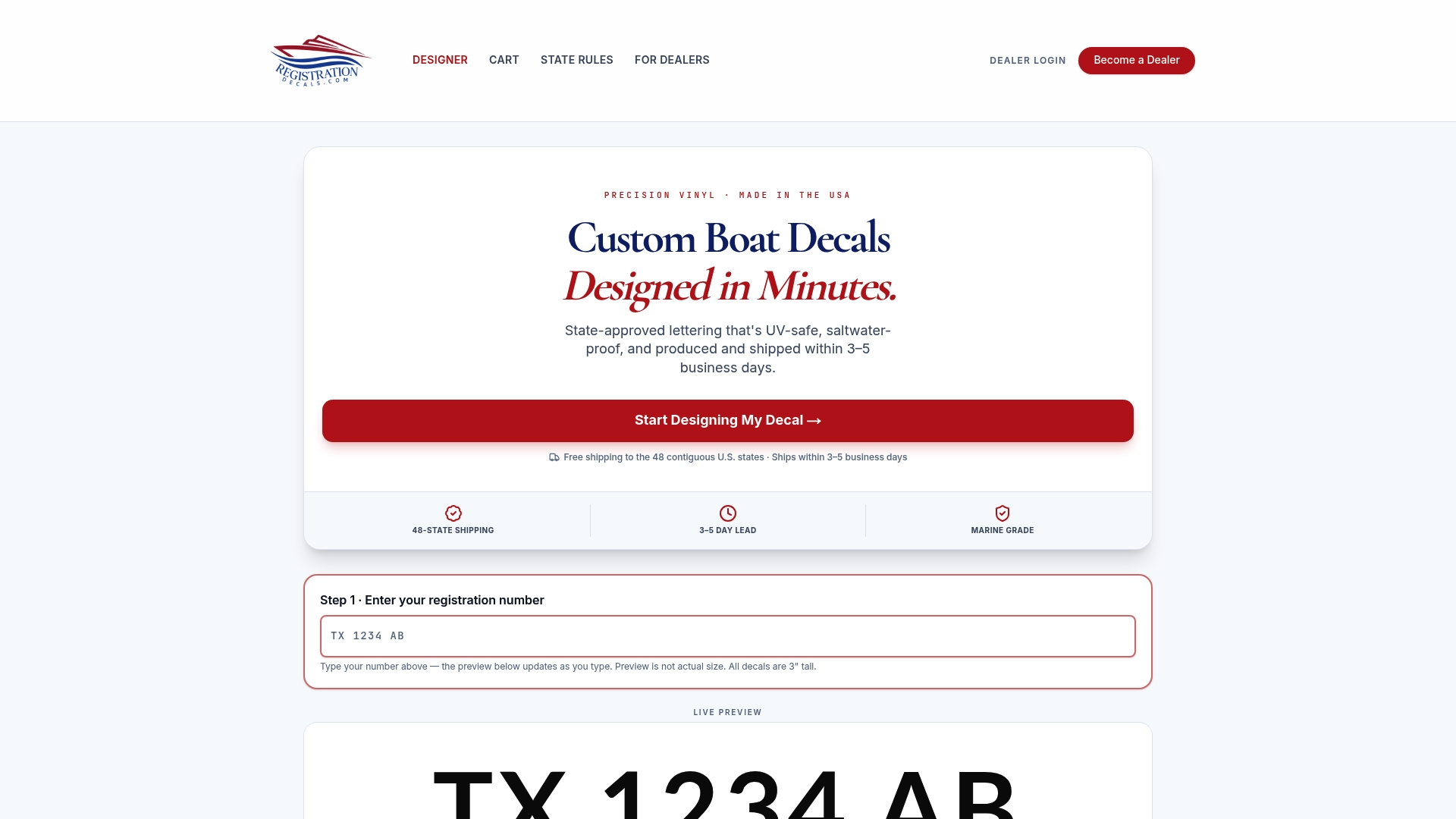
The online design tool lets you enter your registration number, preview fonts and colors against sample hull shades, and confirm your layout meets the 3 inch, block-character standard before you ever pay. Production takes just 3 to 5 business days, with free shipping across the contiguous United States. Marinas and dealerships needing multiple sets can use the bulk ordering option instead of processing orders one at a time.
Before you check out, measure your forward-half display area and confirm your hull's contrast color. Then head to Registrationdecals to build your set and get compliant numbers on the water this season.
Where to Verify Colorado's Boat Registration Rules
- Colorado Parks and Wildlife's registration page covers practical requirements, including size, placement, and how to register or renew.
- The 2026 Colorado Boating Handbook provides display diagrams and exceptions for flared bows, PWCs, and inflatable hulls.
- C.R.S. 33-13-104 is the statutory text behind the display and on-board registration requirements.
- Colorado's online renewal portal handles annual renewals for owners with an existing CPWShop.com account.
Use the CPW page and handbook for practical display questions, the statute when you need the legal basis for a rule, and the online portal when it's time to renew.
Frequently Asked Questions
What size do Colorado boat registration numbers need to be? At least 3 inches high, in block characters, in a color that contrasts with your hull.
Where do I put the validation sticker on my boat? Two inches to the left of the "C" in your registration number, lined up horizontally with the numbers themselves.
Can I paint my own registration numbers instead of using decals? Yes. Painted numbers are allowed under Colorado rules, though marine-grade vinyl tends to last longer and holds contrast better over time.
How long can I use my old state's registration after moving to Colorado? Non-residents can operate for a limited period on a home-state registration before Colorado registration is required.
What happens if I lose my registration card? You must notify CPW in writing within a reasonably short period and pay a replacement fee to get a new card issued.
Sources
- Register a Boat | Colorado Parks and Wildlife
- 2026 Colorado Boating Handbook with Regulations and Statues
- C.R.S. 33-13-104 – Application for vessel number (Colorado Public Law)
- Renew your boat registration online | Colorado.gov