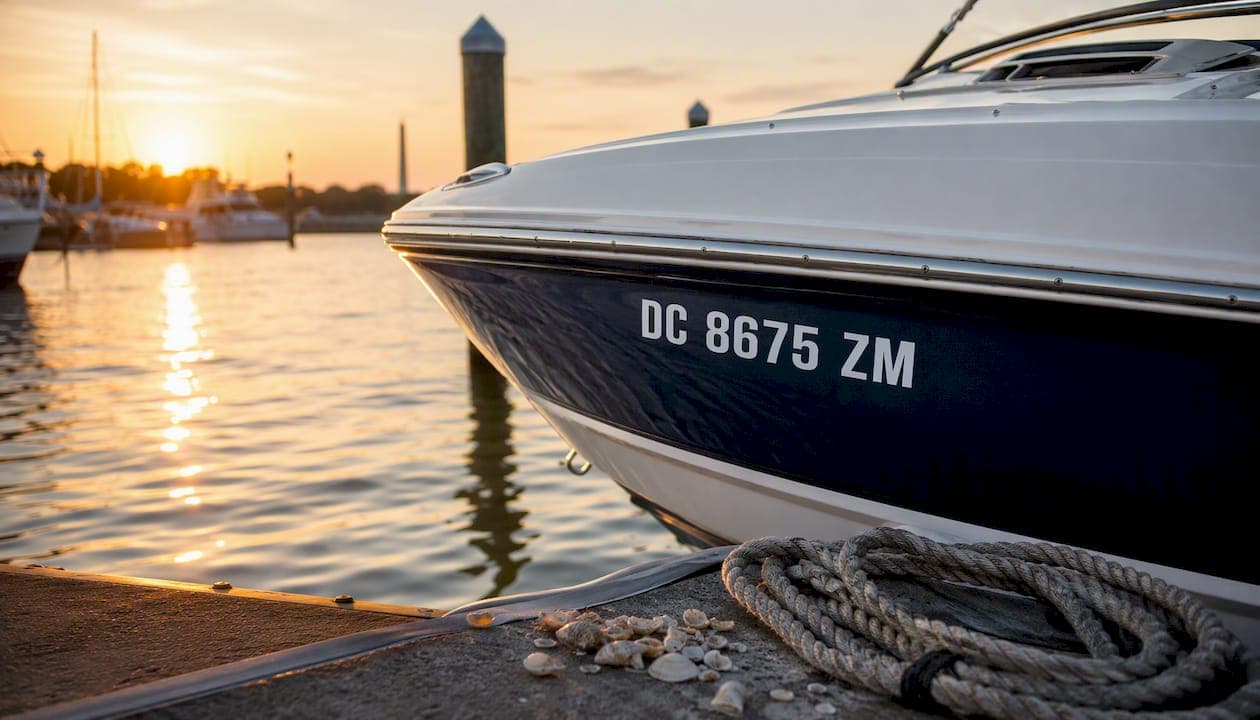
Every motorized vessel principally used on District of Columbia waters must display its DC-assigned registration number in bold block characters at least three inches high, reading left-to-right on the forward half of both sides of the hull, in a color that contrasts clearly with the background. Validation decals must sit within six inches of that number. These requirements come directly from Article 29 §4 of the DC Police Regulations and are enforced by the MPD Harbor Patrol. Registration itself is handled through the OVERS online portal.
The core rules at a glance:
- Numbers must be the DC-assigned identifier (format: DC followed by four digits and two letters, e.g., DC 5678 EF).
- Minimum character height: three inches, bold block style.
- Left-to-right reading on both sides of the bow.
- Color must contrast with the hull or background.
- Validation decals placed within six inches of the number.
- Certificate of Number must be on board during operation.
Key Takeaways
DC boat registration compliance comes down to five things: the right number format, correct size and contrast, proper placement, a valid decal within six inches, and a Certificate of Number on board every time you operate.
| Point | Details |
|---|---|
| Minimum character height | Numbers must be bold block letters at least three inches high on both sides of the bow. |
| Validation decal placement | Decals must sit within six inches of the registration number, measured edge to edge. |
| Certificate of Number | Keep it on board and readable during every trip; a missing certificate is a separate violation. |
| OVERS registration | Register or renew annually through the MPD Harbor Patrol's OVERS portal using scanned PDF documents. |
| Registrationdecals | Offers marine-grade, UV-resistant DC-compliant decals via an online builder with 3–5 business day production and free shipping. |
Table of Contents
- What are the exact format rules for District of Columbia boat numbers?
- Where do you place numbers and validation decals on a DC vessel?
- What is the Hull Identification Number and why does it matter?
- Who must register in DC, and what are the exemptions?
- How do you register or renew a DC vessel registration through OVERS?
- What mistakes get DC boaters cited, and how do you fix them?
- How to choose compliant decals and materials that actually last
- The mistake most DC boaters don't realize they're making
- Get DC-compliant decals without the guesswork
- Official resources for DC boat registration and decals
- Sources
What are the exact format rules for District of Columbia boat numbers?
The MPD Harbor Patrol display rules are specific enough that there is little room for interpretation. Numbers must be bold block letters of good proportion — no script, no italics, no decorative fonts. The minimum height is three inches. Characters that fall even slightly short of that threshold are a citation waiting to happen.
Reading direction and spacing follow a consistent pattern. Letters and numbers must be separated by a space or hyphen roughly the width of a standard letter. Both of these formats are compliant:
- DC 5678 EF
- DC-5678-EF
The hyphen or space is not optional. Running all characters together (DC5678EF) violates the spacing rule, even if every character is the right size.
Color contrast is the other frequent failure point. The number color must contrast with whatever surface it sits on. White numbers on a white hull are not compliant, regardless of how large they are. Dark numbers on a dark hull fail the same way. If your hull color is unusual, choose a contrasting background plate rather than placing numbers directly on the surface.
Pro Tip: Marine-grade vinyl cut in a bold block font holds its shape and color far longer than painted numbers or generic adhesive letters, similar to the durability standards used in marine-grade speakers designed for harsh water environments. UV exposure and water contact degrade softer materials quickly, and a faded or peeling number is treated the same as a missing one during an inspection.
For a side-by-side look at how neighboring states format their decals, the Maryland boat registration decal requirements page shows how display standards compare across the Chesapeake region.
Where do you place numbers and validation decals on a DC vessel?
Placement is as regulated as format. Numbers go on the forward half of each side of the hull, positioned as high above the waterline as practicable. The goal is visibility from a distance, so officers and other boaters can read the number without the vessel needing to be stopped or boarded.
The validation decal rule is precise: within six inches of the registration number. Not near it, not somewhere on the bow — within six inches, measured from the edge of the number to the edge of the decal.
Validation stickers must be displayed within six inches of the vessel identification number, and the Certificate of Number must be carried on board and available for inspection at all times during operation. — MPD Harbor Patrol
The Certificate of Number functions like a vehicle registration card. Keep it in a waterproof sleeve or a ziplock bag tucked into a dry storage compartment. A legible certificate that takes 30 seconds to produce is far better than a soggy, unreadable one that extends an enforcement stop.
Pre-launch placement checklist:
- Numbers are on the forward half of both sides, not midship or aft.
- Characters are at least three inches tall and clearly legible from a reasonable distance.
- Color contrast holds against the current hull finish (check after any repainting).
- Validation decal is within six inches of the number on both sides.
- Certificate of Number is on board and readable.
What is the Hull Identification Number and why does it matter?
The Hull Identification Number (HIN) is a 12-character code assigned by the manufacturer, permanently attached to the vessel. It is not the same as the state registration number. Think of the HIN as the vessel's VIN — it identifies the specific hull, not the owner or the jurisdiction.
Where to find it:
- Primary location: transom on the starboard (right) side, as high as practicable above the waterline.
- Secondary location: a second, unexposed location on the interior of the hull (the specific spot varies by manufacturer).
The HIN matters for registration, titling, and theft recovery. When you submit documents through OVERS or file the PD-330 application, the HIN is a required field. If the HIN is damaged, obscured, or missing, that alone can halt a registration or title transfer.
Pro Tip: Photograph both HIN locations with your phone and store the images in a cloud folder alongside scanned copies of your registration paperwork. A waterproof document sleeve on board for the physical Certificate of Number is worth the few dollars it costs.
Who must register in DC, and what are the exemptions?
The primary rule is straightforward: any vessel principally used on District of Columbia waters must be registered annually in DC. "Principally used" means DC is the primary operating location, not just an occasional stop.
Exemptions that apply:
- Vessels with a valid Certificate of Number from another state or approved territory are generally exempt while temporarily in DC.
- U.S. Coast Guard documented vessels are exempt from state registration numbering requirements, though they must still display their official name and hailing port.
- Non-motorized vessels (canoes, kayaks, paddleboards) are generally not subject to the same motorized-vessel registration rules.
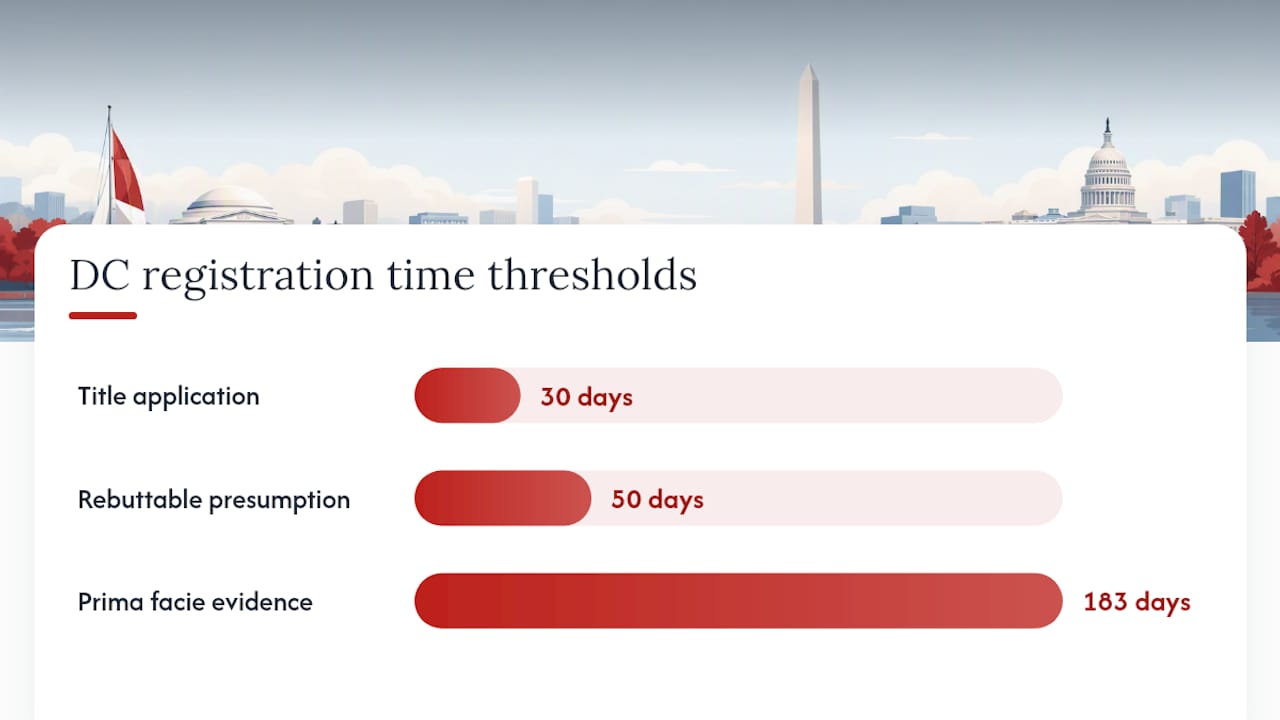
The 50-day and 183-day thresholds under Article 29 §4 define how long an out-of-state vessel can operate in DC before DC registration is required:
- Operating in DC for more than 50 days creates a rebuttable presumption that the vessel is principally used here.
- Operating for more than 183 days is prima facie evidence of principal use in DC — at that point, DC registration is required regardless of where the vessel is titled.
Titling is a separate step from registration. The District of Columbia Boat Titling Act requires a Certificate of Title for vessels principally used in DC. New owners generally have 30 days from acquisition to apply for title. The PD-330 form covers both title and registration applications.
A practical example: a Maryland-registered boat that spends weekends on the Potomac near DC but is kept at a Maryland marina is likely fine under the out-of-state exemption. The same boat stored at a DC marina and used daily for most of the year crosses the 183-day threshold and needs DC registration.
How do you register or renew a DC vessel registration through OVERS?
OVERS — the MPD Harbor Patrol's Online Vessel Registration System — is the standard path for both new registrations and annual renewals. A physical visit to Harbor Patrol is only necessary for exceptions the system cannot handle online.
Step-by-step process:
- Create an OVERS account using a working email address.
- Scan all required documents to PDF before you start: proof of ownership (bill of sale, manufacturer's statement of origin, or prior title), HIN documentation, and existing title if the vessel has one.
- Log in to OVERS, start a new registration or renewal, and upload the scanned PDFs.
- Complete the PD-330 application fields within the system.
- Pay the registration fee online.
- Print and keep the Certificate of Number on board; validation stickers are mailed or available for pickup.
For questions or technical problems, Harbor Patrol can be reached at 202-727-4582.
Pro Tip: OVERS renewal instructions specifically recommend using Chrome or Firefox and turning off pop-up blockers before you start. PDF uploads that fail are almost always a browser or pop-up issue, not a document problem. Scan everything in advance so you are not scrambling mid-session.
Common reasons for rejected uploads: file is not a PDF (JPG or Word documents are not accepted), file size is too large, or the document is illegible because it was photographed at an angle rather than scanned flat. Fix those before you sit down at the computer.
What mistakes get DC boaters cited, and how do you fix them?
Most enforcement stops on DC waters are not random. Officers from MPD Harbor Patrol are looking for specific, visible problems — and several of them are easy to miss until you know what to check.
Common display mistakes:
- Font is not bold block style (script or italic lettering fails immediately).
- Characters are under three inches tall.
- Poor contrast between number color and hull color.
- Validation decal is more than six inches from the registration number.
- Extra numbers or unauthorized markings on the forward half of the hull (only the DC-assigned number belongs there).
- Peeling, faded, or partially detached decals that are no longer legible.
What officers check during a stop: the Certificate of Number (on board and readable), decal placement relative to the registration number, and overall legibility of the number from a normal viewing distance. A missing certificate is a separate violation from a display problem — both can result in citations.
Responding to an enforcement notice:
- Correct the defect as quickly as possible. Order replacement decals, reapply numbers, or retrieve the certificate.
- Document the fix with photographs showing the corrected display.
- Contact Harbor Patrol at 202-727-4582 to show proof of correction. Demonstrating prompt compliance often reduces or eliminates penalties for first-time violations.
The red flags that most reliably trigger a closer look: peeling decals, numbers that have faded to near-invisibility, and boats operating without any visible registration number at all. Keeping decals in good condition is not just aesthetics — it is the difference between a wave from a patrol boat and a boarding.
How to choose compliant decals and materials that actually last
Material choice determines whether your DC registration numbers are still legible two seasons from now or need replacing after one summer. Generic adhesive letters — the kind sold at hardware stores — are not manufactured for marine environments. UV exposure yellows them, saltwater weakens the adhesive, and thermal cycling causes edges to lift.
What to look for in a compliant decal:
- Marine-grade, UV-resistant vinyl rated for outdoor and water exposure.
- Cut vinyl in a bold block font (not printed on a clear backing, which can yellow).
- Adhesive rated for fiberglass, aluminum, and painted surfaces.
- Characters that meet the three-inch minimum height with visible margin to spare.
Application matters as much as material. Clean the hull surface with isopropyl alcohol before applying. Apply in temperatures between 50°F and 90°F — adhesive bonds poorly in cold and can bubble in direct summer heat. Press firmly from the center outward to eliminate air pockets. Allow 24 hours of cure time before the vessel goes in the water.
For hulls with curved bow sections, a backing plate or rigid substrate keeps the number flat and readable rather than conforming to the curve in a way that distorts characters. Some boaters also use domed registration number alternatives when hull geometry makes flat vinyl difficult to apply cleanly.
Registrationdecals offers an online design tool where you enter your DC registration number, select a compliant block font, and choose colors that contrast with your hull. Production runs 3–5 business days, and the decals ship free within the contiguous U.S. For boaters who trailer across state lines, the all-states decal regulations guide is a useful reference for confirming that the same set of decals meets requirements in neighboring jurisdictions.
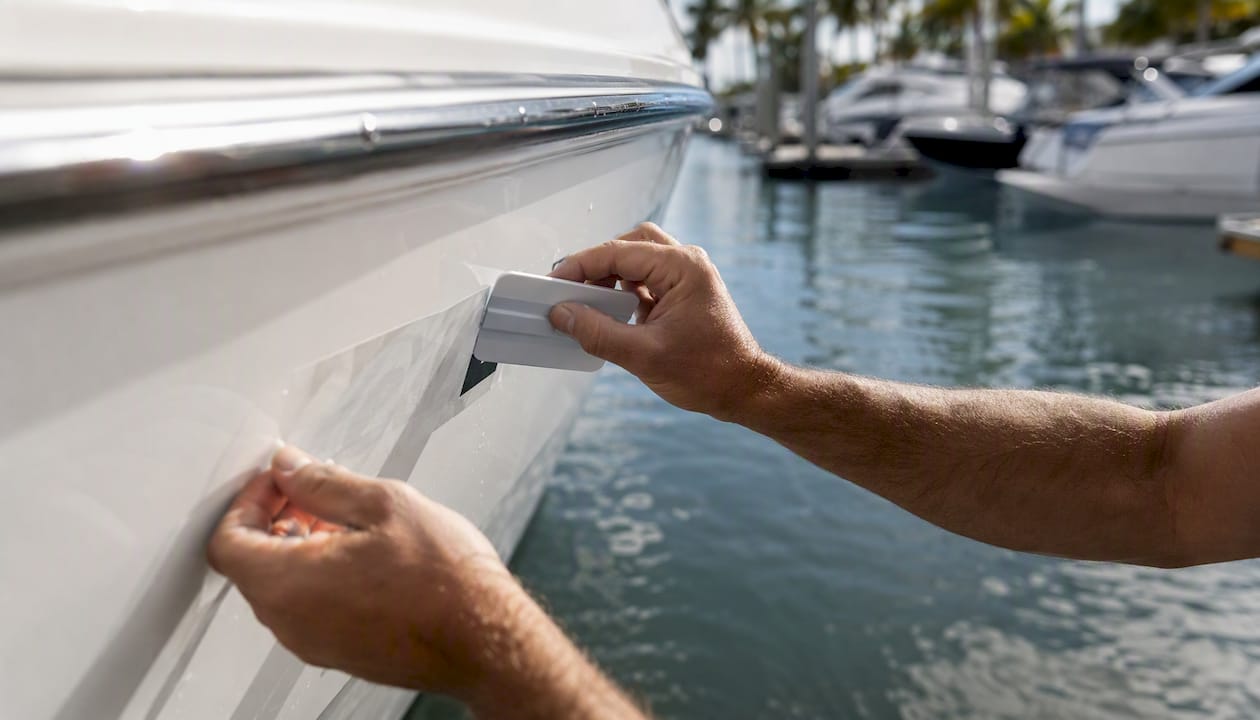
Pro Tip: Rinse decals with fresh water after saltwater exposure and avoid pressure-washing directly over the edges. The adhesive bond at the perimeter is the first thing to fail under high-pressure spray.
The mistake most DC boaters don't realize they're making
The most common error I see from the vendor side is not about font or size — it is surface prep. Owners order the right decals, in the right size, with the right font, and then apply them to a hull that has not been cleaned. Wax residue, sunscreen, and oxidized gelcoat all prevent proper adhesion. The decal looks fine for a few weeks, then starts lifting at the corners. By mid-season, it is peeling, and the owner is looking at a citation for an illegible number.
The fix is simple: wipe the application area with isopropyl alcohol, let it dry completely, and apply in moderate temperatures. Marine-grade vinyl applied correctly to a clean surface lasts years, not months. Ordering correctly sized, compliant decals the first time costs less than replacing a set that failed because of a skipped prep step — and far less than the hassle of an enforcement stop.
Get DC-compliant decals without the guesswork
Registrationdecals makes it straightforward to get registration decals that meet DC's exact display rules. Enter your DC registration number into the online builder, pick a block font and a color that contrasts with your hull, and the system produces marine-grade vinyl decals sized to the three-inch minimum and formatted to DC specs.
Production takes 3–5 business days, and shipping is free across the contiguous U.S. The decals are UV-resistant and saltwater-proof, so they hold up through DC summers and Potomac conditions without fading or peeling. Order your custom DC registration decals and have compliant numbers on the water before your next launch.
Official resources for DC boat registration and decals
Use these primary sources to confirm rules, download forms, and contact Harbor Patrol directly:
- MPD Harbor Patrol — Harbor Legal Requirements: The authoritative web page for display rules, decal placement, certificate requirements, and HIN guidance.
- Article 29 §4 — DC Harbor Regulations (PDF): The full legal code covering numbering requirements, exemptions, and the 50-day and 183-day temporary-use thresholds.
- OVERS — Online Vessel Registration System: The MPD Harbor Patrol portal for new registrations, annual renewals, and account management.
- OVERS Renewal Instructions (PDF): Step-by-step technical guidance for completing an online renewal, including browser recommendations and PDF upload requirements.
- PD-330 — Application for Boat Certificate of Title/Registration Number: The official DC form for applying for a title or registration number; required for new vessels and ownership transfers.
- MPD Harbor Patrol phone: 202-727-4582 — for filing questions, technical problems, and enforcement inquiries.
- Boating Safety Certificate — MPD: Information on the required Boating Safety Certificate and free one-day safety courses offered by Harbor Patrol.
Sources
- Harbor Legal Requirements | mpdc
- Harbor regulations (Article 29 §4) | mpdc (PDF)
- OVERS - MPD Harbor Patrol
- Overs
- Application for Boat Certificate of Title/Registration Number (PD 330) | mpdc