
Michigan requires every registered vessel to display its MC number in plain block letters at least 3 inches high on both sides of the forward half, reading left to right, with a validation decal placed 3 inches to the right of the last character at the same height. The official format is MC followed by four numerals and two capital letters (example: MC 1234 BF), with groups separated by a space or hyphen equal to the width of the letter "M." Decals expire every three years on March 31.
Quick compliance checklist (under 60 seconds):
- Number format reads MC + 4 digits + 2 letters, no I, O, or Q in the suffix
- Letters are plain block style, at least 3 inches tall
- Numbers appear on both sides of the forward half of the hull
- Color contrasts clearly with the hull background
- Validation decal sits 3 inches to the right of the last character, same level as the number
- Registration card (and boating safety certificate if applicable) is on board
Table of Contents
- Where do Michigan MC numbers go on different hull types?
- What are the Michigan validation decal rules and renewal timing?
- What is the exact Michigan MC number format and character rules?
- Which boats need Michigan registration and what's exempt?
- What can enforcement officers check and what are the penalties?
- How do you register a boat in Michigan or renew your decals?
- Why marine-grade decals matter for long-term compliance
- Key Takeaways
- The mistake most Michigan boat owners make before launch day
- Get Michigan-compliant decals without the guesswork
- Useful sources
Where do Michigan MC numbers go on different hull types?
The rule is straightforward on paper: registration numbers go on the forward half of the vessel, on both sides, positioned as high above the waterline as practical. The goal is simple — an enforcement officer or another boater should be able to read the number clearly when the vessel is afloat. What becomes tricky is applying that rule to hulls that don't have a flat, obvious bow panel.
The Michigan Boating Laws and Responsibilities handbook is explicit that numbers must read left to right on both sides and must contrast with the background. No other numbers may appear on either side of the bow. That last point catches owners off guard — if you have decorative numbers or a hull ID displayed on the bow, they need to be relocated or removed.
Hull-type placement at a glance:
| Hull Type | Recommended Placement | Notes |
|---|---|---|
| Standard powerboat / deep-V | On the bow, both sides, above the waterline | Most common; flat panel makes placement easy |
| Pontoon boat | On the front pontoon tube or a flat panel near the bow | Choose the flattest surface; measure for 3" height |
| Sailboat | Forward half of the hull, both sides | Avoid placing below the waterline when heeled |
| Inflatable / aluminum skiff | Bow panel or transom if no forward flat surface exists | Confirm with Michigan SOS if transom is the only option |
| Houseboat | Forward half of the main hull, both sides | High freeboard makes placement straightforward |
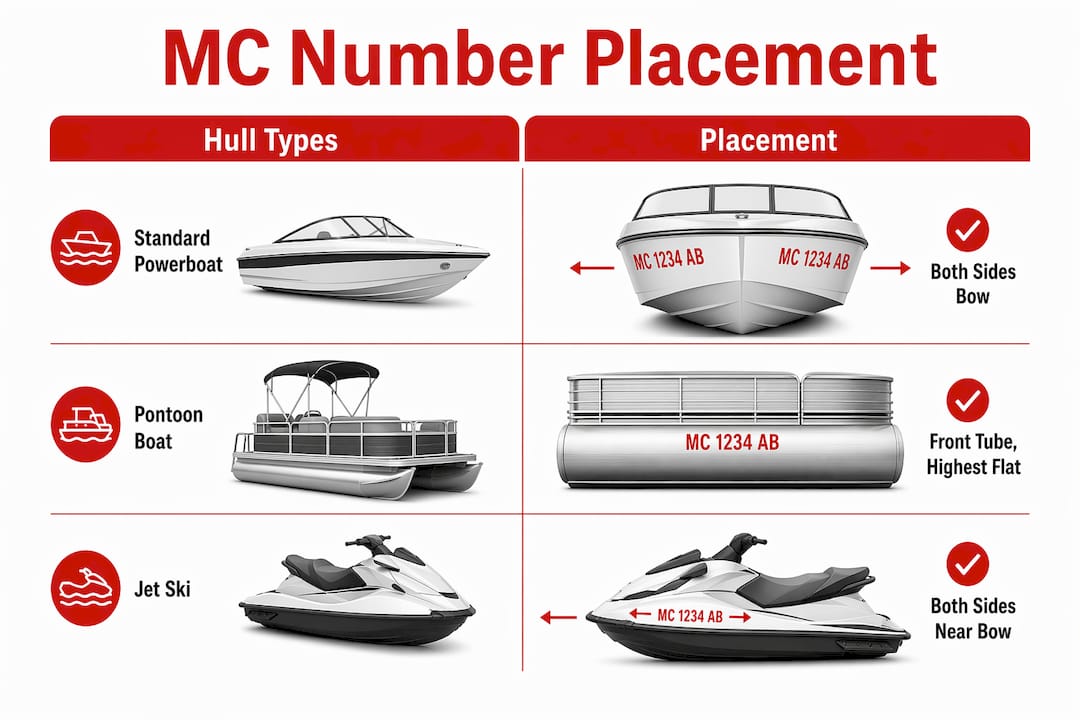
For pontoon boats, the front tube is the most common placement, but the surface curves. Measure the flat portion of the tube before ordering decals — a 3-inch letter on a curved surface can look smaller than it is when viewed from an angle. For inflatables with no usable forward surface, contact the Michigan Secretary of State office to confirm an acceptable alternative before applying numbers.
Pro Tip: Place numbers as high on the hull as practical, not just above the waterline. Numbers near the waterline get obscured by wake, spray, and debris. Higher placement also makes your vessel easier to identify from shore during an inspection.
What are the Michigan validation decal rules and renewal timing?
Decal placement is precise. According to the Michigan Secretary of State, the validation decal must be affixed to the forward half of the vessel on both sides, at the same level as the registration number, exactly 3 inches to the right of the last registration character. Not roughly 3 inches — 3 inches. Use a tape measure when applying.
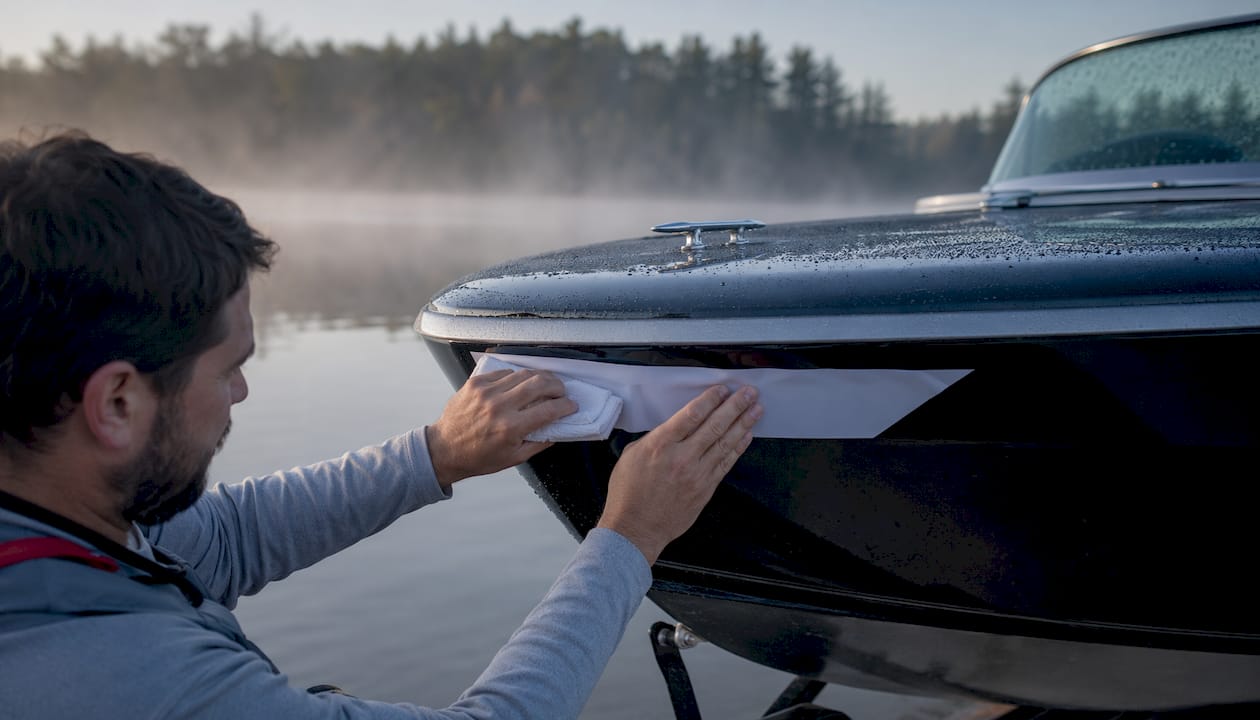
Decals are valid for three years and expire on March 31 of the final year. That March 31 deadline catches a lot of owners because it falls right at the start of boating season in Michigan. If you wait until the ice is off the water to think about renewal, you may already be operating with an expired decal.
Renewal process, step by step:
- Renewals open at the start of the expiration year — start then, not only during the later months.
- Renew online, by mail, or in person at a Michigan Secretary of State branch.
- If renewing by mail, apply several weeks early to allow for processing and delivery.
- Need the decal immediately? Visit a Secretary of State office in person for same-day issuance.
- Replacement decals (lost or damaged) are available by mail or by emailing RenewalByMail@Michigan.gov.
Timing note: Michigan allows renewal by mail up to 45 days before the decal expires. Starting January 1 gives you the full window and eliminates any risk of a lapse during early-season trips.
What is the exact Michigan MC number format and character rules?
The Michigan Administrative Code spells out the format with no ambiguity:
Michigan registration number format: MC followed by four numerals, then two capital letters — written as MC 0000 AA. Groups are separated by a space or hyphen equal to the width of the uppercase letter "M." The letters I, O, and Q are prohibited in the two-letter suffix. Characters must be plain block letters, at least 3 inches high, in a color that contrasts with the hull background.
So a valid number looks like MC 1234 BF or MC-1234-BF. Both the space and hyphen versions are legal — the key is that the gap between groups matches an "M" width, which practitioners find easier to eyeball than measuring a hyphen precisely.
A few things worth knowing about font and style: "plain block letters" means no serifs, no script, no decorative fonts. The required font style is a clean, upright block character that can be read quickly from a moving vessel. Michigan does not specify a single named typeface, but any font that introduces curves, flourishes, or variable stroke widths fails the plain block standard.
Color contrast is a real enforcement point. White letters on a white hull, or dark letters on a dark hull, will draw a citation. Choose a color that reads clearly from at least 50 feet away — black on white, white on navy, or red on white are reliable combinations.
Which boats need Michigan registration and what's exempt?
Most boats on Michigan water need a registration number. The Michigan Legislature statute sets the threshold clearly:
Must register:
- All motorized watercraft, including electric motors and inflatable motors
- All sailboats, regardless of length
- Hand-powered watercraft over 16 feet in length
- Vessels used commercially or for rental, regardless of type
Exempt from registration:
- Watercraft 16 feet or less, propelled only by oars or paddles, not used for rental or commercial purposes
- Non-motorized canoes and kayaks not used for rental or commercial purposes
- Rafts, surfboards, sailboards, and swim floats of any length
- Watercraft registered in another state and used only temporarily in Michigan
That last exemption has a hard limit. Out-of-state registered vessels may use Michigan waters for up to 60 days before Michigan registration is required. Storage or anchoring in Michigan counts toward that 60-day window, so a boat parked at a Michigan marina all summer needs Michigan registration even if it rarely moves.
Vessels of a certain size or with permanently affixed engines generally require a title in addition to registration. The Hull Identification Number (HIN) is required for most titled vessels — have it ready when you apply.
One documented-vessel note worth flagging: if your boat carries U.S. Coast Guard documentation, it may be exempt from displaying the MC number, but it still must display the Michigan state-issued validation decal on the forward half. Owners sometimes assume full documentation means full exemption from state display requirements. It does not.
What can enforcement officers check and what are the penalties?
Michigan DNR and law enforcement officers can stop any vessel underway and request two documents: the Certificate of Number (your registration card) and, for operators born on or after July 1, 1996 who are running a vessel with a motor greater than 6 horsepower, a boating safety certificate. Both must be on board — not at home, not in the truck.

Noncompliance with registration number display rules is a civil infraction. Fines can reach $500. Falsified or deliberately incorrect numbers carry their own separate penalties. Officers can also cite for numbers that are the wrong size, wrong format, or placed on the wrong part of the hull — not just for missing numbers entirely.
A practical habit: keep a duplicate registration card stored separately from the original. If the boat is stolen or the card gets wet and unreadable, a duplicate on file with the SOS or a copy stored digitally saves a trip to the branch before your next outing. If your registration is lost entirely, a bill of sale showing the year, make, HIN, MC number, and both parties' names and addresses can serve as supporting documentation when requesting a replacement.
How do you register a boat in Michigan or renew your decals?
What you need before you apply
Gather the Hull Identification Number (if the vessel has one), your government-issued ID, payment, and basic boat details: year, make, length, and hull material. New registrations for vessels without a prior Michigan record may also need a bill of sale.
Step-by-step registration
- Collect your HIN, owner ID, and boat details.
- Submit your application at a Michigan Secretary of State branch, by mail, or online where available.
- Pay the registration fee based on vessel length (see fee table below).
- Receive your MC number and validation decal — in-person visits allow same-day issuance.
- Apply decals within the required placement rules before operating.
Michigan boat registration fees
Fees are based on vessel length for most watercraft. The Michigan SOS fee schedule lists the following for standard 3-year registrations:
| Vessel Type / Length | 3-Year Fee |
|---|---|
| Less than 12 ft | $14 |
| 12 to <16 ft | $17 |
| 16 to <21 ft | $42 |
| 21 to <28 ft | $115 |
| 28 to <35 ft | $168 |
| 35 to <50 ft | $244 |
| 50 ft and over | $448 |
| Pontoon boats (any length) | $23 |
All registrations expire March 31 in the third year of issuance. Renewals open January 1 of the expiration year.
Why marine-grade decals matter for long-term compliance
A registration number that fades, peels, or loses contrast within a season is a compliance problem, not just an aesthetic one. Michigan law requires numbers to be clearly visible and legible when the vessel is afloat. A sun-bleached or delaminating decal can fail that standard even if it was applied correctly on day one.
Marine-grade vinyl with UV protection and saltwater resistance holds its color and adhesion through years of sun, spray, and temperature swings. Standard vinyl — the kind used for indoor signs or vehicle graphics — degrades faster in a marine environment, especially on hulls that sit in direct sun all summer.
When placing a decal order, specify the exact MC format, confirm the minimum 3-inch letter height, and request plain block style with M-width spacing between groups. Color choice matters too: pick a combination that contrasts with your hull color under bright sunlight, not just in the shop. Black on white and white on dark blue are reliable starting points.
Pro Tip: Measure the placement area on your hull before ordering. Pontoon tubes and curved bows have less flat surface than they appear to. A quick measurement prevents ordering decals that technically meet the 3-inch rule but look cramped or misaligned once applied.
Registrationdecals offers an online design tool that walks you through entering your MC number, selecting compliant block fonts, and choosing colors — all built around Michigan's specific rules. Production runs 3–5 business days with free shipping to the contiguous US, which is fast enough to avoid a lapse if you start the process a week or two before the season opens.
Key Takeaways
Michigan boat registration compliance comes down to four things: the correct MC format, 3-inch plain block letters on both sides of the forward half, a decal placed exactly 3 inches right of the last character, and a registration card on board every time you operate.
| Point | Details |
|---|---|
| MC number format | MC + 4 digits + 2 capital letters; no I, O, or Q; groups separated by an M-width space or hyphen. |
| Letter size and style | Plain block letters, minimum 3 inches high, contrasting color with the hull background. |
| Decal placement | Same level as the number, 3 inches to the right of the last character, on both sides of the forward half. |
| Decal expiration | Expires March 31 every three years; renewals open January 1 of the expiration year. |
| Registrationdecals | Offers Michigan-compliant marine-grade vinyl decals via an online design tool with 3–5 business day production and free contiguous-US shipping. |
The mistake most Michigan boat owners make before launch day
Here is what actually shows up on the water: numbers that are technically the right format but applied too low on the hull, where they disappear behind wake and spray the moment the boat gets up to speed. Or letters that were measured at 3 inches in the shop but applied to a curved pontoon tube where the effective visible height is closer to 2.5 inches. Or a decal that expired in March and the owner genuinely did not notice because they were focused on the engine tune-up.
The contrast issue is underrated. Owners often choose a color that looks fine in the driveway but washes out in direct sun on the water. A DNR officer reading your numbers from a moving patrol boat at 30 feet does not have the luxury of getting closer. If there is any doubt about readability, go higher contrast.
The spacing rule — an M-width gap between groups — sounds fussy, but it exists for a reason. Numbers that run together (MC1234BF with no spacing) are genuinely harder to read quickly. The M-width rule is a practical standard, not bureaucratic detail.
One more thing: keep a photo of your registration card on your phone. It does not replace the physical card for legal purposes, but if the card gets soaked or blown overboard, the photo helps you get a replacement faster and gives you the MC number and HIN in one place.
Get Michigan-compliant decals without the guesswork
Registrationdecals produces custom Michigan boat registration decals in marine-grade UV-resistant vinyl that holds up through full seasons on the water. The online design tool lets you enter your MC number, confirm the plain block font, set the 3-inch minimum height, and choose a color combination that contrasts with your hull — all in a few minutes.
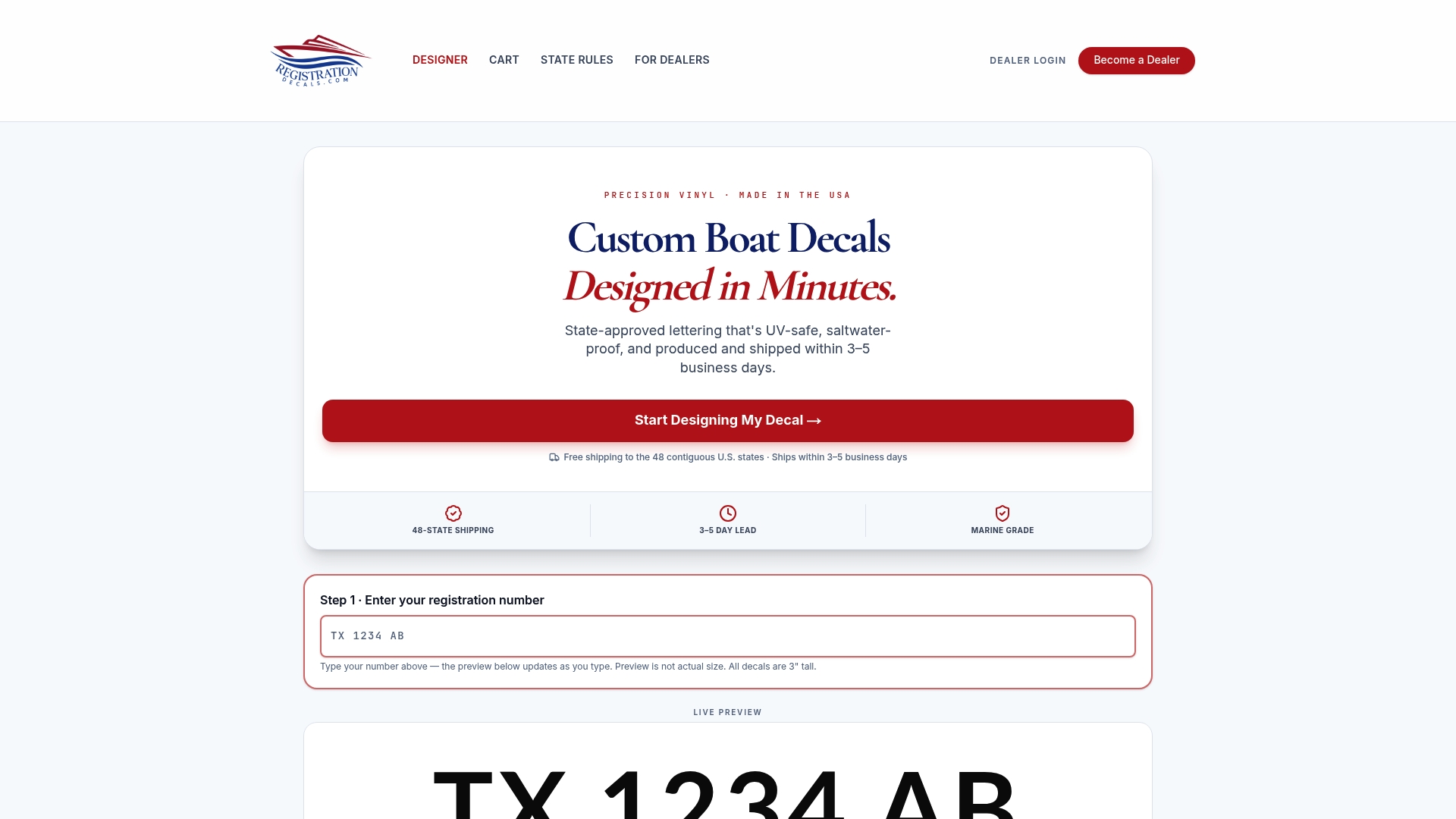
Production takes 3–5 business days, and shipping is free across the contiguous United States. If your decals are expiring before spring or you are registering a new vessel, head to registrationdecals.com and use the design tool to build a compliant set today.
Useful sources
Official Michigan sources to bookmark for registration rules, renewal, and legal text:
- Michigan Administrative Code — Numbering of Vessels and Motorboats: Full rule text on letter size, format, spacing, and prohibited characters
- Michigan Secretary of State — Watercraft Decal page: Decal placement, renewal options, replacement process, and office locations
- Michigan Secretary of State — Recreational Vehicles and Watercraft: Registration fees, exemptions, and residency rules
- Michigan Legislature — MCL 324.80123: Statute covering registration requirements, the 60-day out-of-state rule, and civil penalties up to $500
- Michigan DNR — Boating Rules and Regulations: Age restrictions, safety certificate requirements, and enforcement overview