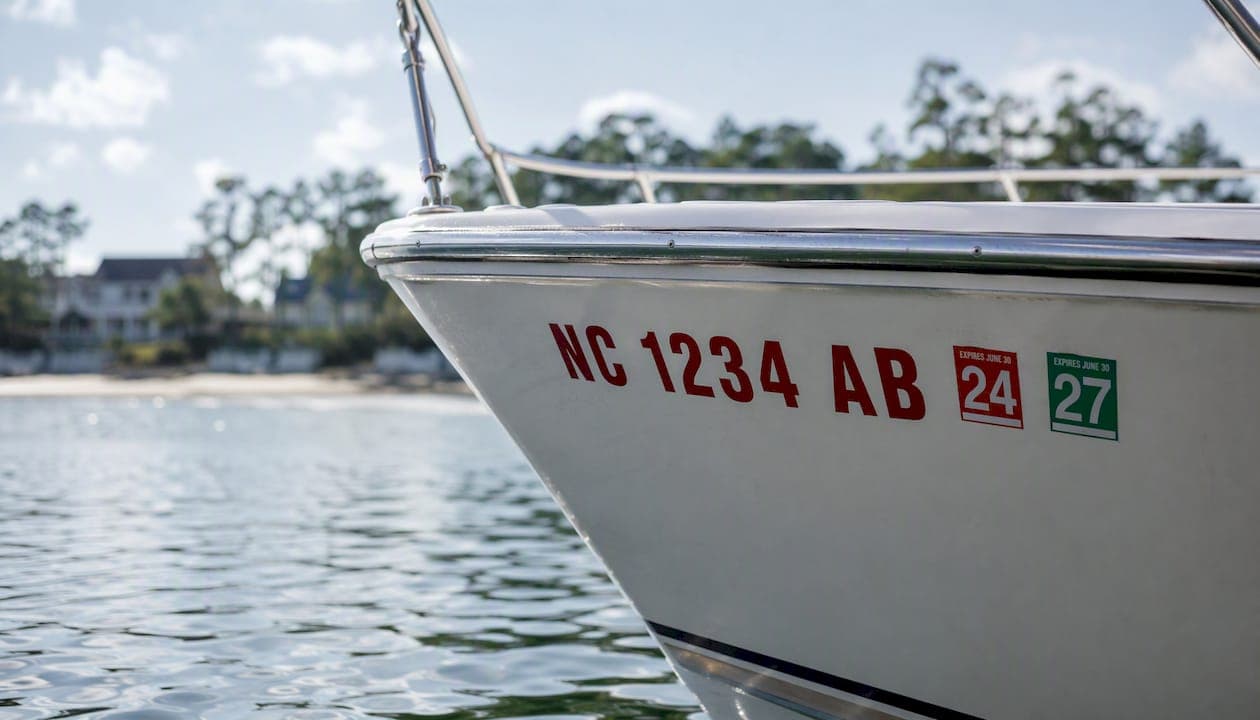
Every vessel operating on North Carolina public waters must display its registration number in a specific format: NC followed by four digits and two letters, written exactly as NC 0000 AB. Those characters must be block-style, at least 3 inches tall, in a solid color that contrasts with the hull, and painted or permanently affixed on both port and starboard sides of the forward half of the bow. No other numbers belong on the bow. Validation decals go on both sides within 6 inches aft of the registration number. Carry the certificate of number on board any time the vessel is underway. That is the short version. Everything below explains the rules in detail, walks through registration steps, and covers what enforcement officers actually look for.
Table of Contents
- Which vessels must be registered in North Carolina
- How North Carolina registration numbers must be formatted and placed
- Where validation decals go and how to apply them correctly
- Registration fees, renewal periods, and duplicate certificates
- How to register or title a vessel in North Carolina
- Replacing lost, stolen, or faded numbers and decals
- What enforcement officers check and how to avoid common violations
- How to look up or verify a boat's registration in North Carolina
- Choosing decals that actually hold up in North Carolina conditions
- Key Takeaways
- Get compliant NC registration decals without the guesswork
- Authoritative sources for current NC rules
Which vessels must be registered in North Carolina
North Carolina Wildlife Resources Commission (NCWRC) requires registration for two broad categories: all motorized vessels used on public waters, and sailboats longer than 14 feet at the load waterline. If your boat has a motor and touches a public lake, river, or coastal waterway, it needs a valid NC registration.
Common exemptions include:
- Non-motorized vessels under 14 feet (canoes, kayaks, paddleboards)
- Vessels operated exclusively on private ponds not connected to public waters
- Lifeboats used solely for emergency purposes
- Vessels already registered in another state, for the first 90 consecutive days in NC
That 90-day rule matters for out-of-state owners and USCG-documented vessels. If you keep your boat in North Carolina for more than 90 consecutive days, you must register it here. Active-duty military members temporarily stationed in NC are exempt from that 90-day transfer requirement, which is a meaningful carve-out for personnel at Camp Lejeune, Fort Liberty, or Seymour Johnson.
Titling is a separate but related requirement. Vessels 14 feet or longer and all personal watercraft must be titled in North Carolina. Registration and title are often processed together, but they are legally distinct. A vessel can be registered without a title (if under 14 feet), but a titled vessel must also be registered.
How North Carolina registration numbers must be formatted and placed
North Carolina Administrative Rule 15A-NCAC-10F-.0106 and NCWRC affixing guidance together spell out every formatting detail. Here is what the rules require:
| Requirement | Specification |
|---|---|
| Format | NC + four digits + two letters (example: NC 0000 AB) |
| Character height | Not less than 3 inches |
| Character style | Block letters and numerals only |
| Color | Solid color contrasting with the hull background |
| Orientation | Left-to-right, readable from port and starboard |
| Placement | Forward half of both port and starboard sides |
| Separation | Hyphen or equivalent space between prefix, numerals, and suffix |
| Prohibited | No other numbers on the bow (except validation year decal) |
The NCWRC Vessel Operators Guide includes a diagram showing the standard layout: NC 0000 AB, with the NC state prefix, a space or hyphen, the four-digit number, another space or hyphen, and the two-letter suffix. That spacing is not optional. Cramming the characters together or omitting the separator fails the legibility standard.
Placement on the "forward half" means the front 50% of the vessel's length. On most boats, that puts the numbers on or just aft of the bow, above the waterline and clearly visible from the side. Numbers placed too far back, near the stern, or too close to the waterline are a common enforcement trigger.
Pro Tip: Before applying or painting, hold a tape measure at the planned location and confirm the characters will sit at least 3 inches tall with consistent spacing. Step back 100 feet and check legibility from both sides. If you squint to read it, an officer will too.
Where validation decals go and how to apply them correctly
Validation decals confirm that registration fees have been paid for the current period. Per NCWRC rules, they must appear on both sides of the bow within 6 inches aft of the registration numbers. That means directly behind the last character of the number, not above or below it.
Key rules for decal display and application:
- Display decals on both port and starboard sides, within 6 inches aft of the registration number
- Apply only to a clean, dry surface with no wax, grease, or old adhesive residue
- Surface temperature must be above 40°F at the time of application to get proper adhesion
- Remove expired or old decals completely before applying new ones; layered decals create confusion during inspections
- Maintain decals in legible condition at all times while the vessel is in operation
USCG-documented vessels are a special case. They are prohibited from displaying North Carolina registration numbers on the hull, but they must still display NC validation decals. That combination trips up a lot of documented-vessel owners. The decals go in the standard bow location; the state number does not appear at all.
Registration fees, renewal periods, and duplicate certificates
G.S. 75A-5 is the governing statute for North Carolina vessel registration fees and renewal timing. It authorizes one-year and three-year registration periods, sets the fee framework by vessel category, and establishes the duplicate certificate process.
| Item | Detail |
|---|---|
| Registration periods | One-year or three-year options |
| Renewal deadline | On or before the first day of the month following expiration |
| Lapsed certificates | Void until renewed; vessel may not legally operate |
| Duplicate certificate | Available upon application with a small statutory fee |
| Fee verification | Always confirm current amounts directly with NCWRC |
Fees vary by vessel length and horsepower category. The statute sets the structure, but NCWRC administers the actual amounts, which can be adjusted. Check the current fee schedule at ncwildlife.org before submitting payment. A three-year registration costs more upfront but saves two renewal cycles and is worth considering for vessels you plan to keep long-term.
Renewing late does not carry a grace period. If your certificate expires on June 30, you must renew by July 1. Operating with a lapsed certificate is a violation, even if the decals on the hull look current.
How to register or title a vessel in North Carolina
The process is straightforward when you have the right documents in hand. Follow these steps:
-
Determine what you need. Motorized vessel or sailboat over 14 feet? You need registration. Vessel 14 feet or longer or a personal watercraft? You also need a title. USCG-documented vessel kept in NC more than 90 days? Registration is required, but no state number goes on the hull.
-
Gather required documents. Complete the VL-1 form, the official NCWRC application for registration and titling. You will also need proof of ownership (manufacturer's statement of origin, existing title, or bill of sale), the vessel's Hull Identification Number (HIN), and appropriate fees. Out-of-state transfers require the prior state's title. Documented vessels need the Certificate of Documentation.
-
Choose how to file. Submit online at GoOutdoorsNorthCarolina.com, mail documents to NCWRC, or visit a Wildlife Service Agent in person. In-person agents can process same-day in most cases.
-
Select your registration period and pay. Choose one-year or three-year, pay the applicable fee, and receive your certificate of number and validation decals by mail.
-
Affix numbers and decals correctly. Once your certificate arrives, apply or paint the registration number exactly as printed, in the correct format and placement. Apply validation decals within 6 inches aft of the number on both sides.
For questions, contact NCWRC directly at 1-888-248-6834 or through the contact portal at ncwildlife.org. Wildlife Service Agents are located throughout the state and can assist with in-person processing.
Replacing lost, stolen, or faded numbers and decals
If your registration numbers are faded, peeling, or no longer legible, replace them before your next launch. Operating with illegible numbers is a violation regardless of whether the underlying registration is current. Keep a copy of your replacement request or receipt on board until the new decals arrive, so you can show an officer that replacement is in process.
When decals fail or numbers become unreadable, here is what to do:
- Submit a duplicate certificate request to NCWRC and pay the statutory duplicate fee to get a replacement certificate and new decals
- Remove all old or expired decals from both sides of the bow before applying replacements
- If painted numbers have faded or chipped, repaint them to the original specification before the vessel goes back in the water
- Do not alter, add to, or change the registration number on the hull unless NCWRC has authorized a change
- If your vessel already has a valid NC number, you are replacing decals only, not the number itself
Timing matters. Decals ordered through NCWRC or a licensed agent typically arrive by mail. If you are waiting on replacements, carry documentation of the pending order. An officer who sees a good-faith replacement in process will generally handle it differently than one who finds nothing at all.
What enforcement officers check and how to avoid common violations
NC Wildlife Officers and U.S. Coast Guard boarding teams focus on legibility first. The rules exist so a vessel can be identified quickly at distance, in low light, or in rough conditions. Anything that compromises that identification is a problem.
Common violations that trigger stops:
- Characters smaller than 3 inches, or painted in a size that looked compliant on land but reads small on the water
- Low-contrast colors (white numbers on a light-gray hull, for example)
- Numbers placed too far aft, outside the forward half of the vessel
- Numbers positioned too close to the waterline and obscured by spray or wake
- Expired validation decals left in place under new ones, creating a layered, unreadable stack
- Covering or altering the Hull Identification Number (HIN), which is a separate federal violation
If an officer stops you, they will ask to see the certificate of number. Under G.S. 75A-5, carrying that certificate on board while operating is a legal requirement. Failing to produce it can result in a citation and a court appearance. Keep it in a waterproof sleeve in the vessel's glove box or storage compartment.
Pro Tip: Before leaving the ramp, walk 100 feet away and look at both sides of the bow. Can you read the full registration number clearly? If not, fix it before you launch.
How to look up or verify a boat's registration in North Carolina
NCWRC maintains registration records accessible through its online portal at ncwildlife.org and through Wildlife Service Agents statewide. To look up a vessel's registration status, you will typically need the registration number, the Hull Identification Number (HIN), or the owner's information.
If you are purchasing a used vessel and want to verify the registration is current and the number matches the certificate, contact NCWRC directly at 1-888-248-6834. Agents can confirm whether a certificate is active, whether the vessel is titled, and whether any liens are recorded.
USCG-documented vessels require a separate lookup through the National Vessel Documentation Center (NVDC), since their primary identification is federal rather than state-based. NC registration status for documented vessels is still maintained by NCWRC, but the vessel name and documentation number are the primary identifiers.
If you find incorrect numbers displayed on a vessel or suspect fraudulent registration, report it to NCWRC's law enforcement division or contact a local Wildlife Officer. Mismatched numbers, altered HINs, or numbers that do not correspond to any active certificate are red flags worth reporting.
Choosing decals that actually hold up in North Carolina conditions
NC coastal boaters deal with saltwater, UV exposure, and temperature swings that destroy cheap vinyl within a season. The material choice matters as much as the placement.
Marine-grade vinyl with UV-stable inks is the baseline standard. Edge-sealed backing prevents water from working under the adhesive at the corners, which is where most decal failures start. For inland lake boaters, UV resistance is still the primary concern; for coastal and Outer Banks operators, saltwater resistance is equally critical.
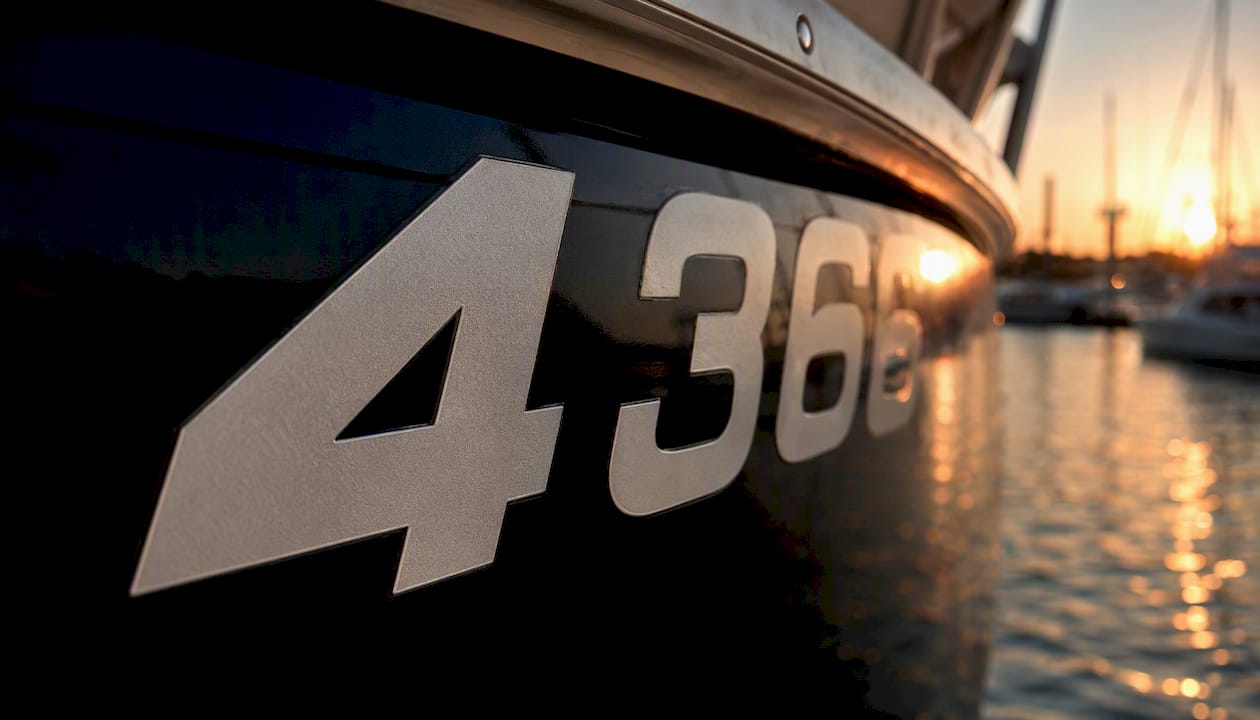
On the design side, the decal must use block fonts, correct hyphenation or spacing between the NC prefix, numerals, and letter suffix, and a color that contrasts with the hull. A white hull needs dark characters; a dark hull needs light ones. The contrast rule is not aesthetic, it is statutory.
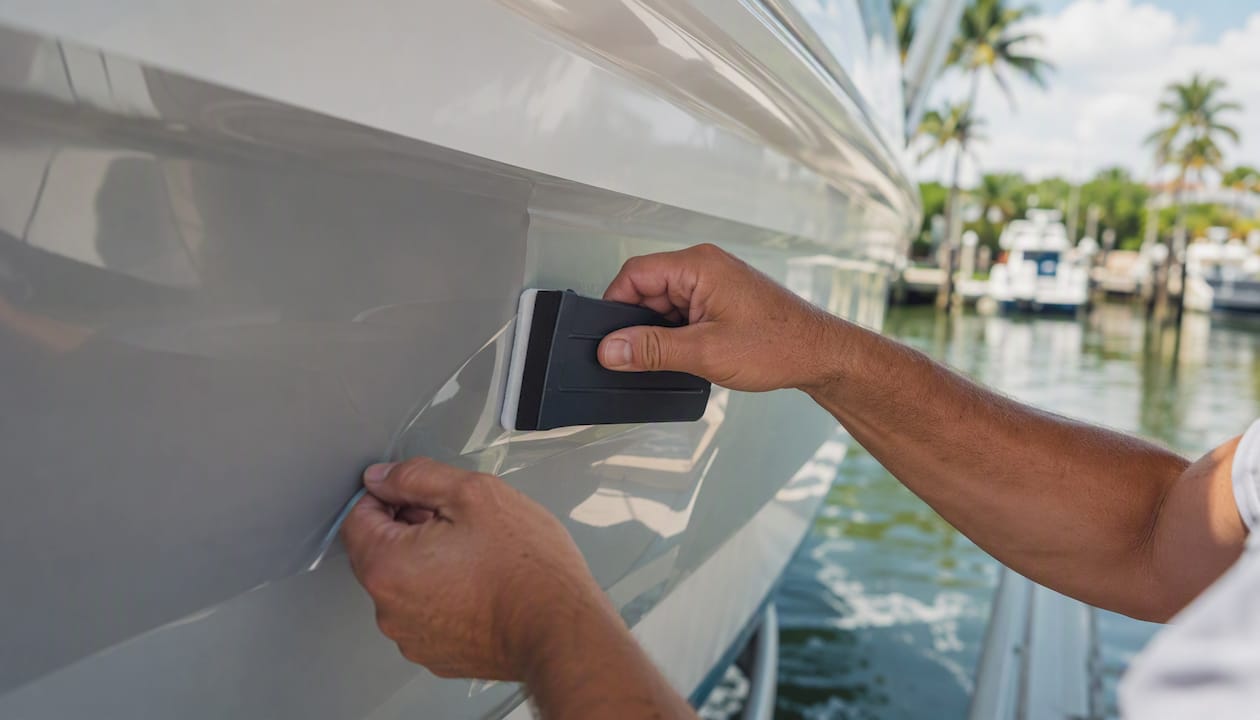
Application technique affects longevity significantly. Apply above 40°F to a hull surface that has been cleaned of wax, grease, and old adhesive. Bubbles under the decal trap moisture and accelerate peeling. A firm squeegee pass from center to edges removes air pockets before they become a problem.
Registrationdecals.com publishes state-specific compliance guides and offers an online design tool that previews how your registration number will look in different color combinations on contrasting hull backgrounds. That preview step is worth using before you commit to a color, because a combination that looks fine on screen can fall short of the contrast standard on a wet hull in direct sun. Their decals are made from marine-grade vinyl designed for UV and saltwater resistance, which covers both coastal and freshwater NC conditions.
Pro Tip: Ask any decal vendor about their weather warranty. A vendor that stands behind the product with a replacement policy if the decal fails within the warranty window is telling you something about the material quality. One that does not offer any warranty is telling you something too.
Key Takeaways
North Carolina boat registration numbers must follow the NC 0000 AB format in 3-inch block characters on both sides of the forward bow half, with validation decals placed within 6 inches aft.
| Point | Details |
|---|---|
| Correct NC format | Use NC + four digits + two letters, separated by hyphens or spaces, exactly as on your certificate. |
| 3-inch block characters | Characters must be solid-color, high-contrast, and at least 3 inches tall on both port and starboard sides. |
| Decals within 6 inches aft | Validation decals go on both sides of the bow, no more than 6 inches behind the last character of the registration number. |
| Carry the certificate on board | The certificate of number is legally required on the vessel whenever it is operating; failing to produce it can mean a court appearance. |
| Registrationdecals for compliant decals | Registrationdecals offers marine-grade vinyl NC-compliant decals with an online preview tool, 3–5 business day production, and free shipping in the contiguous U.S. |
Why clear markings matter beyond the ticket
Most boat owners treat registration numbers as a bureaucratic checkbox. That framing undersells what the rules actually accomplish.
When a vessel is reported overdue, involved in a collision, or found adrift, the registration number is the first thing search-and-rescue teams use to identify it. A faded, low-contrast, or misplaced number adds minutes to that identification process. On open water, minutes matter. The 3-inch minimum and contrast requirement are not arbitrary; they are calibrated so a number can be read from a patrol boat or helicopter at a meaningful distance.
There is also a resale dimension that owners rarely think about until they are mid-transaction. A vessel with illegible or non-compliant numbers creates paperwork complications at transfer. The buyer's lender, insurer, or state agent will want the registration to match the hull, and a number that has been repainted incorrectly or partially obscured by a name graphic can stall a sale.
The practical case for compliant, durable decals is straightforward: the cost of a quality marine-grade set is trivial compared to a citation, a failed inspection, or a delayed sale. And for anyone boating on NC's coastal waterways, where saltwater and UV work fast on cheap materials, the material choice is the difference between decals that last a season and ones that last years.
Get compliant NC registration decals without the guesswork
North Carolina's display rules are specific, and the margin for error is narrow. Registrationdecals takes the format, spacing, and contrast decisions off your plate.
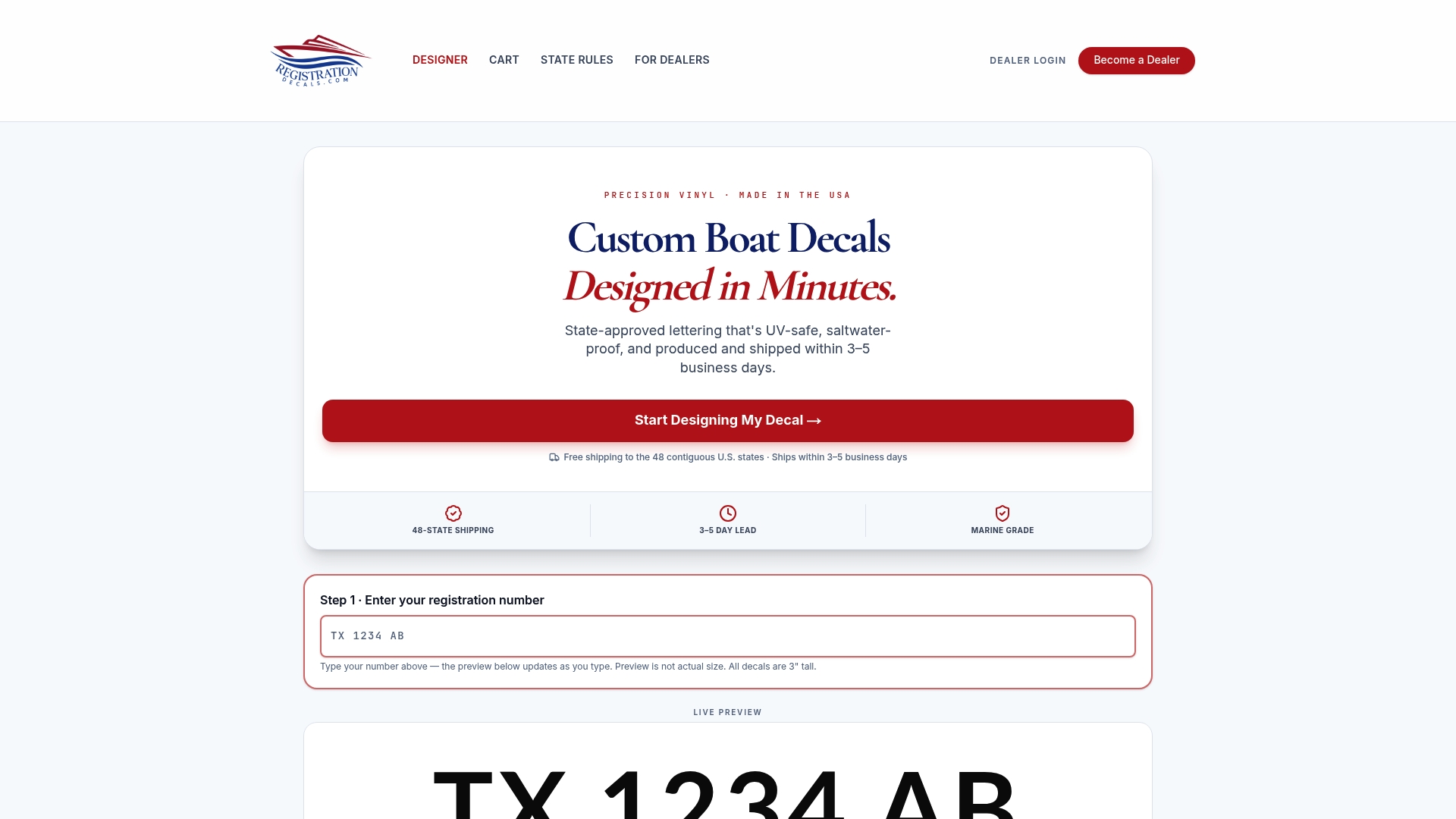
Their online design tool lets you enter your exact registration number, choose a font and color combination, and preview how it will look against your hull color before you order. Every decal ships as marine-grade vinyl, UV-resistant and saltwater-proof, built for the conditions NC boaters actually face. Production runs 3–5 business days, and shipping is free across the contiguous U.S. Bulk orders are available for marinas and dealerships.
Before you order, confirm your registration number exactly as printed on your NC certificate of number, and remove any expired decals from the hull before the new set arrives. Design and order your compliant NC decals at RegistrationDecals.com.
Authoritative sources for current NC rules
Rules and fees change. Bookmark these official sources and check them before registering, renewing, or replacing decals:
- Affixing vessel numbers and decals (NCWRC)
- Registration and Titling | NC Wildlife
- Vessel operators guide (NCWRC)
- G.S. 75A-5 - Application for certificate of number (North Carolina General Statutes)
- Display of Vessel Numbers — North Carolina Rule 15A-NCAC-10F-.0106
- VL-1 Form (Registration & Titling) (NCWRC)
- North Carolina Boat Registration Decal Requirements (2026 Guide) — RegistrationDecals.com
For dock and marina lighting that meets safety standards alongside your vessel compliance setup, dock lighting solutions from Forever Glow are worth reviewing if you operate at night or maintain a slip.
This article provides general compliance information based on publicly available NCWRC guidance and North Carolina statutes. Fees, deadlines, and procedural details can change. Verify current requirements directly with NCWRC at 1-888-248-6834 or ncwildlife.org before registering, renewing, or making any compliance decisions.