
Under 33 C.F.R. § 173.27, boat registration numbers must be plain vertical block characters at least 3 inches tall, spaced with a hyphen or space equal to a standard letter's width, and mounted on the forward half of both sides, reading left to right. Validation decals belong within six inches of the number, though several states tighten that to an exact 3 inches. Get the spacing wrong and you risk a citation even with a perfectly legal registration.
TL;DR:
- Boat registration numbers must be at least 3 inches tall in plain vertical block font, with a consistent gap of one letter width between groups.
- Numbers should be on the forward half of both sides of the hull, with validation decals placed within six inches or, in some states, exactly 3 inches from the number.
- Proper spacing, contrast, and placement are critical to avoid citations, especially since officers judge legibility from a distance rather than measuring precisely.
- State-specific rules may tighten decal distance requirements or specify which side gets the decal, so verify local regulations before application.
- Using pre-spaced decal kits ensures consistent, compliant spacing and color contrast, reducing the risk of accidental violations during inspections.
Table of Contents
- Boat Number Spacing Checklist Before You Launch
- What 33 C.F.R. § 173.27 Actually Requires
- Getting the Spacing Format Right on Your Hull
- Where Exactly to Place Numbers and Decals
- Mistakes That Actually Get Boats Cited
- How to Measure and Apply Boat Number Decals
- How State Rules Differ From the Federal Baseline
- Why Spacing Precision Beats a Nice-Looking Decal
- Order Compliant, Pre-Spaced Decals From Registrationdecals
- Where to Verify These Rules Yourself
- Sources
Boat Number Spacing Checklist Before You Launch
Run through this before you back the trailer down the ramp. Every point below traces back to the federal baseline plus the state-level tweaks most registration offices layer on top.
- Characters must be at least 3 inches tall and cut in plain block font, as required by federal regulations, no script or italics.
- Numbers must sit on the forward half of the hull, on both the port and starboard sides, oriented left to right.
- A gap equal to one letter's width separates the prefix, digits, and suffix, using either a hyphen or blank space.
- The validation decal must be placed within six inches of the number, aligned on the same axis.
- The color must contrast with the hull so the number is clearly legible from a practical distance, per BoatUS Foundation's registration guidance.
- Nothing else, no other numerals or stickers, sits close enough to confuse the registration string.
Miss two or three of these and an officer doing a routine safety check has grounds to flag your boat, even if the registration itself is current.
What 33 C.F.R. § 173.27 Actually Requires
This is the regulation every state marine board builds from, and it's worth reading in plain terms instead of legal shorthand. The federal rule requires numbers painted on or permanently attached to each side of the vessel's forward half, in plain vertical block characters that contrast with the hull color and read left to right, no mirroring, no stacking.
Three details trip up most owners:
- Height is a floor, not a target. Three inches is the legal minimum; nothing stops you from going bigger on a larger hull.
- Spacing is proportional, not fixed. The gap between letter and number groups must equal the width of a standard letter, which is why "I" and "1" are poor references for measuring, they're too narrow to represent a typical character width.
- Backing plates are allowed. When hull curvature, rub rails, or a low-profile bow make direct application impractical, a permanently attached plate carrying the number satisfies the rule.
"Visible and legible" isn't defined by exact inches in the federal text, but practical guidance from BoatUS treats 100 feet as the working distance test. If a number blurs into an illegible smudge from across a marina slip, it fails that test regardless of what the tape measure says.
Getting the Spacing Format Right on Your Hull
A compliant string looks like MD 1234 AB or MD-1234-AB, either separator works, as long as its width matches a standard letter. A breakdown of spacing between boat registration numbers confirms both formats pass inspection nationwide.
Two-letter prefixes group naturally against the digit block. Three-letter prefixes, common in states like Massachusetts or Wisconsin, need the same proportional gap, don't compress it just because the string runs longer.
Common failures to avoid:
- Cursive or italic fonts, which violate the "plain vertical block" requirement outright.
- Kerning so tight the separator disappears, effectively merging prefix and digits into one unreadable string.
- Mirrored or reversed characters from a poorly applied decal.
- Decorative outlines or drop shadows that cut contrast against the hull.
Pro Tip: On personal watercraft, where bow space is tight, use a pre-spaced decal kit rather than individual letters. It's nearly impossible to eyeball letter-width spacing accurately on an 8-inch-wide PWC nose.
Where Exactly to Place Numbers and Decals
"Forward half" means measured from the bow to the transom, and the number sits somewhere in that front section, not tucked under a rail cap or hidden by a bow rail where it's obscured from a side view.
- Measure your hull's total length and mark the midpoint; anything forward of that line qualifies.
- Use a strip of masking tape as a level guideline, running it parallel to the waterline or gunwale rather than eyeballing it.
- Place the validation decal within six inches of the number's suffix, typically on the port side unless your state specifies otherwise.
- If the hull curves or a rub rail interrupts the surface, install a flat backing plate sized to hold the full number string without bending.
Some states, Hawaii among them, specify the decal sits exactly 3 inches aft and in line with the number rather than "within six inches." Check your registration paperwork before assuming the looser federal standard applies.
Pro Tip: Apply painter's tape above and below your guideline before placing any decal. It keeps the whole string level across a curved hull where your eye alone will drift.
Mistakes That Actually Get Boats Cited
Officers doing dock checks see the same handful of violations over and over. Undersized characters top the list, decals that measure closer to 2 inches than the required 3 don't pass, no matter how sharp they look.
- Low contrast, white numbers on a light hull, is nearly as common and just as citable.
- Incorrect or missing spacing between letter and digit groups confuses the registration string enough to draw scrutiny.
- Decals mounted too far aft of the number, or missing altogether after a hull wash or re-wrap.
- Extra numerals, like a hull ID sticker, placed close enough to the registration to cause confusion.
Penalties vary by state, some issue a warning with a correction deadline, others cite immediately during peak-season patrols, emphasizing the importance of wearing life jackets on boats for safety compliance. Checking your state's registration decal rules before the season starts beats finding out from an officer on the water.
How to Measure and Apply Boat Number Decals
Gather a tape measure, a level, masking tape, marine-grade cleaner, a squeegee, and either a pre-spaced decal kit or individual character strips.
- Clean the hull section thoroughly with marine-grade cleaner and let it dry fully, any residue shortens decal life.
- Mark a level guideline with masking tape, measuring from the waterline for consistency on both sides.
- Lay out characters, pre-spaced kits handle this automatically, but with individual letters, use a spare character as a spacing gauge between groups.
- Confirm the gap equals a full letter's width before committing to adhesion.
- Apply from one edge, pressing with a squeegee to eliminate air bubbles, then repeat the exact placement on the opposite side.
- Step back and compare both sides for matching height and alignment.
Guidance compiled by LegalClarity on boat number placement echoes the same sequence: guideline first, spacing check second, adhesion last. After winter storage, recheck for lifted edges or faded contrast, saltwater and UV exposure both degrade cheaper vinyl faster than owners expect.
Pro Tip: Full step-by-step application details, including surface prep for aluminum versus fiberglass hulls, are covered in Registrationdecals' guide to applying vinyl registration decals.
How State Rules Differ From the Federal Baseline
States build on 33 C.F.R. § 173.27 rather than replace it, but the add-ons matter. Washington's DOL registration rules and Hawaii's DOBOR guidance both specify decal distances more precisely than the federal "within six inches" language.
- Some states lock the decal-to-number gap at exactly 3 inches instead of allowing up to six.
- A few specify which side, port or starboard, gets the decal versus the number sequence.
- USCG-documented vessels often skip state numbering entirely, displaying the official number and name on the transom under 46 C.F.R. § 67.121 instead.
Confirm your exact requirement on the paperwork mailed with your registration, or check your state's decal regulation page directly. The federal rule is the floor, not the ceiling, in most states.
Why Spacing Precision Beats a Nice-Looking Decal
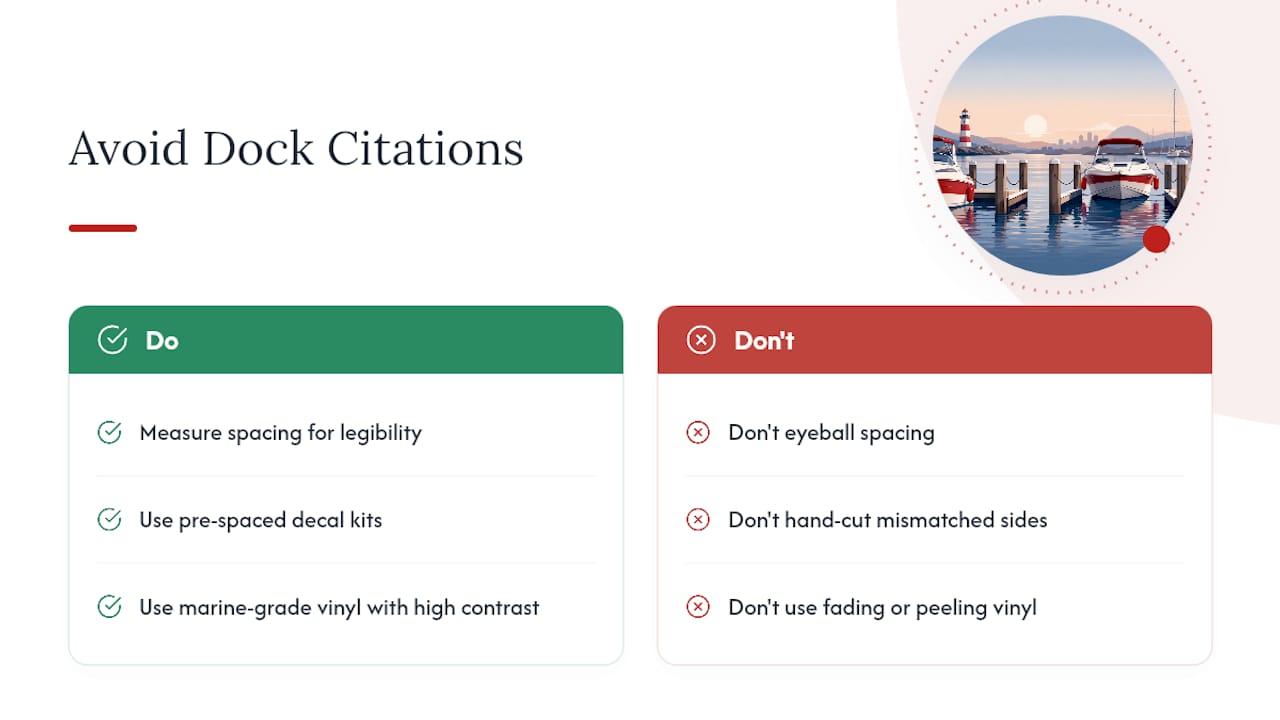
Most owners treat boat number spacing as a cosmetic afterthought, something to eyeball after the bigger decisions like hull color or trim. That's backwards. A number that's technically 3 inches tall but crammed with a half-inch separator fails the same inspection as one that's too small outright, and it fails for a reason most people don't expect: enforcement officers aren't measuring with a ruler on the dock, they're judging legibility at a glance, the same way the federal 100-foot standard implies.
Pre-spaced decal kits solve a problem hand-cut lettering can't: consistency between the port and starboard side. I've seen more citations tied to mismatched spacing between the two sides than to any single measurement being wrong. Marine-grade vinyl matters here too, a decal that fades or lifts after one saltwater season doesn't just look bad, it drifts out of compliance the moment contrast drops below what's legible at range. The materials and the layout are the same compliance question, not two separate ones.
— Taylor
Order Compliant, Pre-Spaced Decals From Registrationdecals
Skip the tape-measure guesswork. An online design tool builds your registration string with correct letter-width spacing already calculated, so the layout that passes inspection is the layout you get, whether you're ordering a single set or outfitting a marina's rental fleet.
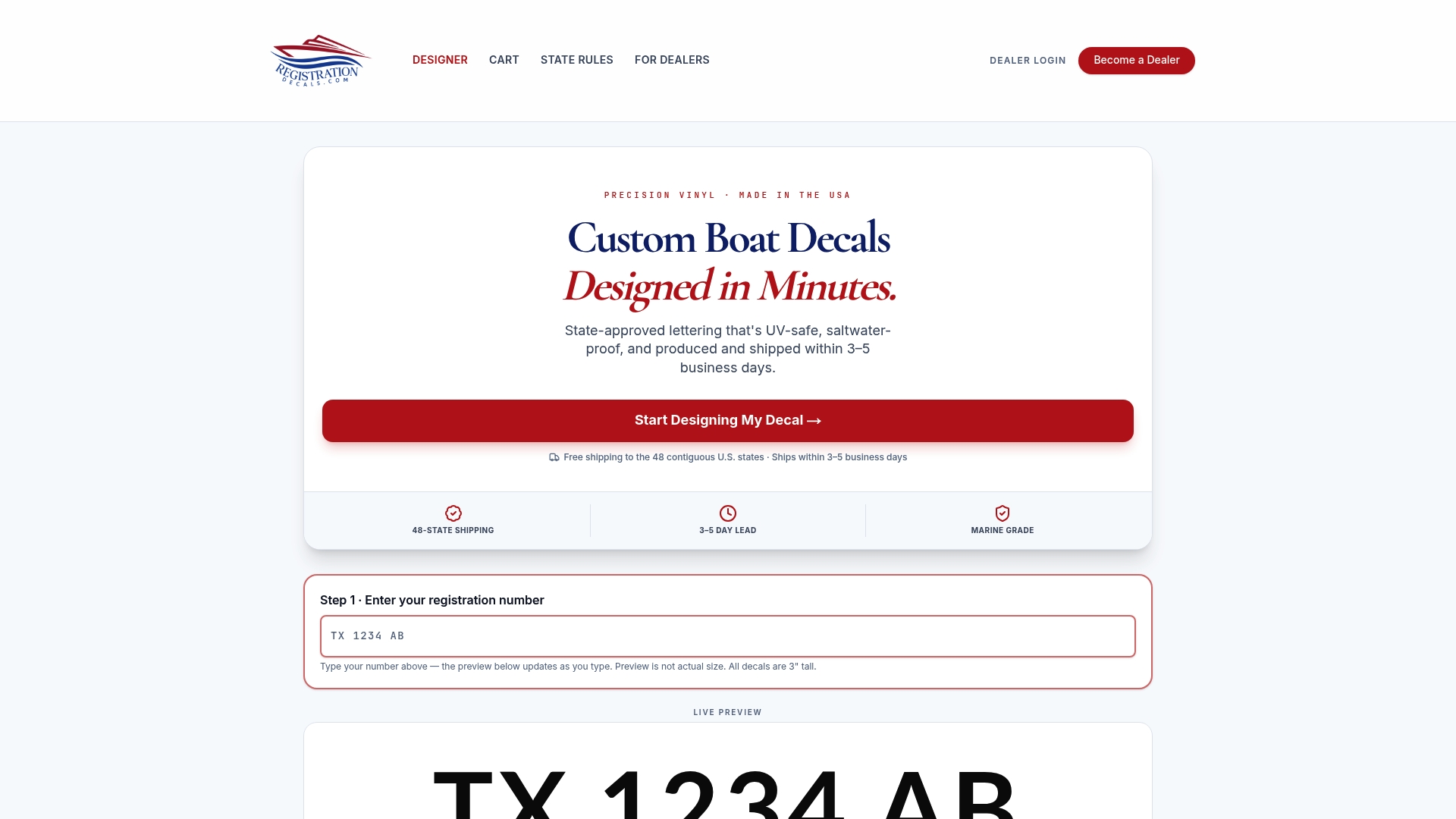
Enter your state-issued number, pick a font and color combination that meets contrast requirements, and the tool handles prefix, digit, and suffix grouping automatically. That matters most on personal watercraft, where PWC-specific decal sizing leaves little room for error. Orders ship on marine-grade vinyl built to resist UV fade and saltwater lift, with production running 3 to 5 business days and free shipping across the contiguous United States. Marinas and dealerships needing volume can also review wholesale decal options for bulk orders.
Head to Registrationdecals and enter your registration number to see your compliant layout before you buy.
Where to Verify These Rules Yourself
- 33 C.F.R. § 173.27 is the federal source for character height, spacing, and forward-half placement.
- DLNR Hawaii's vessel numbering page shows how one state tightens the decal-distance rule to an exact 3 inches.
- Washington DOL's boat registration page illustrates state-level enforcement and documentation requirements.
- BoatUS Foundation's study guide summarizes practical display expectations that mirror the federal text.
Cross-check your own state's registration office page against these before you finalize your decal order, the federal floor rarely changes, but state specifics do from one renewal cycle to the next.
Sources
- Code of Federal Regulations Title 33: Part 173 — Numbers: Display; Size; Color
- Numbering your vessel — DLNR Hawaii Division of Boating and Ocean Recreation
- Registration requirements — BoatUS Foundation study guide