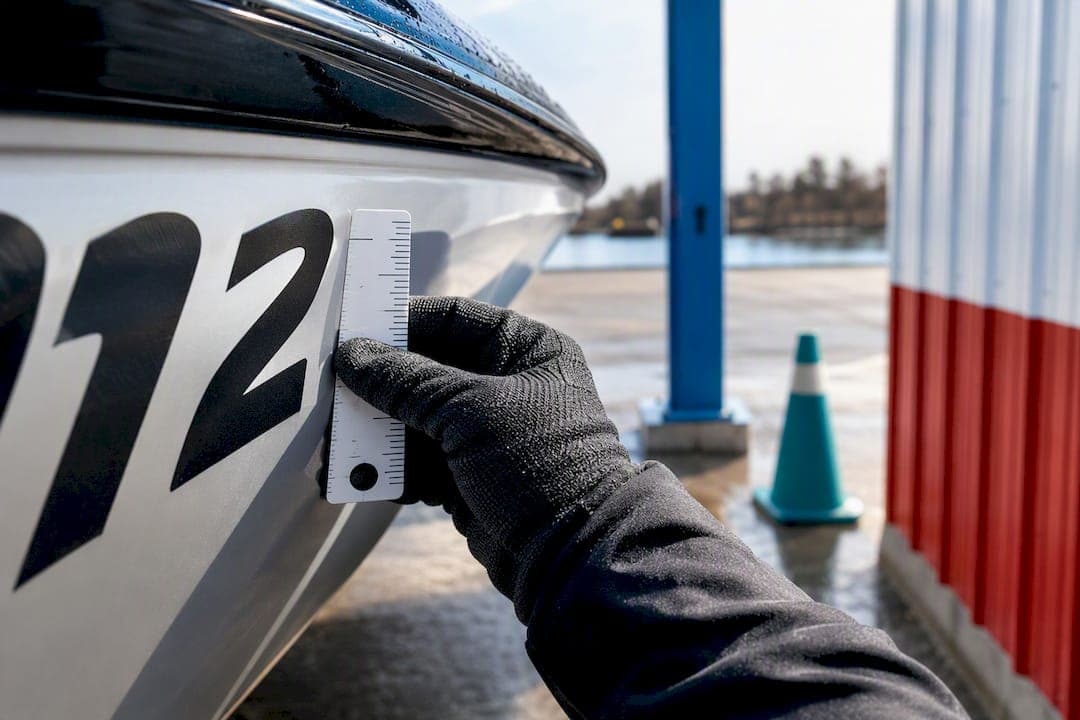
For this article, "temporary boat numbers" means state-compliant, marine-grade vinyl registration decals, not paper placards or tape-on stickers. Properly sized, formatted, and placed vinyl decals satisfy federal and state display rules on their own. The rest comes down to getting the size, spacing, and location right the first time.
TL;DR:
- Vinyl registration decals must have at least 3-inch tall, plain block characters in sharp contrast to the hull, placed on both sides of the forward hull.
- Cast vinyl with a protective laminate is recommended for durability against UV, saltwater, and trailer wear, especially on curved or textured surfaces.
- Online ordering tools should enforce spacing, size, and contrast rules, with reviews before production to prevent compliance errors.
- Proper surface preparation and installation in moderate temperatures are crucial to ensure decals adhere flatly and last through exposure.
- Professional decals reduce the risk of citations by adhering strictly to federal and state display regulations, avoiding common design and placement mistakes.
Table of Contents
- What the Rules Require for Displaying Temporary Boat Numbers
- Choosing Marine-Grade Vinyl That Actually Lasts
- How to Design and Order Compliant Numbers Online
- Installing and Maintaining Vinyl Registration Decals
- Ordering for Marinas and Dealerships
- Why Professionally Made Decals Reduce Risk
- Order Marine-Grade Decals Built to Pass Inspection
- Sources
What the Rules Require for Displaying Temporary Boat Numbers
Every recreational boat operating on public water needs its registration number visible, legible, and positioned exactly where regulators expect to find it. The federal baseline comes from 33 CFR 173.27, and most states build their own codes directly on top of it.
The rule itself is specific. Numbers go on the forward half of the hull, on both sides, in plain vertical block characters, at least 3 inches tall, in a color that contrasts sharply with the hull. Characters read left to right, and any hyphen or space separating the prefix, number, and suffix has to be at least as wide as the stroke of the letters around it. Skip the hyphen or squeeze the spacing and an officer can flag it as non-compliant even if the boat is legally registered.
Validation stickers add a second layer. They need to sit within six inches of the registration number, and while the federal rule sets that six-inch window, states vary on how many stickers you display and where the renewal sticker goes relative to the original. A few states use a single sticker; others require decals on both sides to match dual-side numbering. Checking state-specific boat registration decal requirements before you order saves a reorder later.
Before you call a decal finished, run through this:
- Character height measures 3 inches or more, front to back
- Font is plain block style, no script, no italics, no decorative serifs
- Color contrasts clearly against the hull (dark numbers on white hulls, light numbers on dark hulls)
- Numbers appear on both sides of the forward hull, matching left to right
- Validation stickers sit within a few inches of the number, per your state's placement convention
Choosing Marine-Grade Vinyl That Actually Lasts
Not all vinyl survives saltwater, UV exposure, and trailer abrasion equally. Two categories dominate the decal world: calendared vinyl and cast vinyl. Calendared vinyl is cheaper and stiffer, and it tends to shrink, crack, or lift at the edges within a season or two on a hull that flexes and gets washed constantly. Cast marine-grade vinyl, the kind found in products like ORACAL 751 or 951, conforms to curved or riveted hulls without lifting and holds up far longer against UV and salt exposure.
A laminate overlay adds another layer of protection against fading and abrasion, which matters most on boats that see heavy trailer use or dock rubbing.
- Cast vinyl over calendared vinyl for anything with curves, rivets, or rough gel coat
- A gloss or matte overlaminate for boats stored outdoors or used in saltwater regularly
- High-contrast color pairs (white on navy, black on white) over subtle tone-on-tone choices
- Backing plates for pontoon rails, tubes, or any hull section where the surface won't hold adhesive directly
Pro Tip: If your hull has rivets, ridges, or a rough non-skid texture where numbers need to go, order a backing plate instead of trying to stretch the decal over the surface. It solves the adhesion problem and keeps the numbers flat and legible.
How to Design and Order Compliant Numbers Online
Ordering decals online only works if the design tool enforces the same rules an inspector will check. Here's the sequence that gets it right the first time.
- Enter your exact registration number as issued by your state, including the prefix and suffix letters.
- Set spacing or hyphens to match your state's format. If your state issues numbers with a hyphen (like FL 1234 AB), the decal needs that same spacing built in, not squeezed together.
- Pick a size at or above 3 inches. Larger numbers read easier from a distance and reduce inspection friction, even though 3 inches is the legal floor.
- Choose a plain block font and a contrasting color that reads clearly against your hull color.
- Review the digital proof carefully before approving. This is the step that catches spacing or letter-height mistakes before they're cut into vinyl.
- Confirm production and shipping. Most orders through Registrationdecals ship within 3 to 5 business days, with free shipping across the contiguous United States.
Installing and Maintaining Vinyl Registration Decals
A decal that's cut correctly can still fail if it's installed badly. Surface prep matters more than most boat owners expect.
- Clean the hull surface with rubbing alcohol or a dedicated vinyl prep solution. Skip soap, which leaves a residue that weakens adhesion.
- Apply in moderate temperatures, ideally 50 to 90 degrees Fahrenheit, out of direct sun. Vinyl adhesive bonds poorly in cold weather and can bubble in extreme heat.
- Use the transfer tape method, peeling slowly at a low angle to avoid stretching the letters out of shape.
- Use backing plates on rough or curved sections instead of forcing the decal to conform.
Once installed, check your numbers every season for fading, lifting edges, or cracking. If the contrast fades enough that the numbers are hard to read at a distance, it's time to replace them.
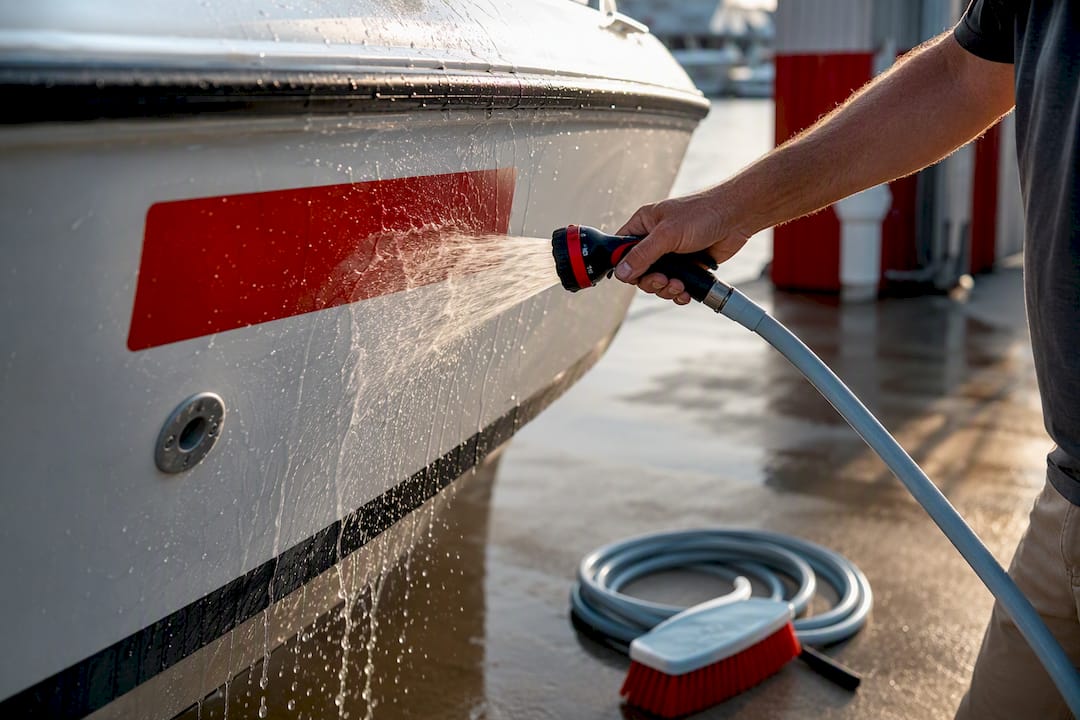
Pro Tip: Salt residue accelerates edge lifting faster than sun exposure does, so rinsing with fresh water and applying marine ceramic coating for boats can help protect your hull and decal adhesion. Rinse the decal area with fresh water after every saltwater trip, the same way you'd rinse the rest of the hull.
Ordering for Marinas and Dealerships
Dealerships showing boats on the water face a different problem: the boat isn't registered to the dealer permanently, but it still needs a visible number during test runs. Many states address this directly. Washington's vessel registration code, for example, allows dealers to use assigned dealer numbers on removable backing plates for demonstration purposes, provided the plate keeps the number visible from both sides.
For marinas and dealerships ordering in volume, a few habits keep things simple:
- Keep a saved specification sheet (font, size, color, spacing convention) so every reorder matches without a fresh design pass
- Request proofs on file before bulk production, especially for fleets with different hull colors
- Build in lead time around your busiest season, since 3 to 5 business day production still requires ordering ahead of a launch date
Dealer resources and install sheets make on-site application faster when a crew is installing numbers across multiple boats in a single afternoon.
Why Professionally Made Decals Reduce Risk
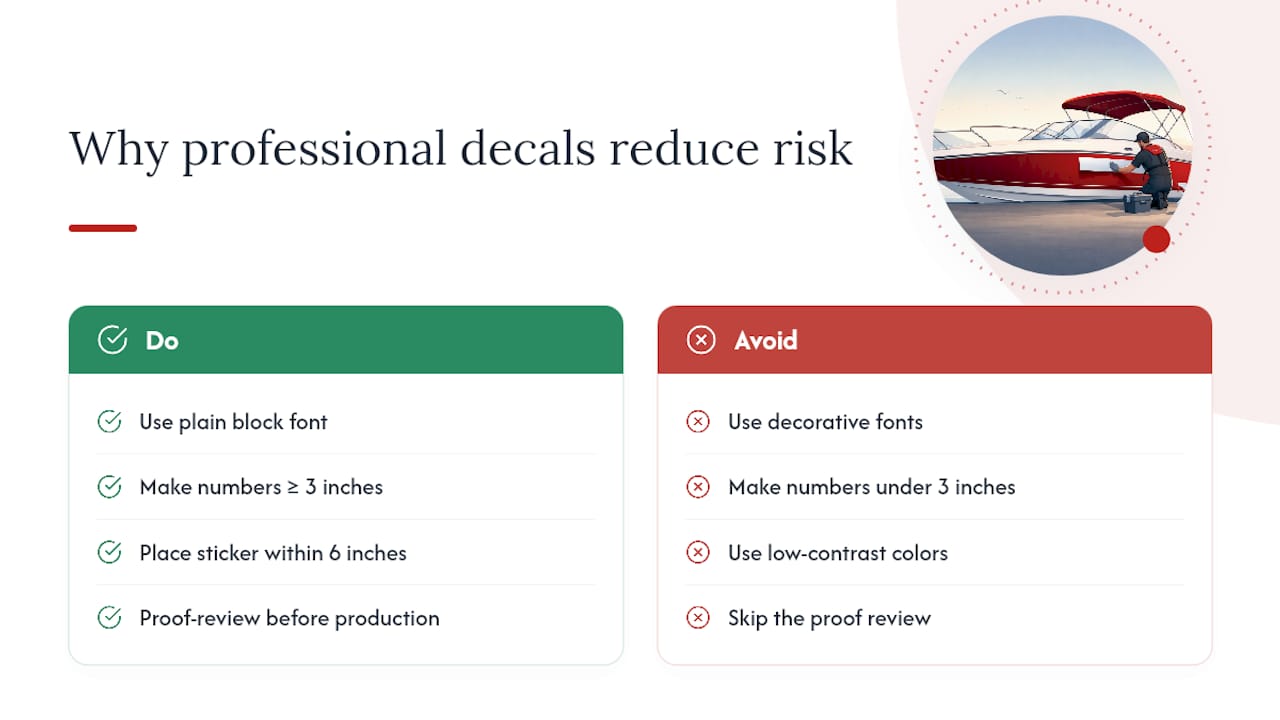
Most compliance problems come down to the same handful of mistakes: font that's too decorative to count as "plain block," numbers under the 3-inch minimum, low-contrast color choices, or a validation sticker placed more than six inches from the registration number. Skipping the proof review step is the other big one. It's the last checkpoint before a mistake gets committed to vinyl.
Marine-grade cast vinyl solves half the problem by outlasting cheaper material. The other half comes from a design process that enforces the size, spacing, and contrast rules before production starts. That combination is why professionally made decals see far fewer citations and reorders than DIY solutions. When your state has an unusual quirk, like dual stickers or a specific hyphen convention, check a dedicated state guide rather than guessing.
— Taylor
Order Marine-Grade Decals Built to Pass Inspection
Registrationdecals is the alternative to guessing at font size and hoping a hardware-store sticker survives a season on saltwater. The design tool builds the federal spacing, sizing, and contrast rules into every decal before it's cut, so you're not left second-guessing your proof against a code book.
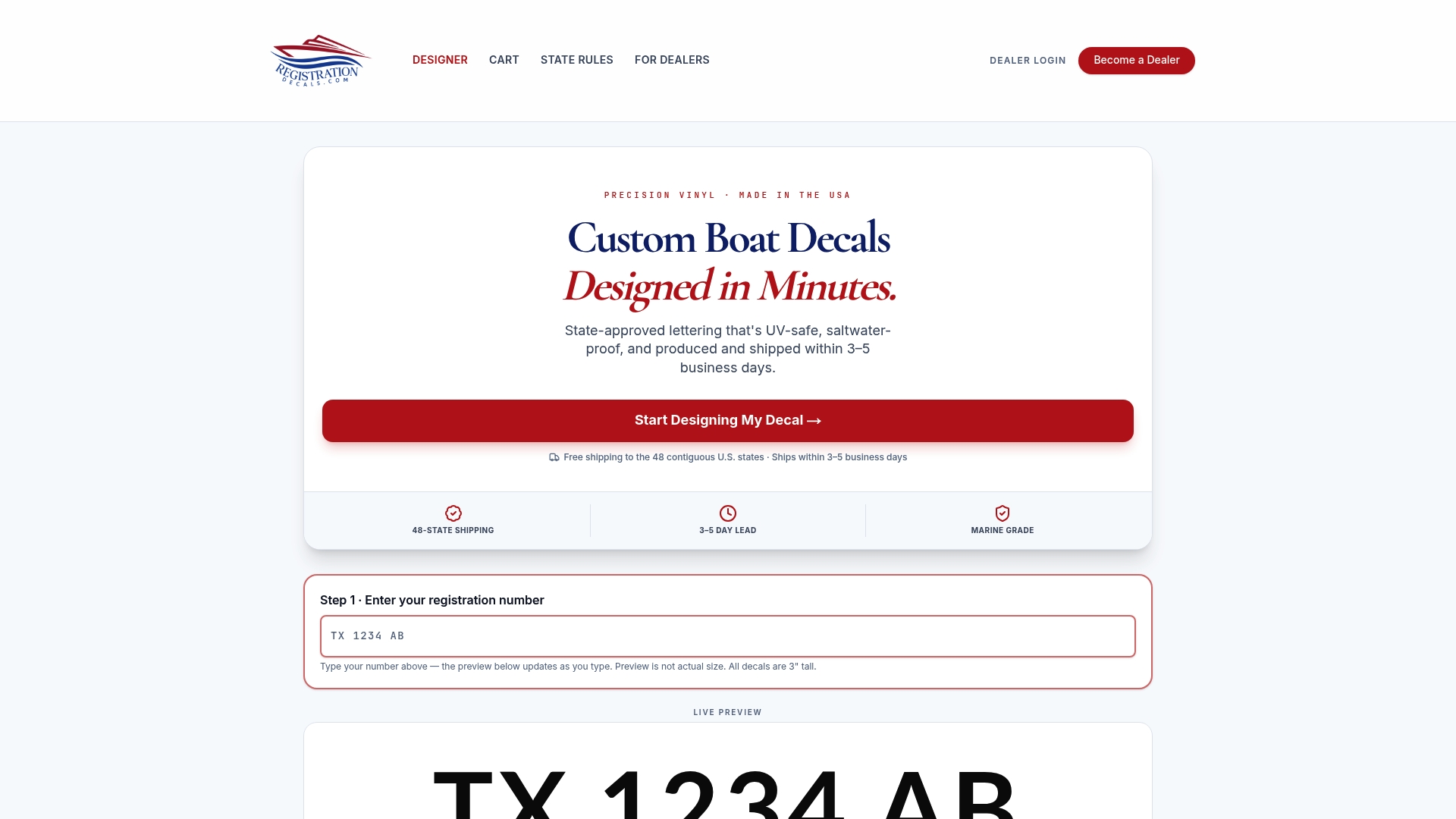
Every set ships in marine-grade cast vinyl, rated for UV and saltwater exposure, and production runs 3 to 5 business days with free shipping across the contiguous United States. Marinas and dealerships get wholesale ordering options for fleets that need consistent specs across multiple boats. If you're not sure your current numbers meet the letter-height or contrast requirement, check how long marine vinyl decals actually last before your next inspection. Start your design now at Registrationdecals and enter your registration number to see a proof in minutes.
Sources
Federal display rules come directly from 33 CFR 173.27. For material selection, see the vinyl comparison from Decal District. State-specific rules and installation steps are covered in Registrationdecals.
- Wash. Admin. Code § 308-93-145 - Vessel registration numbers - Display, size, color | State Regulations | US Law | LII