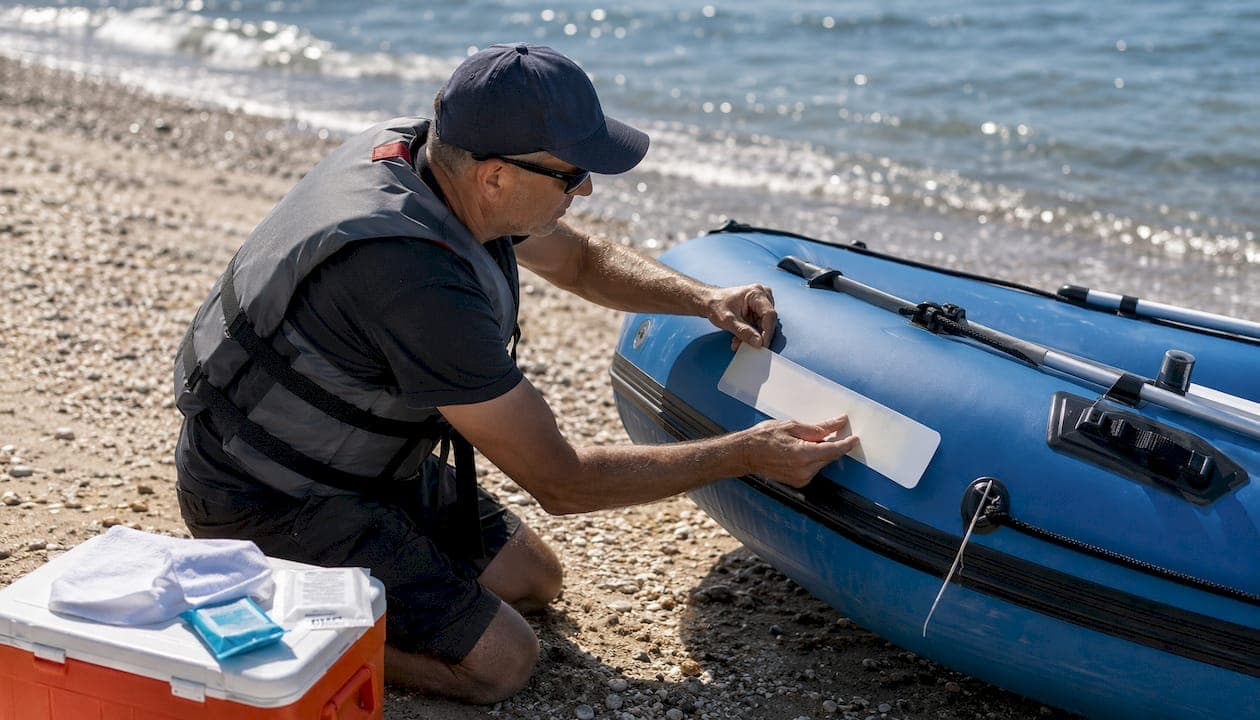
The most reliable way to display registration numbers on a PVC or Hypalon inflatable is to apply marine-grade vinyl decals to a semi-flexible ABS registration plate, then mount that plate above the rubbing strake with industrial mounting tape or adjustable straps. That single method solves the two problems that sink every other approach: flexible tubes reject direct adhesives over time, and folding or rolling a boat destroys decals applied straight to the fabric.
A few things to confirm before you order anything:
- Character height: The US Coast Guard standard and most state rules require block characters at least 3 inches tall. Some states set a higher minimum, so check yours.
- Placement: Numbers go on both port and starboard sides, forward of the beam, above the bond line. Confirm your state's exact placement language before you drill or tape anything.
- Registration numbers function like a license plate for your vessel — they help search-and-rescue teams and enforcement officers identify your boat fast. Durability is not optional.
Table of Contents
- What do US boat registration number rules actually require?
- Which attachment methods actually work on inflatable boats?
- PVC vs Hypalon vs textured fabrics: what bonds and what fails
- How to apply registration plates and decals to an inflatable
- How to keep your registration numbers readable for years
- What to order and where to find the right kit
- Key Takeaways
- Why the plate-plus-decal approach is the one worth defending
- Get compliant inflatable boat numbers from Registrationdecals
- Useful sources and where to verify the rules
What do US boat registration number rules actually require?
Most states follow a consistent baseline, but the details vary enough that you should verify before ordering.
The common requirements across US jurisdictions:
- Block-style characters, minimum 3 inches tall, in a color that contrasts with the hull background
- Displayed on both port and starboard sides, forward of the beam
- Numbers and letters read left to right on both sides
- A space equal to one character width between the state prefix and the number group, and again before the last two characters (example: FL 3645 JY)
- State-issued validation sticker displayed near the numbers, usually within a few inches
Registration numbers vs. the Hull Identification Number (HIN): These are two different things. Your HIN is a 12-character serial number assigned by the manufacturer, typically molded or stamped into the transom. Most mass-produced inflatables do carry a HIN, but some entry-level or imported dinghies do not. Registration numbers, by contrast, are issued by your state when you register the vessel and must be displayed visibly on the hull. The HIN is for manufacturer tracking and title purposes; the registration number is what law enforcement and rescuers use on the water.
To find your state's exact rules on boat registration numbers, go directly to your state boating agency's website. Character height, spacing, and placement requirements can differ, and a few states require numbers on the transom as well. If you want a state-by-state example of how specific these rules get, the Florida requirements page shows the kind of detail you should look for in your own state's rules.
Which attachment methods actually work on inflatable boats?
Not all mounting options hold up equally well on flexible tubes. Here is how the main categories compare.
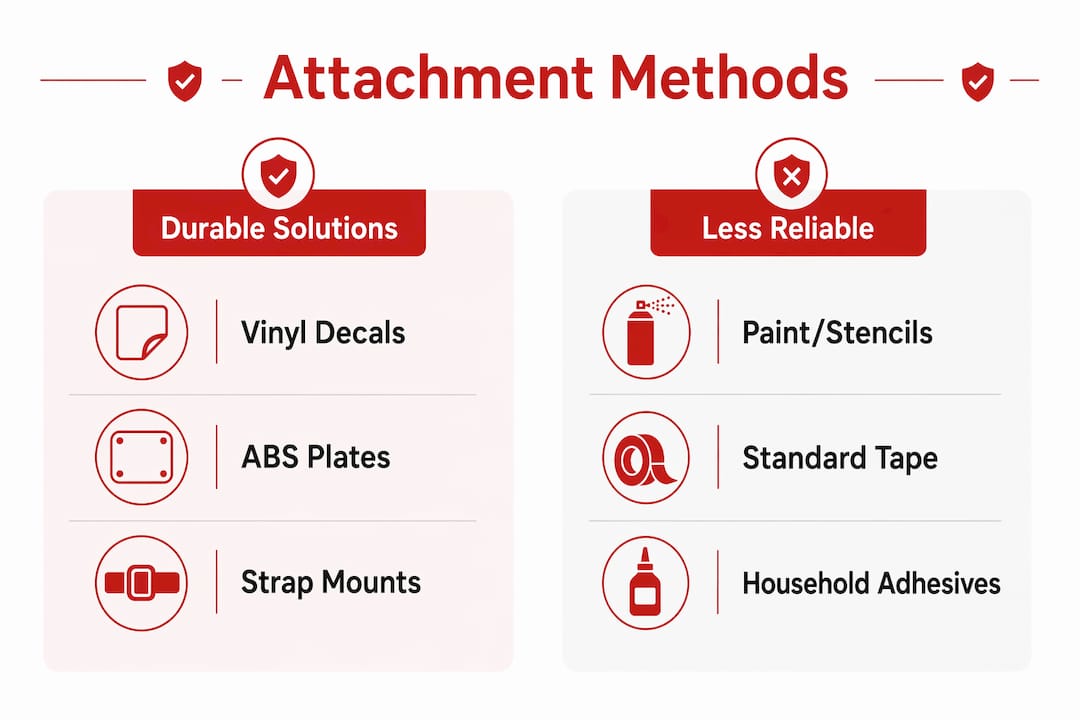
Direct marine-grade vinyl decals Applied straight to the tube, these work on smooth PVC and Hypalon surfaces when the material is clean and the adhesive is rated for marine use. The upside is simplicity. The downside: if you deflate and roll your boat for storage, repeated flexing will crease and eventually delaminate the decal. Best for boats that stay inflated most of the season.
Pre-spaced transfer decal strips These arrive pre-arranged on application tape so every character is already spaced and aligned. You peel and apply as a single strip rather than placing individual letters. Faster, cleaner, and far fewer alignment errors. Still subject to the same flexing limitation as direct decals.
Semi-flexible ABS registration plates with industrial mounting tape A 4" x 24" semi-flexible ABS plate gives the decals a flat, stable surface to bond to, which is the real fix for adhesion problems on curved or textured tubes. The plate attaches to the tube with 3M SCOTCH MOUNT™ EXTREME double-sided tape. No drilling, no paint, no permanent alteration. The plate flexes slightly with the tube but protects the decals from the worst of the folding stress.
Strap-mounted or Velcro plate systems The same ABS plate, but secured with adjustable nylon straps through D-rings, grab handles, or perimeter lines instead of tape. This is the right call if you deflate and store your boat regularly. The plate comes off in seconds, the decals stay intact, and you remount when you launch. The trade-off is that straps can shift if not cinched properly, so check tension before every outing.
Painted or stenciled numbers Permanent, cheap, and generally a bad idea on inflatables. Paint cracks as the tube flexes, adhesion to PVC and Hypalon is inconsistent, and you cannot remove it without damaging the fabric. Avoid this unless your manufacturer explicitly approves it.
For owners who deflate frequently, removable plate systems are the clear choice. Plates also preserve resale value and warranty by keeping harsh adhesives off the tube fabric.
PVC vs Hypalon vs textured fabrics: what bonds and what fails
Material matters more than most owners realize before their first decal peels off mid-season.
PVC is the most common inflatable material. It has a relatively smooth surface, but it is flexible and can have a slight plasticizer residue that interferes with adhesive bonding. Clean it thoroughly with isopropyl alcohol before applying anything.
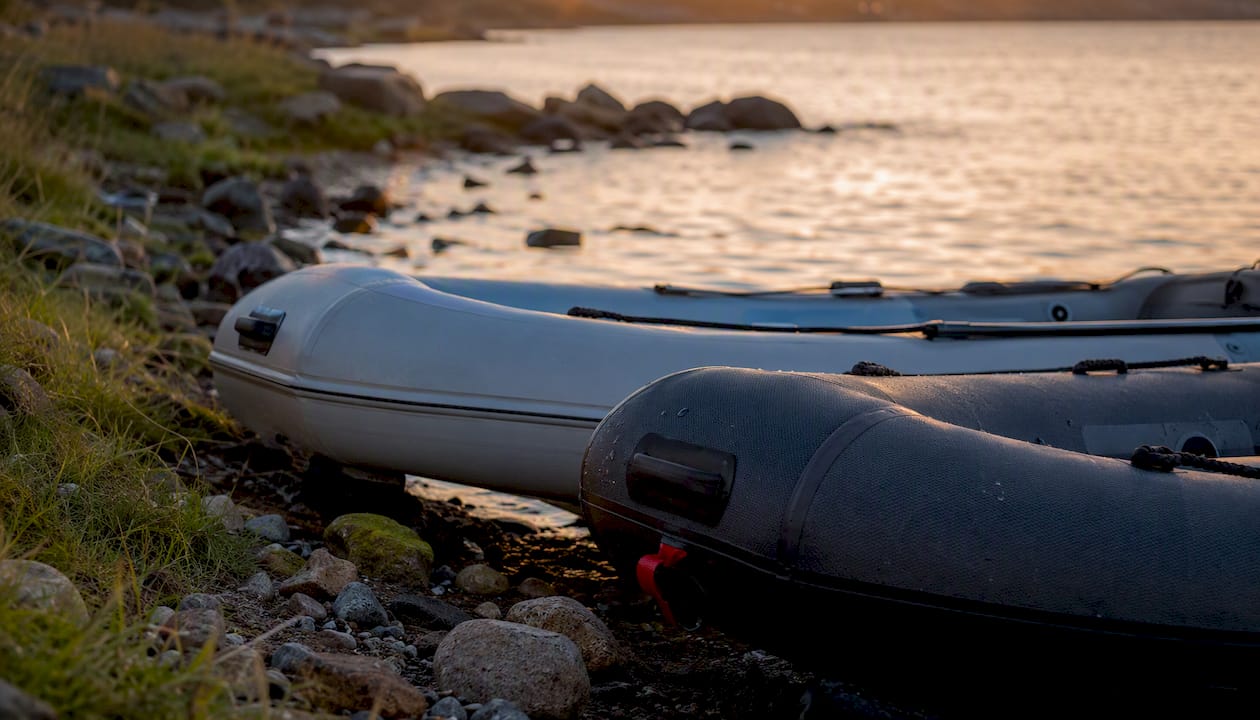
Hypalon (technically CSPE rubber) has a rougher, more textured finish than PVC. It is chemically more resistant, which is great for durability but means some adhesives bond less aggressively. Marine-grade vinyl with specialty adhesive is specifically formulated to handle both materials. Standard consumer vinyl from a craft store is not.
Textured or hybrid fabrics — canvas-like weaves, mesh, or waffle-weave surfaces — are the hardest case. The texture prevents full contact between the adhesive and the surface, so even good marine vinyl can fail. For these materials, plate-based mounting is the only reliable option. Apply the decals to the smooth side of the plate, then mount the plate to the hull.
What works reliably across all three:
- Marine-grade vinyl decals with UV-resistant, fuel-resistant adhesive
- 3M SCOTCH MOUNT™ EXTREME tape for plate-to-tube adhesion
- Semi-flexible ABS plates as a stable decal surface
What fails: Standard consumer vinyl, solvent-based household adhesives, and any tape not rated for outdoor marine use. UV exposure and saltwater cycling will destroy these within a season.
Pro Tip: Before ordering a full set, apply one sample decal to an inconspicuous spot on your tube and leave it for 48 hours. If the edges lift, switch to a plate system. If you deflate regularly, plan for removable plates from the start rather than retrofitting later.
How to apply registration plates and decals to an inflatable
Surface prep determines whether your numbers last one season or five. Follow this sequence.
- Choose placement. Mount plates above the bond/rubbing strake, slightly forward of the beam, on both port and starboard sides. Confirm your state's exact placement rules before you mark anything.
- Clean the surface. Wipe the mounting area with isopropyl alcohol on a lint-free cloth. Remove all dirt, salt residue, and silicone contaminants. Let it dry completely.
- Light abrasion (if permitted). If your product manufacturer allows it, a light pass with a 3M gray scuff pad improves adhesion on smooth PVC. Skip this step if the manufacturer does not recommend it — you do not want to void your boat warranty.
- Dry-fit the plate. Hold the plate in position and mark the corners with low-tack painter's tape. This is your alignment guide.
- Mount the plate. Peel the backing from the industrial mounting tape, press the plate firmly into position, and hold it with steady pressure for 60 seconds. For strap systems, thread straps through D-rings or perimeter lines and cinch snugly.
- Apply decals to the plate. Spray the smooth side of the plate lightly with application fluid. This lets you float the transfer strip into exact position before the adhesive sets. Squeegee from center outward to remove fluid and bubbles.
- Peel the transfer tape. Pull back slowly at a low angle. If a character lifts with the tape, lay it back down and squeegee again before continuing.
- Cure time. Avoid submerging or pressure-washing the decals for at least 48–72 hours after application.
Tools to have on hand: isopropyl alcohol wipes, lint-free towels, low-tack painter's tape, a plastic squeegee, application fluid, and mounting straps or industrial tape if not included in your kit.
Pro Tip: After installation, photograph both port and starboard numbers from eye level at the distance an enforcement officer would view them from a small craft. If the characters are hard to read or the contrast looks weak in the photo, fix it before you leave the dock.

How to keep your registration numbers readable for years
Compliance is not a one-time task. Numbers that were legible when you launched can fade, peel, or crease into illegibility by the following season.
Inspection cadence and what to look for:
- Check numbers at the start and end of each season
- Look for lifting edges, fading, cracking, or creasing from deflation
- Confirm color contrast is still strong enough to read at a distance
- Verify your state validation sticker is current and positioned correctly
Cleaning and care:
- Rinse with fresh water after every saltwater outing
- Use mild soap and a soft cloth; avoid abrasive pads or solvents near decal edges
- UV-protectant sprays compatible with vinyl can slow fading, but confirm compatibility with your specific decal product before applying
When to replace: Visible peeling, significant fading, or any loss of legibility means replacement. If you applied decals directly to the tube and they have started creasing from repeated deflation, do not wait for full delamination. Replace them and consider switching to a plate system. The fix is straightforward: marine vinyl decals are easy to reorder and apply.
Storage habits matter. Boats stored deflated and rolled put far more stress on direct-applied decals than boats stored inflated. If rolling is your normal storage method, strap-mounted plates are the only approach that holds up long-term without regular replacement.
What to order and where to find the right kit
Getting the specs right before you order saves a second trip.
Order checklist:
- Plate dimensions: 4" x 24" is the standard size that meets USCG and most state requirements
- Character height: 3" block font minimum for most US states; confirm your state's requirement before ordering
- Material: marine-grade vinyl with UV-resistant, fuel-resistant inks
- Adhesive system: industrial mounting tape pre-applied to the plate, or adjustable straps for removable setups
- Color contrast: black characters on a white plate is the most common and most legible combination
- Pre-spaced strips: order your specific registration sequence pre-arranged on application tape to eliminate alignment errors
Vendor types to look for:
- Specialist decal manufacturers who offer custom registration sequences on marine-grade vinyl (Registrationdecals offers exactly this, with an online design tool and 3–5 business day production)
- Marine-supply kit sellers who bundle plates, decals, application fluid, and mounting hardware in one package
- Dealers who pre-space your number strip on application tape so you get a factory-aligned result
On price: Marine-grade materials cost more than consumer vinyl kits. The difference shows up in year three, when the marine-grade decal is still legible and the consumer vinyl has peeled. For a boat that sees regular saltwater or UV exposure, the upgrade pays for itself in avoided replacements and avoided compliance fines.
If your inflatable has a textured or canvas-like fabric, ask the vendor for a material sample before ordering a full set. A quick adhesion test on your specific hull is worth more than any general recommendation.
Key Takeaways
A marine-grade vinyl decal applied to a semi-flexible ABS registration plate is the most durable, non-invasive solution for displaying compliant inflatable boat numbers on PVC or Hypalon hulls.
| Point | Details |
|---|---|
| Verify state rules first | Check character height, placement, and spacing requirements with your state boating agency before ordering. |
| Choose plates over direct decals | A 4" x 24" ABS plate gives decals a stable surface and protects them from flexing and deflation damage. |
| Use marine-grade materials only | UV-resistant, fuel-resistant vinyl with industrial mounting tape outperforms consumer alternatives in saltwater and UV conditions. |
| Follow the prep-and-apply sequence | Clean with isopropyl alcohol, dry-fit, apply with application fluid, squeegee, and allow 48–72 hours to cure before launching. |
| Registrationdecals for custom orders | Registrationdecals offers marine-grade custom decals with an online design tool, pre-spaced options, and free shipping in the contiguous US. |
Why the plate-plus-decal approach is the one worth defending
Most of the debate among inflatable owners comes down to convenience versus durability. Direct-stick decals are faster to apply, and on a boat that stays inflated all season in calm freshwater, they often hold up fine. But the owners who end up frustrated are almost always the ones who deflated for winter storage, rolled the boat, and came back in spring to find their numbers creased and half-detached.
The plate system is not complicated or expensive. It is just the approach that accounts for how inflatables actually get used: launched, deflated, stored, relaunched, sometimes transported on a car roof, sometimes left in the sun for hours. A flat ABS plate with marine-grade decals handles all of that without drama. The strap-mounted version adds full removability, which matters if you store the boat in a bag.
What gets overlooked is the warranty angle. Applying solvent-based adhesives or paint directly to PVC or Hypalon tubes can void the manufacturer's warranty on the hull fabric. A plate system with industrial mounting tape avoids that entirely. It is a small detail that becomes a large problem if you ever need to make a warranty claim.
The other thing worth saying plainly: registration numbers are not just a bureaucratic checkbox. They are how a Coast Guard crew or a marine patrol officer identifies your vessel in an emergency. Faded, peeling, or illegible numbers slow that process down. The investment in marine-grade materials is partly about compliance and partly about making sure that if something goes wrong on the water, your boat is easy to find.
Get compliant inflatable boat numbers from Registrationdecals
Registrationdecals makes it straightforward to order exactly what your inflatable needs: custom marine-grade vinyl decals, pre-spaced on application tape for your specific registration sequence, sized to the 3-inch block character standard, and available in the color combinations that meet state contrast requirements.
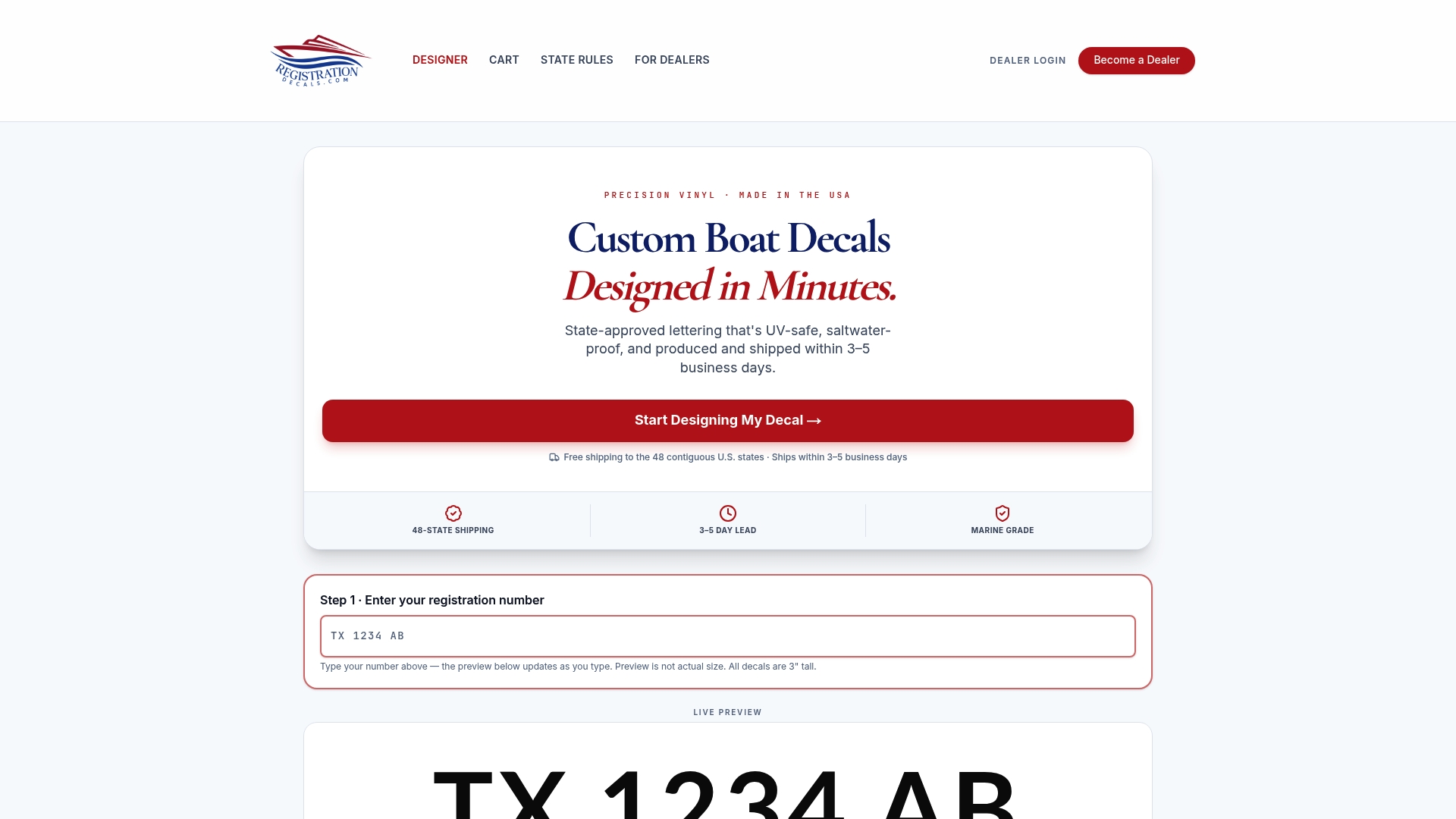
The online design tool lets you enter your registration number, pick your color and font, and preview the result before you order. Production runs 3–5 business days, and shipping is free across the contiguous US. If your boat has a textured or unusual fabric, reach out before ordering to ask about material compatibility or a sample. For marina operators and dealers who need bulk orders, the wholesale ordering page handles volume requests directly.
Design and order your custom decals at Registrationdecals today and get your inflatable on the water with numbers that will still be readable at the end of the season.
Useful sources and where to verify the rules
Before you order or install anything, confirm the requirements that apply to your specific state and vessel. These are the primary sources worth bookmarking.
- US Coast Guard (USCG): The federal authority on vessel registration display standards, including block character requirements and placement guidance. Start at uscgboating.org for federal baseline rules.
- Your state boating agency: Every state sets its own character height, spacing, and placement rules. Find your state agency through the National Association of State Boating Law Administrators (NASBLA) directory.
- Premium ABS Registration Plate Kit specs: Documents plate dimensions (4" x 24"), material specs, and compliance notes for USCG and state requirements.
- Complete Marine Registration Plate Kit: Full kit specs including semi-flexible ABS plate dimensions, decal set details, and application fluid instructions.
- Registrationdecals state regulation pages: State-specific guides covering character height, placement, and spacing rules. Swap the state in the URL to find your own state's page.
- Character height reference: Quick reference on how tall registration numbers need to be and how to measure correctly.
On each of these pages, look specifically for: minimum character height, block font requirement, color contrast rules, placement relative to the bow, and whether your state requires numbers on the transom in addition to the sides.