
Most kayaks in the United States need registration numbers displayed on the hull, but whether yours is one of them depends entirely on your state. The federal baseline under 33 CFR 173 sets the display standards, while each state decides who must register. Your immediate next steps:
- Check your state's boating agency (usually the Department of Natural Resources or DMV) to confirm whether your kayak requires registration based on length, motor status, or a universal rule.
- Confirm your kayak's length and motor status. Most states exempt non-motorized kayaks below a length threshold; a few, like Ohio, require registration for every vessel regardless.
- Prepare compliant numbers and a validation decal. Once you have your assigned number, it must meet the 3-inch block character standard and be placed on the forward half of both sides of the hull. Registrationdecals.com produces marine-grade vinyl decals built to those specs.
Table of Contents
- How kayak registration requirements vary by state
- What the law actually requires for displaying your numbers
- Which marking method holds up best on a kayak hull
- How to order and install compliant registration decals
- How to register a kayak: the actual process
- What happens when your numbers don't pass inspection
- State-by-state quick reference for kayak registration rules
- Key Takeaways
- Why marine-grade decals are the right call for most kayakers
- Registrationdecals makes compliant kayak decals straightforward
- Official sources and further reading
How kayak registration requirements vary by state
Federal law establishes the display rules, but registration authority belongs to the states. That split matters: 33 CFR 173 tells you how to display numbers; your state tells you whether you need them at all.
Most states fall into one of four categories:
A. Universal registration — every vessel, regardless of length or propulsion, must be registered. Ohio is the clearest example: the Ohio DNR assigns an "OH" number to all vessels, and that number stays with the boat for life.
B. Motorized-only registration — non-motorized kayaks are fully exempt. Several states fall here, making a trolling motor the trigger that changes your legal status overnight.
C. Length-threshold registration — non-motorized kayaks above a certain length must register. Thresholds vary widely by state: Minnesota at 10 ft, Rhode Island at 12 ft, Iowa at 13 ft, Texas at 14 ft, Virginia at 18 ft, and Michigan at 20 ft.
D. Alternative permits or AIS decals — some states skip traditional registration for non-motorized craft but require a waterway access permit (Oregon) or an aquatic invasive species sticker instead.
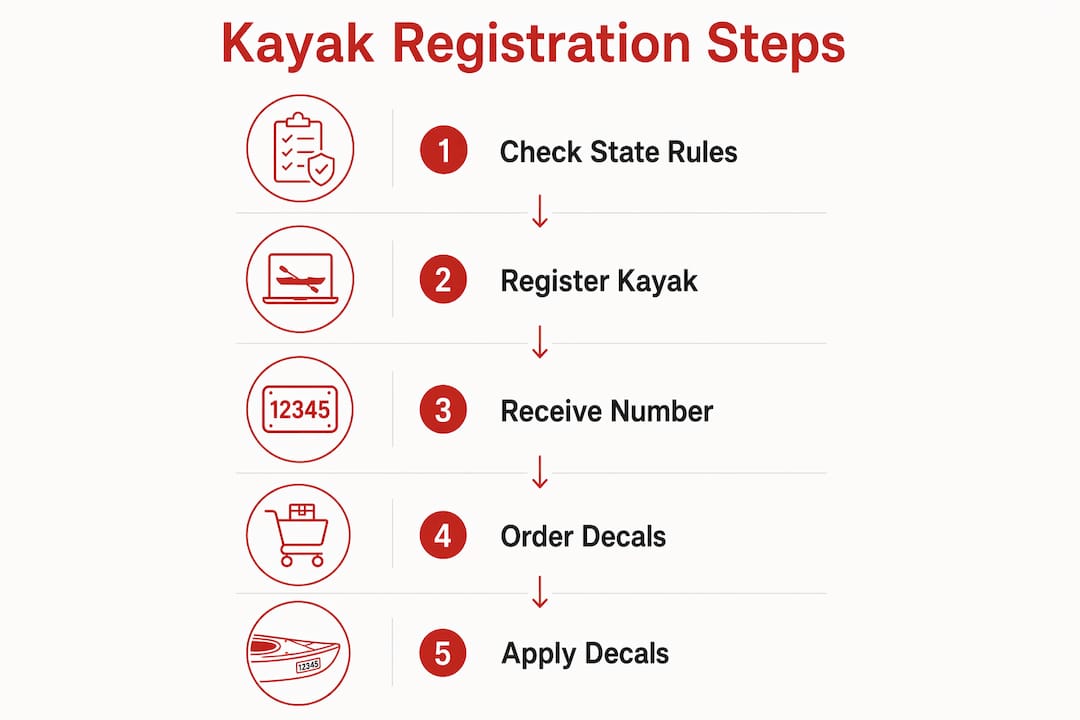
For interstate paddling, most states allow out-of-state vessels to operate on their waters for 60–90 days before local registration is required. That said, rules change, so always verify with the destination state's boating agency before a multi-state trip.
| State | Registration trigger | Length cutoff | Notes |
|---|---|---|---|
| Ohio | All vessels | None | OH number assigned for vessel's life |
| Minnesota | Length-based | 10 ft+ | Non-motorized kayaks 10 ft and over |
| Rhode Island | Length-based | 12 ft+ | Non-motorized kayaks 12 ft and over |
| Iowa | Length-based | 13 ft+ | Non-motorized kayaks 13 ft and over |
| Texas | Length-based | 14 ft+ | Non-motorized kayaks 14 ft and over |
| Virginia | Length-based | 18 ft+ | Non-motorized kayaks 18 ft and over |
| Michigan | Length-based | 20 ft+ | Non-motorized kayaks 20 ft and over |
| Oregon | Alternative permit | N/A | Waterway Access Permit required |
| Hawaii | Motorized or 8 ft+ | 8 ft+ | Manually propelled boats 8 ft or under exempt |
Even when your kayak is fully exempt from registration, your state may still require an AIS sticker or waterway access permit. Exempt does not always mean no paperwork.
What the law actually requires for displaying your numbers
The display rules are more specific than most kayak owners expect. 33 CFR 173.27 sets the federal floor, and nearly every state adopts it verbatim or adds minor requirements on top.
Breaking that down into the specifics you need before ordering:
- Minimum height: 3 inches for each character. No exceptions, no matter how small the kayak. See how tall registration numbers need to be for a quick reference.
- Font: Plain vertical block characters only. Script, italic, serif, or decorative fonts are non-compliant. Check the acceptable boat number fonts before you order.
- Color contrast: Numbers must contrast with the hull background. White hull needs dark numbers; dark hull needs light numbers.
- Placement: On both port and starboard sides, on the forward half of the hull. For a kayak, that means the bow section ahead of the cockpit.
- Orientation: Read left to right from both sides. Numbers on the port side are not mirrored.
- Spacing: The state prefix (e.g., "OH"), the numerals, and the letter suffix must each be separated by a space or hyphen equal to the width of a letter. "OH 1234 AB" or "OH-1234-AB" are both correct; "OH1234AB" is not.
- Validation decal placement: Within 6 inches of the registration number, typically immediately aft of the suffix on each side. Ohio places decals a short distance from the number toward the stern.
Pro Tip: Before you commit to final placement, mock up the position with painter's tape. On a short kayak hull, the "forward half" is a surprisingly small area, and getting the decal too close to the bow curve can make it hard to read from a distance. Manufacturers and decal specialists recommend a template test before applying.
One practical note for kayaks specifically: the forward half of a 12-foot kayak is roughly the first 6 feet. Place numbers as high on the hull side as the shape allows, keeping them visible from the water at 100 feet.
Which marking method holds up best on a kayak hull
Not all kayaks take decals the same way. The right marking method depends on your hull material, how much sun and salt the boat sees, and whether you want a permanent solution or something you can update when you re-register.

Marine-grade vinyl decals are the right choice for the vast majority of kayaks. UV-stable cast vinyl with a pressure-sensitive adhesive bonds well to smooth polyethylene, fiberglass, and ABS hulls. The adhesive is strong enough to stay put through years of sun and saltwater, but the decal can still be removed cleanly when you need to update your registration. Lifespan depends on UV exposure and surface prep, but quality marine vinyl decals routinely outlast a registration cycle.
Paint or epoxy lettering makes sense on fiberglass hulls where you want a truly permanent mark. The tradeoff is prep work: you need to sand, prime, and seal, and correcting a mistake means repainting. For most recreational kayakers, the flexibility of vinyl is worth more than the permanence of paint.
Engraving or mounting plates solve a specific problem: inflatables and highly textured hulls where adhesive simply won't hold. A semi-flexible ABS mounting plate secured with marine-grade adhesive or mechanical fasteners gives you a flat, stable surface for both the registration numbers and the validation decal. This is the correct solution for inflatable kayaks, not a workaround.
Pro Tip: Polyethylene kayak hulls have low surface energy, which means standard adhesives struggle to bond. Wipe the application area with denatured alcohol, let it dry completely, then leave the hull in the sun for 20–30 minutes before applying. That "gassing off" period drives out plasticizers that interfere with adhesion. Apply in warm conditions (above 60°F) and use firm squeegee pressure from the center outward.
How to order and install compliant registration decals
Getting the decals right before you apply them saves a lot of frustration. Here is the full process from confirmation to launch-ready.
- Confirm your state's format. Look up your state's registration number format (prefix length, numeral count, suffix). The all-50-states regulation hub at Registrationdecals has this by state.
- Measure your bow area. Identify the forward half of your hull and find the largest flat or gently curved area on each side. Note the available height so you can confirm 3-inch characters will fit with clearance above and below.
- Choose your color contrast. Pick a number color that clearly contrasts with your hull. If your kayak is a mid-tone color, go with white or black numbers and confirm the contrast looks obvious in direct sunlight.
- Order the correct size. Three inches is the legal minimum; ordering at 3 inches is fine for most kayaks. Confirm character height, spacing, and hyphen format when you place the order.
- Prep the surface. Clean with denatured alcohol. Let it dry. If the hull is polyethylene, allow the gassing-off period described above.
- Apply in warm, dry conditions. Peel the backing, position carefully, and squeegee from center to edges. Work out any air bubbles immediately.
- Place the validation decal within 6 inches. Immediately aft of the registration number suffix on each side. Remove any expired decals before applying the new one.
- Check on receipt. Before installing, verify character height with a ruler, confirm the spacing between prefix/numerals/suffix, and check that the numbers read left to right (not mirrored) on both sets.
Registrationdecals ships within 3–5 business days with free shipping in the contiguous U.S. When the decals arrive, a quick measurement check takes 30 seconds and can save you a citation on the water.
Common mistakes to avoid: placing numbers on the rear half of the hull, using a decorative or italic font, leaving expired validation decals in place under the new ones, and applying decals in cold weather when adhesive won't bond properly.
How to register a kayak: the actual process
The registration process is straightforward once you know which agency handles it in your state. Most states route vessel registration through the Department of Natural Resources, the Department of Wildlife Resources, or the DMV.
What you typically need:
- Proof of ownership: a bill of sale, manufacturer's certificate of origin (MCO), or existing title
- Completed registration application (available online or at the agency office)
- Payment for registration fees (fees vary by state and vessel length)
- Photo ID
Online vs. mail: Processing time varies significantly. Some states issue registration numbers immediately through an online portal; others process mail applications over several weeks. If you need to paddle before the decals arrive, most states allow you to carry a copy of your registration application as temporary proof.
What you receive: A certificate of number, your assigned registration number, and validation decals. The certificate must be carried onboard or kept accessible whenever you're on the water.

Title requirements: Some states require a title for vessels above a certain length, often 14 feet or longer. Titling is a separate step from registration and usually involves an additional fee. Check your state's threshold before assuming a short kayak is title-exempt.
Ownership transfers: Registration numbers in many states stay with the vessel, not the owner. When you sell or transfer a kayak, notify the issuing authority within the state-specified window (often 15–30 days). The new owner then re-registers in their name, keeping the same hull number.
Out-of-state visitors: Most states allow vessels registered in another state to operate locally for 60–90 days without re-registering. After that window, local registration is required.
Registration fee ranges and timelines vary by state. Online applications in many states produce an immediate number assignment; mail-in applications can take several weeks. Check your state agency's current processing times before your planned launch date.
What happens when your numbers don't pass inspection
Enforcement on the water is usually straightforward: a conservation officer or marine patrol officer pulls alongside, reads your registration numbers from a distance, and either waves you on or signals a stop. Poor contrast and undersized characters are the two most common reasons for a stop.
The most frequent violations officers cite:
- Characters under 3 inches high. This is the single most common error, especially on kayaks where owners try to keep numbers small and unobtrusive.
- Decorative or non-block fonts. Script and italic fonts are not legal, regardless of size.
- Mirrored numbers on the port side. Both sets must read left to right. Mirroring the port-side numbers is a surprisingly common mistake.
- Missing or expired validation decals. An expired decal left in place does not count as current. Remove it and replace it.
- Numbers placed too far aft. Any placement behind the midpoint of the hull is non-compliant.
- No separation between number groups. "OH1234AB" without spaces or hyphens fails the spacing rule.
First-offense fines typically range from about $25 to $200 depending on the state and the specific violation. Repeat violations or missing registration entirely can result in higher fines. Impoundment is rare but possible for vessels with no registration at all. The practical fix for most violations is immediate: correct the numbers before your next trip and carry your registration certificate.
Registration numbers also serve a purpose beyond compliance. They are the primary identifier for search-and-rescue operations. A kayak with unreadable numbers is harder to locate and identify in an emergency.
State-by-state quick reference for kayak registration rules
Rules change, so treat this table as a starting point and verify with the official state agency before you register or launch. The all-50-states regulation hub at Registrationdecals keeps state-specific decal sizing and placement rules current.
| State | Requirement summary | Length threshold | Official resource |
|---|---|---|---|
| Ohio | All vessels must register | None | Ohio DNR |
| Minnesota | Non-motorized kayaks above threshold | 10 ft+ | MN DNR Boat Registration |
| Rhode Island | Non-motorized kayaks above threshold | 12 ft+ | RI DEM Boating |
| Iowa | Non-motorized kayaks above threshold | 13 ft+ | Iowa DNR Boating |
| Texas | Non-motorized kayaks above threshold | 14 ft+ | TX Parks & Wildlife |
| Virginia | Non-motorized kayaks above threshold | 18 ft+ | VA Dept. of Wildlife Resources |
| Michigan | Non-motorized kayaks above threshold | 20 ft+ | MI DNR Watercraft |
| Oregon | Waterway Access Permit required | N/A | Oregon State Marine Board |
| Florida | All vessels must register | None | FL DHSMV |
| Hawaii | Manually propelled, 8 ft or under exempt | 8 ft+ | HI DLNR DOBOR |
For states not listed here, check your state's DNR, Department of Wildlife Resources, or DMV website directly. Many states also require AIS (aquatic invasive species) stickers regardless of registration status, so search for both requirements when you look up your state.
Key Takeaways
Whether your kayak needs registration numbers comes down to your state's rules, but the display standards are federal and apply everywhere numbers are required.
| Point | Details |
|---|---|
| Federal display standard | 33 CFR 173 requires plain block characters at least 3 inches high, contrasting color, on the forward half of both sides. |
| State rules vary widely | Ohio requires all vessels to register; Virginia exempts non-motorized kayaks under 18 ft; motorized kayaks trigger registration in every state. |
| Validation decal placement | Place the validation decal within 6 inches of the registration number suffix on each side; remove expired decals first. |
| Surface prep matters | On polyethylene hulls, clean with denatured alcohol and allow a gassing-off period before applying vinyl decals for lasting adhesion. |
| Registrationdecals | Registrationdecals produces marine-grade vinyl decals sized and spaced to meet 33 CFR 173, with 3–5 business day production and free contiguous U.S. shipping. |
Why marine-grade decals are the right call for most kayakers
The legal framework here is not complicated, but the gap between knowing the rules and actually having compliant numbers on your hull is where most kayak owners get tripped up. Paint is permanent and fussy. Engraving works on specific hull types. For the overwhelming majority of recreational kayaks, marine-grade vinyl decals are the practical answer: they meet the spec, they last, and when your registration renews or you sell the boat, they come off cleanly.
The one thing I'd push back on is the instinct to minimize the numbers. Kayakers often want small, unobtrusive markings that don't interrupt the hull's appearance. Three inches is already the minimum; going smaller to preserve aesthetics puts you in violation and, more importantly, makes your vessel harder to identify in an emergency. Readable numbers at distance are the whole point.
For readers who want a ready-made compliant option, Registrationdecals's marine-grade vinyl decals are built to the 3-inch block character standard with UV-stable, saltwater-proof materials. The turnaround is fast enough that you can order after you receive your registration certificate and have decals before your next weekend on the water.
Registrationdecals makes compliant kayak decals straightforward
Ordering registration decals that actually meet state and federal specs used to mean hunting down a local sign shop and hoping they knew the boating rules. Registrationdecals cuts that out entirely.
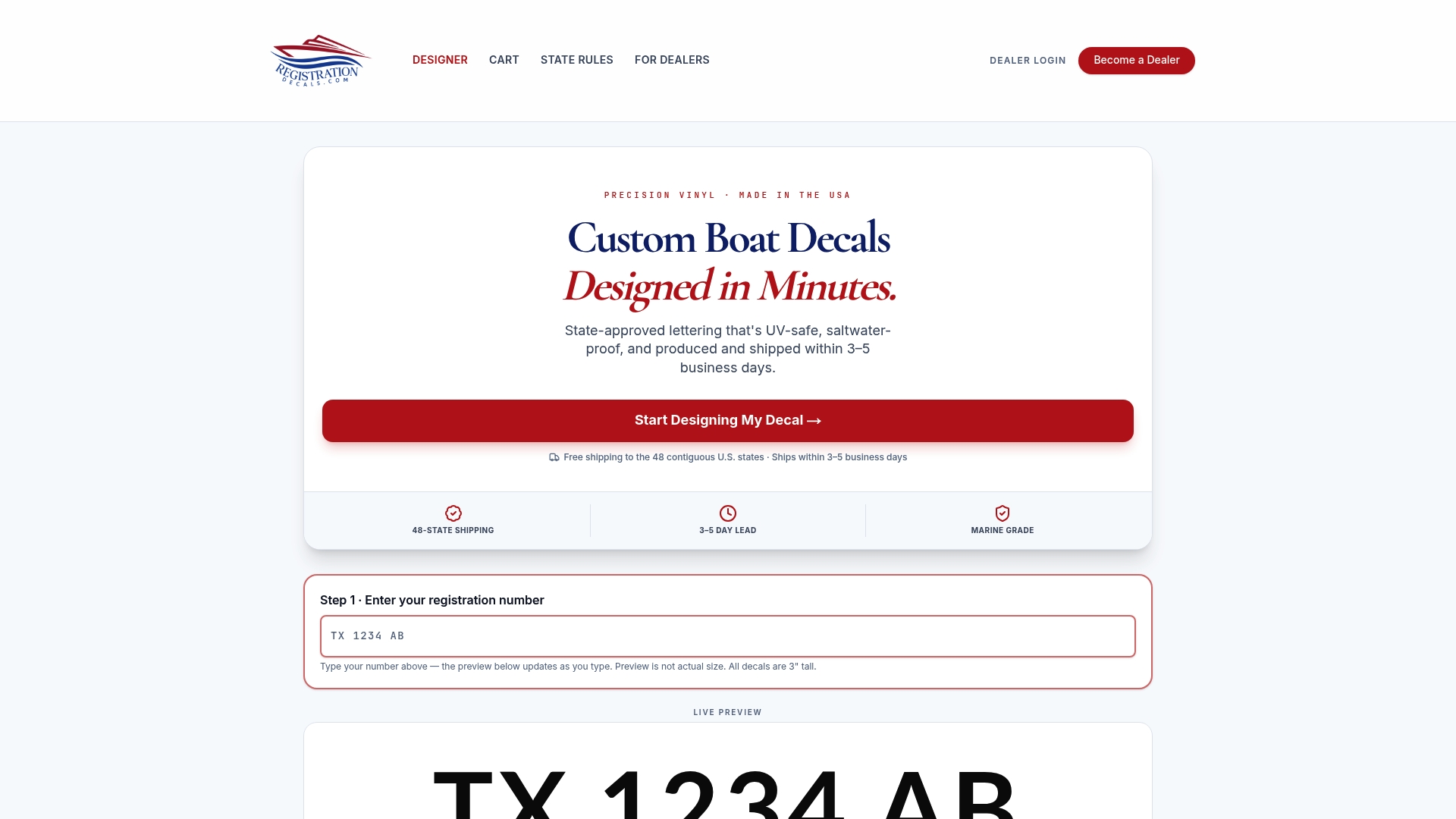
The online design tool lets you enter your registration number, choose your color and font (all options are block-character compliant), and preview the result before you order. Decals are cut from marine-grade UV-resistant, saltwater-proof vinyl built to hold up on kayaks that see real conditions. Production runs 3–5 business days, and shipping is free across the contiguous U.S. Bulk options are available for marinas and dealerships managing multiple vessels.
Every set is sized to meet 33 CFR 173 and state display guides, with correct character height, spacing, and hyphen formatting built in. Mounting plates for inflatables and textured hulls are also available. Clear installation instructions ship with every order.
Design and order your decals at Registrationdecals, or check the state-by-state regulation guide to confirm your state's exact requirements before you buy.
Official sources and further reading
Use these resources to verify current rules for your state and confirm installation specs before you order or apply decals.
- Federal display standard: 33 CFR 173 — Boating Safety — the primary federal rule governing character size, placement, contrast, and spacing for all registered vessels.
- Ohio DNR — Displaying Your Numbers & Decals: ohiodnr.gov — Ohio's universal registration rules and decal placement guidance.
- Texas Parks & Wildlife — Placement of TX Number and Decal: tpwd.texas.gov — validation decal placement rules and diagrams.
- Virginia Department of Wildlife Resources — Watercraft Registration: dwr.virginia.gov — registration, titling, and transfer requirements including ownership change obligations.
- Hawaii DLNR DOBOR — Numbering Your Vessel: dlnr.hawaii.gov — full display requirements and registration process for Hawaii.
- Florida DHSMV — Numbering and Decals: flhsmv.gov — Florida's permanent registration number rules and bow placement requirements.
- Registrationdecals — All 50 States Regulation Hub: registrationdecals.com/regulations — state-by-state decal sizing, color contrast, and placement requirements.
- Registrationdecals — Where Do Registration Numbers Go: registrationdecals.com — placement diagrams and measurement guidance for correct bow positioning.
- Hardline Products — Boat Lettering Installation Kit: hardlineproducts.com — surface prep and adhesion guidance for plastic hulls.
- Hardline Products — Registration Sticker Plate for Inflatables: hardlineproducts.com — ABS mounting plate solution for inflatables and textured hulls.
This article provides general information about U.S. kayak registration requirements and is not legal advice. Registration rules change; confirm current requirements with your state's boating agency or the relevant official source before registering or launching.