
Marina fleet numbering means displaying each vessel's state-issued certificate number in legible, 3-inch-minimum block characters on the forward half of the hull, using durable marine-grade decals that satisfy federal and state display rules. The compliant approach combines two things: knowing the 33 CFR Part 173 display standard cold, and sourcing decals built to survive years of UV and saltwater exposure without going through a redesign cycle every season.
TL;DR:
- Use a minimum of 3-inch tall, contrasting block characters on both sides of the forward hull; spacing between groups must equal one character width.
- Select marine-grade vinyl with UV protection and an overlaminate, ensuring decals last several years under exposure to sun, saltwater, and pressure washing.
- Place decals on the forward half of the hull, with validation stickers within 6 inches, and keep a record of installation photos and registration documents for each vessel.
- Standardize decal design and placement across the fleet to ensure consistency, and order decals in bulk with a master spreadsheet to streamline supply and replacements.
- Proper surface preparation, accurate alignment, and careful application with a squeegee are critical for decal durability and compliance.
Table of Contents
- What federal and state rules govern boat registration numbers?
- How do you choose durable decal materials for a fleet?
- How should you lay out and place fleet numbering decals?
- Fleet management: ordering, tracking, and recordkeeping
- How do you install and maintain vinyl registration decals?
- Save yourself the trouble: RegistrationDecals.com for fleet orders
- What marina managers get wrong the first time
- Sources
What federal and state rules govern boat registration numbers?
The federal baseline lives in 33 CFR Part 173, and every marina operator managing multiple vessels should know it well enough to spot a violation on sight. Section 173.11 sets applicability for vessels with propulsion machinery, 173.15 requires the number to be displayed at all, and 173.27 spells out how: plain vertical block characters, at least 3 inches tall, in a color that contrasts sharply with the hull, read left to right, with spaces or hyphens between the letter and number groups equal in width to one character.
The Coast Guard validation sticker, where a state issues one, has to sit within 6 inches of the registration number under §173.35. States build on this floor rather than replace it. Florida's own statute, for example, mirrors the federal language almost exactly, requiring the number on both sides of the forward half in 3-inch block letters with the current decal placed near it, per Florida Statute 328.48. Documented vessels, racing boats, and small tenders carrying a parent vessel's number with a suffix often follow different rules or qualify for exemptions, so BoatUS recommends confirming a vessel's status before assuming standard hull numbering applies.
Run this checklist across every boat in the marina before renewal season:
- Number is at least 3 inches tall on both port and starboard, forward half of the hull.
- Color contrasts clearly against the hull finish.
- Spacing or hyphen between letter and number blocks equals one character width.
- Validation sticker sits within 6 inches of the number, where the state issues one.
- The certificate of number is aboard the vessel, not just in an office file.
How do you choose durable decal materials for a fleet?
Vinyl decals live outdoors, in salt spray, under direct sun, for years at a stretch, so the material spec matters more than the design. Marine-grade vinyl with UV-stable inks resists the chalking and color drift that cheaper adhesive vinyl shows within a season. An overlaminate adds a second layer of protection against abrasion and hull cleaners, and adhesive choice needs to match the surface: gelcoat and painted aluminum hold adhesives differently, and the wrong pick shortens life regardless of how good the vinyl itself is.
Expect a well-made marine-grade decal to hold color and adhesion for several years under normal exposure, with heavy tropical sun or frequent pressure washing shortening that window. When you're comparing vendors for a fleet order, ask for specifics on each of these:
- Vinyl grade and UV rating
- Overlaminate presence and type
- Adhesive formulation for your hull material (gelcoat vs. painted)
- Edge-sealing method to prevent lift
- Color contrast options against your hull color
RegistrationDecals.com builds its decals from marine-grade vinyl rated UV-safe and saltwater-proof, which covers the durability spec a fleet manager actually needs without having to interrogate five separate vendors on material chemistry.
Pro Tip: Order one extra decal set per vessel size class when you place a fleet order. Replacing a single damaged decal later without a matching spare means re-ordering a tiny batch at a higher per-unit cost.
How should you lay out and place fleet numbering decals?
Layout and placement are the two places small mistakes create real compliance problems, and both are fixable with a template rather than guesswork.
- Set the character height and style. Use plain vertical block characters at a minimum of 3 inches, never italic or script fonts, since 33 CFR Part 173 requires block styling that reads left to right.
- Lock in contrast. Pick a decal color that stands out against the specific hull finish. White numbers vanish on light gray hulls; dark numbers disappear on navy.
- Space it correctly. Leave a gap or hyphen between letter and number groups equal to one character's width, matching the federal spacing rule.
- Place on the forward half, both sides. Numbers belong on the forward portion of the hull on both port and starboard, never tucked near the stern.
- Use a backing plate where the hull curves. On hulls where contour breaks up legibility, a rigid backing plate keeps the decal flat and readable, and it's allowed under the backing-plate provisions in the federal rule.
- Set the sticker distance. Place the validation sticker within 6 inches of the number per §173.35.
- Standardize across the fleet. Pick a consistent color palette and layout template per hull color group so every vessel in that class looks consistent, which also speeds bulk production.
Fleet management: ordering, tracking, and recordkeeping
Managing decals across a dozen boats is a different job than handling one, and the marinas that do it well treat it as a repeatable process rather than a series of one-off decisions.
Bulk ordering starts with a master spreadsheet: registration number, hull ID, size class, and hull color for every vessel, laid against a fixed set of size and color presets. That single document is what turns a 40-boat order into one clean batch instead of forty individual back-and-forths with a decal vendor, and it's the difference between templated production and a pile of custom exceptions that each take extra staff time.
Recordkeeping should include a dated photo of each installed decal, a crosswalk between hull identification numbers and registration numbers, and a replacement log noting when each set went on. Store certificates of number centrally, not in individual boat glove boxes, since owners change and paperwork walks off with them.
Plan decal replacement on an inspection-led cycle rather than a fixed calendar. Most marine-grade decals hold up for three to seven years depending on sun and salt exposure, but a transfer of ownership, a damaged decal, or a number that's faded past legible contrast should trigger immediate replacement regardless of age. When a state issues a new validation sticker, update it at the same time you're already at the boat for any decal work. Doing both in one visit saves a second round of staff time later.

Pro Tip: Photograph every hull's registration area at the same angle each year. Side-by-side photos make fading obvious long before a dockside inspector would flag it.
How do you install and maintain vinyl registration decals?
Installation quality determines how long a decal actually lasts, regardless of how good the vinyl is.
- Prep the surface. Clean and degrease the application area, working in moderate temperatures. Cold surfaces resist adhesive bonding; extreme heat causes the vinyl to stretch during placement.
- Align before committing. Use a template or masking tape guide to set position before peeling any adhesive backing, since block-letter spacing rules leave little room for a crooked install.
- Apply with a squeegee. Work from center outward in overlapping passes to push out air bubbles, applying firm, even pressure.
- Allow cure time. Let the adhesive set fully before the boat goes back in the water, following the vendor's installation guidance.
- Maintain with vinyl-safe cleaners. Harsh solvents break down adhesive and overlaminate over time; a dedicated marine vinyl cleaner extends life.
- Watch for edge lift and bubbling. Small edge lift can often be re-pressed early; widespread bubbling or color fade past legible contrast means it's time to remove and replace the set.
Save yourself the trouble: RegistrationDecals.com for fleet orders
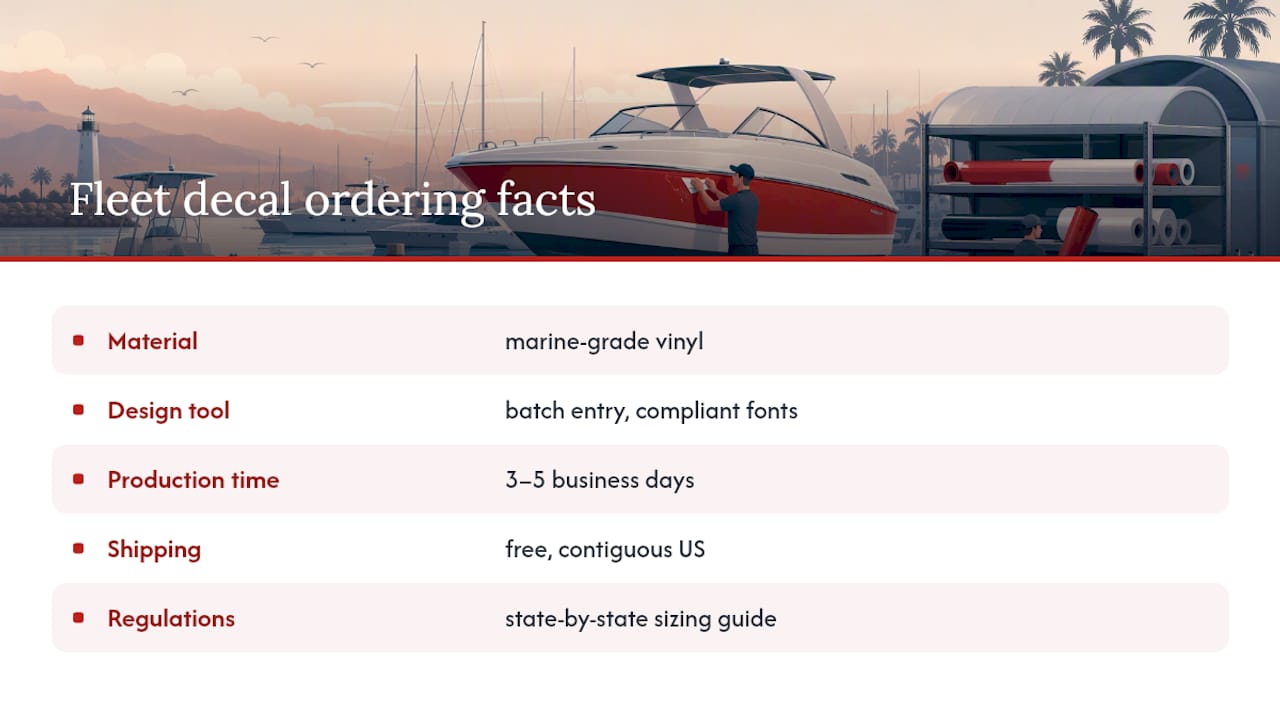
Fleet numbering for a marina full of boats is fundamentally a logistics problem wearing a compliance costume, and RegistrationDecals.com is built around exactly that combination. Every decal is cut from marine-grade vinyl rated UV-safe and saltwater-proof, so a 30-boat order doesn't turn into a rolling replacement project two summers later.
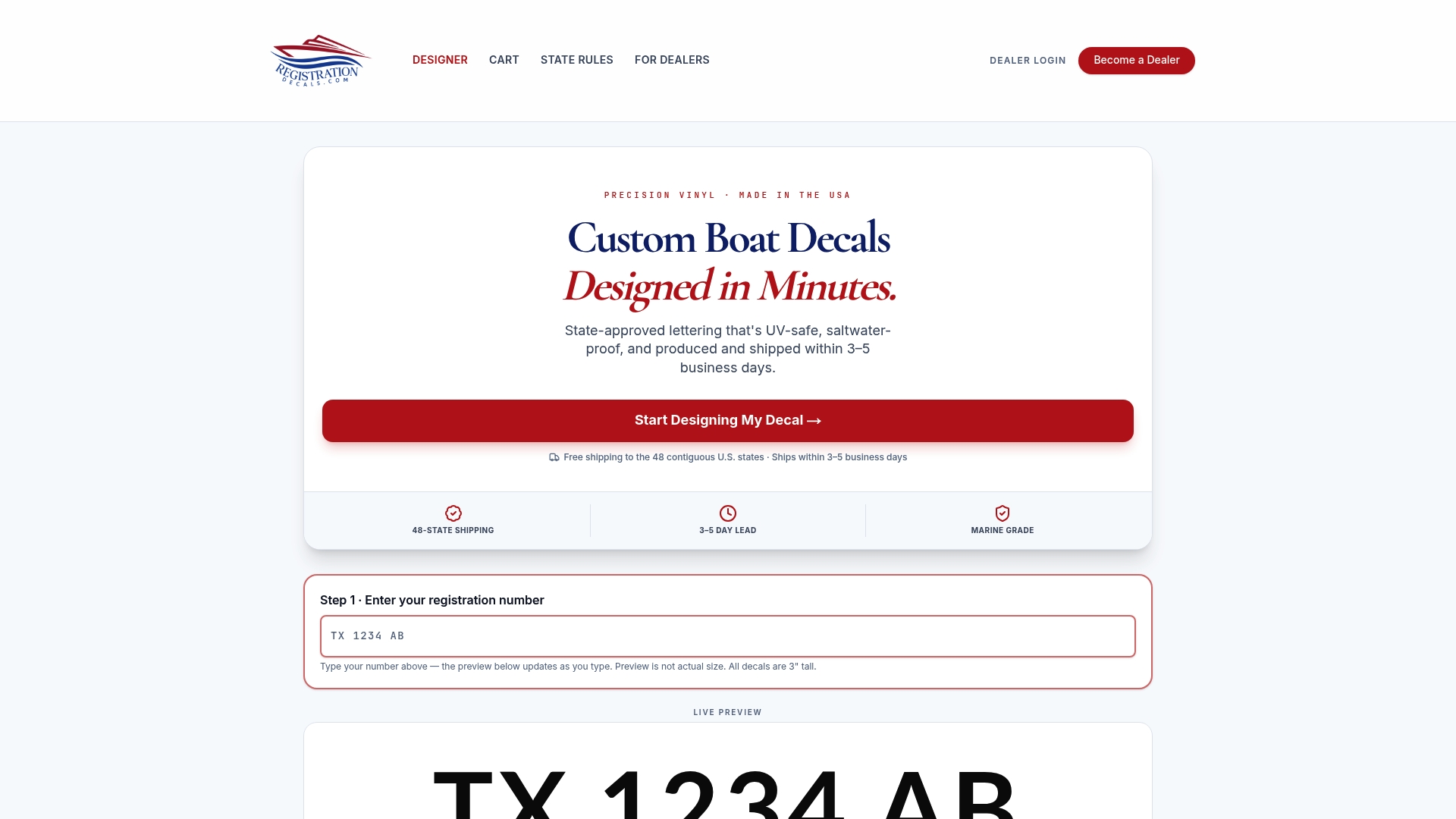
The online design tool lets you enter each vessel's registration number, pick block-letter fonts that meet the federal spacing and sizing rules, and set a consistent color palette across a whole fleet in minutes rather than emailing specs back and forth with a print shop. Bulk orders move through production in 3 to 5 business days, with free shipping anywhere in the contiguous United States, so a marina refreshing forty hulls before a season opener isn't stuck waiting weeks on a vendor.
If your fleet spans multiple states, the regulations reference by state helps confirm sizing and placement quirks before you finalize an order. Ready to standardize your fleet? Start a bulk order or request a quote and get every hull looking consistent, compliant, and durable before your next inspection.
What marina managers get wrong the first time
Most marinas that struggle with fleet numbering aren't fighting the regulation. They're fighting their own inconsistency. I've seen operations where five different boats had five different decal vendors, three different fonts, and no record of when any of it was installed. The fix isn't complicated, it's just unglamorous: audit every hull against the federal spacing and sizing rule in one pass, standardize on one template per hull-color group, then place a single bulk order instead of a dozen scattered ones.
The operators who get this right treat week one the same way every time: audit what's on the water now, lock in one design standard, then order in bulk. It's less interesting than debating font choices, and it's the entire game.
— Taylor
Sources
For the regulatory text itself, read 33 CFR Part 173 directly, and cross-check practical display guidance through BoatUS. For state-by-state placement nuances and installation steps, see RegistrationDecals.com's regulations page and installation guide.
- eCFR :: 33 CFR Part 173 (Dec. 31, 2025) -- Vessel Numbering and Casualty and Accident Reporting
- Registration Requirements - BoatUS Foundation