
Every motorized vessel on South Carolina waters must display an "SC" registration number in plain block characters at least three inches high on both sides of the forward half of the hull, in a color that contrasts with the background. The registration certificate must be on board whenever the vessel is in use. Those two rules cover most enforcement stops. Get them wrong and you are looking at a citation before you even clear the dock.
SCDNR is the single authoritative source for South Carolina vessel registration. The number format reads like this: SC 3717 ZW or SC-3717-ZW, with letters and numbers separated by a space or hyphen. Validation decals received at registration must be affixed to each side of the bow immediately following the registration number, within 6 inches of it. Numbers must read left to right. That's the complete display rule in two sentences.

Table of Contents
- How do you register or title a boat in South Carolina?
- What are the exact display rules for SC registration numbers and decals?
- HIN versus registration number: what's the difference?
- How do you transfer a boat title and registration in South Carolina?
- Can you look up a South Carolina boat registration number?
- What are the penalties for noncompliance, and what is the BUI standard?
- What makes a decal actually compliant and durable on the water?
- Key Takeaways
- Why the decal material question matters more than most owners think
- Get compliant SC registration decals without the guesswork
- Authoritative sources and where to confirm the rules
How do you register or title a boat in South Carolina?
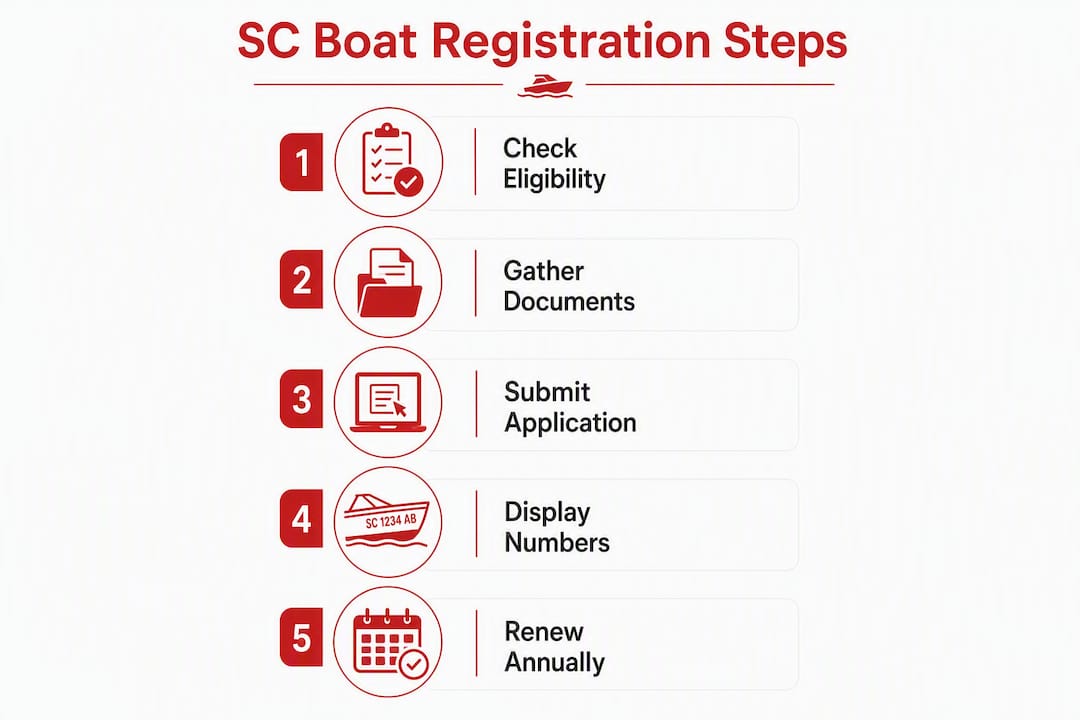
SCDNR requires titling and registration for motorized vessels operated on public waterways. Here is the sequence most owners follow:
- Gather your documents. You need a bill of sale, the Hull Identification Number (HIN), a valid government-issued photo ID, and the previous title if the boat has been titled before.
- Resolve county property taxes. Some South Carolina counties require proof that personal property taxes on the vessel are current before a registration transfer can be processed. Check with your county auditor's office before submitting anything to SCDNR.
- Complete the SCDNR application. Download the titling and registration forms from the SCDNR boating page. Fill out the application for certificate of title and registration.
- Pay the applicable fees. Current fee schedules are listed on the SCDNR forms page. Fees vary by vessel length and horsepower; confirm the current amounts directly with SCDNR since they are subject to change.
- Submit your application. You can submit by mail or in person at an SCDNR office. Some transactions are available online through the SCDNR portal.
- Receive your registration card and decals. Once approved, SCDNR issues a registration card and validation decals. The card must stay on the vessel whenever it is operating.
A few things worth knowing before you start:
- Dealers sometimes handle initial titling paperwork, but the owner is legally responsible for renewals, display compliance, and decal placement going forward.
- If you bought the boat from a private seller, confirm the title is signed over correctly before submitting anything to SCDNR. A missing seller signature is one of the most common reasons applications stall.
- Notify SCDNR in writing within a month of any change of ownership or address to keep your records current.
- Keep a copy of your registration card on the vessel at all times, even during short trips.
What are the exact display rules for SC registration numbers and decals?
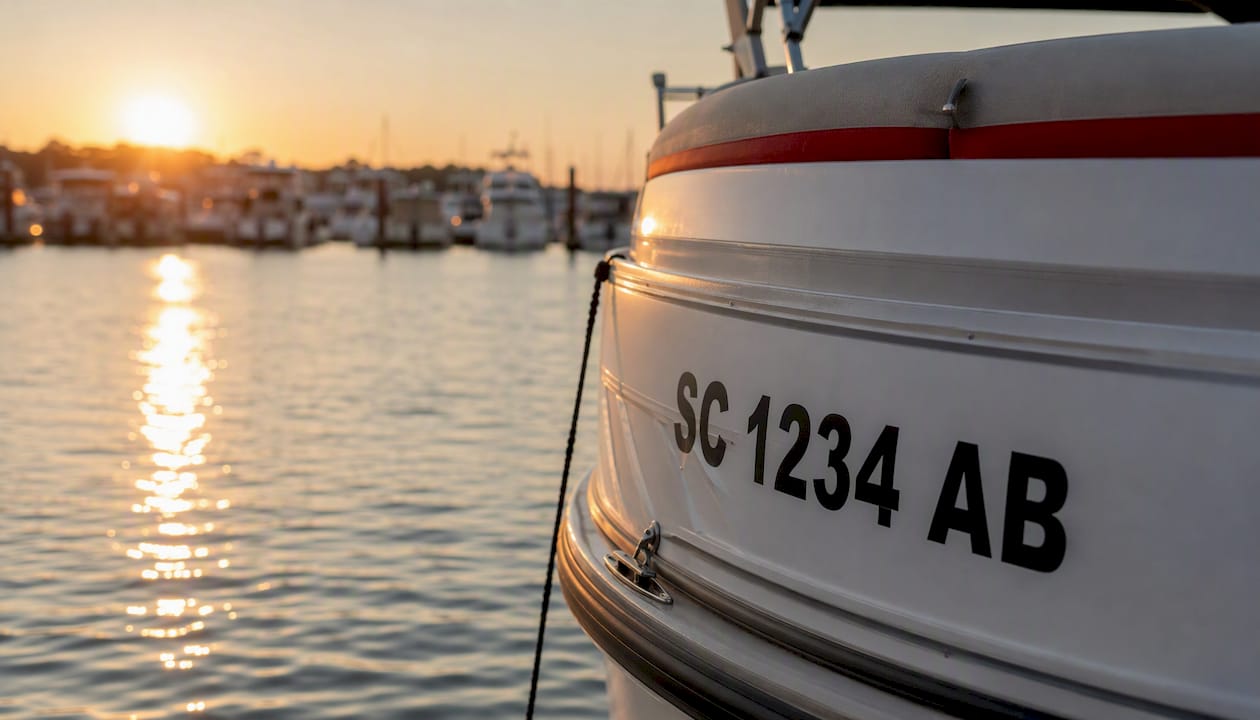
South Carolina's display requirements come directly from S.C. Code Regs. § 123-6, and they are more specific than most owners realize.
| Requirement | Rule |
|---|---|
| Prefix | Must begin with "SC" |
| Format | "SC" + numbers + letters, separated by space or hyphen |
| Character height | Not less than 3 inches |
| Character style | Plain vertical block letters only |
| Color | Must contrast with the hull background |
| Reading direction | Left to right |
| Placement | Both sides of the forward half of the hull |
| Decal position | Within 6 inches immediately following the registration number |
The contrast rule matters more than owners often think. White numbers on a white hull fail inspection even if every other spec is correct. Black on white, white on dark blue, or any combination where the characters are clearly readable from a patrol boat at distance will pass. If you are unsure, hold a photo of your hull next to your decal color options before ordering.
When hull curvature or a structural feature prevents direct placement, SCDNR permits mounting the number on a backing plate attached to the forward half so it remains visible from each side. Decals must still sit within 6 inches of the number and must never cover the HIN.
For outboard motors and certain vessel types like catamarans and pontoon boats, S.C. Code Regs. § 123-9 has slightly different decal placement rules. On outboards, decals bearing the title number go on the starboard motor cowling. On catamarans and pontoon boats, placement follows the same forward-half rule but may require a backing plate given the hull geometry.
Dealers and manufacturers operating unregistered vessels for demonstration purposes use removable plates rather than permanent decals. That exception does not apply to private owners.
Pro Tip: Plain block characters are required, but "plain" still gives you choices. Avoid condensed or italic fonts. A standard sans-serif block style with consistent stroke width reads cleanly from distance and satisfies the regulation. See boat number fonts for a breakdown of which styles work and which ones technically fail the "plain vertical block" standard.
For a visual reference on exactly where numbers and decals should sit on common hull types, this placement guide shows bow-side examples with decal positioning.
HIN versus registration number: what's the difference?
These two identifiers confuse owners constantly, and mixing them up on SCDNR forms causes delays.
The Hull Identification Number (HIN) is a 12-character code assigned by the manufacturer. It is the boat's permanent identity, similar to a vehicle VIN. The Coast Guard and SCDNR use it to track the vessel across ownership changes, recalls, and theft records. You do not display the HIN on the outside of the hull. It is typically stamped or molded into the transom (upper starboard corner) and sometimes also appears on an interior surface.
The state registration number (starting with "SC") is issued by SCDNR and serves as the vessel's operational identifier on South Carolina waters. This is what you display on the hull and what law enforcement checks during a stop.
Key differences at a glance:
- Who issues it: HIN = manufacturer (per USCG standards); registration number = SCDNR
- Format: HIN = 12 alphanumeric characters; SC registration = "SC" + numbers + letters
- Permanence: HIN stays with the hull forever; registration number can change with ownership or state
- Where it appears: HIN = transom or hull interior (not displayed publicly); registration number = both sides of the forward half of the hull
- Purpose: HIN = permanent vessel identity and recall tracking; registration number = proof of current state registration
Home-built boats without a factory HIN present a specific situation. SCDNR can assign a state-specific HIN prefixed with "SCZ" when no factory number exists. If you are titling a home-built vessel, contact SCDNR's Watercraft Section directly to initiate that process before submitting your registration application.
How do you transfer a boat title and registration in South Carolina?
Buying a used boat in South Carolina involves more paperwork than most people expect. Here is what both parties need to complete a clean transfer:
- Bill of sale signed by both buyer and seller, including the purchase price, date, HIN, and vessel description
- Signed title with the transfer section completed by the seller (if the vessel has been previously titled)
- Completed SCDNR transfer application with all required fields filled in
- HIN verification to confirm the number on the hull matches the title documents
- County property-tax clearance if your county requires it before processing a registration transfer
- Transfer fee paid to SCDNR at submission
Timing matters. SCDNR forms specify that owners must notify the Watercraft Section in writing within 30 days of any ownership or address change. Missing that window does not void the transfer, but it creates a records gap that can complicate future transactions.
Watch for these common transfer pitfalls: A mismatched HIN between the title and the physical hull will stop the transfer cold. Sellers sometimes forget to remove their old decals, which can confuse the next owner about which registration is current. And if the seller's registration card is still in the boat, it needs to come out — the buyer's new card replaces it the moment the transfer is complete.
Out-of-state transfers add one more step. If you are bringing a vessel into South Carolina from another state, SCDNR may request a physical HIN inspection before issuing a South Carolina title. Have the boat accessible and the out-of-state title ready when you contact the Watercraft Section.
Can you look up a South Carolina boat registration number?
The short answer: not through a public online database. South Carolina does not maintain a freely searchable public registry of vessel registrations. Owner personal data is protected under state privacy rules.
That said, there are legitimate ways to verify a vessel's registration status:
- Law enforcement — has direct access to registration records during patrols and stops.
If you suspect registration fraud or a stolen vessel, contact SCDNR's Watercraft Section and, if the situation involves a crime, your local law enforcement agency. Do not publish a vessel's full registration number in a public sale listing without considering that it can be used to impersonate ownership. Redacting the middle digits in photos is a reasonable precaution.
What are the penalties for noncompliance, and what is the BUI standard?
South Carolina marine law enforcement patrols actively, and registration violations are among the most common stops on the water. Operating without a properly displayed registration number or without the registration card on board can result in a citation and fine. The exact fine amounts are set by the courts and vary by circumstance, but the practical consequence is a stop, a delay, and a record.
The BUI standard in South Carolina mirrors the motor vehicle DUI threshold: operating a vessel with a blood alcohol concentration of 0.08% or higher is treated as per se evidence of impairment. SCDNR marine officers enforce BUI alongside registration and safety equipment checks. A BUI conviction carries criminal penalties, not just a fine.
Practical steps to stay clear of enforcement issues:
- Display your SC registration number in 3-inch block characters on both sides of the bow, with decals within 6 inches
- Keep the registration card on board every time the vessel is in use
- Never operate with a BAC at or above 0.08%
- Report any boating accident to SCDNR promptly; South Carolina law requires accident reporting when there is injury, death, or property damage above a certain threshold
If you are involved in a boating accident, contact SCDNR's Watercraft Section to understand your reporting obligations. Failing to report a qualifying accident is itself a violation.
What makes a decal actually compliant and durable on the water?
The regulation says "plain vertical block characters not less than 3 inches high" in a contrasting color. What it does not say is anything about how long those characters need to stay legible. That part is on you.
Standard adhesive vinyl from a craft store will peel, fade, or bubble within a season on a hull that sees saltwater, UV exposure, and regular washing. Marine-grade vinyl with UV-stable inks and a saltwater-proof laminate holds up for years under those conditions. The difference shows up not just in appearance but in enforcement: a faded or partially peeled number is still a noncompliant number.
When ordering or making decals, look for these features:
- Marine-grade vinyl substrate rated for outdoor and saltwater exposure
- UV-stable inks that resist fading under direct sun
- Pre-spaced characters so the spacing between letters and numbers is consistent and regulation-compliant out of the box
- Minimum 3-inch character height guaranteed before you confirm the order
- High-contrast color options matched to your hull color
- Backing-plate compatibility if your hull has curves that prevent flat adhesion
Registrationdecals produces custom SC registration decals from marine-grade vinyl using an online design tool where you enter your registration number, pick your colors, and select your font. Production runs 3–5 business days, and shipping is free within the contiguous US. For guidance on which font styles satisfy the "plain vertical block" standard, the font requirements page walks through the options.
Pro Tip: When installing, align the bottom edge of your registration number parallel to the waterline on the forward half of the hull. Then place your validation decal immediately to the right of the last character, within 6 inches. That sequence satisfies both the placement rule and makes the number easy to read from a patrol boat approaching from either side.
Key Takeaways
South Carolina boat registration compliance comes down to four things: correct number format, correct display size and placement, valid decals within 6 inches of the number, and the registration card on board.
| Point | Details |
|---|---|
| Registration number format | "SC" prefix + numbers + letters, separated by a space or hyphen, reading left to right |
| Display size and placement | Plain block characters at least three inches high, on both sides of the forward half of the hull, contrasting with the hull color |
| Decal placement | Validation decals must be affixed within 6 inches immediately following the registration number on each side |
| Registration card on board | The certificate must be on the vessel whenever it is in use; notify SCDNR within 30 days of ownership or address changes |
| Compliant decals | Registrationdecals offers marine-grade, UV-stable SC registration decals with a 3–5 business day production time and free contiguous US shipping |
Why the decal material question matters more than most owners think
The most common mistake I see is treating the decal as an afterthought. Owners spend real money on a boat, go through the SCDNR registration process correctly, and then slap on whatever vinyl letters they found locally. Six months later the characters are fading, one letter has lifted at the corner, and they are one patrol stop away from a citation for a noncompliant display.
The regulation does not specify material, but it does require the number to be "painted or permanently attached" and to contrast with the background. A peeling decal fails both tests. Marine-grade vinyl is not a premium upgrade; it is the minimum that actually holds up to the conditions South Carolina boaters deal with: sun on Lake Murray in July, salt spray on the coast, repeated pressure washing. Registrationdecals uses UV-stable, saltwater-proof vinyl and gives you an online design tool to get the sizing and color right before you order. The 3–5 business day production time means you are not waiting weeks to get back on the water legally.
The other thing worth saying: if you bought a used boat and the previous owner's decals are still on the hull, remove them before you apply yours. Two sets of numbers on the same hull creates confusion during a stop and can raise questions about which registration is current.
Get compliant SC registration decals without the guesswork
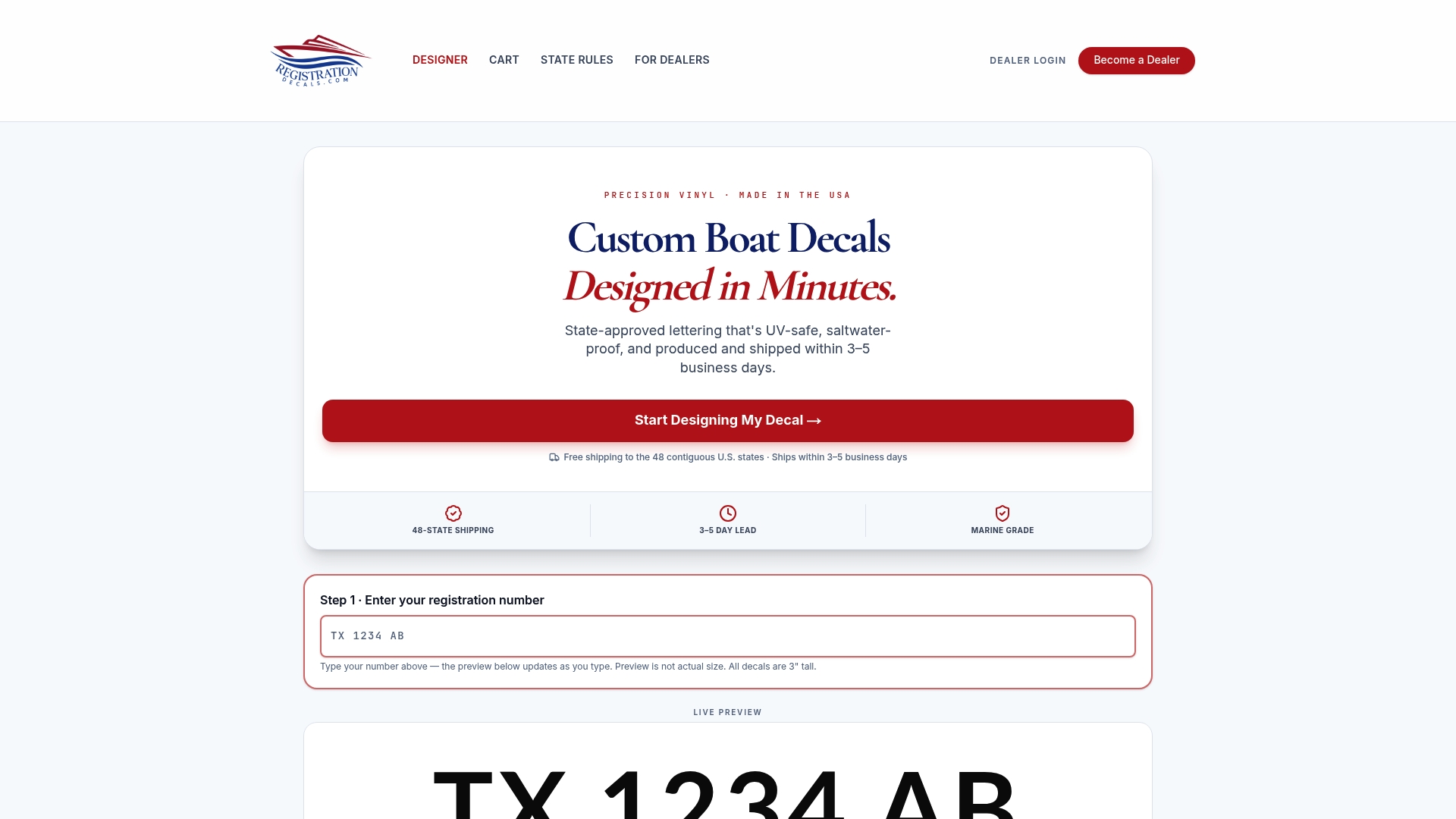
Registrationdecals is the direct route to state-compliant, marine-grade SC registration decals without hunting down a local sign shop or guessing at sizing. You enter your registration number, choose your colors and font from block-style options that meet South Carolina's plain vertical character requirement, and the decals ship free to anywhere in the contiguous US within 3–5 business days.
The online design tool at RegistrationDecals.com handles pre-spacing so your characters are correctly separated right out of the package. If you have questions about sizing for a curved hull or need guidance on backing-plate options, the support team can help before you place your order. For a full summary of South Carolina's decal requirements alongside ordering options, the South Carolina regulations page covers both in one place.
Authoritative sources and where to confirm the rules
For anything involving legal requirements, forms, or fees, go to the primary sources:
- SCDNR Boating: Title and Register a Watercraft or Outboard Motor in SC — the authoritative source for registration requirements, titling forms, fee schedules, and the registration FAQ
- SCDNR Boating FAQ — answers to common questions about titling, renewals, and transfers directly from SCDNR
- Chapter 123, South Carolina Code of Regulations (PDF) — the full regulatory text governing vessel registration display rules, including S.C. Code Regs. § 123-6 and § 123-9
- Boat-Ed South Carolina Study Guide: Displaying Registration Numbers and Validation Decals — a clear secondary summary of display rules useful for quick reference
- Registrationdecals South Carolina Regulations Page — publisher-maintained summary of SCDNR display rules with decal ordering options
SCDNR is the authoritative source for legal requirements, forms, and fees. The Registrationdecals regulations page is the right starting point for decal materials, sizing, and ordering.