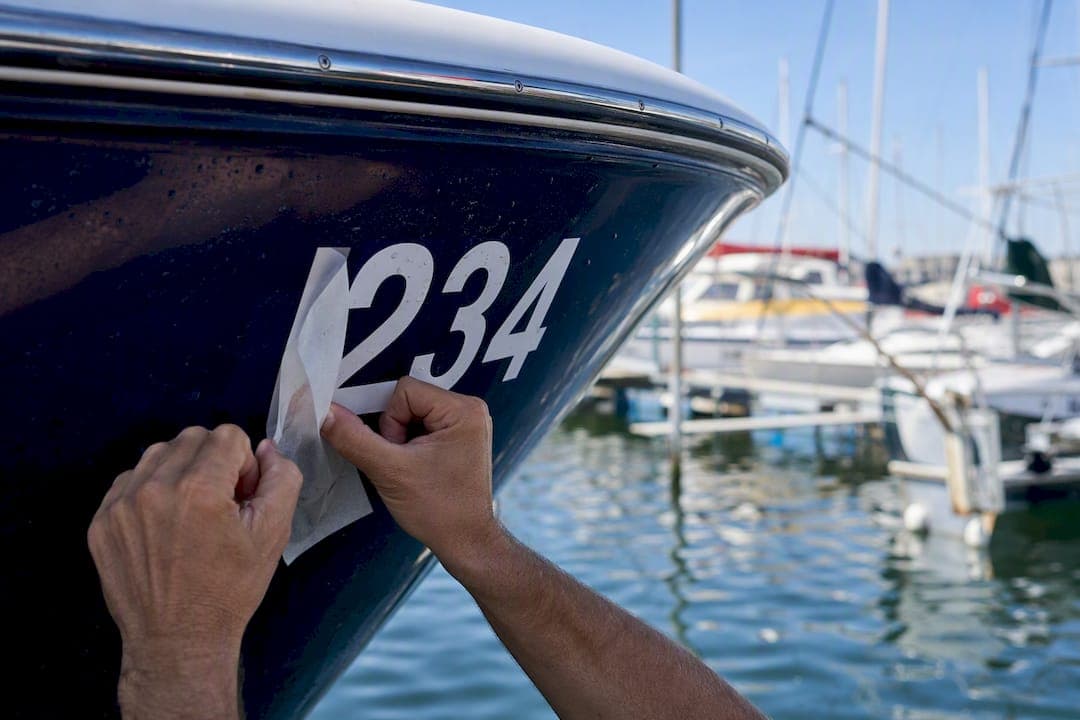
Every state requires plain block characters at least 3-inch tall, reading left-to-right, on both sides of the forward half of your hull, in a color that contrasts with the boat. Vinyl decals satisfy this rule as long as they're permanently affixed and marine-grade. Your next move is simple: confirm your state's exact spec, then measure your hull before you order or paint anything.
TL;DR:
- Ensure registration numbers are at least 3 inches tall, in a plain block font, and in a contrasting color for both sides of the forward hull.
- Measure the forward half of your hull accurately and place the numbers roughly one-third back from the bow, matching on both sides.
- Verify your state's specific spacing, hyphen, and decal placement rules through official sources to avoid inspection failures.
- Use marine-grade vinyl with UV inhibitors for durability, expecting a lifespan of 3 to 10 years depending on water type and maintenance.
- Prefer vinyl decals over paint for easier correction, faster installation, and to meet legal permanency standards if made from quality, UV-resistant material.
Table of Contents
- Your Quick Compliance Checklist Before You Order
- What U.S. Law Requires and How to Check Your State's Rule
- Getting Placement, Spacing, and Formatting Right
- Why Marine-Grade Vinyl Holds Up Better Than You'd Expect
- Choosing a Compliant Block Font and Color That Actually Reads
- How to Install Boat Numbers Without Bubbles or Peeling
- Keeping Your Numbers Legible and Compliant Year After Year
- Decals or Paint: What Actually Matters Long-Term
- Order Compliant Block-Letter Decals in Minutes
- Where to Verify Your State's Exact Requirements
- Sources
Your Quick Compliance Checklist Before You Order
Before you touch a decal or a paintbrush, run through this short list. It takes ten minutes and saves you from a redo.
- Pull your registration certificate and copy your number and state prefix exactly as printed, including hyphens or spaces.
- Measure the forward half of your hull on both sides and confirm you have room for characters at least 3 inches tall, or taller if your state requires more.
- Choose a plain block font, pick a color that contrasts sharply with your hull, and check your state's rule on spacing or hyphens between the prefix, digits, and suffix.
- Decide between vinyl decals and painted numbers, then either gather your materials or open an online design tool to preview the layout.
Pro Tip: Snap a photo of your hull next to a tape measure before you design anything. It's the fastest way to catch a forward-half space that's narrower than you think.
What U.S. Law Requires and How to Check Your State's Rule
The baseline is remarkably consistent across the country. Most states require plain, block-style characters at least 3 inches tall, read left-to-right, in a color that contrasts against the hull. Numbers go on the forward half of the vessel, on both the port and starboard sides, with nothing else printed in that same space that could be confused for your registration number.
That's the floor. States build on it differently, and the differences matter if you want your boat to pass inspection on the first try.
Texas is a good example of how specific a state can get. Texas Parks and Wildlife requires block characters no less than 3 inches tall, read left-to-right, with hyphens or spaces separating the letter prefix from the numbers and the trailing letters. Texas also specifies that the validation decal sits about 3 inches behind the registration number, not scattered somewhere else on the hull.
Other states diverge in smaller but still important ways:
- Some states require characters taller than the 3-inch minimum for larger vessels.
- Some specify exact spacing (a full character space) between the prefix, the digit string, and the suffix, while others just say "legible and separated."
- Some states are stricter about validation decal placement, requiring it directly in line with the number rather than just nearby.
The pattern most state agencies follow lines up closely with the Discover Boating overview of registration requirements: visible block letters, minimum 3 inches, forward-half placement, no competing numbers in that zone, and strong contrast against the hull color.
Here's the part boat owners skip and shouldn't: read your own state's actual regulation page, not a general boating forum thread. Search "[your state] boat registration number requirements" and look for a .gov domain or your state's fish and wildlife or motor vehicle department. If you can't find it quickly, a state-by-state aggregator can point you in the right direction, though you should still verify against your state's own agency before you order anything. Registrationdecals also maintains a regulation hub covering all 50 states if you want a faster starting point.
Getting Placement, Spacing, and Formatting Right
Placement mistakes are the most common reason numbers fail inspection, and they're almost always avoidable with a tape measure.
- Find the forward half. Measure your hull's total length from bow to stern, divide by two, and mark the midpoint. Your registration numbers need to sit somewhere in that front section on both sides of the boat, not straddling the midpoint. A rough shortcut some installers use: aim for roughly one-third back from the bow, which typically lands well within the forward half on most hull shapes.
- Mirror the placement port and starboard. The number should read left-to-right on both sides, which means it's not simply flipped. Measure from the same reference point (often the bow or a rub rail) on each side so the numbers sit at matching heights and positions.
- Respect spacing and hyphen rules. Most states want a visible break, whether it's a hyphen or a blank space equal to roughly one character width, between the letter prefix and the digits, and again before any trailing letters. Registrationdecals' guide on registration number placement walks through this in more detail if your layout looks cramped.
- Place the validation decal correctly. Your current-year validation sticker typically needs to sit in line with your registration number, within roughly 3 to 6 inches of it. Texas specifies about 3 inches behind the number specifically. Check where your validation decal actually belongs rather than guessing.
The single most common inspection flag isn't size. It's a validation decal stuck somewhere convenient, like the stern, instead of next to the registration number where it belongs.
Why Marine-Grade Vinyl Holds Up Better Than You'd Expect
"Marine-grade vinyl" isn't a marketing term you can ignore. It refers to vinyl film built with UV inhibitors that resist fading from direct sun exposure, paired with an adhesive formulated to stay bonded through saltwater spray, temperature swings, and constant flexing as the hull moves through water.

Cheaper craft-store vinyl skips the UV inhibitors and uses a general-purpose adhesive, which is why it chalks, fades, or curls at the edges within a season or two on a boat that's actually used on the water.
How long should a properly installed decal last? Expect a range of roughly 3 to 10 years depending on the vinyl grade, your climate, and how consistently the boat is cleaned and cared for. Freshwater boats stored under cover on the higher end of that range; saltwater boats moored in direct sun and salt spray year-round on the lower end. Registrationdecals breaks down the factors that affect marine vinyl lifespan if you want the fuller picture before you order.

Material quality also matters for legal compliance, not just aesthetics. Regulations generally require registration numbers to be permanently affixed, and a decal that meets that permanence standard qualifies just as well as painted numbers in the eyes of most state agencies. A decal that's already peeling after eight months doesn't meet that bar anymore, which is exactly why the vinyl grade you choose matters as much as the size and font.
Choosing a Compliant Block Font and Color That Actually Reads
"Block" has a specific meaning here, and it rules out more fonts than you'd think. A block font is a plain, upright character with consistent stroke width and no flourishes. Think of the lettering on a highway sign. Retail guidance from marine suppliers commonly points to fonts like Univers or a straightforward full block style as safe choices that satisfy state font requirements.
What gets rejected regularly:
- Script or cursive fonts, even bold ones.
- Italicized or slanted lettering.
- Condensed or stylized fonts where letters are narrower than they are tall.
- Anything with serifs, shadows, or 3D effects that blur the outline at a distance.
Decorative fonts fail inspections for a practical reason: law enforcement needs to read your number quickly from a moving patrol boat. A font that looks great up close but blurs together at 50 feet defeats the entire purpose of the requirement. Check the exact font requirements for your registration numbers if you're unsure whether a style crosses the line.
On sizing, don't trust a screen preview alone. A 3 inch character on your monitor and a 3 inch character on your hull are two different things once transfer tape and hull curvature enter the picture. Print a paper template at actual size and hold it against the hull before you commit to an order.
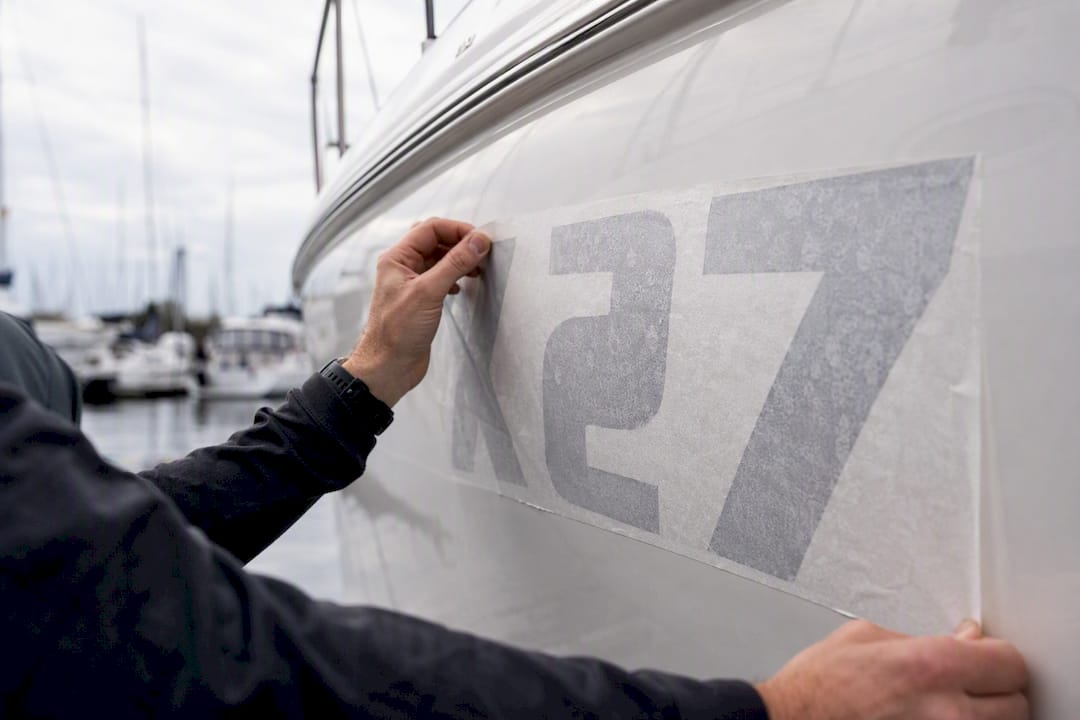
For color, look at your hull's actual shade, not the generic "white boat" assumption. Dark navy or forest green hulls need a light, bright number color; white or light gray hulls need a bold dark color like black or navy. Registrationdecals has more detail on choosing a contrasting number color that holds up in bright sun and from a distance.
Pro Tip: If your hull color is a mid-tone like light blue or tan, test your color choice against the actual hull in full sunlight, not indoor lighting. Contrast that looks fine in your garage sometimes disappears at noon on the water.
How to Install Boat Numbers Without Bubbles or Peeling
Good installation is what separates a decal that lasts a decade from one that's lifting at the corners by July.
- Clean and degrease the surface. Wash the application area with soap and water, then wipe it down with isopropyl alcohol to remove wax, salt residue, and oils. Skipping this step is the number one cause of early peeling.
- Check the temperature. Install in moderate weather, ideally between 50°F and 90°F. Vinyl adhesive doesn't bond well in cold temperatures and can stretch or wrinkle in extreme heat.
- Dry-fit before you commit. Tape your decal in place with painter's tape, using your forward-half measurements to confirm alignment on both sides before removing any backing paper.
- Choose your application method. A dry application works well on flat sections; a light water-and-a-drop-of-dish-soap solution on the hull surface gives you a few extra seconds to reposition on curved areas, a technique many installers used to avoid bubbles during application.
- Squeegee from the center outward. Work in overlapping strokes toward the edges to push out air and water, rather than starting at one edge and dragging across.
- Peel the transfer tape slowly, at a low angle. Pull back on itself rather than straight up, which keeps the vinyl from lifting with it.
- Let it cure before exposure. Give the adhesive at least 24 hours away from water contact, longer in cooler weather, before launching or washing the hull.
If you spot a small bubble after installation, a pin prick at the edge followed by gentle pressure usually flattens it. Persistent lifting at a corner, though, usually means the surface wasn't fully degreased, and reordering a fresh decal is often faster than fighting a bad bond.
Pro Tip: Keep the backing paper from your old decal as a template. It makes repositioning a replacement in the exact same spot much faster.
Keeping Your Numbers Legible and Compliant Year After Year
A decal that passed inspection some years ago won't necessarily pass today. UV exposure and salt buildup affect visibility over time, often unnoticed until fading becomes evident.
- Rinse with fresh water and a mild boat soap after saltwater use; avoid petroleum-based cleaners or abrasive pads directly on the lettering.
- Check edges for lifting every few months, especially after winter storage or a season of heavy sun exposure.
- Inspect color contrast in direct sunlight once a year. Fading is gradual, so a side-by-side comparison with a photo from a prior season catches it faster than memory alone.
- Replace decals showing cracking, chalking, or peeling before your next registration renewal, not after an inspector flags it.
- Order a full replacement set rather than patching one letter. Mismatched vinyl age and color rarely passes as consistent, compliant lettering.
Decals or Paint: What Actually Matters Long-Term
Paint has one real advantage: it's baked into the gelcoat and never peels at the edges. But it's slow, requires masking and multiple coats, and a mistake means sanding and starting over. For most owners, that tradeoff isn't worth it anymore.
Marine-grade vinyl decals close that durability gap while adding speed, easy correction if you make a design error, and lower cost. Registrationdecals built its process around that reality: UV-resistant, saltwater-proof vinyl, a design tool that shows your exact layout before you order, and production that ships in days, not weeks. For the vast majority of recreational boat owners, that's the better path.
— Taylor
Order Compliant Block-Letter Decals in Minutes
You've seen the rules: 3-inch block letters, correct placement, proper contrast, permanent affixing. Getting there without a paintbrush is where Registrationdecals earns its keep. The online design tool lets you enter your exact registration number, pick a compliant block font, and choose a contrasting color, then see your layout before you commit to anything.
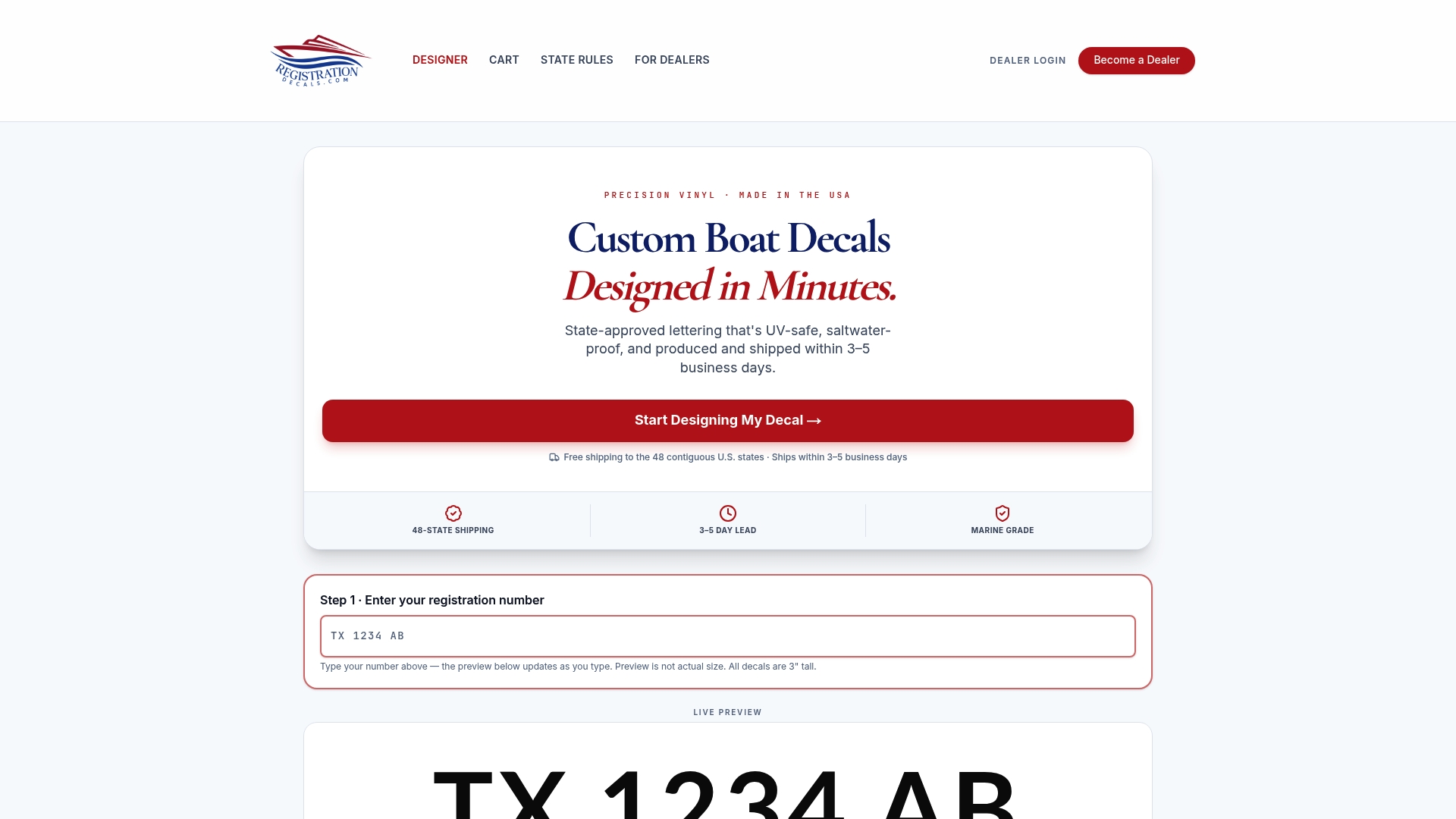
Every set ships from marine-grade vinyl built to handle UV exposure and saltwater without curling or fading prematurely, and production runs 3 to 5 business days with free shipping across the contiguous United States. Marina operators and dealerships placing bulk orders get the same turnaround and materials at volume. If you're outfitting a personal watercraft instead of a boat, the jet ski decal option covers that sizing separately.
Before you check out, confirm your state's exact spacing and decal placement rule on Registrationdecals' regulation pages, then head to the design tool and preview your numbers at true size.
Where to Verify Your State's Exact Requirements
Bookmark your own state's boating authority page first. Texas boat owners can check Texas Parks and Wildlife's placement rules directly, and every state has an equivalent. The Discover Boating overview, Registrationdecals' regulation hub, and a general registration process guide are useful for cross-checking any rule that seems ambiguous on a first read.
Sources
- Boat registration numbers (SafeBoatingAmerica)
- Numbers and Decals on Vessels — Texas Parks & Wildlife Department
- Boat registration number guide (Discover Boating)
- Boat lettering guide (West Marine)