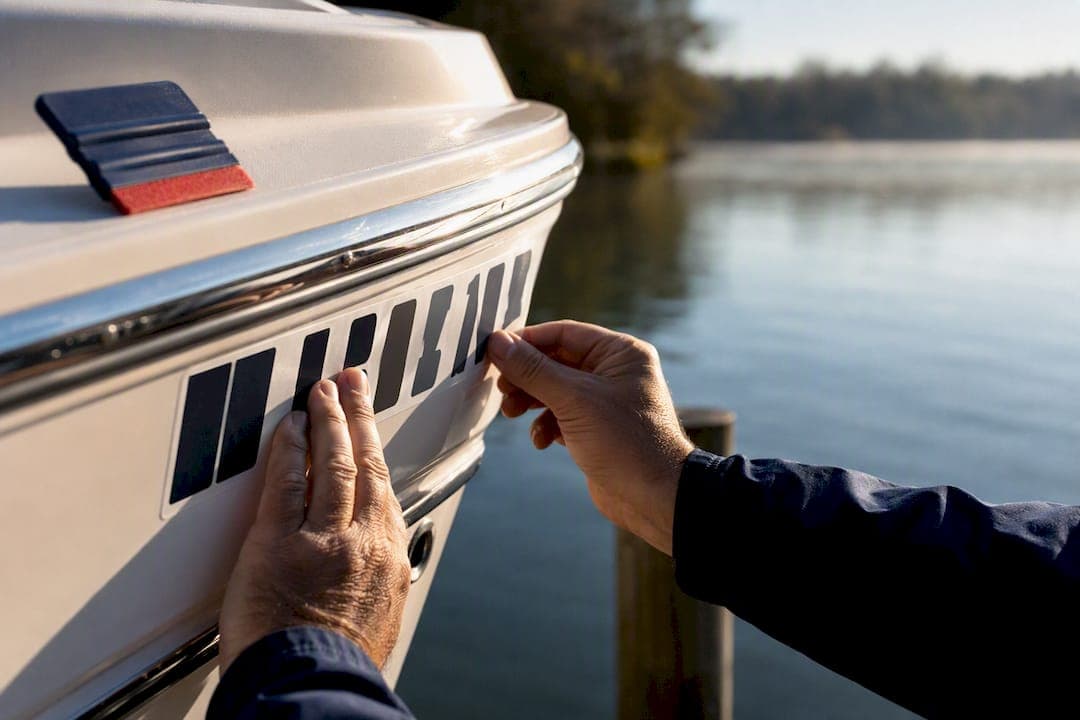
Most state-issued boat registration numbers stay with the hull as long as the boat remains registered in the same state. They typically change in four situations: you move the boat's principal operation to another state, you switch to U.S. Coast Guard documentation, the boat undergoes a major rebuild that triggers a new title, or the registration lapses and the state reassigns the number. Federal rules require the new state to honor your old number for at least 60 days while you re-register.
TL;DR:
- Moving the boat to a new state or switching to federal documentation will generally trigger a new registration number, with recognition periods lasting at least 60 days.
- Rebuilding the hull or allowing registration to lapse can lead to a new number being issued or the old one being reassigned to another vessel.
- Keeping registration current and updating contact information prevents accidental reassignment or penalties for late renewal.
- After a number change, decals should be applied on the forward half of the bow in contrasting colors, with proper spacing according to state regulations.
- Most states now offer online processing for transfers and renewals, but documentation switches and interstate moves may require in-person or mailed applications.
Table of Contents
- Common Scenarios That Cause Registration Numbers to Change
- How to Transfer or Update a Boat Registration Number
- Replacing Numbers the Right Way: Decals and Compliance
- Timing, Fees, and State Rules to Expect
- How to Avoid Losing Your Registration Number
- What Boat Owners Get Wrong About Their Registration Number
- Where to Get Compliant Numbers When Yours Changes
- Sources
- FAQ
Common Scenarios That Cause Registration Numbers to Change
A registration number rarely changes on its own. It changes because something specific happened to the boat, the owner, or the paperwork. Here's what typically triggers a new number:
- Moving to a new state. Federal law gives you at least 60 days of recognition for your old number after you relocate the boat's principal place of use, though some states stretch that window to 90 or 120 days.
- Switching to USCG documentation. Once a vessel is documented with the Coast Guard under 46 CFR part 67, the state-issued bow numbers come off and the vessel operates under its USCG documentation federal official number instead.
- Major rebuilds. If a hull is reconstructed to the point a state considers it a new vessel, the original number can be retired and replaced with fresh numbering and titling.
- Expired registration. Let renewal lapse long enough, and the state may release your old number back into circulation for someone else to claim.
- Same-state ownership transfer. This is the scenario most owners actually worry about, and it's the easy one. Virginia's boating agency notes that when a boat changes hands within the same state, the existing number is usually reassigned to the new owner rather than replaced. You get a new certificate, not a new number.
Florida works the same way on the display side: the agency states the number stays with the vessel for as long as it's operated or stored in Florida, regardless of how many times it changes hands.
How to Transfer or Update a Boat Registration Number
If you fall into one of the change scenarios above, the process is more paperwork than mystery. Here's the typical sequence:
- Gather your documents. Bill of sale, current registration, title (if your state issues one for boats), a valid photo ID and payment for the transfer or new registration fee.
- Choose your submission method. Most states now offer an online portal for renewals and simple transfers, but interstate moves and documentation switches often still require an in-person visit to the DMV or DNR office, or a mailed application. If you're documenting with the Coast Guard instead, you'll file federal form CG-1258.
- Carry proof while you wait. Processing usually takes a few days to a couple of weeks depending on the state and method.
- Cancel or retire the old registration. Some states close out the old record automatically when you register elsewhere; others expect you to notify them.
Pro Tip: Keep a photo of your bill of sale and old registration on your phone. If you're stopped during the grace period before your new documents arrive, that photo is often enough to satisfy an officer that a transfer is in progress.
The federal minimum grace period is 60 days, which is generous, but it's not unlimited, and running past it without action is what actually causes problems.
Replacing Numbers the Right Way: Decals and Compliance
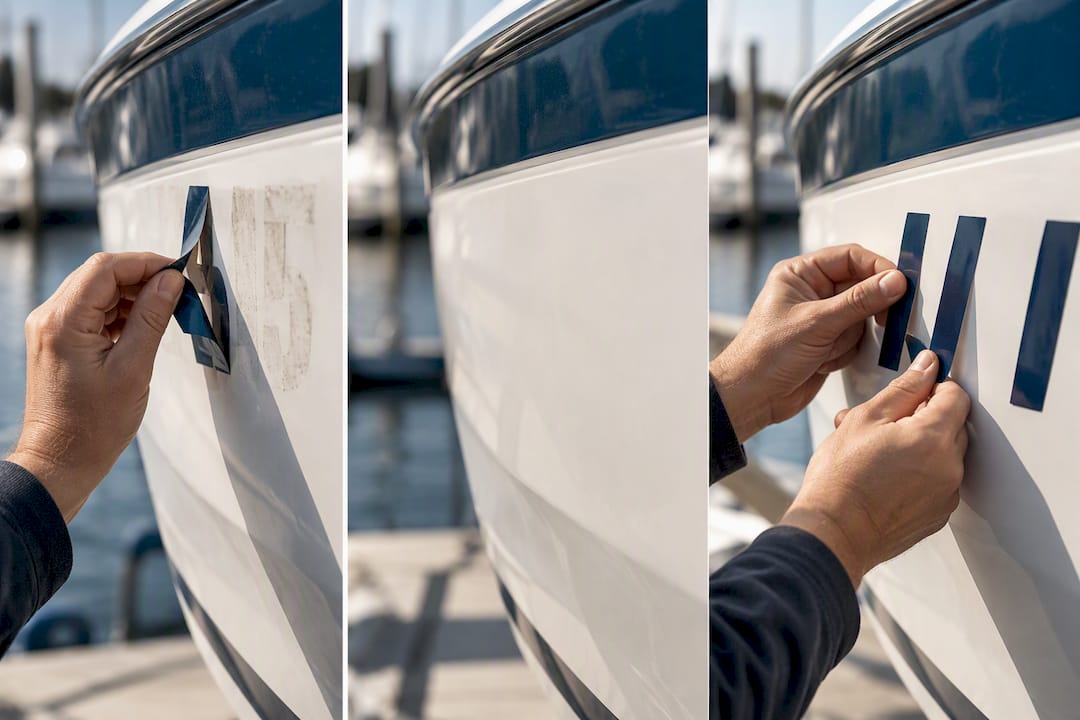
Once your number changes, or you simply need new markings after a transfer, how you remove and reapply numbers matters almost as much as getting the number itself right. Peeling adhesive-backed vinyl cleanly, without scarring gelcoat, is a different job than stripping painted numbers, which often requires an approved solvent or a professional detailer to avoid damaging the hull finish.
Most state agencies accept marine-grade vinyl decals in place of hand-painted numbers, and for good reason: vinyl holds sharper edges, survives sun and saltwater exposure far longer than paint, and can be replaced in minutes if a number changes again. A few things to keep in mind when applying new ones:
- Numbers generally belong on the forward half of the bow, on both sides of the hull.
- Characters need to contrast clearly against the hull color so they're readable at a distance.
- Check spacing and letter height against your state's specific display rules before ordering, since minimum sizes vary.
- Inspect decals periodically for lifting edges or fading, since a partially peeled number can draw the same scrutiny as a missing one.
Registrationdecals builds its numbers from marine-grade vinyl rated for UV and saltwater exposure, and its online design tool lets you enter your new number, pick colors and fonts, and get a compliant set produced in 3 to 5 business days with free shipping across the contiguous United States.
Timing, Fees, and State Rules to Expect
Renewal cycles typically run a few years depending on the state, and the single biggest reason owners lose their number isn't a move or a sale. It's a missed renewal notice sent to an old address.
- Keep your mailing address and email current with your registering state so renewal notices actually reach you.
- Remember the 60-day federal floor for interstate recognition; some states extend it, but none can shorten it below the federal minimum.
- Georgia's wildlife agency warns that expired registrations can lead to reassignment, meaning your specific number may already belong to another boat by the time you try to renew late.
- Virginia and Florida both charge standard transfer and renewal fees, with penalty fees added for late renewal. Exact amounts vary by state and boat length class, so check your agency's current fee schedule before applying.
- If your number is reassigned, expect to pay a reissue fee for the new one, on top of any late penalty already owed.
How to Avoid Losing Your Registration Number
Prevention here is mostly administrative, not technical. A few habits keep you off the reassignment list entirely:
- Renew on time, every time. Set a calendar reminder ahead of your renewal date rather than relying solely on a mailed notice.
- Update your address and email immediately after a move, even if you're not changing your boat's state of operation yet.
- Never assume a used boat's displayed number is still valid. Require the seller's current registration or complete the transfer immediately at closing, before you put the boat on the water.
- If your number already lapsed and got reassigned, accept the new number, register promptly, and order replacement decals right away so the boat is legal the moment you're back on the water.
What Boat Owners Get Wrong About Their Registration Number
The confusion I see most often isn't about registration numbers changing. It's about people conflating three different identifiers that serve three different purposes. The hull identification number, or HIN, is a permanent manufacturer-assigned code that never changes no matter what state you're in or who owns the boat. Your state registration number is the one that can shift with a move, a documentation switch, or a lapse. A USCG official number replaces the state number entirely once you document federally, and each system exists for a different reason.
The practical fix is boring but effective: keep digital copies of your registration and title on your phone, and carry paper proof during any transfer window. And when a number does change, pull the old decals off promptly. Enforcement officers notice ghost outlines of old numbers as readily as they notice missing ones.
— Taylor
Where to Get Compliant Numbers When Yours Changes
Once you've handled the paperwork, whether that's a state transfer, a documentation switch, or a reissue after a lapse, you still need the hull itself to match what's on file. There are services designed for that moment, offering marine-grade vinyl that's UV and saltwater resistant, online design tools to enter your new number and pick colors and fonts quickly, and production that ships in a few business days with free delivery in the contiguous United States.
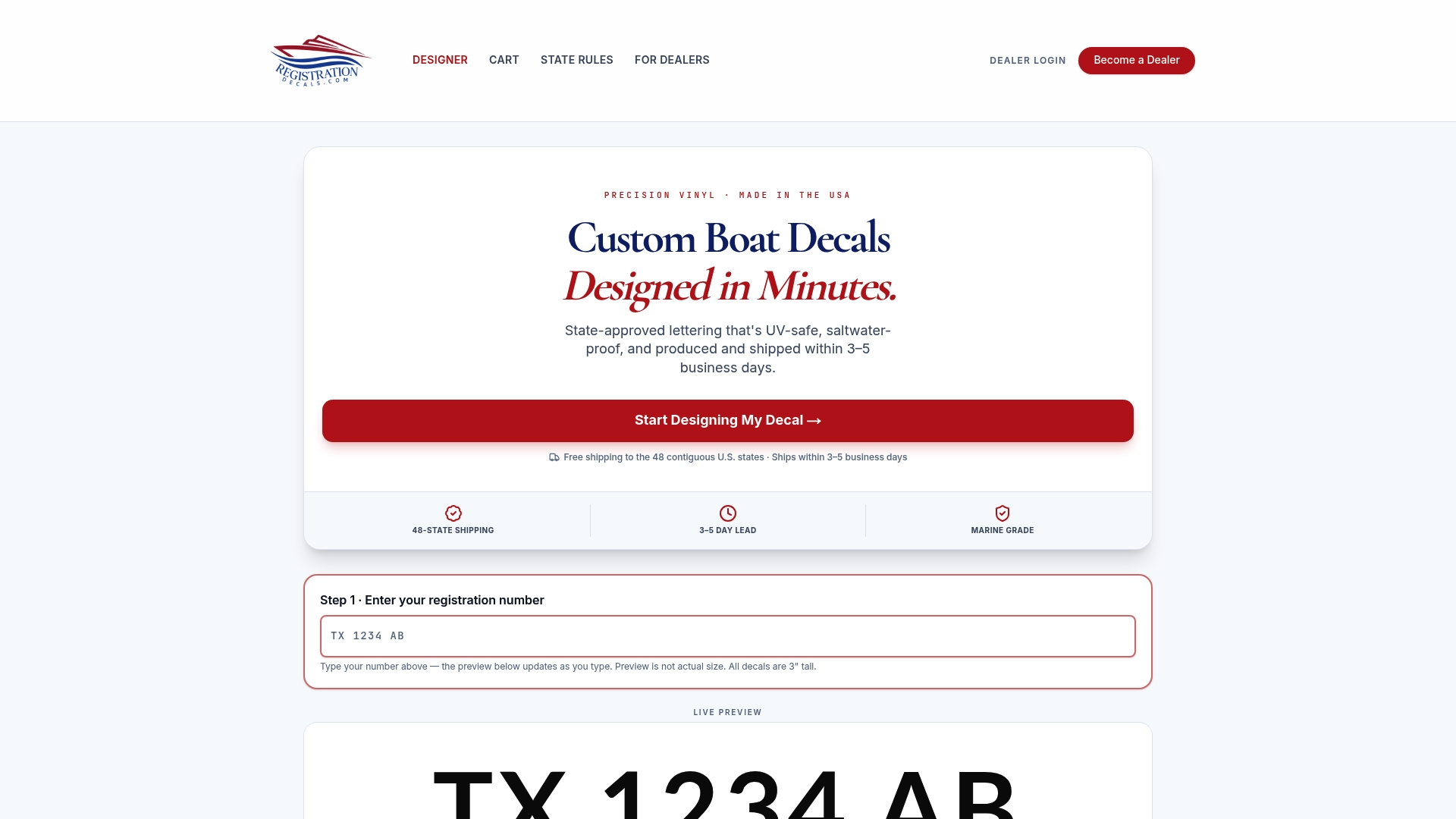
That turnaround matters more than it sounds like it should. A boat with mismatched or missing numbers is a boat that shouldn't be on the water, and waiting weeks for custom decals just extends the gap. Registrationdecals covers boat-specific sizing and placement for pontoons, bass boats, aluminum hulls, and center consoles, so the contrast, spacing, and character height meet your state's display rules from the first order. Start your set on the main design page, enter your new number, and you'll have compliant decals on the hull well within any reasonable grace period.
Sources
For state-specific forms and current fee schedules, check your own state's DMV or DNR boating page directly. The federal framework governing numbering and documentation lives in 46 CFR part 67 and 46 USC 12302. Florida's and Virginia's agencies, linked throughout this article, offer clear examples of how individual states apply those federal rules.
- Numbering and Decals - Florida Department of Highway Safety and Motor Vehicles
- Watercraft registration, titling, and sales tax requirements | Virginia DWR
- 46 CFR part 67 — Official number assignments (eCFR)
- Boat registration FAQs | Georgia DNR
FAQ
Can You Look Up a Boat Registration Number Online?
Most states offer an online vessel registration lookup through their DMV or DNR site, letting you confirm a number's status before buying a used boat. Availability and detail level vary by state, so check the registering state's specific portal rather than a national database.
How Do Boat Registration Numbers Work?
A registration number is assigned by the state where the boat is principally operated, and it must be displayed on the forward half of the bow on both sides. The number generally stays with the vessel through ownership changes within the same state, but it can change if you move states, document federally, or let registration lapse, as Georgia's guidance explains.
Is the Hull Number the Same as the Registration Number?
No. The hull identification number, or HIN, is a permanent code assigned by the manufacturer and never changes. The state registration number is a separate marking that can change if your boat's home state, documentation status, or registration standing changes.
What Are the Best Boat Registration Numbers to Buy?
Marine-grade vinyl decals are the standard most states accept in place of painted numbers, since they resist UV fading and saltwater corrosion far longer. Registrationdecals produces custom sets from that material, with a $35.99 one-time price per set and 3 to 5 business day production.
Do Boat Registration Numbers Expire?
The number itself doesn't expire, but the registration attached to it does, typically every one to three years. If you let a registration lapse long enough, the state can reassign your old number to another boat, so renewing on time is the only way to guarantee you keep it.