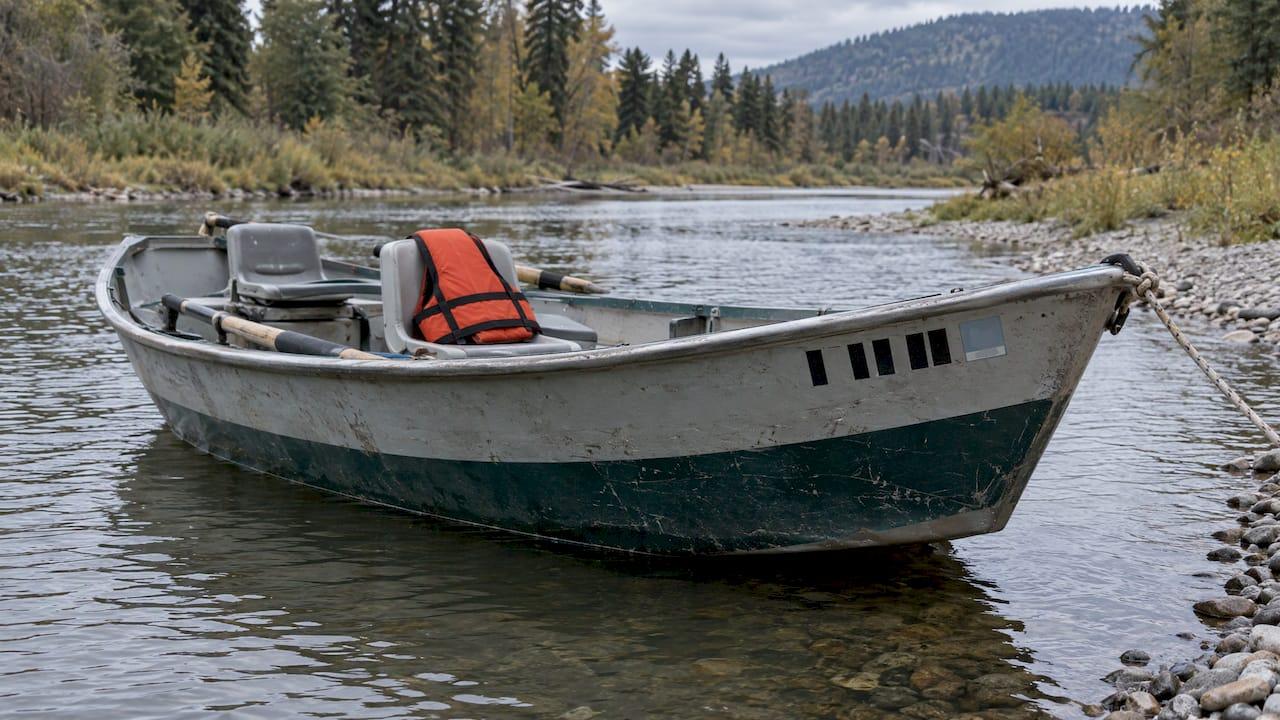
A drift boat registration number is the state-issued ID you display on the bow. Federal rules say it must be at least 3 inches tall, in plain block characters, on both sides of the forward half, in a color that contrasts with the hull. Your state assigns the number and sets the decal rules. Whether your boat needs one at all depends on how it is propelled and where you fish.
This guide covers each of those points. It shows how the number is formed, where the number and validation decal go, which boats are exempt, and how to pick decals that survive a season of rock bumps, sun and river spray.
TL;DR
- Federal rules (33 CFR § 173.27) require block characters at least 3 inches high, on each side of the forward half, reading left to right, contrasting with the hull.
- Your state issues the number and the validation decal. Formats and decal positions differ by state, so check your state agency's page before you order.
- A rowed drift boat may be exempt in some states, while a motor-equipped one usually is not. The rules turn on propulsion, length and state law.
- Use marine-grade vinyl and apply it to a clean, dry surface so the number stays legible for years.
- We make custom, state-compliant number decals for $35.99 per set, produced in 3-5 business days, with free shipping in the contiguous US.
Table of Contents
- Does your drift boat need a registration number?
- Where the number comes from
- Federal rules for size, style and spacing
- Where the number and validation decal go
- Drift boat situations that change the answer
- Choosing decals that last on the river
- Our perspective
- Order your drift boat numbers
- FAQ
- Sources
Does your drift boat need a registration number?
Not always, and the answer is set by your state, not by the boat's design. A drift boat is a small, often oar-powered craft, and several states treat that differently from a motorboat.
Here is how it looks in the states we have checked:
- New Hampshire exempts sailboats under 20 feet and vessels powered only by oars or paddles from displaying a number, though exempt vessels that must still be registered carry a state-issued decal.
- Hawaii excludes boats that are manually propelled from registration, along with motorized vessels whose propulsion produces less than five horsepower.
- South Dakota requires a decal on each side of the bow for nonmotorized boats over 12 feet, and numbers for nonmotorized boats over 18 feet or any motorboat. A violation is a Class 2 misdemeanor.
- Pennsylvania exempts unpowered kayaks, sculls, sailboards and similar low-volume boats from displaying numbers, per its boating code.
A 14-foot drift boat with a small kicker motor is a different case from a pure oar boat. If a motor is mounted, assume your state's motorboat rules apply until your state agency tells you otherwise. If you only row, look up your state's rule for nonmotorized boats by length.
Other federal exemptions exist too. Under 33 CFR § 173.13, racing-only vessels are exempt. A tender under 10 horsepower is exempt only if it displays its owner's numbered vessel's number plus "1" and is used solely to travel between that vessel and shore. The subpart also does not apply to vessels with a valid marine document, foreign vessels temporarily in U.S. waters, or certain government vessels.
If your state's page says the boat needs a number, read on. If you are unsure, the state boating agency is the final word, and a call before you buy anything is quick.

Where the number comes from
You do not choose your registration number. The state assigns it when you first register the boat, and you then have it made into decals. That is why vendors cannot hand you a number: they print the one on your registration paperwork.
The federal format is set by 33 CFR § 174.23. A state number has two capital letters for the issuing state, then not more than four numerals and not more than two capital letters (for example NH 1234 BD), or not more than three numerals and three letters. The letters I, O and Q cannot appear in the suffix.
States apply this in their own way:
- Massachusetts: the number is assigned at first registration. It starts with MS, then no more than four numbers and two capital letters. If your registration card is missing, the MS number will suffice to identify the boat.
- New Hampshire: the bow number starts with NH, then four numbers and one or two letters. A boat previously registered there keeps the same number for the life of the boat, and the DMV does not issue specific numbers on request.
So a buyer of a used drift boat should look at the transfer paperwork. Some states carry the number with the boat, while others issue a new one. Your state agency will say which applies.
Numbers last through renewals, but the validation decal does not. Under federal rules, a certificate of number must not be valid for more than 3 years, and many states set shorter periods. Plan to replace the validation decal each time you renew.
Federal rules for size, style and spacing
The core federal rule is 33 CFR § 173.27. It says each number must be painted on or permanently attached to each side of the forward half of the vessel. It must also be:
- in plain vertical block characters,
- not less than 3 inches high,
- a color that contrasts with the background,
- distinctly visible and legible,
- read from left to right,
- separated between letter and number groups by a space or hyphen equal to the width of a letter other than I or a number other than 1.
The full text is on the eCFR page for 33 CFR § 173.27. For a plain-language walk-through of the federal number format and display, a registration number format and display guide is a handy second read.
Two practical points matter on a drift boat.
Contrast beats style. Hawaii's boating division suggests the best results come from a very dark color on a light background or the reverse. It also notes that slanted or script numbers do not meet Coast Guard standards. Whitewater-style graphics and fancy fonts look good on a hull but can fail an inspection. Our guides on which color registration numbers must be and which font is required go deeper.
Nothing else nearby. Hawaii also states that no other numerals, letters or devices may be placed near the vessel number. Pennsylvania says no other number may appear on either side of the bow. If you want a boat name, a guide's logo or a fishing-club sticker, keep it well clear of the number. Our page on other numbers on the bow explains what is safe.
If you want to check your sizing before ordering, our boat number design guide shows how to confirm that characters stand three inches tall.
Where the number and validation decal go
Federal rules put the number on the forward half of each side. States add their own details about the bow and the decal. Federal rules for states that issue validation stickers require them to be displayed within 6 inches of the number, but many states are stricter.
| State | Number placement | Validation decal |
|---|---|---|
| Washington | Bow, block style, at least 3 inches, hyphen or equal space between the three segments | Within 6 inches of the number, both sides of the bow, aft of and in line with it |
| Florida | Both sides of the bow, block, at least 3 inches | Port (left) side only, immediately before or after the number |
| Texas | Each side of the forward half, block, at least 3 inches | In line with the TX number and 3 inches toward the stern |
| Hawaii | Each side of the forward half, at least 3 inches, legible from 100 feet | 3 inches aft of the number and in line, each side |
| Pennsylvania | Above the waterline, both sides of the bow, solid vertical block characters | Within 6 inches of the number and level with it, about 3 by 3 inches |
Sources: Washington DOL, Florida FLHSMV, Texas Parks & Wildlife, Hawaii DOBOR, and the Pennsylvania Code.
Note how Florida puts the decal on the port side only, while Washington wants decals on both sides. That is why copying a friend's setup from another state is risky. We keep state pages for Washington and Florida if you fish those rivers.
For a general answer on layout, see where registration numbers go on a boat and whether numbers go on both sides.
Drift boat situations that change the answer
Drift boats do not look like a typical bay boat, and the hull shape raises a few real questions.
High, flared sides and a curved bow
The number belongs on the forward half, and the key is that it stays distinctly visible. Place it on the flat or gently curved part of the side, not across a seam, rivet line or deep curve where the characters distort. Put the decal in line with the number as your state describes.
Aluminum, fiberglass and wood hulls
Aluminum is common in drift boats, and it needs a clean, oil-free surface for any adhesive vinyl. Our guide to registration numbers on aluminum boats covers prep. Painted wood and fiberglass need the same clean, dry surface, with the paint fully cured.
Hulls with no good spot for a number
Some states allow a workaround. Pennsylvania lets boats configured so a hull number would not be easily visible, including inflatables, carry the number and validation decals on boards lashed to the bow on each side. Ask your state agency if a board is accepted where you boat.

Documented vessels
If a boat holds a Coast Guard document, the rule flips. Washington says federal regulations prohibit displaying the WN registration number on documented vessels, which still show state decals on the forward half. Texas allows USCG documented vessels to show only the validation decal. This is rare for a drift boat, but it explains why some boats have a decal and no number.
Antique boats
Texas lets antique-registered boats display the decal on the left part of the windshield. Without a windshield, the decal goes with the certificate of number and must be available for inspection on public water. That could matter to a restored wooden drift boat.
A boat that is stopped for a missing number
Courts take proper display seriously in both directions. The Pennsylvania Code notes that in Commonwealth v. Rachau (1996), officers lacked reasonable suspicion to stop an operator for a missing sticker when a valid one was in fact displayed but unseen. Clear, correctly sized, well-placed decals help the officer see what you have.
Choosing decals that last on the river
A drift boat takes more abuse than most boats. It is dragged up ramps, scraped on gravel bars, bumped by anchor chains and soaked and dried again day after day. Decal choices matter.
- Marine-grade vinyl. Choose material made for UV and saltwater exposure, not general indoor sign vinyl. Our decals are produced in-house from marine-grade vinyl selected for UV and saltwater resistance.
- Matching the contrast rule. White on a dark hull, black on a light one. Avoid mid-tone colors that blend into the paint.
- Clean, dry application. Hawaii's boating division advises applying numbers and decals to a clean, dry surface and pressing firmly. It says a clear spray coating may help secure them, and that mounting on a removable backing plate may help when refinishing.
- Edge protection. Round the corners of decal sheets and keep edges away from areas where oars, tow straps or gear drag. Outdoor graphics are judged on peel strength and weather testing, and the same logic applies to hull decals.
- Correct size at order time. Measure the flat area of the hull and confirm the height. Characters must be at least 3 inches tall, and the group spacing must match the federal rule.
Our perspective
We see the same mistakes again and again. Owners order decals before they have their state number, pick a stylish font that is not block, or place the validation decal on the wrong side. Each one is avoidable.
Our approach is to make the right result the easy one. You enter your registration number, choose a contrasting color and a block font in our online design tool, and the layout is built to follow state rules. We make every set in-house from marine-grade vinyl chosen to resist UV and saltwater, because a number that peels or fades after a season does not do its job.
For a drift boat owner, the plan is simple: confirm what your state requires, get your number, order a set that matches, and apply it to a clean hull. Our state compliance guidance is there to help at each step.
Taylor
Order your drift boat numbers
Our custom boat registration numbers and decals are $35.99 per set. You design them online by entering your registration number and choosing colors and fonts. We produce them in 3-5 business days and ship free within the contiguous United States.
Start on our custom registration decal page. If your drift boat has an aluminum hull, our aluminum boat numbers page is the closest fit. Not sure about sizing or placement? Browse our boat registration answers.
FAQ
What is the first step to getting drift boat registration numbers?
Register the boat with your state boating or motor vehicle agency, because the state assigns the number. Some states, such as New Hampshire, do not issue a specific number on request. Once you have it, you can order decals that match your paperwork.
How big do the numbers have to be?
Federal rules require plain vertical block characters at least 3 inches high, in a color that contrasts with the hull. They must read left to right, with a space or hyphen between groups. States may add more detail, so check your state agency's page too.
Do both sides of the bow need numbers?
Federal rules call for numbers on each side of the forward half. Florida's validation decal is the exception to a symmetrical setup, as it goes on the port side only. See our page on numbers on both sides for more.
Can a rowed drift boat skip the number?
In some states, yes. New Hampshire exempts vessels powered only by oars or paddles from displaying a number, and Hawaii does not require registration for manually propelled boats. Other states set length cutoffs, as South Dakota does at 12 and 18 feet for nonmotorized boats. Confirm with your own state agency.
Sources
- 33 CFR § 173.27, Numbers: Display; size; color (eCFR)
- 33 CFR § 173.13, Exemptions (eCFR)
- 33 CFR Part 173 Subpart B, Numbering (eCFR)
- 33 CFR § 174.23, Form of number (eCFR)
- 33 CFR Part 174, State Numbering and Casualty Reporting (eCFR)
- Boat Registration FAQs (Mass.gov)
- Boat Registrations (NH Division of Motor Vehicles)
- Section 270-E:9 Exemptions From Displaying Numbers (New Hampshire)
- Boat registration and hull identification numbers (Washington DOL)
- Numbering and Decals (Florida FLHSMV)
- Numbers and Decals on Vessels (Texas Parks & Wildlife)
- Numbering Your Vessel (Hawaii DOBOR)
- 58 Pa. Code § 93.5 (Pennsylvania)
- Codified Law 32-3A-3 (South Dakota Legislature)
- Registration number format and display guide
- Peel strength and weather testing for outdoor graphics