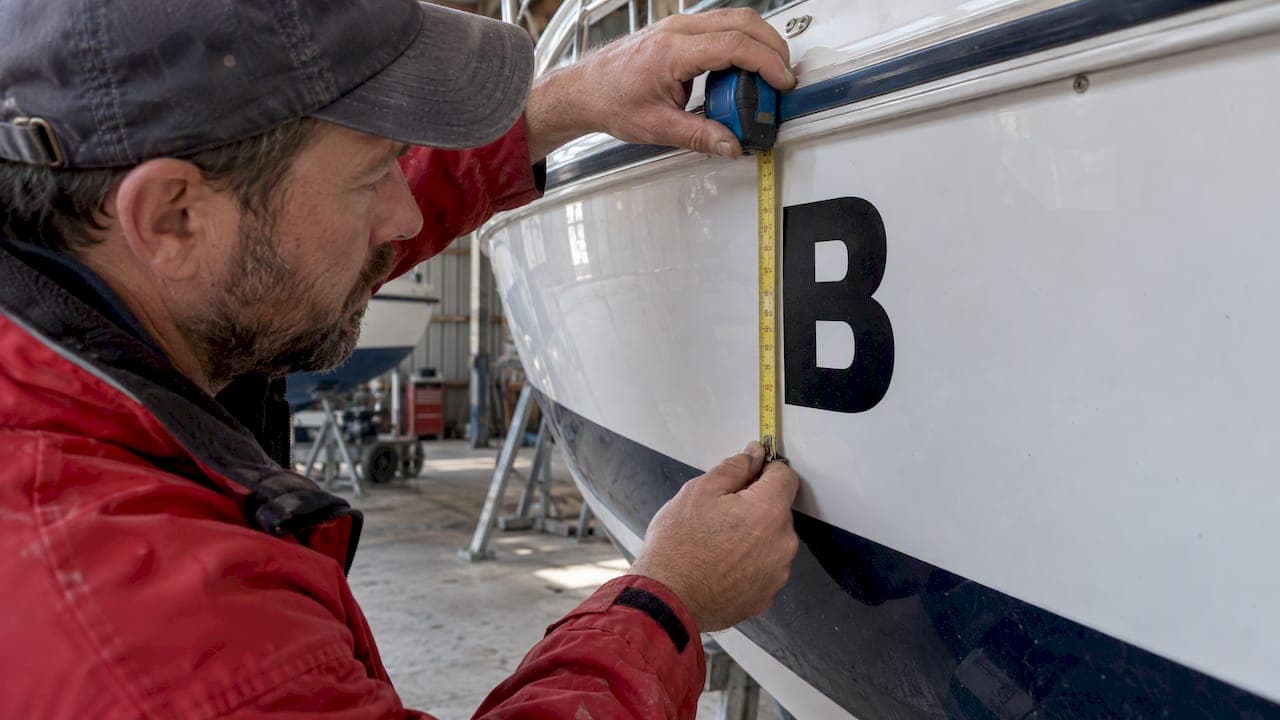
Your registration numbers must be plain vertical block characters at least 3 inches high, in a color that contrasts with your hull, placed on both sides of the forward half of your boat, and readable left to right. Spacing or hyphens should equal roughly one character's width, and validation decals typically go within about 6 inches of the number. The baseline for all of this is 33 CFR 173.27.
TL;DR:
- Check whether your boat is state registered or federally documented; documented vessels put the name and hailing port on the stern and mark the official number inside.
- States differ on decal order and whether decals appear on one or both sides, so follow your boating agency’s diagram and match your certificate exactly.
- Measure the shortest applied character after installation, since vinyl may stretch and paint may bleed; a design file showing 3 inches does not guarantee compliance.
- Marine grade vinyl is removable and straightforward to install, paint is permanent, and raised characters resist abrasion but often require more installation effort.
- Apply vinyl on a calm, dry day above 50 degrees Fahrenheit, and test a small hull patch first because cold or damp conditions weaken adhesion.
Table of Contents
- Federal baseline: what 33 CFR 173.27 actually requires
- State variations and where validation decals go
- Design specifics: font, size, color, and spacing that pass inspection
- Placement and measuring: a step-by-step layout method
- Materials and application methods: vinyl, paint, or raised characters
- Quick compliance checklist you can follow before launch
- How RegistrationDecals.com supports compliance with marine-grade decals
- Instructions for measuring and spacing the registration numbers correctly
- Maintenance and care for decals in marine environments
- Step-by-step design process for compliant boat numbers
- Comparing materials for boat numbers: durability and ease of use
- Practical view: keep legal markings simple
- Where to order compliant custom decals
- FAQ
- Sources
Federal baseline: what 33 CFR 173.27 actually requires
The federal rule is short, but every clause matters at inspection time. 33 CFR 173.27 sets the floor that every state registration number has to clear, regardless of where you boat.
- Characters must be plain, vertical block letters and numbers, not script, italic, or decorative fonts.
- Height must be at least 3 inches, measured on the applied character, not just the printed design.
- Color must contrast clearly with the hull or background panel behind it.
- Numbers must appear on both sides of the vessel, on the forward half, and read left to right.
- Spacing or a hyphen between the letter and number groups should equal about the width of one character.
If your hull color makes contrast difficult, a painted or attached backing plate in a contrasting color solves the problem without repainting the hull. Documented vessels follow a different system entirely: the vessel's name and hailing port go on the stern, and the official number is marked inside the hull rather than displayed as a bow registration number. Before designing anything, confirm with your state agency whether your boat is state-numbered or USCG-documented, since the two paths require different markings.
State variations and where validation decals go
States build on the federal floor, and that's where most of the real-world differences show up. Validation decal rules are the most common source of confusion.
- Decals are generally affixed within about 6 inches of the registration number, though some states place them before the number and others after.
- A comprehensive guide to state registration rules notes that some states only require decals on one side, while others require both.
- Your state's boating agency diagram or mailed instructions, not a generic guide, is the final word on exact layout.
- Whatever appears on your certificate should match your hull display exactly, including spacing and character sequence.
Pull up your state's printed instructions before you apply anything permanent. A five-minute check avoids a redo later.
Design specifics: font, size, color, and spacing that pass inspection
Good design here means restraint. Plain block characters, like Helvetica or Arial Bold, satisfy the federal requirement; script, outline, shadowed, or condensed decorative fonts do not, and they're a common reason boats get flagged during dockside checks described in the state registration rules guide.
- Minimum height is 3 inches across every character, not an average, so measure the shortest letter after it's applied.
- High-contrast pairs work best: dark numbers on white or light hulls, white or light numbers on dark hulls.
- Spacing or a hyphen between the prefix, number, and suffix should equal roughly the width of one character, as detailed in guidance on spacing between boat registration numbers.
- Formatted examples typically look like "DC 5678 EF" or "DC-5678-EF," depending on your state's preferred format.
Avoid stacking the number vertically or wrapping it around a curve sharp enough to distort letter height, since both can trigger a measurement failure even if the design looked fine on paper. For more on which typefaces satisfy the font requirements for boat registration numbers, check your state's exact specification before finalizing artwork.
Pro Tip: Print your design at full scale on paper first and tape it to the hull to check readability from a few feet away before committing to vinyl or paint.
Placement and measuring: a step-by-step layout method
Getting the numbers level, identical on both sides, and properly sized takes a measured approach rather than eyeballing it.
- Pick a reference point on the forward half of the hull, usually near the bow rail or a visible seam, and measure an equal distance aft on both port and starboard sides.
- Mark the top and bottom of the character area with painter's tape to keep the layout level and identical on both sides.
- Check the height above the waterline so the number stays visible even when the boat is loaded or underway.
- Confirm orientation reads left to right when viewed from outside the boat, since mirrored or reversed numbers are a common citation trigger noted in the state rules guide.
- Apply a single test character, let the adhesive set, then measure it with a ruler or straightedge to confirm it holds at a true 3 inches.
Photograph both sides once everything is applied. It gives you a quick reference if you ever need to confirm compliance without hauling out a tape measure again.
A single applied test character, measured at three points after the adhesive sets, is the most reliable way to confirm your 3-inch minimum actually holds up once installed.
If your boat is used for dealer demos, manufacturer transport, or temporary display, a removable backing plate lets you swap or remove numbers without repainting or re-applying vinyl each time.
Materials and application methods: vinyl, paint, or raised characters
Each display method satisfies the federal rule differently, and the right choice depends on how much you value ease of installation versus long-term permanence.
- Vinyl decals are the most common choice for recreational boats: easy to apply, removable for re-registration, and available in marine-grade materials rated for UV and saltwater exposure.
- Paint offers a permanent finish but depends heavily on a steady hand or stencil work to keep block characters crisp and evenly spaced.
- Raised or molded characters are the most durable option, often used on larger or commercial-style vessels, though they take more effort to install correctly.
Before applying anything, clean the surface thoroughly with isopropyl alcohol to remove wax, salt residue, and oils. Dry application tends to work better for beginners because it keeps the decal from sliding during alignment, while wet application lets experienced installers reposition before the adhesive sets. Test a small patch of hull first if you're unsure how the material will bond.
Pro Tip: Apply decals on a calm, dry day above 50 degrees Fahrenheit, since cold or damp conditions weaken adhesive bonds on marine vinyl.
Quick compliance checklist you can follow before launch
Run through this list before you head to the ramp, especially right after a fresh application or a state re-registration.
- Characters measure at least 3 inches, verified after installation.
- Font is plain block style, no script or decorative elements.
- Color contrasts clearly against the hull or backing plate.
- Numbers appear on the forward half, both sides, reading left to right.
- Spacing or hyphen equals about one character's width.
- Validation decals sit within roughly 6 inches of the number, per your state's diagram.
- No other similar-sized numbers sit near the bow that could cause confusion, a point covered in guidance on extra numbers near the bow.
- Photos of both sides are saved for your records.
| Checklist item | Federal or state source |
|---|---|
| 3-inch minimum height | 33 CFR 173.27 |
| Plain block characters | 33 CFR 173.27 |
| Forward half, both sides, left to right | 33 CFR 173.27 |
| Validation decal within about 6 inches | State registration rules guide |
Always double-check your issuing state's diagram for the exact decal location since that detail varies more than the federal rule itself.
How RegistrationDecals.com supports compliance with marine-grade decals
Custom boat registration decals are available, with product lines for jet skis, pontoons, bass boats, aluminum hulls, and center consoles, made from marine-grade vinyl that resists UV fading and saltwater exposure. An online design tool helps lock in correct height and spacing before ordering, so the layout matches federal and state specifications from the start. Production typically runs 3 to 5 business days with free shipping across the contiguous United States. For placement and measuring, our guide on where registration numbers go on a boat walks through the same forward-half logic in more visual detail.
Instructions for measuring and spacing the registration numbers correctly
Start with the character height, since it's the measurement most often done wrong. Measure the applied character itself, top edge to bottom edge, at its shortest point, not the digital file or the decal backing paper. If any character falls under 3 inches once applied, it fails the federal minimum regardless of what the design file said.
Spacing comes next. The gap between your state prefix, the number sequence, and the suffix should equal roughly the width of one character, whether you're using a hyphen or a blank space. A format like "FL 1234 AB" needs consistent gaps on both sides of the number block, and the hyphenated version, "FL-1234-AB," follows the same logic with the hyphen standing in for that gap.
Lay out the full sequence on a flat surface or template before transferring it to the hull. Use a level or straightedge to keep the baseline consistent across all characters, since even a slight upward or downward drift becomes obvious once the decal is permanent. Measure from your chosen forward-half reference point to the start of the first character, then repeat the exact same distance on the opposite side so both sides match.

Once applied, remeasure. Vinyl can stretch slightly during application, and paint can bleed at the edges, both of which affect final character height. A five-minute check with a tape measure after installation catches problems while they're still easy to fix.
Maintenance and care for decals in marine environments
Marine-grade vinyl is built to handle UV exposure and saltwater, but a little routine care extends its appearance and adhesion considerably. Rinse your hull with fresh water after saltwater trips, paying attention to the decal edges where salt crystals tend to accumulate and work under the adhesive over time.
Avoid high-pressure washers aimed directly at the decal edges, since concentrated pressure can lift the vinyl at the corners. A soft cloth or sponge with mild soap handles routine cleaning without stressing the adhesive bond.
Check the decal edges periodically for lifting, especially after extended sun exposure or a long winter in storage. A small lifted corner can be pressed back down early, but once water gets underneath, the decal usually needs replacement rather than repair.
Avoid parking your boat decal-side against a dock bumper or trailer bunk for extended periods, since constant pressure and friction wear down the vinyl surface faster than normal sun and water exposure. If you store your boat outdoors year-round, a breathable cover that doesn't trap moisture against the hull helps preserve both the decal and the surrounding gelcoat.
Step-by-step design process for compliant boat numbers
The fastest path to a compliant design starts with your state's exact registration number and format, issued when you register or renew. Write it down exactly as it appears on your certificate, hyphens and spacing included.
From there, an online design tool simplifies the process considerably: enter your registration number, select a font that meets the plain block requirement, choose a contrasting color pair, and the tool automatically keeps height and spacing within compliant ranges. This removes the guesswork of manually calculating spacing or second-guessing whether a font qualifies as "block style."
If you prefer a manual approach, start with a vector design program or even a printed stencil, using a plain block font like Helvetica Bold. Set the character height to exactly 3 inches or slightly larger to account for any trimming or application stretch, then calculate spacing manually using the one-character-width rule.
Either way, proof your design against your state's instructions before ordering or printing: confirm the format matches your certificate, the color contrasts with your hull, and the characters read left to right when viewed from the dock. Order a physical sample or test print when possible, since colors and proportions can look different on a screen than on a curved hull surface.
Comparing materials for boat numbers: durability and ease of use
The three common display methods, vinyl, paint, and raised characters, each trade off differently between durability, ease of installation, and how well they satisfy the regulatory baseline.
Vinyl decals install the fastest and require no painting skill, since the backing paper handles alignment and the adhesive does the rest. Marine-grade versions resist UV fading and saltwater degradation, and because they're removable, they're the simplest option when you re-register or sell the boat. They meet the federal plain block and contrast requirements as easily as any other method, provided the font and color are chosen correctly.
Paint offers a permanent finish that some owners prefer for a built-in look, but it depends entirely on steady freehand work or careful stencil use. Uneven edges, bleeding, or inconsistent height are common problems that can push a painted number under the 3-inch minimum in places, even when the design intended otherwise.
Raised or molded characters are the most durable option physically, standing up well to abrasion and long-term sun exposure, but they take more effort and often professional installation to align correctly on a curved hull. For most recreational boat owners, marine-grade vinyl balances the three factors best: durable enough for seasonal and year-round use, simple enough for a weekend installation, and fully capable of meeting 33 CFR 173.27 when sized and spaced correctly.

Practical view: keep legal markings simple
Registration numbers aren't the place for creative flair. Readability and contrast matter more than style, so save decorative graphics, flames, or custom lettering for other parts of the hull where compliance rules don't apply.
— Taylor
Where to order compliant custom decals
Marine-grade vinyl remains one of the simplest, most widely used ways to meet the federal and state baseline without repainting your hull. Our custom boat registration numbers and decals are built from UV and saltwater-resistant vinyl, with an online design tool that keeps sizing and spacing within the ranges this guide covers, plus 3 to 5 business day production and free shipping across the contiguous United States.
If you own a pontoon, jet ski, bass boat, or aluminum hull, dedicated product lines like jet ski numbers or pontoon numbers are sized for those specific hull shapes. Start your order whenever you're ready to get a compliant set on the water.
FAQ
What is the minimum size for boat registration numbers?
Registration numbers must be at least 3 inches high, measured on the applied character itself, under 33 CFR 173.27. This is a federal floor, so some states may require the same minimum but never a smaller one.
Do boat registration numbers need to go on both sides?
Yes, federal rule requires numbers on both the port and starboard sides of the forward half of the hull, reading left to right. Our guide on whether numbers go on both sides confirms this applies to nearly all state-numbered recreational vessels.
How far apart should the letters and numbers be spaced?
Spacing or a hyphen between character groups should equal roughly the width of one character, as outlined in 33 CFR 173.27. A format like "DC 5678 EF" or "DC-5678-EF" satisfies this requirement consistently.
What happens if my boat is USCG-documented instead of state-numbered?
Documented vessels follow a different marking system: the vessel's name and hailing port appear on the stern, and the official number is marked inside the hull rather than displayed as a bow registration number. The USCG boater's guide and a useful external resource on yacht documentation both explain when documentation applies instead of standard state registration.
Can I use vinyl decals instead of painting numbers directly on my hull?
Yes, marine-grade vinyl decals are a widely used, fully compliant option as long as they meet the size, contrast, and placement rules in 33 CFR 173.27. They're also removable, which makes re-registration or ownership changes simpler than repainting.