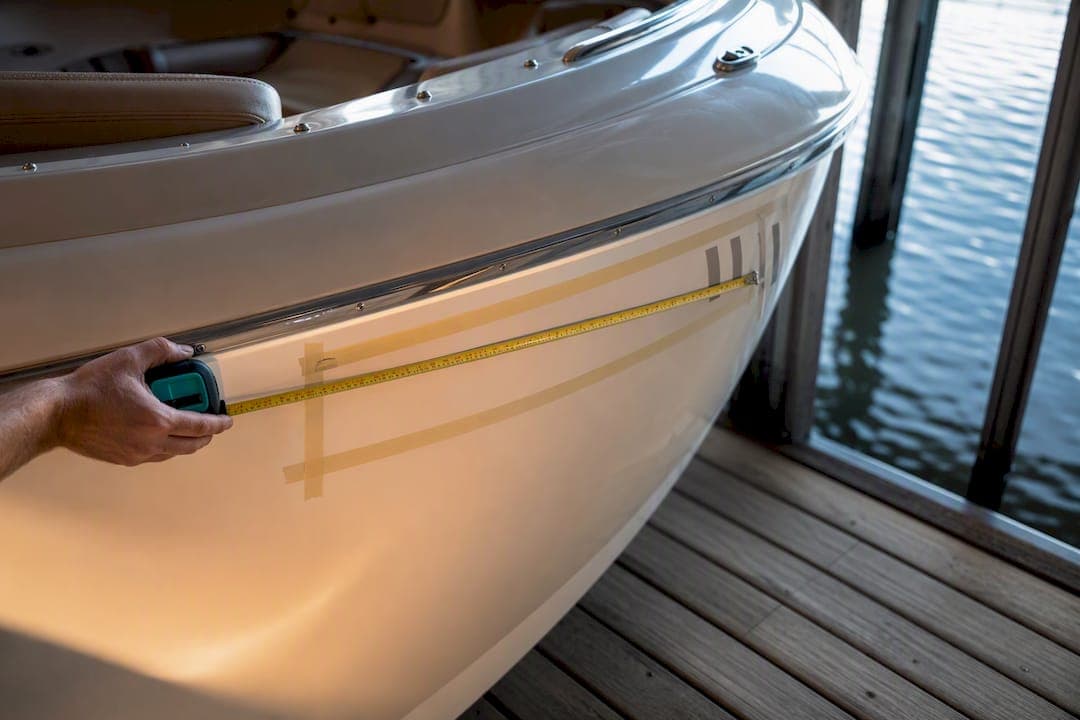
Make your registration numbers at least 3 inches tall in block characters, mounted on the forward half of the hull, on both sides, with decals within about 6 inches of the number toward the stern. Before you order or paint anything, measure the usable bow area in inches at that spot. That single measurement determines whether your numbers pass inspection or get flagged.
TL;DR:
- Ensuring boat numbers contrast with the hull color and are mounted on the forward half of the vessel is critical for passing inspection.
- Accurate measurement of the available space on the hull, including mock-up testing, prevents sizing and placement errors that cause inspection failures.
- Proper surface preparation, including cleaning and drying before applying decals, is vital to prevent peeling, bubbling, or lifting over time.
- Federal HINs are permanently affixed near the transom and must not be confused or covered with registration decals or numbers.
- Using marine-grade vinyl with UV protection and high contrast colors ensures legibility and durability for the decals in harsh conditions.
Table of Contents
- What are the state and federal display rules for boat numbers?
- How do you measure your boat for numbers?
- How do you apply boat numbers correctly?
- HIN vs. registration numbers: what's the real difference?
- Why do boat numbers fail inspection, and how do you fix it?
- What has RegistrationDecals.com learned from years of producing boat decals?
- Measure twice, order once: an editorial take
- Design compliant decals with RegistrationDecals.com
- Sources
What are the state and federal display rules for boat numbers?
Every state sets its own registration rules, but the pattern repeats almost everywhere. Numbers need to be block characters, at least 3 inches tall, running left to right, and placed so they contrast clearly against the hull color. A white hull needs dark numbers; a dark hull needs light ones. Gray-on-gray may look sharp in a showroom, but it fails the visibility test that inspectors actually care about.
Placement matters as much as height. The numbers belong on the forward half of the vessel, visible on both sides, not tucked near the stern or hidden behind rails and cleats. Registration decals, which show your renewal status, typically go within about 6 inches of the number toward the back of the boat. Only the current decal can be showing. Virginia DWR's guidance is a good example of how states structure this: 3-inch minimums, forward-half placement, and the 6-inch decal rule show up in some form across most jurisdictions.
Formatting follows a set order too:
- State prefix, followed by the number sequence, followed by a letter suffix
- Characters separated by a space or hyphen, depending on what the issuing state requires
- Always read left to right, never stacked or reversed
One separate detail trips people up constantly: the federal Hull Identification Number is not the same thing as your state registration number. The HIN is a 12-character code, permanently affixed at or near the transom, governed by 33 CFR § 181.25 and § 181.29. More on that distinction below.
How do you measure your boat for numbers?
Grab a flexible tape measure, a straightedge, a roll of masking tape, a marker, and a level or laser line if you have one. That's the full kit. You don't need anything specialized to get accurate numbers.
- Pick your baseline. Mark a horizontal line on the hull, forward of midship, where the numbers will sit.
- Measure usable width. Run the tape along that line from where the numbers start to where the curve of the bow starts cutting into readable space.
- Record vertical clearance. Check how much height you have for the tallest character before you hit a rail, rub strip, or seam.
- Check both sides. Confirm the port and starboard measurements are close enough to mount symmetrically.
For sizing math, a standard 3-inch character set typically runs a certain width sufficient for six characters, depending on font and spacing. Scale the width proportionally if you're going taller than the minimum. Round measurements to the nearest eighth of an inch where the surface curves, since even small rounding errors show up once six characters are lined up across a bow.
Pro Tip: Do a dry mockup with masking tape before you commit to anything. Tape out the full character string at your measured width, step back ten feet, and check it from a normal viewing distance. Curved hulls hide alignment problems that only show up once you're not standing right on top of them.
How do you apply boat numbers correctly?
Surface prep decides more install outcomes than any other single step, and proper gelcoat protection can be vital to preparing and maintaining the surface before applying decals. Remove wax, degrease the area completely, and let it dry fully before you touch a decal to the hull. Skipping this is the single most common reason numbers peel or bubble within a season.
- Wipe down with isopropyl alcohol or a dedicated degreaser, not just soap and water
- Lightly scuff glossy gelcoat if the decal manufacturer recommends it for adhesion
- Let the surface dry completely; trapped moisture causes bubbling later
For alignment, use the hinge method: tape the decal in place, fold it back on a center hinge of masking tape, then peel and apply one half at a time. Measure off a centerline first, especially for longer number strings, so you're not eyeballing symmetry.
Wet application gives you the most forgiveness. Mix a mild soap-and-water solution, wet the surface, position the decal while it can still slide, then squeegee the water out from the center toward the edges. This method is the one Hoosier Decal's installation guide recommends for first-timers and for longer number sequences, since the extra time to adjust position matters more than the marginally faster dry cure.
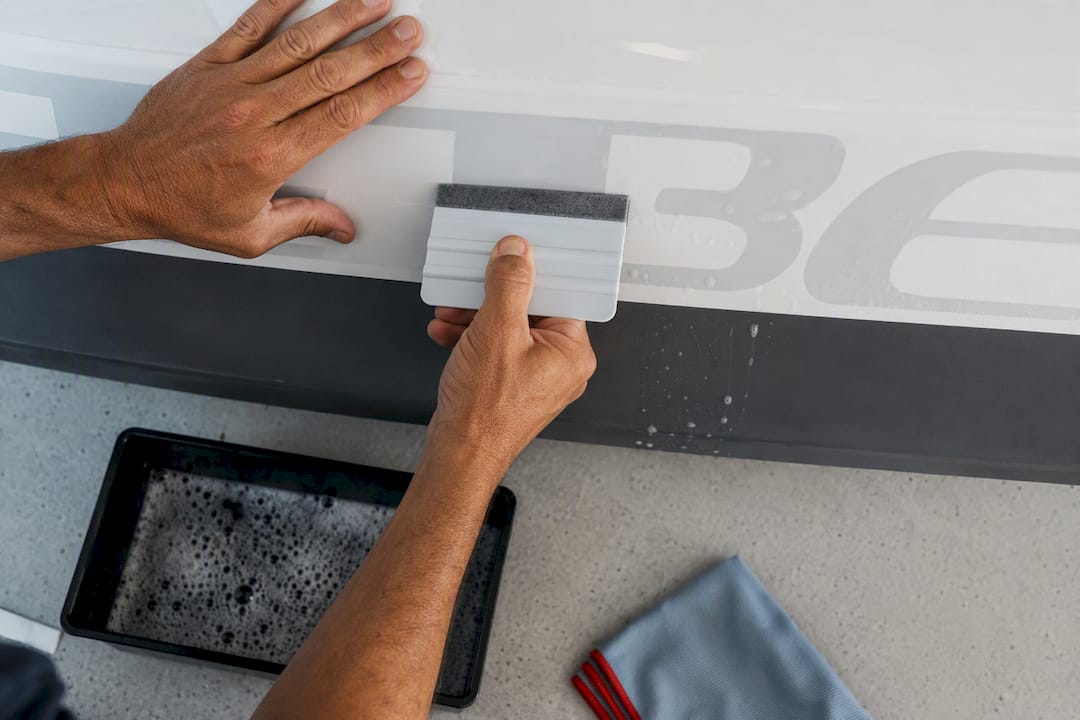
Dry application skips the water. You peel and place directly, which works fine for short numbers and installers who've done this before, but it leaves zero room to slide the decal once it touches the hull.
Pro Tip: If a decal starts lifting at the edges after a hot day, a heat gun on low, run gently over the lifted section, will often re-soften the adhesive enough to press it back down. If that doesn't hold, the adhesive has failed and it's time to replace the piece rather than patch it.
HIN vs. registration numbers: what's the real difference?
These two numbers get confused constantly, and mixing them up is the most common regulatory mistake boat owners make. They're governed by different authorities, serve different purposes, and follow completely different display rules.
- HIN (Hull Identification Number): A 12-character code assigned once, federally regulated, permanently affixed at or near the transom with characters at least 1/4 inch tall under federal display rules.
- Registration number: State-issued, renewed periodically, displayed prominently on the forward half of the hull at a minimum of 3 inches tall, visible from both sides.
Never paint over, alter, or obscure your HIN. It functions as a legal identifier tied to ownership and theft recovery, separate from your visible registration number entirely. Confusing the two, or worse, covering the HIN with a numbers decal because it seemed like convenient real estate, creates a real compliance problem. For a side-by-side breakdown, RegistrationDecals.com's HIN versus registration number explainer walks through exactly where each one belongs.
Why do boat numbers fail inspection, and how do you fix it?
Most inspection failures trace back to one of three problems: poor contrast, peeling decals, or numbers sized wrong for the available space.
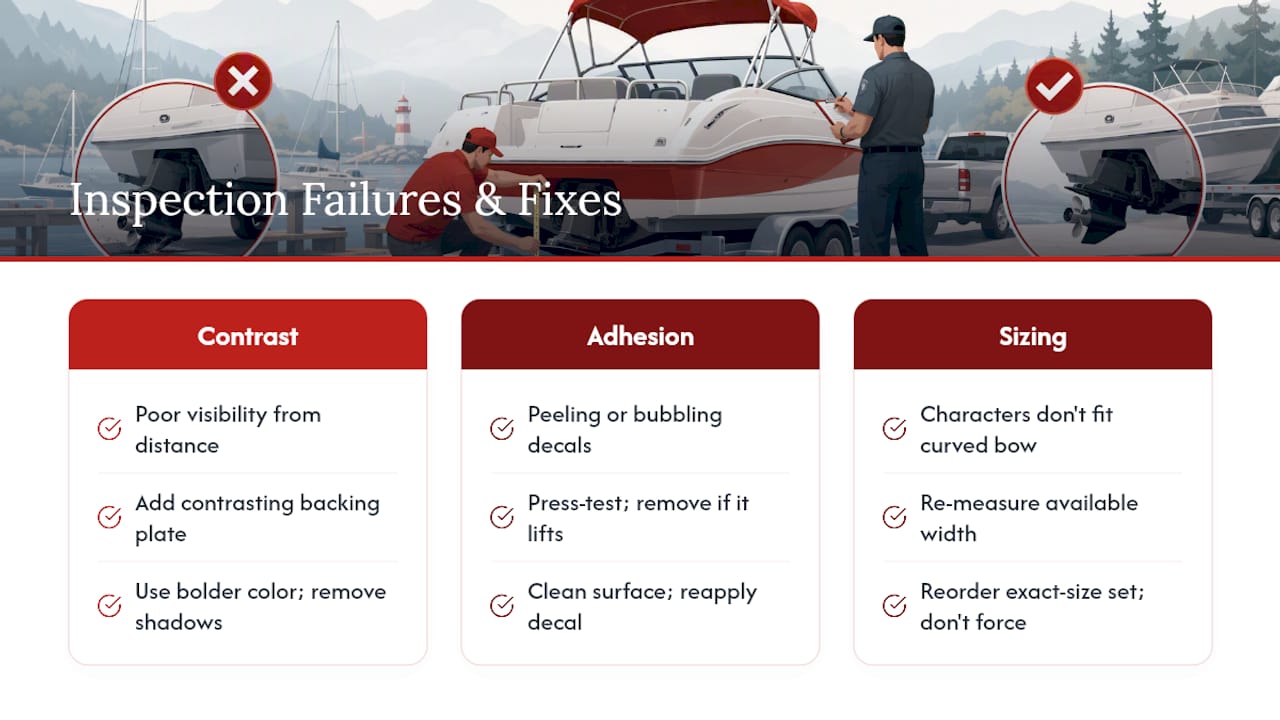
Visibility issues usually mean the color choice didn't account for lighting or hull glare. Adding a contrasting backing plate behind the numbers, or swapping to a bolder color, solves most of these without a full reapplication. Drop decorative outlines and shadow effects too. They look good in a design preview and disappear from thirty feet on the water.
Peeling or bubbling almost always traces back to skipped surface prep, a point installer guides consistently flag as the most common failure cause. Press-test a corner: if it lifts with light pressure, pull the whole decal, clean the surface properly, and reapply rather than trying to patch a bad bond.
Sizing errors happen when someone orders based on a guess instead of an actual measurement, then tries to force an oversized character set onto a curved bow where it doesn't fit flat. Re-measure, reorder to that exact width, and don't compromise on curvature.
For upkeep, skip abrasive polishes near the numbers, use a UV protectant on the surrounding gelcoat, and check the decals once a year for lifting edges before they become a bigger problem.
What has RegistrationDecals.com learned from years of producing boat decals?
Marine-grade vinyl is not optional if you actually want the numbers to last. UV exposure fades cheap vinyl within a season or two, and saltwater works its way under weak adhesive within months. A durable, state-compliant vinyl built for marine conditions holds color and adhesion far longer, which matters directly for legibility, since faded or lifting numbers are exactly what draws inspection attention.
Order high-contrast colors, not whatever matches your hull scheme. A number set that blends into the boat looks great at the dock and fails the one job it has on the water.
Use the site's preview tool before finalizing anything, since it catches sizing mismatches before they become a shipping delay. Production runs 3 to 5 business days, so build that into your timeline if you're racing a registration deadline. And when old decals come off, dispose of the backing and adhesive residue properly rather than leaving scraped vinyl loose in the bilge.
Measure twice, order once: an editorial take
The advice that gets repeated most about boat numbers, "just make sure they're big enough," is the wrong emphasis entirely. Size minimums are the easy part. Almost nobody fails inspection because their numbers are 2.5 inches instead of 3. They fail because of contrast, curvature miscalculation, or decals crumbling after two seasons of saltwater.
If there's one thing worth prioritizing over everything else in this process, it's the ten minutes spent measuring actual usable hull space before ordering anything. A masking-tape mockup at your real measured width will show you problems a spec sheet never will. Curved bows eat width fast, and six characters that fit fine on paper can crowd badly once they're wrapped around real fiberglass.
The HIN and registration number confusion deserves more attention than it usually gets, too. Painting over or altering a federal HIN because it looked like open space is a mistake that's entirely avoidable with five minutes of research beforehand.
Compliance here isn't really about satisfying an inspector. It's about a number that stays legible enough for search and rescue to read it from a moving boat in bad light. Everything else, the font choice, the color scheme, is secondary to that.
— Taylor
Design compliant decals with RegistrationDecals.com
An online design tool helps you go from measurement to installed decal without the guesswork of matching a font size to a spec you're not sure about. The online design tool lets you enter your actual measured width, preview color contrast against your hull tone, and confirm the fit before you commit to an order, so you're not eyeballing proportions from a catalog photo.
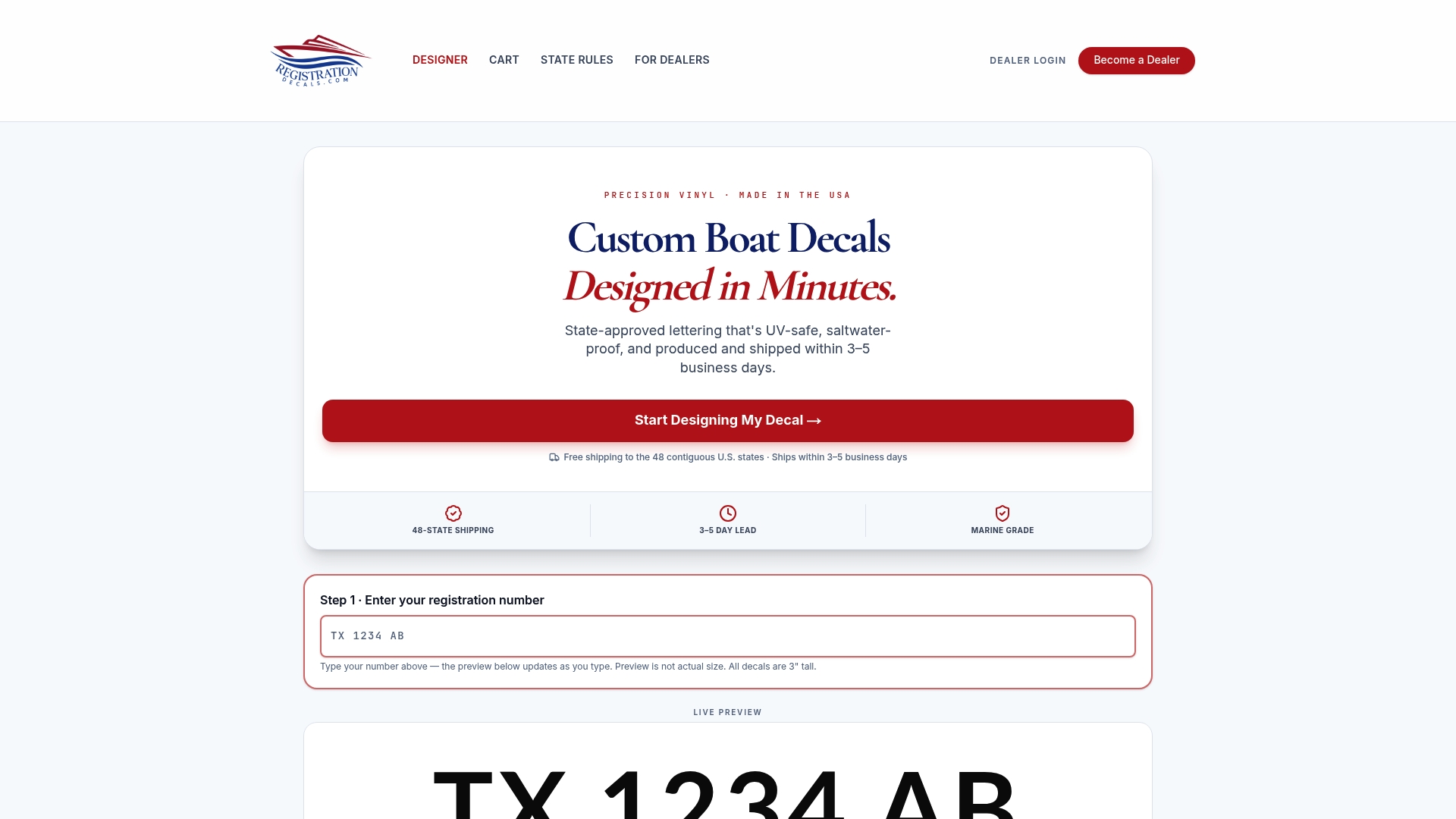
Preset sizing options align with the common state minimums covered above, and the guidance pages walk through placement specifics for different hull types, including how pontoon placement differs from a standard bow. Marine-grade vinyl decals ship with a production window of 3 to 5 business days and free shipping across the contiguous United States. Confirm your own state's exact requirements first using the regulations by state page, then head to the design tool and enter your measurements to get a proof back the same day.
Sources
- 33 CFR § 181.25 and § 181.29 — Hull identification number format and display
- Watercraft registration, titling, and sales tax requirements | Virginia DWR