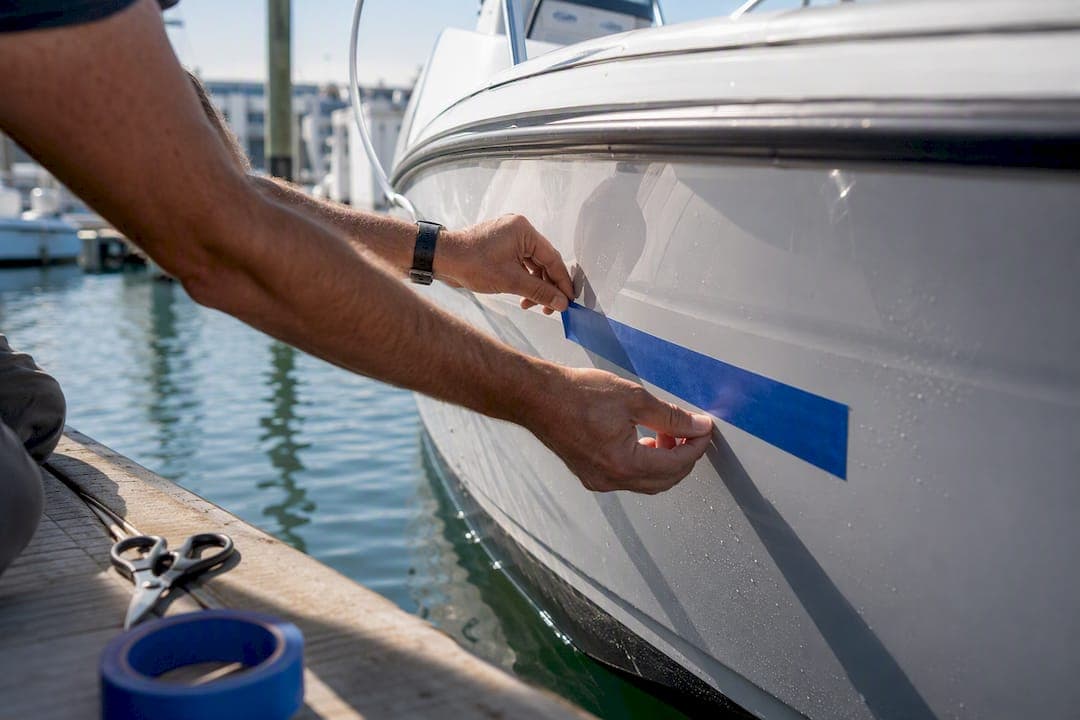
A Hull Identification Number (HIN) is a permanent, manufacturer-assigned identifier for a boat, similar to a car's VIN. A registration number is a state-issued operating ID you must display to legally run the boat, similar to a license plate. One never changes; the other can, depending on where you live and who owns the boat.
- HIN: assigned once by the manufacturer (or the state, for older or homemade boats), tracked by the U.S. Coast Guard's Manufacturer Identification Code system, and used for title and history checks.
- Registration number: issued by your state boating authority, tied to current ownership, and used for on-water enforcement.
- Need both, but for different reasons: the HIN proves what the boat is; the registration number proves who's operating it legally right now.
Key Takeaways
A HIN is a permanent, federally standardized hull identifier assigned once by the manufacturer, while a registration number is a state-issued operating ID that changes with ownership and location.
| Point | Details |
|---|---|
| HIN is permanent | The 12-character format never changes once assigned by the manufacturer or state. |
| Registration numbers change | They update with ownership transfers, renewals, or moves to a new state. |
| Location matters for verification | Check the starboard transom for the HIN and both bow sides for registration decals. |
| Match numbers before buying | Always compare the hull's HIN to the title and bill of sale before any purchase. |
| Marine-grade vinyl protects compliance | UV-resistant, saltwater-proof decals stay legible longer than standard vinyl. |
Table of Contents
- HIN vs Registration Number at a Glance
- What Is a Hull Identification Number (HIN)?
- What Is a Boat Registration Number?
- Where Is the HIN Located on a Boat?
- Buying, Selling, or Titling: Which Number Actually Matters?
- Getting Your Decals Right: Materials and Sizing That Meet State Rules
- Why This Distinction Gets Overlooked More Than It Should
- Sources
HIN vs Registration Number at a Glance
The two identifiers overlap in purpose but never overlap in function. One is baked into the hull for life. The other rides on a decal that changes with ownership, state, or renewal cycles.
| Dimension | HIN | Registration Number |
|---|---|---|
| Purpose | Permanent identity of the physical hull | Proof of current legal registration to operate |
| Who issues it | Manufacturer (via USCG-assigned Manufacturer Identification Code), or state if built before 1972 or homemade | State boating authority (e.g., Washington DOL, Wisconsin DNR) |
| Permanence | Fixed for the life of the hull | Changes with ownership, renewal, or state relocation |
| Typical location | Starboard transom, upper right | Both sides of the bow, in a decal |
| Legal basis | Federal rule, required since November 1, 1972 | State law, varies by jurisdiction |
If you're checking a boat's history or resolving a title dispute, the HIN is your reference point. If you're making sure you can legally launch this weekend, the registration number and decal are what a marine officer will check.
Pro Tip: Write down your HIN and photograph it the day you buy the boat, then save that photo with your title paperwork. If the plate ever gets scratched, painted over, or swapped during a resale dispute, you'll have your own record to fall back on.
What Is a Hull Identification Number (HIN)?
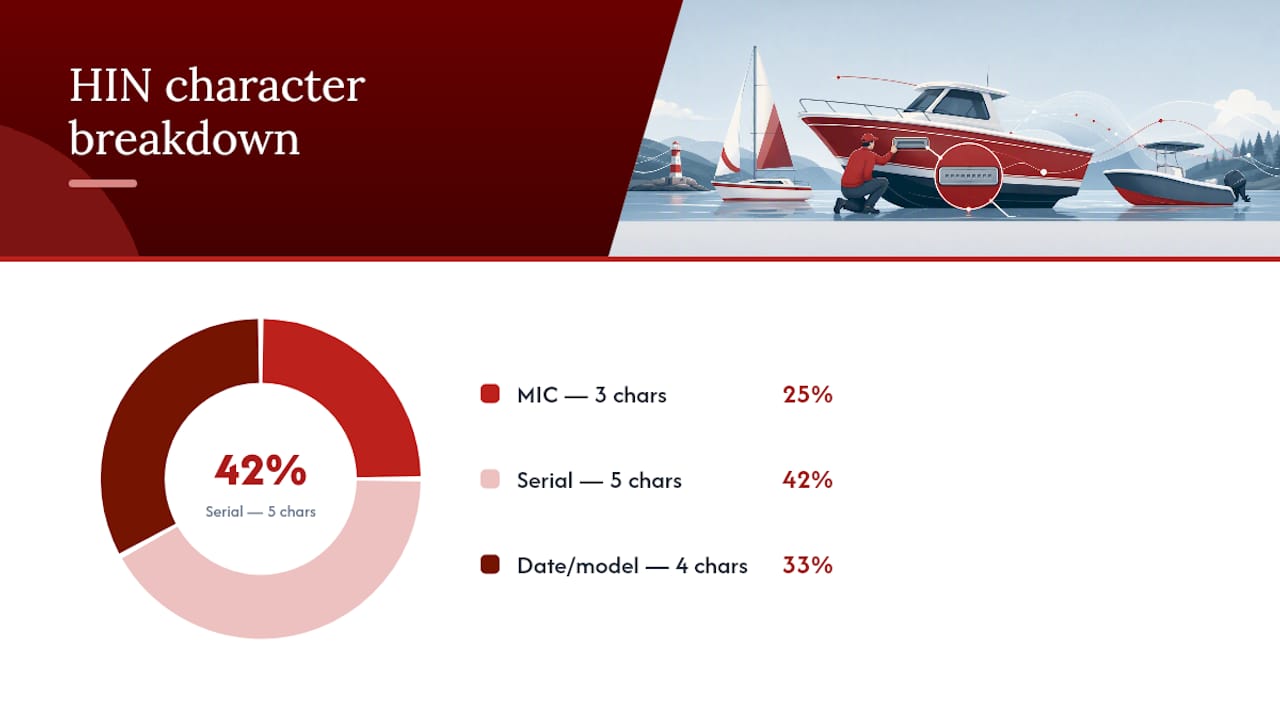
Every boat manufactured or imported into the United States after November 1, 1972 must carry a 12-character Hull Identification Number, and that number never changes for the life of the hull.
The 12 characters aren't random. They break down into three parts:
- Manufacturer Identification Code (MIC): the first three characters, assigned by the U.S. Coast Guard to identify who built the boat.
- Serial section: the next five characters, a unique hull serial number the manufacturer assigns.
- Date/model code: the final four characters, encoding the month and year of certification along with the model year.
Manufacturers typically skip the letters I, O, and Q in HINs, since those characters are too easily confused with the numbers 1 and 0. Federal marking rules for hull identification are laid out in 33 CFR Part 173, which governs how HINs must be assigned and displayed. Because the MIC ties directly back to a specific builder, the Coast Guard can use it to trace a boat's manufacturing origin decades after it left the factory, which matters enormously in stolen-boat recovery and title verification.
What Is a Boat Registration Number?
A registration number works like a license plate for your boat. Your state issues it when you register the vessel, and it stays tied to your ownership record, not the hull itself.
Format varies by state, but most follow a similar pattern: a two-letter state prefix, a string of numbers, and a two-letter suffix, typically separated by hyphens (something like WA-1234-AB). A handful of states use slightly different spacing or letter placement, so always check your registration card rather than assuming a neighboring state's format applies to you.
Display rules are where most owners slip up. Here's the general pattern most states follow:
- Numbers go on both sides of the forward half of the boat, read left to right.
- Characters must be block letters, plain and vertical, at least 3 inches tall in most states.
- Numbers need to contrast sharply with the hull color, so a white hull needs dark lettering and vice versa.
- Any required decals (validation stickers, county stickers) mount close to the registration number, often within a few inches.
Washington State's Department of Licensing spells out these exact spacing and contrast rules, and most states mirror that framework closely. Faded or peeling decals aren't just an eyesore. They're a fast way to get flagged during a routine safety check.
Where Is the HIN Located on a Boat?
Finding your HIN takes about thirty seconds once you know where to look, but plenty of owners never check until they need to.
The primary HIN sits on the starboard (right) side of the transom, within 2 inches of the top edge, stamped, molded, or affixed permanently. Manufacturers also place a duplicate HIN somewhere less exposed, often inside a hatch, beneath a fitting, or in another spot state agencies like Wisconsin's DNR require as a backup against tampering. That second number exists specifically so a damaged or altered primary plate doesn't erase the boat's identity.
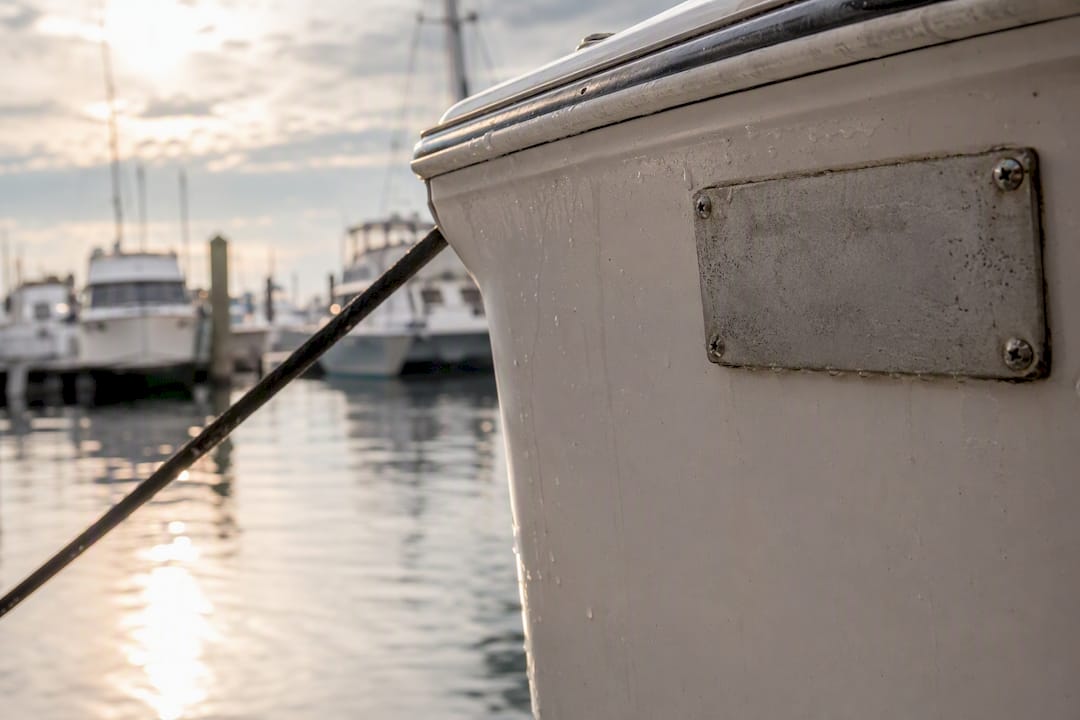
Registration numbers, by contrast, live on both sides of the bow, usually with the current decal mounted within about 6 inches of the number itself.
Run this quick check next time you're at the dock:
- Photograph both the primary and duplicate HIN.
- Compare the HIN on the hull against the number on your title, word for word.
- Look for scratches, uneven paint, or adhesive residue around the transom plate. That's often a sign a plate was swapped or altered.
Pro Tip: If the numbers on your hull and your title don't match exactly, stop the sale. That mismatch is one of the most common red flags in used-boat fraud.
Buying, Selling, or Titling: Which Number Actually Matters?
Every transaction hinges on getting the right number checked at the right moment, and skipping a step here is how title disputes happen months later.
- Before you buy: Physically match the HIN stamped on the transom to the HIN listed on the title and the bill of sale. Insist the bill of sale references the HIN, not just the registration number, since registration numbers change with ownership.
- After a sale or a move to a new state: Re-register the boat under the new state's rules and obtain fresh registration numbers and decals. The HIN travels with the boat unchanged.
- If the HIN is missing, damaged, or doesn't match: Contact the original manufacturer if it still exists, then reach out to your state's watercraft registration office. States follow Wisconsin DNR's approach for boats built before November 1, 1972, which allows for a state-assigned number when no federal HIN exists.
Getting Your Decals Right: Materials and Sizing That Meet State Rules
Compliance isn't just about picking the right numbers. It's about making sure they stay legible for years in sun, salt, and rough weather, which is where material choice actually matters more than most owners realize.
Standard vinyl fades and peels within a season or two on saltwater boats. Marine-grade UV-safe, saltwater-proof vinyl holds its contrast and adhesion far longer, which keeps you compliant with state height and legibility rules instead of scrambling to replace a peeling decal before a safety inspection.
A few practical steps before you order:
- Measure your hull twice to confirm you're meeting your state's minimum character height, usually 3 inches.
- Choose high-contrast color combinations against your hull, not just a color you like.
- Order a matching set for both sides of the bow, not a single decal.
- Build in 3 to 5 business days for production and shipping when timing a registration renewal.
If you're relocating, replace your decals to match the new state's format and hang onto your old registration paperwork. It smooths the title transfer process considerably.
| Point | Details |
|---|---|
| Material choice affects compliance | Marine-grade UV-safe vinyl resists fading and peeling, which keeps numbers legible for inspections. |
| Measure before ordering | Confirm your state's minimum character height, typically around 3 inches, before finalizing your design. |
| Order both sides | Registration numbers and decals need to appear on both sides of the bow, not just one. |
| Plan for production time | Expect 3 to 5 business days for production and shipping when timing a renewal. |
Why This Distinction Gets Overlooked More Than It Should
Most owners treat the HIN and registration number as interchangeable paperwork, and that's the mistake that causes real problems at resale time. The HIN is the boat's fingerprint. It doesn't care who owns the vessel or which state it's floating in. The registration number is closer to a rental agreement with the state, renewed, replaced, and reissued as circumstances change.
The conventional advice, "just make sure your numbers are displayed," undersells what's actually at stake. A mismatched HIN during a sale isn't a paperwork hiccup. It's the single clearest signal of a stolen hull or a title that's been laundered through a few too many private sales. Buyers who skip that one comparison are the ones who end up in a dispute months later with no legal claim to the boat they paid for.
If you're buying, prioritize the HIN check first, before you even think about registration paperwork. If you already own the boat, spend ten minutes photographing both numbers and filing them with your records. It's the cheapest insurance policy you'll ever take out on a boat.
Sources
- What is a Hull Identification Number?
- Uscgboating
- Boat registration and hull identification numbers | Washington State Department of Licensing
- Hull Identification Number (HIN) - Wisconsin DNR