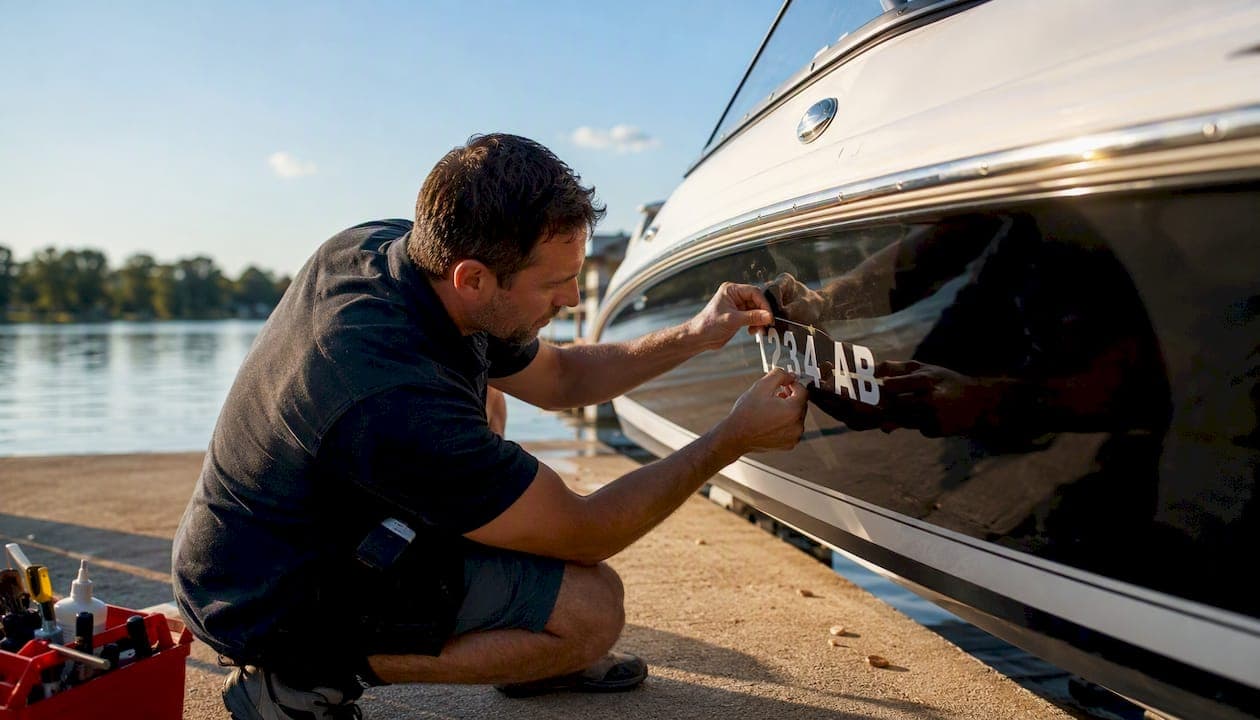
New York boat registration numbers follow a fixed format: the prefix "NY" followed by up to four digits and up to two capital letters, with each group separated by a space or hyphen exactly the width of a letter (example: NY 1234 AB or NY-1234-AB). Three rules cover most compliance failures before you even leave the dock:
- Letters must be block style, at least a few inches high, in a color that contrasts with the hull.
- Numbers must appear on both sides of the bow, reading left-to-right, on the forward half of the vessel.
- The display must be clearly readable from a typical reasonable distance in daylight.
The New York State Boater's Guide and NYS DMV are the two authoritative sources for every rule below.
Key Takeaways
New York boat registration numbers must follow the exact format NY 1234 AB, displayed in 3-inch block letters on both sides of the bow, readable from 100 feet, with validation stickers placed 3 inches to the stern of the number.
| Point | Details |
|---|---|
| Exact format required | NY + up to 4 digits + up to 2 letters, separated by a letter-width space or hyphen. |
| Display specs | Block letters, minimum 3 inches high, high-contrast color, both sides of the bow. |
| Validation sticker placement | In line with the number, 3 inches to the stern; documented vessels place stickers 18 inches from the bow. |
| Registration form | Complete MV-82B with proof of ownership, sales tax documentation, and fee payment. |
| Registrationdecals | Offers pre-spaced, marine-grade NY-compliant decal sets with a 3–5 business day turnaround and free contiguous-US shipping. |
Table of Contents
- What are the exact display requirements for New York boat registration numbers?
- Where do validation decals go, and what about documented vessels?
- How do you register a boat in New York and get your number?
- What you need to know about dealer-issued temporary registrations
- Why the Hull Identification Number matters for your registration
- Decal vs. painted numbers: which holds up on New York waters?
- How to apply registration number decals correctly
- Common mistakes that lead to citations on New York waters
- A practical perspective on getting this right
- Get NY-compliant registration decals from Registrationdecals
- Sources
What are the exact display requirements for New York boat registration numbers?
The format is precise and non-negotiable. According to the New York State Boater's Guide, your registration number must read: NY + up to four numbers + up to two capital letters, with each group separated by a space or hyphen that is the width of a single letter. "NY1234AB" with no separator fails. "NY 1234 AB" with double-width gaps also fails. The separator width is its own specification.
Letter style and size are equally strict. Block letters only, no script or decorative fonts, and nothing smaller than 3 inches high. The color must contrast with the hull background so the number reads clearly from a distance. White letters on a white hull, or dark letters on a dark hull, will not pass.
Placement is where many owners get tripped up. The number goes on both the port and starboard sides of the bow, on the forward half of the vessel, reading left-to-right on each side. Critically, it must be the only number displayed on the forward half. Any additional numerals, hull codes, or manufacturer markings in that zone can confuse Marine Patrol during an inspection or emergency identification.
| Requirement | Specification |
|---|---|
| Format | NY + up to 4 digits + up to 2 capital letters |
| Separator | Space or hyphen, width of one letter |
| Letter style | Block letters only |
| Minimum letter height | 3 inches |
| Color | High contrast with hull background |
| Placement | Both sides of the bow, forward half |
| Visibility | Readable from at least 100 feet |
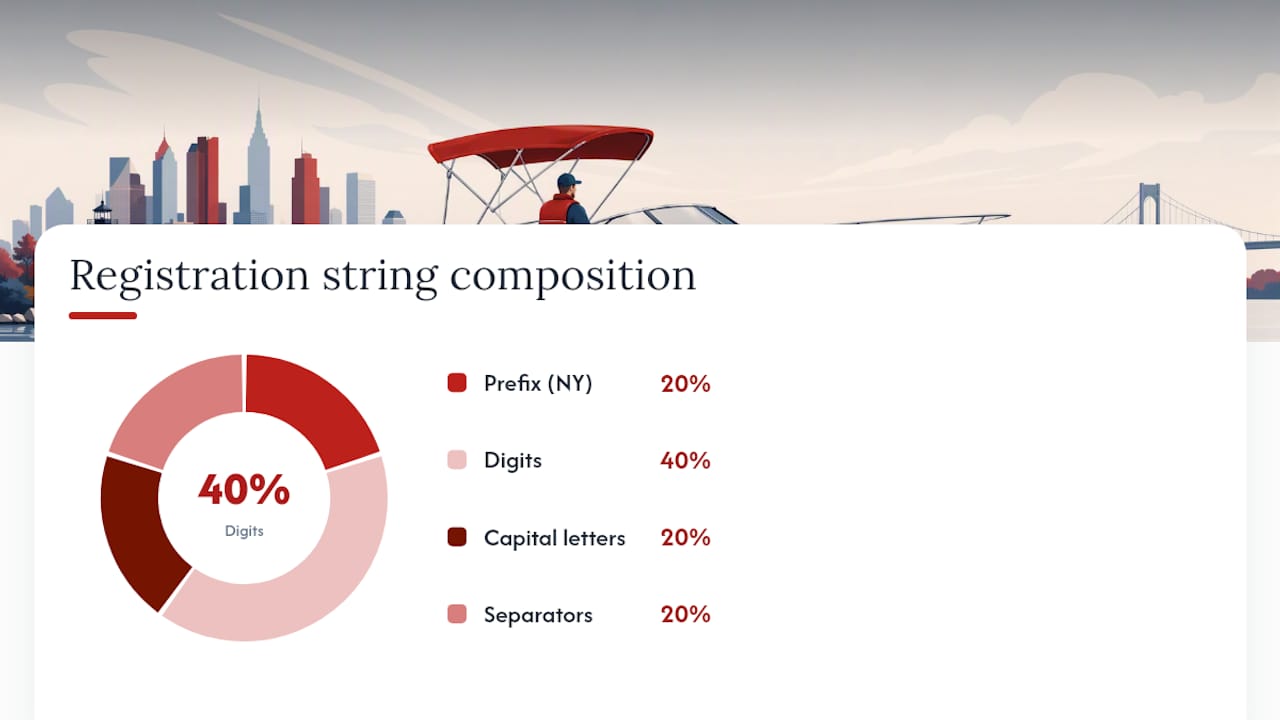
Valid: NY 1234 AB, NY-1234-AB Invalid: NY1234AB (no separator), ny 1234 ab (lowercase), NY 1234 AB with a thin dash instead of a letter-width gap
Where do validation decals go, and what about documented vessels?
Validation stickers go on both sides of the bow, positioned in line with the registration number and slightly toward the stern of that number. They do not float above or below the number line — they sit alongside it, offset to the stern side.
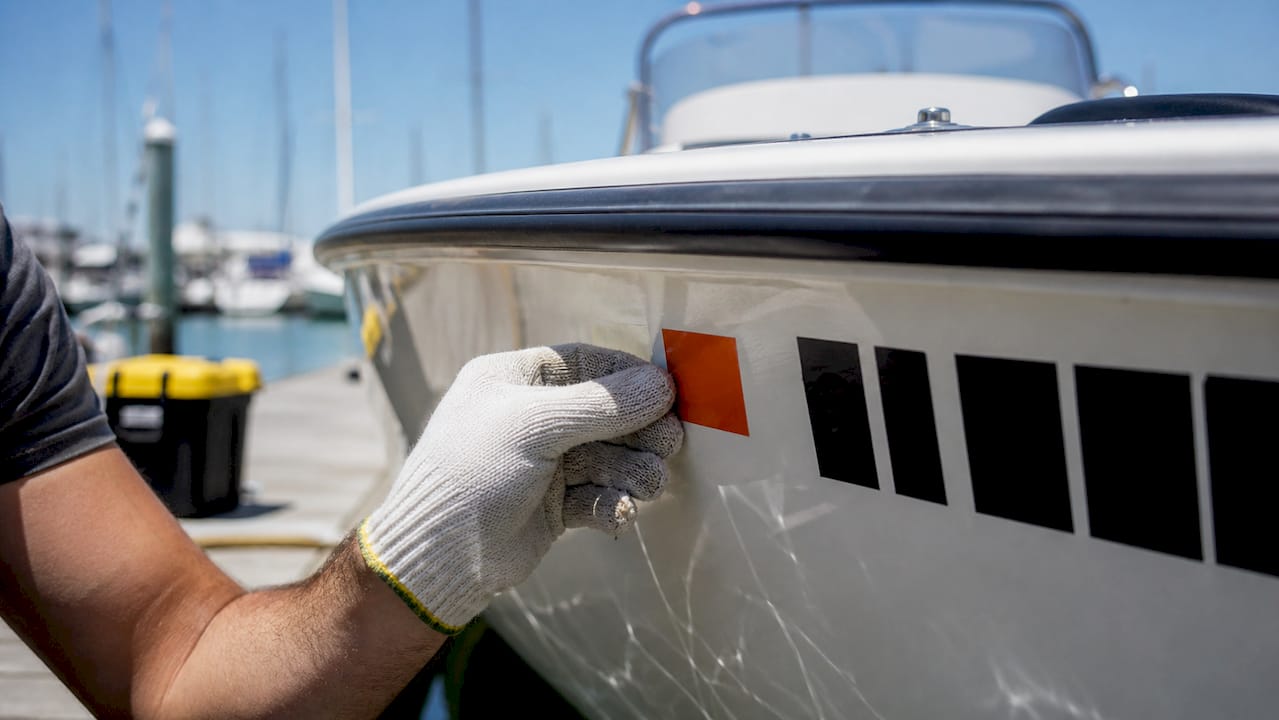
U.S. Coast Guard–documented vessels are a specific exception. If your boat carries federal documentation, NYS does not assign a state registration number. You still receive NY validation stickers, but they are placed at a specified distance from the bow on both sides, not adjacent to a registration number that does not exist on the hull.
Key placement rules at a glance:
- Standard vessels: stickers in line with the number, 3 inches to the stern of the last character.
- Documented vessels: stickers only, placed about 18 inches from the bow on both sides.
- Both sides of the bow are always required, no exceptions.
- Stickers must remain legible; a peeling or faded sticker is treated the same as a missing one.
For a visual reference on exactly where numbers and stickers land on the hull, the placement guide at Registrationdecals shows bow zones with diagrams.
How do you register a boat in New York and get your number?
Every mechanically propelled pleasure vessel operating on New York waters must be registered. Registrations run for a multi-year cycle, and fees scale by boat length. Here is the process:
- Complete Form MV-82B. The Boat Registration/Title Application is the core document. Fill it out completely before visiting a DMV office or mailing it in.
- Gather proof of ownership. This means a manufacturer's certificate of origin (for new boats), a prior title, or a bill of sale for used vessels.
- Provide proof of sales tax payment or a sales tax clearance document. No registration moves forward without it.
- Pay the applicable fee. Fees are calculated by boat length; the DMV fee schedule is listed on the registration landing page.
- Submit everything to a DMV office or by mail.
Once processed, NYS issues your registration number and validation stickers. Until they arrive, you may operate on a temporary certificate if one was issued.
What to keep on board:
- The registration certificate (or temporary MV-53 if newly purchased from a dealer).
- Current validation stickers properly affixed to the hull.
- Photo ID for the registered owner.
NYS Parks confirms that mechanically propelled pleasure vessels are subject to the three-year cycle, with fees tied to vessel length.
What you need to know about dealer-issued temporary registrations
Dealers enrolled in the NYS DMV Boat Registration Program can issue temporary registrations directly at the point of sale, which means you can legally operate a newly purchased boat before your permanent registration arrives. The temporary certificate is Form MV-53, valid for 45 days. The DMV Commissioner can extend that by up to 30 additional days in specific circumstances.
Dealer numbering is tightly controlled:
- Dealers must issue registration-number assignment labels in sequential order and maintain full accountability for every label in their inventory.
- A dealer cannot assign a new NY registration number to a boat that already carries a valid NY number. The existing number stays with the vessel.
- Temporary registrations are restricted to dealer sales. A dealer cannot issue an MV-53 for a boat sold through a private transaction.
When you drive off the lot (or launch from the ramp) on a temporary registration, keep the MV-53 certificate on board at all times. Marine Patrol will ask for it. The temporary number displayed on the hull must match the certificate exactly.
Why the Hull Identification Number matters for your registration
The Hull Identification Number (HIN) is a 12-character identifier, functionally similar to a vehicle VIN, affixed to the transom of the boat. NYS Parks requires a HIN on most boats manufactured after November 1, 1972. Without one, DMV will not process your registration.
If your HIN is missing or incomplete, the path forward runs through the NYS Office of Parks, Recreation and Historic Preservation:
- Download and complete Form OPS-420 (HIN Application).
- Submit photos of the transom area where the HIN should appear.
- NYS Parks will schedule an inspection. During that inspection, an officer may request a pencil tracing of any partial markings, additional photos, or an affidavit if the HIN is nonstandard or worn.
- Once confirmed, Parks assigns a HIN, which you then bring to DMV to complete registration.
HIN mismatch: The HIN stamped on your transom must match the HIN printed on your registration certificate. If they differ, notify DMV immediately. Operating with a mismatched HIN can complicate ownership verification and create problems during any enforcement stop or resale.
Homemade boats and pre-1972 vessels fall under specific exceptions, but they still need a Parks-assigned HIN before DMV will register them.
Decal vs. painted numbers: which holds up on New York waters?
Paint is technically legal, but most New York boat owners who have tried it once switch to marine-grade vinyl decals and do not look back. Here is why.
Paint requires careful masking, a steady hand, and the right marine enamel. Done well, it can last. Done poorly, it chips, fades, or runs within a season. Touching up painted numbers to maintain the 3-inch height and contrast requirements is tedious work.
Marine-grade vinyl decals cut cleanly, apply in under 30 minutes, and when made from UV-resistant, saltwater-proof material, hold their color and adhesion through multiple seasons. The 100-foot readability requirement is not just a day-one standard. A number that was readable when you registered the boat but has faded to near-invisible two years later is still a compliance failure.
Practical material considerations:
- Choose UV-resistant vinyl rated for outdoor marine use. Standard craft vinyl degrades quickly in direct sun and salt spray.
- High-contrast color combinations (white on dark hulls, black or dark blue on white hulls) maintain readability as the decal ages.
- A UV laminate overcoat adds meaningful protection against UV degradation and abrasion.
- Adhesive must be rated for wet and submerged surfaces; standard pressure-sensitive adhesives lift at the waterline.
Pro Tip: Check your decals at the start of each season. Run your finger along the edges. Any lifting corner or visible fading is worth addressing before you get on the water, not after a Marine Patrol stop.
For context on how long properly specified decals actually last, Registrationdecals covers marine vinyl lifespan in detail.
How to apply registration number decals correctly
Getting the placement right the first time saves you from peeling and repositioning, which weakens the adhesive bond. Follow these steps:
- Clean the hull surface. Wipe the application area with isopropyl alcohol to remove wax, salt residue, and oils. Let it dry completely. Applying to a waxy or damp surface is the single most common cause of early lifting.
- Check the temperature. Apply between 50°F and 90°F. Cold surfaces reduce adhesive tack; hot surfaces cause the vinyl to stretch and distort during application.
- Measure your placement zone. The number goes on the forward half of the hull, on both sides of the bow. Measure from the bow back to confirm you are in the correct zone, and mark a light horizontal reference line with masking tape to keep the letters level.
- Dry-fit first. Hold the decal sheet against the hull before peeling the backing. Confirm the spacing looks right and the height clears 3 inches.
- Apply with a squeegee. Peel the backing, position the decal, and work from the center outward with firm, overlapping squeegee strokes to push out air bubbles.
- Remove the transfer film slowly. Pull it back at a low angle (roughly 30 degrees) to avoid lifting the letters with it.
- Allow cure time. Wait at least 24 hours before water exposure. Full adhesive cure takes longer, so avoid pressure washing the area for 72 hours.
Pro Tip: Order a pre-spaced decal set rather than individual letters. Pre-spaced sets lock in the correct letter-width separator automatically, which eliminates the most common DIY spacing error that leads to a noncompliant display. Registrationdecals's application guide walks through each step with visuals.
Common mistakes that lead to citations on New York waters
Marine Patrol officers check registration numbers on every vessel stop. These are the errors that generate the most citations:
- Wrong separator width. A thin hyphen or a double-width gap both fail. The separator must equal one letter width.
- Script or italic fonts. Block letters only. Any decorative font is noncompliant regardless of size.
- Letters under 3 inches. This is more common than it sounds. Measure before you apply.
- Low-contrast color. Gray on silver, dark blue on black, or any combination that blends into the hull background.
- Numbers on the wrong half. Placing the registration number aft of the midpoint of the hull is a placement violation.
- Extra numbers on the forward half. A manufacturer's hull code, a dock number, or any other numeral in the forward zone creates ambiguity for officers.
- Faded or peeling decals. A number that was compliant when applied but is no longer readable from 100 feet is still a violation.
If you are stopped by Marine Patrol, present your registration certificate, point to your validation stickers, and if your decals are newly installed, a receipt or order confirmation showing recent purchase helps establish good faith. Officers generally want to see that you are making a genuine effort to comply.
A practical perspective on getting this right
The compliance rules for New York boat registration numbers look simple on paper, but the field tells a different story. The separator width rule trips up more owners than any other single requirement. A thin dash from a hardware-store letter kit looks close enough until an officer measures it. The 3-inch minimum catches people who ordered the "standard" size from a general craft supplier without checking the actual measurement.
What actually works: order from a supplier who builds the NY format into the product. Pre-spaced sets eliminate the separator guesswork entirely. Marine-grade UV vinyl means you are not back at the dock with a fading number two seasons in. And keeping your registration certificate on board, not just at home in a file, is the difference between a quick stop and a real problem.
Marinas and dealerships ordering in bulk face an additional layer: sequential label accountability and the restriction on reissuing numbers for previously registered vessels. Getting that wrong at the dealer level creates headaches for buyers that can take weeks to untangle at the DMV.
Get NY-compliant registration decals from Registrationdecals
Registrationdecals produces custom boat registration decals built specifically to meet New York's display requirements, from the correct block-letter format and pre-spaced separators to the 3-inch minimum height. Every set ships on marine-grade UV-resistant, saltwater-proof vinyl, so the number stays readable through the full three-year registration cycle.
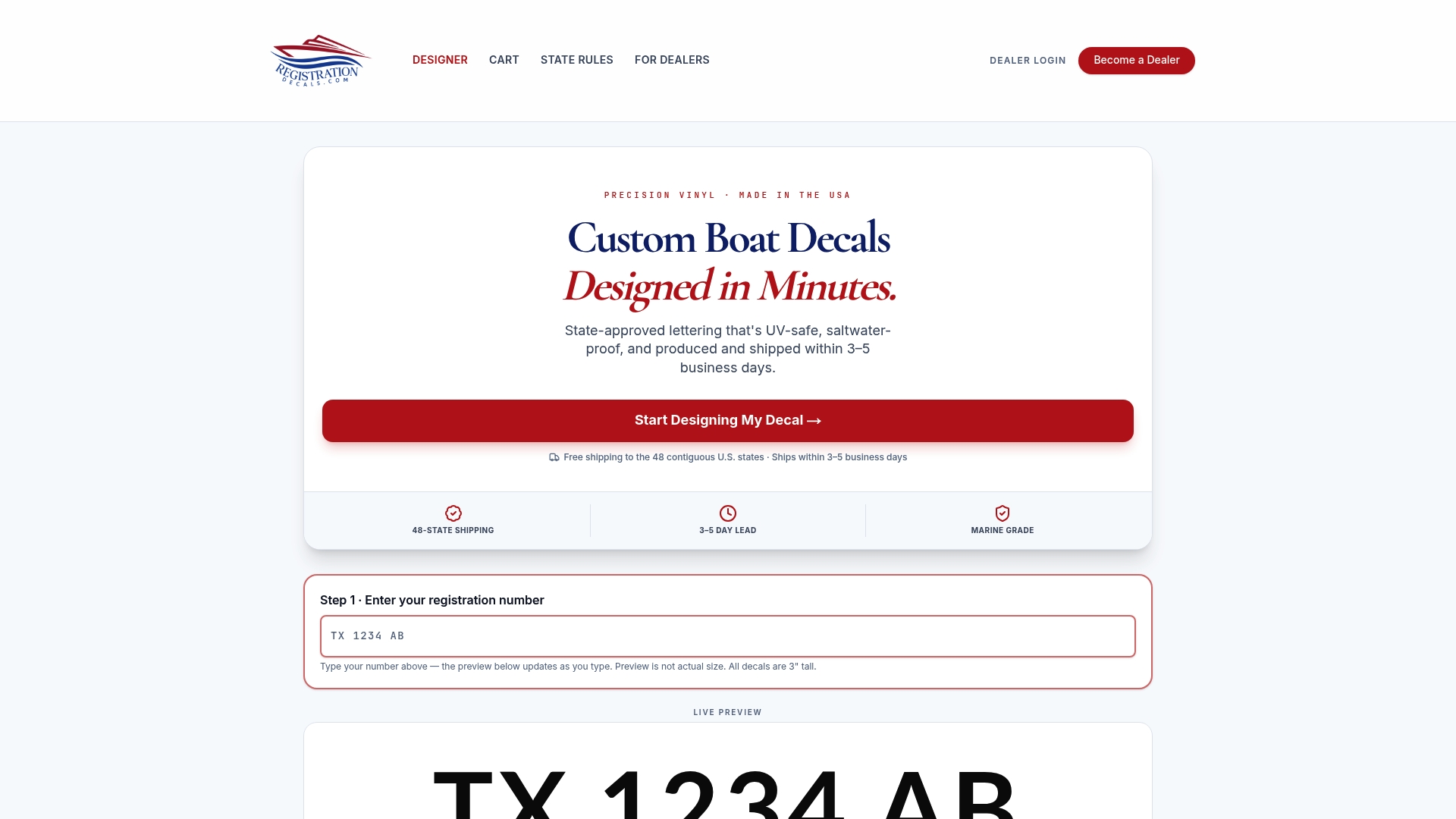
The online design tool lets you enter your NY registration number, choose a color combination that contrasts with your hull, and preview the finished set before ordering. Production runs 3–5 business days, with free shipping throughout the contiguous United States. Bulk orders for marinas and dealerships are available through the same platform.
Order your NY-compliant decal set at Registrationdecals, or review the New York state requirements page to confirm your format before you order.
Sources
- Register a Boat | NY DMV
- New York State Boater's Guide - 2024 - 9
- Dmv
- HIN Registrations - NYS Parks, Recreation & Historic Preservation