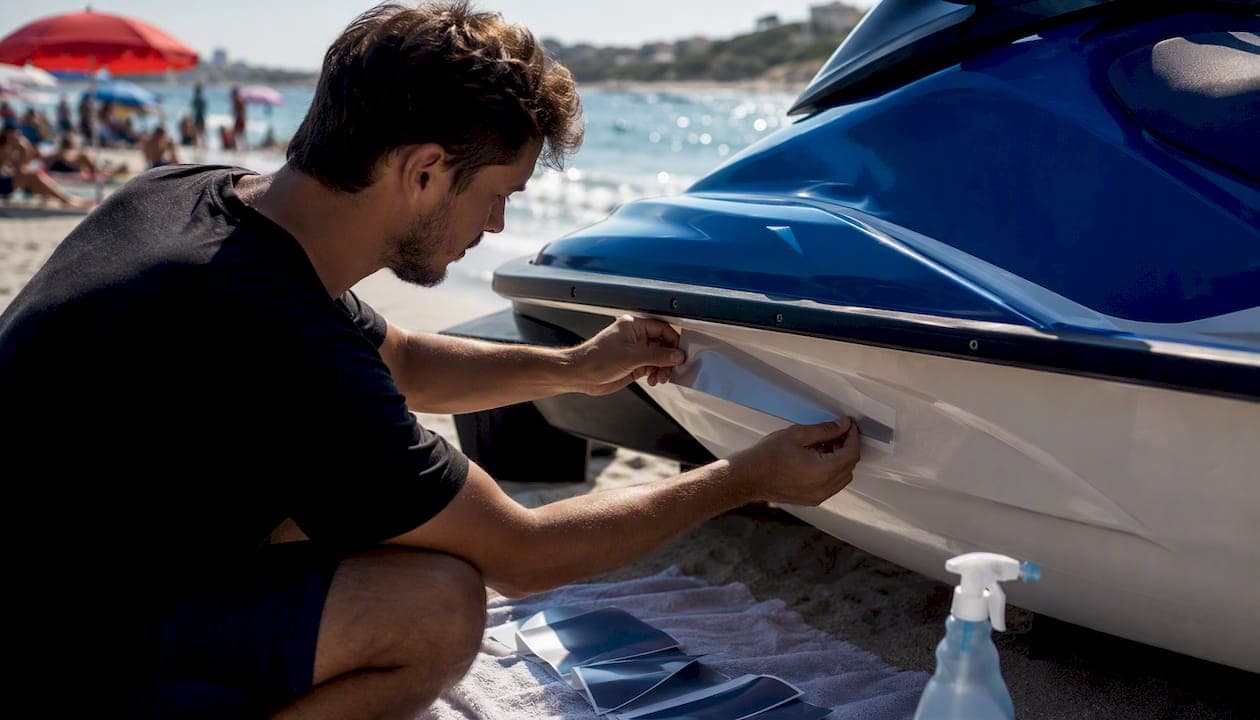
Every U.S. jet ski must display its state-issued registration number on both sides of the bow in block characters at least 3 inches tall, reading left to right, with enough contrast to stand out from the hull color. A current validation decal goes near that number, typically within a few inches of the last character. Those are the two non-negotiable elements. For a compliant, durable kit that covers both, Registrationdecals offers marine-grade vinyl sets in 3" and 4" heights, with left and right numbers plus the validation decal, customizable online and shipped in 3–5 business days.
The short version: block letters, at least 3" tall, both bow sides, left-to-right, high contrast, plus a current validation decal nearby. Order a marine-grade vinyl kit sized to your state's minimum, and you're covered.
Quick checklist before you order:
- Confirm your state's minimum character height (most require 3"; some allow 4" for better visibility)
- Order a left/right number pair plus a validation decal in the same kit
- Choose a color that contrasts clearly with your hull
- Verify placement: forward half of the bow on both sides
Key Takeaways
Every U.S. jet ski must display state-issued registration numbers in 3-inch block characters on both bow sides, with a current validation decal nearby, applied to a degreased hull using a marine-grade vinyl kit.
| Point | Details |
|---|---|
| Minimum character height | Most states require 3" block characters; confirm your state before ordering. |
| Kit contents | Order a left/right number pair plus a validation decal in the same kit. |
| Material baseline | Marine-grade vinyl with UV-resistant ink and fuel-resistant adhesive lasts 3–7 years. |
| Installation prep | Degrease and remove all wax before applying; wax is the leading cause of early failure. |
| Registrationdecals | Offers customizable 3" and 4" PWC kits with digital proofing and 3–5 day production. |
Table of Contents
- What are the legal display requirements for jet ski registration numbers?
- Where exactly do registration numbers and the HIN go on a jet ski?
- How do you apply PWC registration decals without them peeling off?
- How do you pick the right registration-number kit for your PWC?
- What does a compliant registration decal kit typically cost?
- Why compliance-first decals are worth the investment
- Get compliant PWC registration decals from Registrationdecals
- Useful sources for state rules and further reading
What are the legal display requirements for jet ski registration numbers?
Most U.S. states follow the same core framework, though the details vary enough to matter. Florida requires registration numbers at least 3 inches high in block letters on both sides of the bow, reading left to right, with the number contrasting against the hull background. The registration number stays with the vessel, not the owner. Michigan's rules add a specific separation requirement: the validation decal must sit 3 inches after the last registration character. Texas similarly requires block characters no less than 3 inches tall on each side of the forward half of the vessel, with the validation decal placed nearby.
The table below maps the key legal requirements to the kit specs that satisfy them.
| Requirement | Spec detail | Kit feature that satisfies it |
|---|---|---|
| Minimum character height | 3" (most states); 4" optional for larger hulls | 3" or 4" kit height options |
| Letter style | Block characters only | Block-font decal sets |
| Orientation | Left-to-right on both bow sides | Left and right number pair included |
| Contrast | Must stand out from hull background | Color-contrast selection at checkout |
| Validation decal | Near the registration number (3" after last character in Michigan) | Validation decal included in kit |
| Separation from other markings | Space or hyphen between letter and number groups | Pre-formatted character spacing |
| Adhesive backing | Must stay on hull in marine conditions | Marine-grade vinyl with pressure-sensitive adhesive |
One nuance worth knowing: states agree on the 3-inch minimum and block-letter requirement, but they differ on exactly where the validation decal sits and whether groups are separated by a space or a hyphen. Always check your state's specific rules before ordering.
Where exactly do registration numbers and the HIN go on a jet ski?
These two identifiers serve different purposes and live in different places. Mixing them up is a common source of confusion.
Registration number placement:
- Forward half of the bow, both port and starboard sides
- Characters read left to right from bow to stern
- Minimum 3" height (state-specific; confirm yours)
- Validation decal within a few inches of the last character, typically on the port (left) side in many states
Hull Identification Number (HIN) placement:
- Permanently affixed to the transom or the outermost starboard side of the hull
- A 12-character identifier assigned by the manufacturer, not the state
- Sea-Doo uses the manufacturer code "YDV" as the first three characters of the HIN
- Not a substitute for the displayed registration number; serves title, history, and theft-recovery purposes
| Feature | Registration number | HIN |
|---|---|---|
| Assigned by | State boating authority | Manufacturer |
| Purpose | Patrol identification on the water | Title, history, theft recovery |
| Location | Both bow sides, forward half | Transom or outermost starboard hull |
| Format | State prefix + numbers, block letters | 12 characters, alphanumeric |
| Changeable | Yes, when re-registered | No, permanent |
| Minimum height | 3" (most states) | No display-height requirement |
A few state-specific nuances: Florida specifies that the registration number remains with the vessel even when ownership changes. Texas requires expired validation decals to be removed before new ones go on. Michigan places the validation decal exactly 3 inches after the last registration character. If you move states, you'll likely need new decals to match the new registration.
How do you apply PWC registration decals without them peeling off?
Poor prep causes most early failures, not poor materials. Follow this sequence and the decals will bond properly.
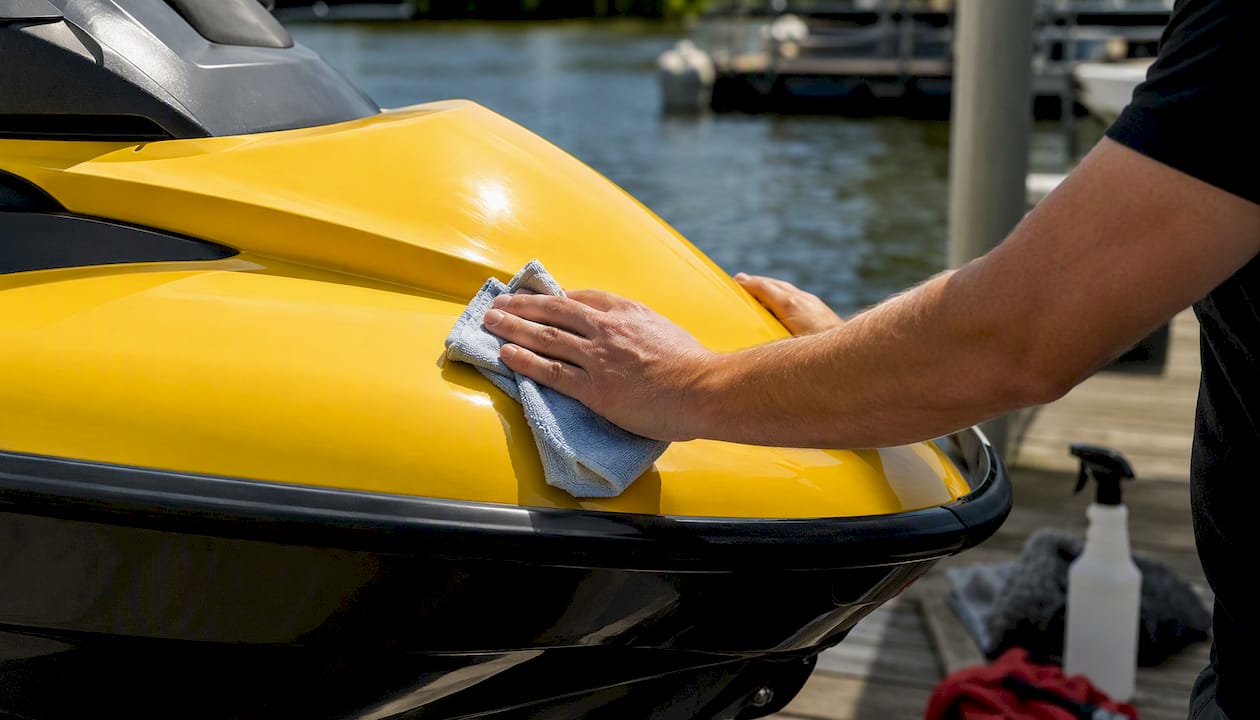
- Degrease the application area with a mild, residue-free solvent such as glass cleaner and a lint-free towel. Remove all wax and oil. Applying over a waxed surface is the single most common cause of premature edge lift.
The wetted method is worth the extra step on a PWC. Jet ski hulls curve more sharply than most boat bows, and a dry application on a compound curve almost always traps a bubble or lands slightly crooked. A soapy mist buys you the few seconds of repositioning you need.
Pro Tip: Verify left-to-right orientation before peeling the backing. On the port side, the state prefix reads toward the bow. On the starboard side, it reads toward the stern. Swapping them is an easy mistake that requires a replacement set.
For a full walkthrough, Registrationdecals has a step-by-step application guide that covers both dry and wetted methods.
How do you pick the right registration-number kit for your PWC?
Run through this checklist before you add anything to your cart.
- Confirm your state's minimum height. Most states require 3"; some enforcement guidance suggests 4" for better visibility on darker hulls. Check your state's rules first.
On turnaround: a 3–5 business day production window is realistic for a custom kit with digital proofing. Faster is possible for standard configurations. If you're ordering for a marina or dealership, bulk ordering options can reduce per-unit cost significantly, and Registrationdecals supports wholesale dealer orders for exactly that use case.
What does a compliant registration decal kit typically cost?
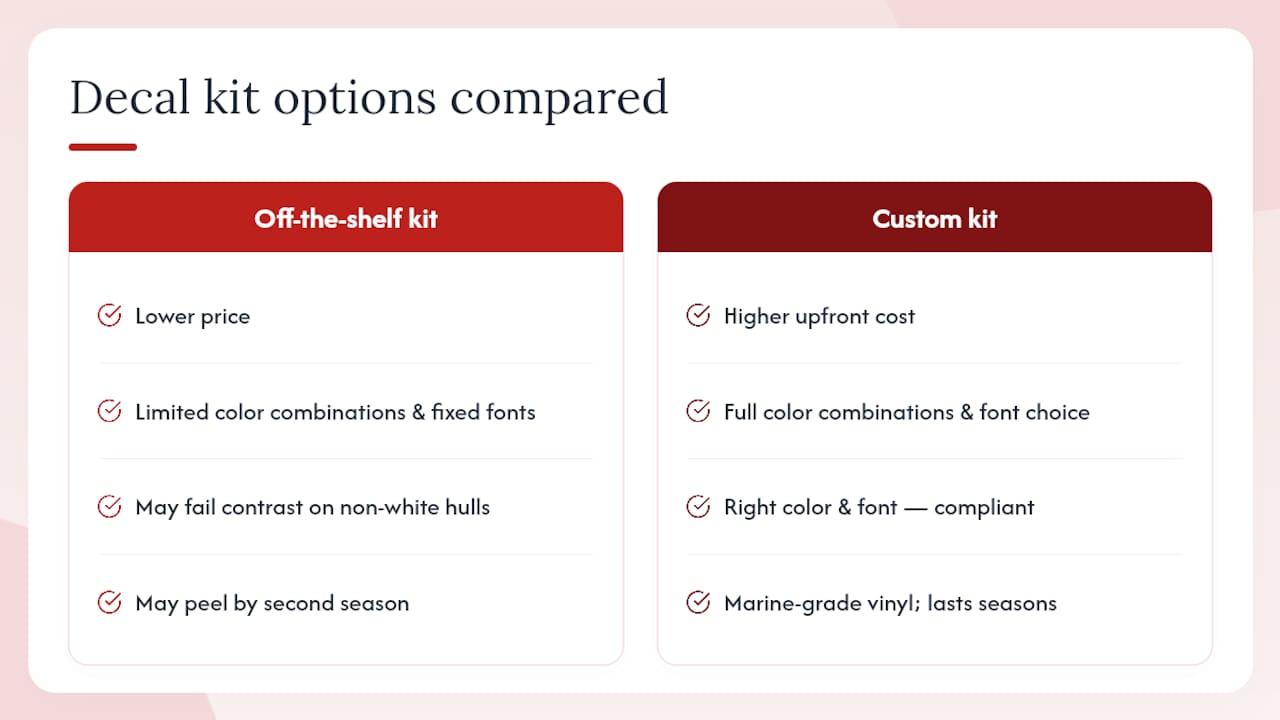
Off-the-shelf kits from marina shops or big-box retailers run lower in price but come in limited color combinations and fixed fonts. If your hull color is anything other than white or black, you may end up with a non-contrasting set that technically fails compliance.
Custom kits cost more upfront and take a few extra days, but you get the right color, the right font, a digital proof before production, and marine-grade materials that last. The math usually favors the custom route when you factor in the cost of a replacement set after a generic kit peels off in its second season.
For most PWC owners, a complete custom kit (left/right numbers plus validation decal, marine-grade vinyl, digital proof) represents a straightforward one-time purchase that covers multiple seasons. Registrationdecals offers both 3" and 4" options with full color and font customization, and ships free within the contiguous U.S.
Why compliance-first decals are worth the investment
Most PWC owners treat registration decals as an afterthought, something to slap on before the first launch of the season. That mindset is what leads to a peeling number by August and a citation from a water patrol officer who can't read the registration from 50 feet away.
The compliance requirements aren't arbitrary. Block characters, minimum height, and contrast rules exist so that patrol officers can identify a vessel quickly on the water. A faded, peeling, or wrong-colored decal defeats that purpose, and officers can and do issue fines for it.
What's underestimated is how much the installation step matters. A marine-grade kit applied over wax will fail faster than a mid-grade kit applied correctly to a clean, degreased hull. The material matters, but prep matters just as much. Spending a few extra minutes on surface prep at the start of the season is the single highest-return action a PWC owner can take.
For edge cases, such as an unusual hull color, a state with stricter separation rules, or a PWC registered in a state you're visiting, the right move is always to contact the issuing agency directly. State boating authority websites are the authoritative source, and most have a phone line for exactly these questions.
Get compliant PWC registration decals from Registrationdecals
Registrationdecals builds custom PWC registration kits on marine-grade, UV-resistant, saltwater-proof vinyl, with 3" and 4" height options, full color and font selection, and a digital proof before anything goes to production. Every kit includes a left/right number pair and the validation decal in one order.
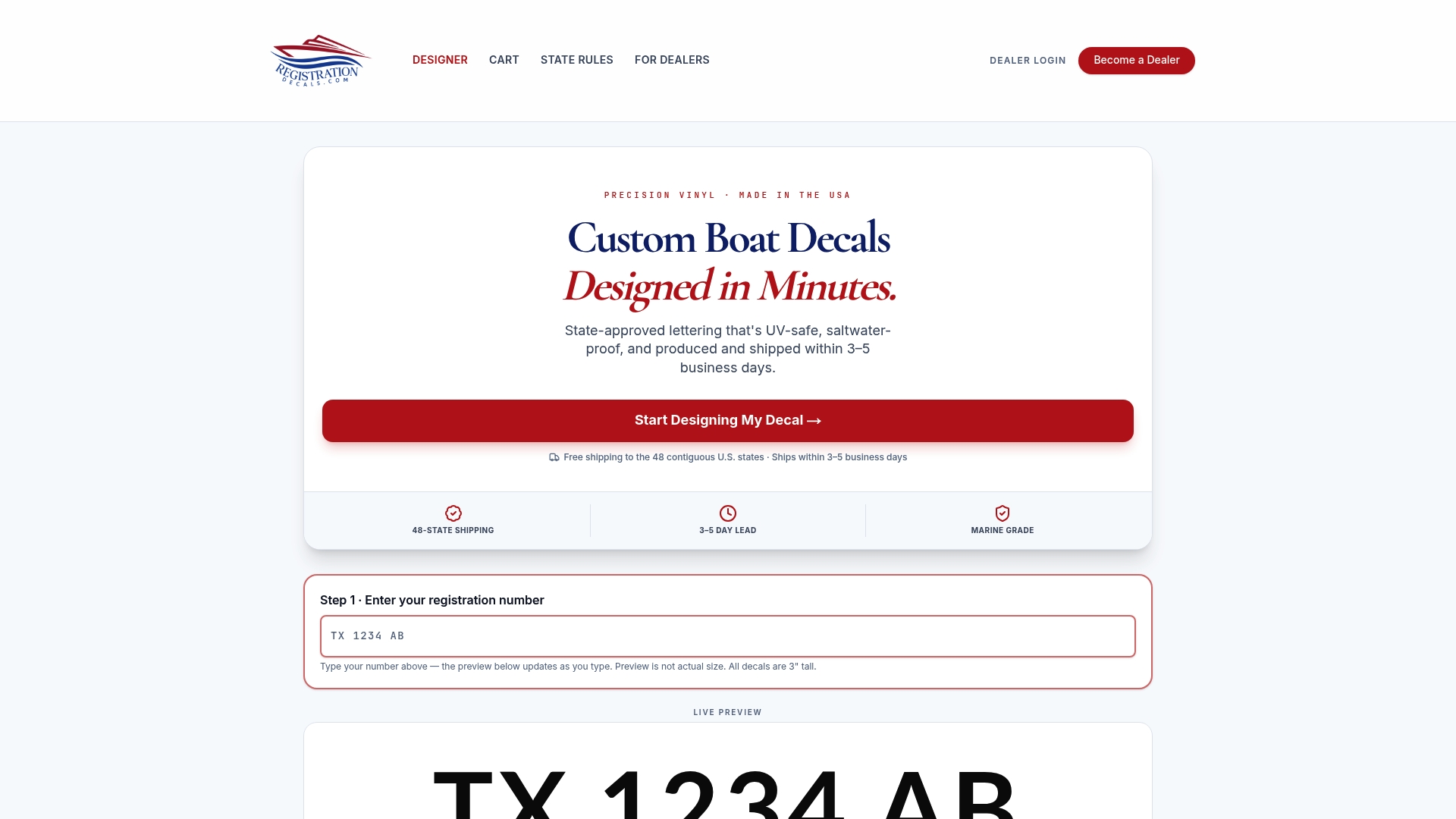
The online design tool takes a few minutes: enter your registration number, pick your colors, choose your font, and request a proof. Production runs 3–5 business days, and shipping is free across the contiguous U.S. Marina operators and dealerships can order through the wholesale dealer program for volume pricing. To design your kit and confirm it meets your state's specs, visit Registrationdecals.com and use the state regulations guide at checkout.
Useful sources for state rules and further reading
- Numbers and Decals on Vessels — Texas Parks & Wildlife Department
- Numbering and Decals - Florida Department of Highway Safety and Motor Vehicles
- Displaying the Registration Number and Validation Decals
- A Newbie’s Guide to Applying Registration Numbers - The Watercraft Journal
- Sea Doo VIN Lookup (Jet Ski & PWC HIN Lookup) | Boat Alert Blog
- How to Apply Vinyl Boat Registration Decals | RegistrationDecals.com
- Custom Boat Registration Decals — Design & Order Online | RegistrationDecals.com
Always verify current rules directly with your state's boating authority before ordering. Rules can change, and the issuing agency's current guidance is the only authoritative source for your specific registration.