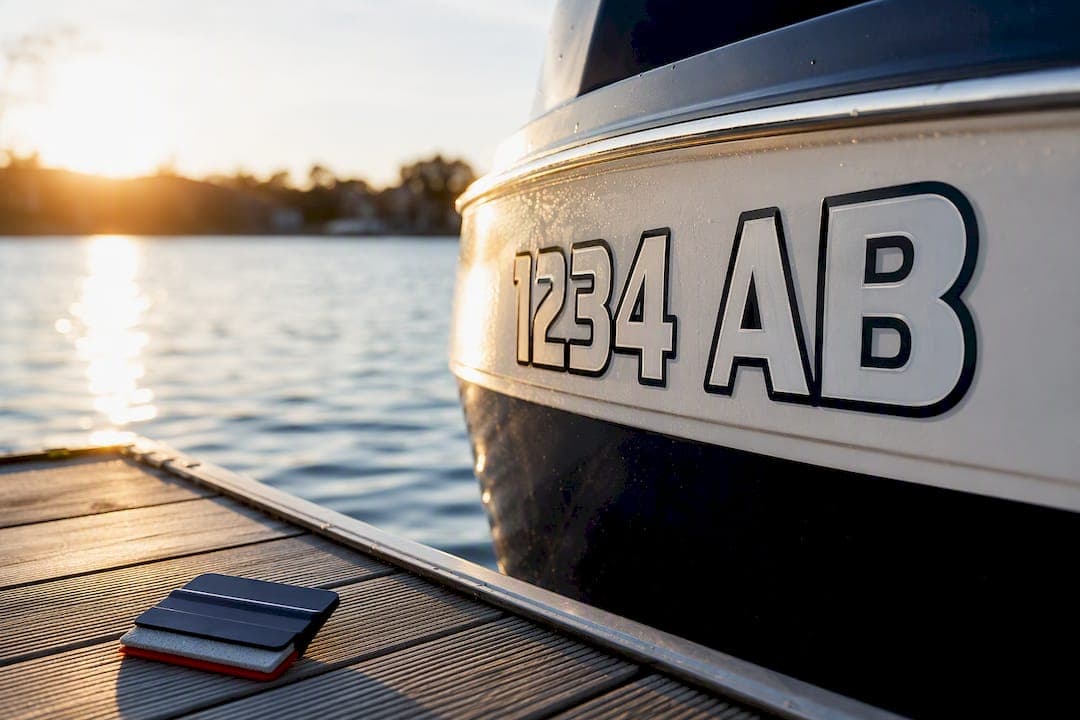
Two-color registration numbers are legal in every US state, provided the finished characters still meet the federal display rule: plain vertical block characters at least 3 inches tall that contrast sharply with the hull. The fastest way to hit that mark is a solid fill color wrapped in a contrasting outline, or a single-color number mounted on a contrasting backing plate. Check your state's boating agency for placement quirks before you order.
TL;DR:
- Two-color registration numbers must have a high-contrast outline or backing plate to meet visibility standards at a distance of 100 feet.
- The final characters need to be at least three inches tall and in plain block style regardless of the coloring technique used.
- Using marine-grade, UV-resistant vinyl for both fill and outline from the same supplier prevents uneven fading and ensures longevity.
- Proper surface preparation, correct measurement, and careful layer alignment are essential to maintain contrast and comply on water.
- Most common mistakes involve poor installation, incompatible vinyl layers, or color choices that lose contrast under sunlight.
Table of Contents
- What Federal Law Says About Two Color Boat Numbers
- Which Two-Color Combinations Actually Pass the Contrast Test
- Four Two-Color Templates You Can Order Today
- How to Install Two-Color Numbers Without Ruining the Contrast
- Keeping Two-Color Decals Looking Sharp for Years
- Pre-Launch Compliance Checklist
- What Most Boat Owners Get Wrong About Two-Color Numbers
- Order Compliant Two-Color Numbers Built for Real Sun and Saltwater
- Sources
What Federal Law Says About Two Color Boat Numbers
The rule that governs every registration number on every recreational boat in the country is 33 CFR §173.27. It doesn't mention "two-color numbers" by name, because it doesn't need to. It cares about the result, not the technique. As long as the final visible characters meet the standard, how you got there (single vinyl layer, layered fill and outline, or a painted plate) is up to you.
Here's what the regulation actually requires:
- Characters must be plain, vertical block style. No italics, no script, no decorative serifs.
- Each character must be at least three inches high, measured on the finished, mounted number, not the design file.
- The number must contrast with the boat's color. A navy hull with navy numbers fails even if the numbers are painted on perfectly.
- Numbers go on both sides of the vessel, on the forward half of the hull.
- Spacing between the letter/number group and the number group must equal the width of one letter, and a hyphen or equivalent space separates the two, per CFR — 33 CFR §173.27.
- A backing plate is explicitly allowed when hull shape or rigging makes direct placement impractical.
That contrast clause is where two-color designs earn their keep. A dark fill on a light hull already satisfies the rule on its own, but adding an outline in the opposite tone builds in a margin of safety. If your fill color ever reads too close to the hull shade in certain light (gelcoat yellowing, a metallic paint job, a tinted hull wrap), the outline still carries the contrast requirement by itself.
BoatUS adds a practical layer to the federal text: numbers need to be block letters, at least three inches tall, contrasting with the hull, and validation stickers are typically placed within 6 inches of the number, usually on the port side. That sticker proximity rule matters for layout. If you're designing a two-color number with a wide outline, leave room. A number that bleeds into the sticker zone forces an awkward placement decision later.
States build on the federal floor, and they don't all build the same way. Before you finalize a design, verify these items with your own state's boating authority:
- Exact sticker placement. Some states specify inches from the number; others just say "near it."
- Measurement interpretation. A few agencies measure character height including any outline stroke; most measure the base character only.
- Documented vessel exemptions. Federally documented boats generally display a different identifier and are exempt from state numbering in most cases, but confirm this with your state.
- Kayak and canoe rules. Many states exempt unpowered, human-powered craft from numbering entirely, while others require it if a trolling motor is added.
Hawaii's boating division is a good example of a state guide that mirrors the federal language closely but adds a real-world test: numbers should be visible and legible from 100 feet away. That distance test is essentially how a marine patrol officer evaluates your boat on the water. Nobody's walking up with a ruler in most routine checks. They're looking at your hull from a passing patrol boat and asking whether the numbers are readable. A well-executed two-color design, with genuine contrast rather than two near-identical shades, passes that test more easily than a single flat color that happens to blend into glare or shadow.
Which Two-Color Combinations Actually Pass the Contrast Test
Not every "two-color" idea holds up once it's on the water. Some patterns meet the letter of the regulation and read clearly at 100 feet. Others look sharp in a design preview and turn into a legibility problem the moment sun glare hits the hull.
Three approaches consistently work:
- Solid fill with a contrasting outline. A navy or black fill with a thin white or silver outline is the most common compliant style, and it's forgiving across lighting conditions.
- Fill on a contrasting backing plate. Instead of an outline stroke, you mount a single-color number on a rectangular plate in the opposite tone. This is often the simplest fix for patterned hulls or heavy gelcoat texture, according to Hawaii's boating division.
- Reversed light-fill, dark-outline combos. On dark or matte-finish hulls, a light fill (white, cream, silver) edged in a dark outline reads just as clearly as the more common dark-on-light setup.
What doesn't work: gradients, drop shadows, or translucent fills that shift tone depending on the angle of the sun. A gradient number might look great in a mockup, but the moment part of that gradient drifts close to the hull shade, you've got a contrast failure on part of the character. Thin shadow effects run into the same problem: they're decorative, not functional, and an officer evaluating legibility from a distance won't register them as adding contrast.
Match your color pair to your hull:
| Hull color | Recommended fill | Recommended outline |
|---|---|---|
| White or light gel coat | Navy or black | White or silver |
| Dark blue or black | White or cream | Navy or black |
| Red or maroon | White | Black |
| Metallic or pearl finish | Black or navy (backing plate preferred) | White |
Pro Tip: Order both colors in the same vinyl product line. Mixing a budget vinyl outline with a premium marine-grade fill is the single most common cause of one color fading years before the other.
That's not a cosmetic detail. Marine-grade, UV-resistant vinyl and a generic craft-store vinyl age at different rates under the same sun exposure, according to BoatUS's decal guidance. Two years in, you end up with a crisp white outline around a chalky, sun-bleached fill, and the contrast that made your design compliant on day one has quietly degraded.
Four Two-Color Templates You Can Order Today
Here are four layouts that cover most hulls on the water, with the sizing details that keep them legal.
- Dark fill, light outline (white or light hulls). Use a black or navy fill with a 1/8 inch light outline for standard 3 to 4 inch characters. This is the most requested combination for fiberglass runabouts and pontoons, and it clears the contrast rule with margin to spare.
- Light fill, dark outline (dark hulls and metallics). White or cream fill with a 1/8 to 3/16 inch dark outline. Metallic and pearl gel coats shift color under different light, so the wider outline on this template gives you a buffer against contrast readings that vary by angle.
- Backing plate template (textured or patterned hulls). A single solid-color number mounted on a rectangular backing plate in the opposite tone. Skip the outline layer entirely here since the plate itself carries the contrast. This is usually the cleanest option for hulls with dark stripes, camo wraps, or heavy gel coat texture.
- Oversized template for wide-beam or high-visibility needs (4 to 6 inch characters). Anything larger than the 3 inch minimum still needs the outline stroke to scale with it. A practical guideline is a 1/8 inch stroke for 3 to 4 inch characters and a 3/16 inch stroke for 4 to 6 inch characters, wide enough to register as an outline without swallowing the letterform. Keep the spacing between your letter group and number group equal to one full character width, and don't forget the hyphen.
If you're unsure which font styles actually satisfy the "plain vertical block character" language, Registrationdecals's font guidance breaks down which styles pass and which get rejected at the dock.
How to Install Two-Color Numbers Without Ruining the Contrast
A compliant design can still fail on the water if the installation is sloppy. Here's the sequence that avoids the most common problems.
- Measure and mark placement first. Numbers go on the forward half of the hull, on both sides, positioned so port and starboard match. Check your sticker placement rules now, since some states require the validation sticker within 6 inches of the number, per BoatUS.
- Prep the surface properly. Wipe the area down with a marine-safe degreaser or isopropyl alcohol. Remove any wax residue completely. Vinyl won't bond to a waxed surface no matter how good the adhesive is, and let the hull dry fully before you touch it.
- Pick your window. Application temperature matters more than most owners expect. Aim for a hull surface between 60 and 80°F, and avoid direct hot sun. Heat makes the vinyl stretch as you apply it, which can cause bubbling or misalignment once it cools and contracts.
- Align the layers carefully. If your two-color number comes as separate fill and outline pieces rather than one pre-laminated decal, use a level and a transfer-tape strategy: tape both layers in position, do a dry fit, and confirm the outline sits evenly around the fill before committing. A registration mismatch of even an eighth of an inch is visible up close and looks unfinished from a distance.
- Use a backing plate where the hull fights you. Rivets, rub rails, ribbed hull sections, or heavy texture can all distort a decal applied directly to the surface. A rigid backing plate solves that and keeps your two-color contrast intact regardless of what's underneath it.
Pro Tip: Ordering a pre-registered, pre-laminated two-color decal from the start skips step 4 entirely. The fill and outline arrive already aligned as one piece, which removes the single biggest source of DIY installation errors.
Hull paint type affects how well any decal adheres, and gel coat texture in particular can undermine a clean bond. Mazza Marine's guide to hull paint and gel coat is worth a look if your boat has an older or heavily textured finish before you commit to a direct-application decal over a backing plate.
Keeping Two-Color Decals Looking Sharp for Years
The biggest threat to a two-color number isn't the law. It's uneven fading. When the fill color washes out faster than the outline, or vice versa, you end up with a number that's still technically compliant on paper but looks worn and mismatched on the water.
- Use matched marine-grade vinyl for both colors from the same product line, never two different vinyl grades pieced together.
- Clean with mild soap and a soft brush. Skip abrasive pads and harsh solvents, which can dull the vinyl finish and accelerate edge lifting.
- Inspect annually, especially after peak sun months, and look specifically for edge lifting or a visible color gap between fill and outline.
- Replace decals sooner on boats stored outside in high-sun regions like Florida, Texas, or coastal South Carolina, where UV exposure is constant.
Uneven fade between the two colors is one of the clearest signs of mismatched vinyl formulations, and it's largely preventable by sourcing both layers from one supplier rather than DIY-pairing two different products. RegistrationDecals.com builds every two-color set from the same UV-resistant, saltwater-proof marine vinyl for fill and outline alike, so both layers age at the same rate. For a fuller picture of expected lifespan under real sun exposure, see how long marine vinyl decals typically last.
Pre-Launch Compliance Checklist
Run through this before you back the trailer down the ramp:
- Measure one character. It should be at least 3 inches tall, including any outline that adds to the overall visible height.
- Confirm block-style lettering and check that contrast reads clearly from a distance. Step back roughly 100 feet or view from shore if you can.
- Check spacing and hyphen placement, and confirm numbers match on both port and starboard sides.
- Verify the sticker sits within your state's required distance from the number.
- Look the decal over for bubbles, lifting edges, or gaps between the fill and outline layers.
What Most Boat Owners Get Wrong About Two-Color Numbers
The mistakes we see most often at Registrationdecals aren't legal misunderstandings. Owners generally know the size and placement rules. What trips them up is execution: picking a script-adjacent font that looks sharp on a laptop screen but reads as noncompliant up close, choosing an outline color that's too close in value to the fill under direct sun, or skipping surface prep and wondering six months later why the edges are lifting.
Mismatched vinyl is the other repeat offender. A boat owner buys a fill color from one source and an outline from another, and within a season, one layer is noticeably duller than the other.
Registrationdecals addresses this at the design stage. The online tool shows a live preview before you order, so you can catch a weak color pairing before it's cut into vinyl. Every two-color set uses the same marine-grade vinyl for both layers, production runs 3 to 5 business days, and shipping is free across the contiguous United States. None of that replaces good installation habits, but it removes the two biggest points of failure before the decal ever reaches your hull.
— Taylor
Order Compliant Two-Color Numbers Built for Real Sun and Saltwater
Registrationdecals gives you a faster path to a compliant, good-looking number set than piecing one together from separate fill and outline vinyl sources. The design tool lets you pick your character size, fill color, outline color, and font, then shows a live preview before you commit, so contrast problems get caught on screen instead of on the water.
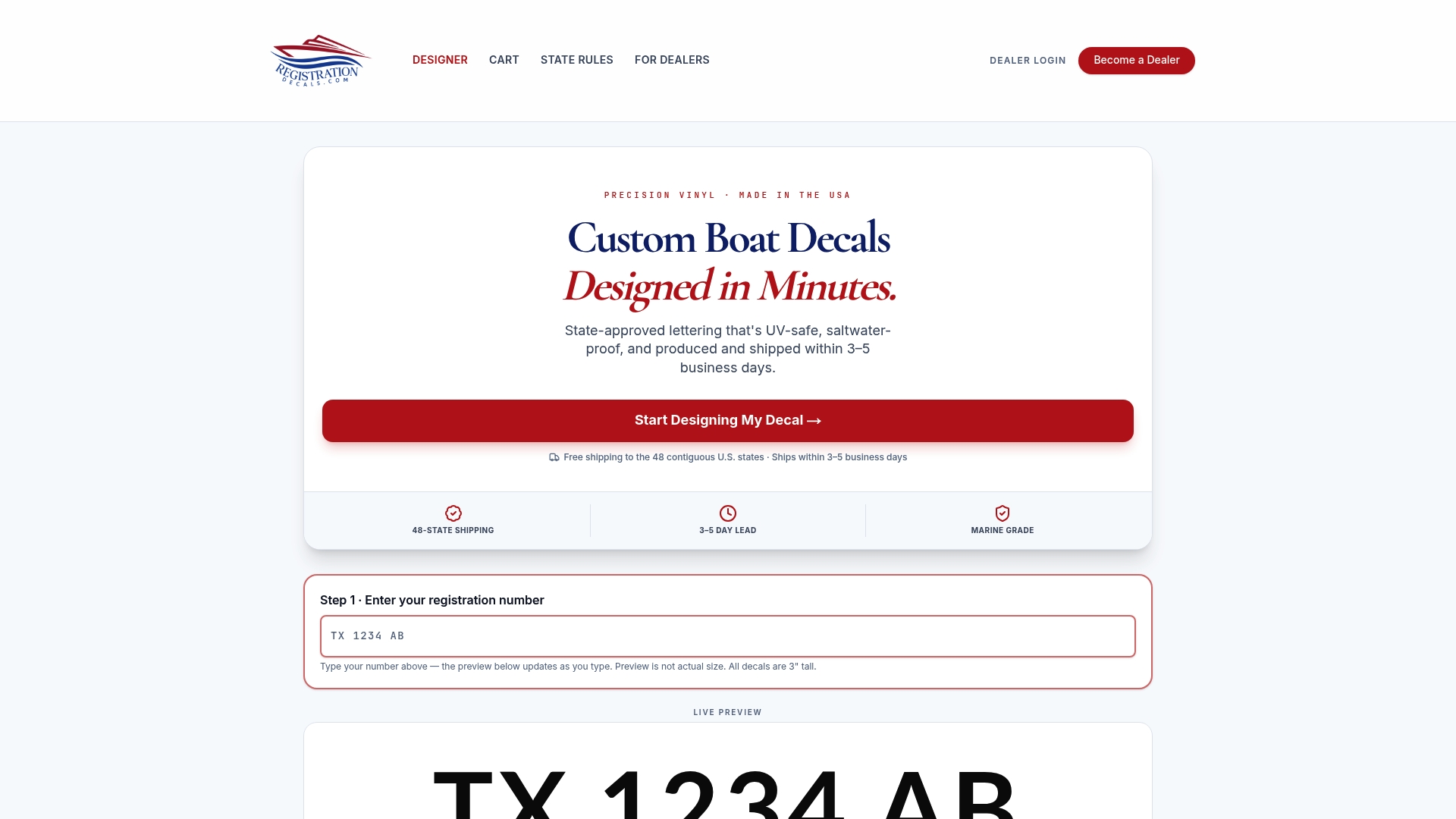
Once you approve the design, production runs 3 to 5 business days and ships free across the contiguous United States. Every set uses matched marine-grade, UV-resistant, saltwater-proof vinyl for both the fill and the outline, so the two colors age together instead of fading at different rates. If your hull has heavy texture or an odd rigging layout, the same design tool supports backing-plate options too. If you're also wondering whether your numbers need to appear on both sides of the hull, Registrationdecals's placement guide walks through it before you finalize your order.
Start your custom two-color decal design now and have compliant numbers on the water within the week.
Sources
- CFR — 33 CFR §173.27 Numbers: Display; size; color.
- BoatUS — Registration requirements (study guide).
- BoatUS — Boat lettering and decal product page.