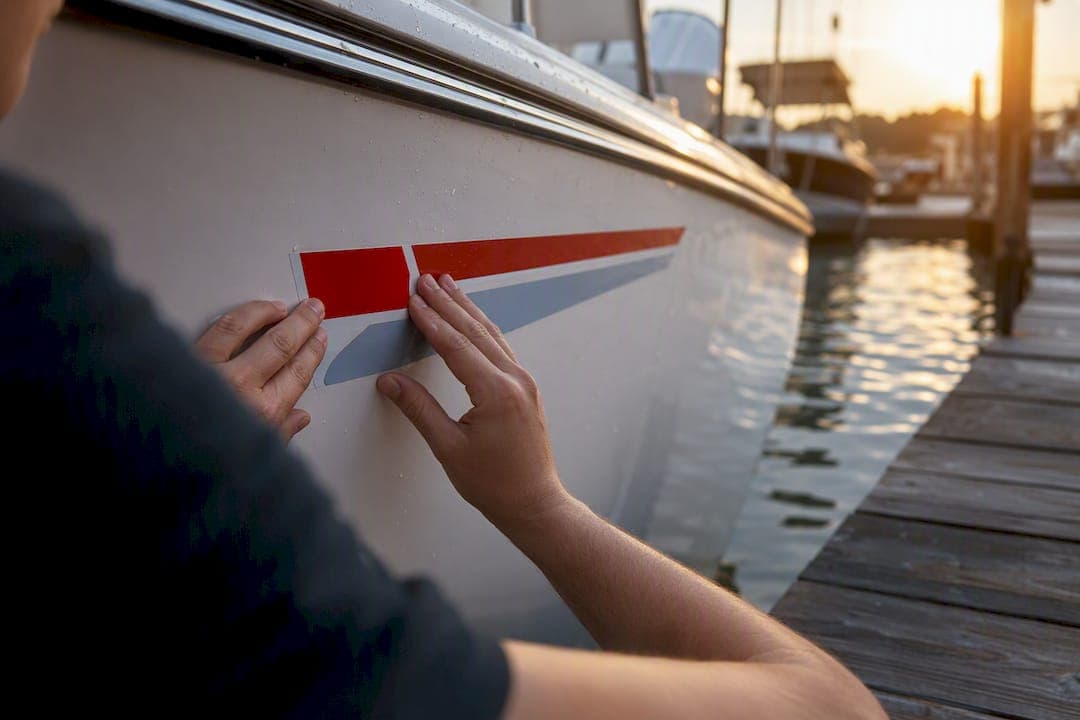
Budget around a dozen to a few dozen dollars for a basic custom decal set from a vendor like Registrationdecals, with premium two-color or reflective options costing noticeably more. That's separate from your state registration fee, which ranges from about $5.50 in Florida to $95.20 in Oregon depending on vessel class. Replacing a lost or damaged official decal through your state usually costs $2 to $25.
TL;DR:
- The government registration fee varies widely by state, from around $5.50 in Florida to over $95 in Oregon, depending on vessel size and class.
- Custom retail boat decal prices range from $12 to $25 for basic sets and up to $80 for multi-color, reflective, or laminated options, with size and finish affecting the cost.
- Replacing a lost decal at the state typically costs $2 to $25, but vendor-made replacements can be produced within 3 to 5 days and often cost more upfront.
- Marine-grade vinyl decals last between 3 to 7 years, with lamination significantly extending lifespan and protecting against UV, saltwater, and physical wear.
- Buying from online vendors like Registrationdecals allows for personalized, compliant decals that are faster and often cheaper than official state reissues, provided the vendor meets state regulations.
Table of Contents
- What Do Boat Registration Decals Actually Cost?
- How Much Do Custom Boat Decals Cost at Retail?
- What Does It Cost to Replace a Lost Boat Decal?
- Which Decal Materials Actually Last Longer on Water?
- Where Should You Buy Compliant Boat Decals?
- How Do You Order and Install Boat Registration Decals?
- Why Registrationdecals Backs Its Compliance and Materials
- The Real Mistake Boat Owners Make on Decals
- Get Your Compliant Decals Made Right, Fast
- Sources
What Do Boat Registration Decals Actually Cost?
The confusion around boat registration decals cost almost always comes down to one thing: people mix up two entirely separate expenses. One is a government fee. The other is a purchase you make from a vendor. They're not the same line item, and they don't come from the same place.
Your registration fee is what your state charges to legally document your vessel, usually tied to length, type, and sometimes horsepower. Your decal (also called a registration sticker) is the physical, numbered adhesive that proves that registration is current and displayed on your hull. A duplicate decal is a replacement for one that's lost, faded, or stolen. Then there's the title or transfer fee, a one-time charge in most states when you first register or change ownership, plus occasional add-ons like Aquatic Invasive Species (AIS) stickers required in states dealing with mussel contamination.
State registration fees swing wildly. BoatRegistrationUSA's fee comparison shows Florida's starting fee at roughly $5.50 for the smallest vessel class, while Oregon's starts near $95.20. That's not a typo. A 17-foot bass boat can cost almost 20 times more to register in one state than another, and vessel class within a state adds another layer of variation.
Here's how three representative states break down their fee structures:
| State | Base Registration Fee (approx.) | Duplicate/Replacement Decal Fee | Notes |
|---|---|---|---|
| Florida | ~$5.50 to $32.25 by length | Varies by county tax collector | Biennial renewal |
| Oregon | ~$95.20 starting | Set by DMV | Among the highest base fees |
| Texas | Set by vessel length class | Listed on TPWD fee chart | Includes title fee separately |
A few things push your total above the base fee, and they're easy to miss when you're budgeting:
- Title fees, charged once at initial registration or ownership transfer, often $5 to $20 depending on the state.
- Local option taxes some counties add on top of the state fee.
- AIS or mussel-prevention stickers, mandatory in several western states for boats used on public waterways.
- Biennial versus annual renewal cycles. A state with a "low" annual fee might cost more over two years than a state with a higher biennial fee.
Dmv is a useful starting point for confirming which of these apply in your state, since every agency structures its fee schedule a little differently. The bottom line: your government fee and your decal purchase are two different budget lines, and neither one predicts the other.
How Much Do Custom Boat Decals Cost at Retail?
Vendor pricing for custom boat registration decals follows a fairly predictable tier structure, and knowing where you land in it helps you avoid overpaying for features you don't need.
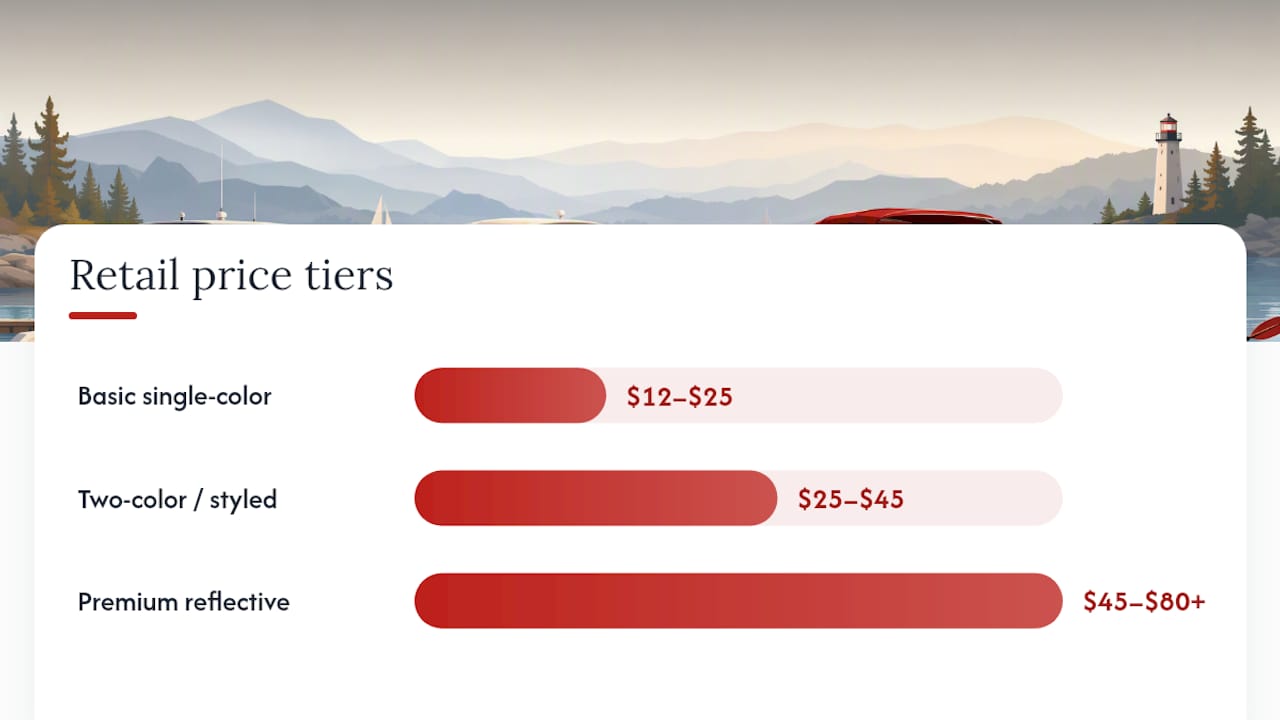
Basic single-color decal sets, the kind most boat owners actually need to satisfy state requirements, typically run $12 to $25 per set. These include your registration numbers in a solid color, sized to your state's minimum height requirement (usually three inches). Step up to two-color designs, outlined lettering, or italic fonts, and you're looking at $25 to $45. Add reflective vinyl, laminate overlays, or rush production, and premium sets can reach $45 to $80 or more.
What actually moves the needle on price:
- Size: larger character heights use more material and sometimes require a different production run.
- Color complexity: a two-color decal with an outline costs more to produce than a flat single color because it requires layered vinyl or a second cut pass.
- Reflective or laminate finishes: these add UV and abrasion protection but cost more upfront.
- Rush production: expediting a normal 3 to 5 day turnaround to next-day or two-day shipping typically adds a flat fee.
- Bulk orders: marinas and dealerships ordering decals for multiple vessels often qualify for per-set discounts that individual buyers don't see.
A practical way to think about it: if your boat lives outdoors or gets heavy sun exposure, the $10 to $15 premium for a laminated, UV-rated finish is cheap insurance against having to reorder in two years. If it's stored in a covered slip or garage most of the year, a basic set does the job fine. Vendor snippets across the boating accessories market consistently show that starting prices cluster around $12 to $25 for standard sets, with custom fonts and multicolor layouts as the main price escalators.
What Does It Cost to Replace a Lost Boat Decal?
Losing a decal, or watching one peel off after a few brutal summers, is more common than most first-time owners expect. The fix depends on whether you go through your state agency or order a vendor replacement, and the two paths differ in cost, speed, and paperwork.
Official duplicate decal fees are usually modest. A few real examples:
- Nevada charges $20 for a replacement certificate and decal through its wildlife department.
- Wisconsin lists a replacement certificate fee around $2.50 on its DNR registration fee schedule, among the lowest in the country.
- Louisiana bundles a duplicate decal with certificate replacement for about $10 through its Department of Wildlife and Fisheries.
- Texas lists duplicate decal costs directly on its TPWD fee chart alongside standard registration fees.
Ordering a duplicate from your state agency generally follows the same short process everywhere:
- Confirm your current registration number and expiration date, usually found on your registration card or renewal notice.
- Submit a replacement request online, by mail, or in person, depending on what your state allows.
- Pay the duplicate fee (typically $2 to $25).
- Wait for processing, which can take anywhere from a few days online to a couple of weeks by mail.
That processing time is exactly why a lot of owners turn to vendor-made replacements instead. A vendor like Registrationdecals can produce a custom set matching your exact registration numbers in 3 to 5 business days, often faster than a state mailing cycle. The catch: you need to confirm your state accepts vendor-made decals as valid displays of your registration number, which most do, since the decal itself doesn't replace your registration certificate, it just displays the number. Dmv that vendor ordering is frequently quicker than waiting on an official reissue, but the acceptance question is worth confirming before you order. Registrationdecals maintains state-by-state regulation pages so you can check your state's specific rules before placing an order.
Which Decal Materials Actually Last Longer on Water?
Cheap decals fail in predictable ways: cracking at the edges after a season of sun, lifting at the corners in saltwater spray, fading to an unreadable gray within a year or two. The material spec on your decal determines whether you're buying once or reordering every 18 months.
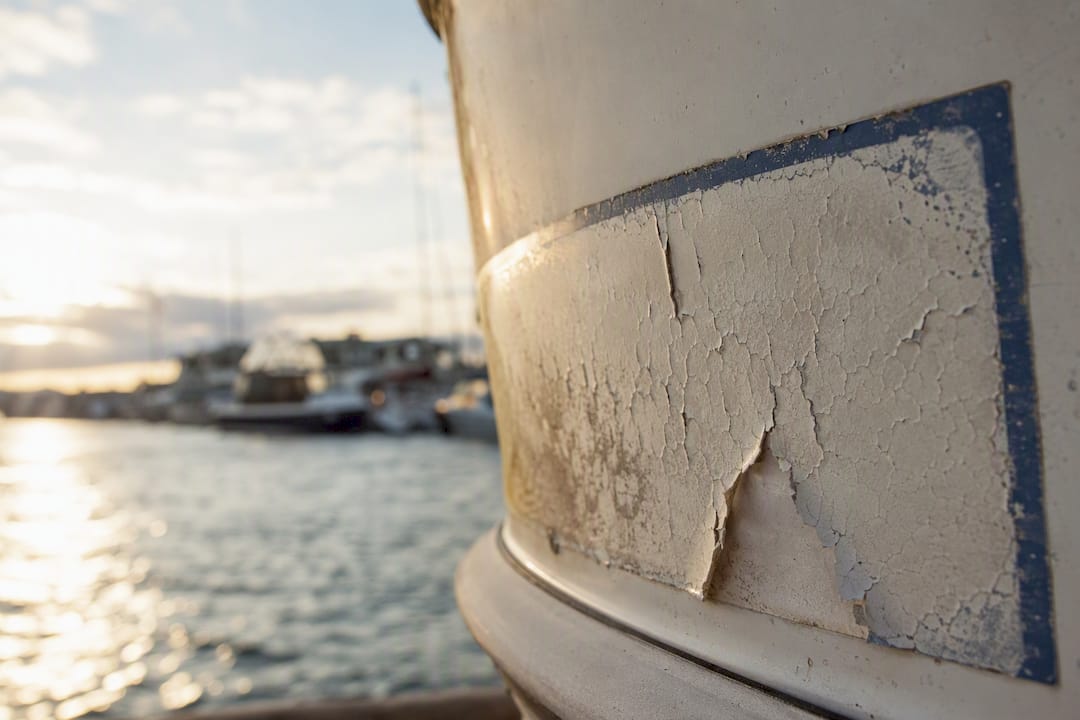
Marine-grade vinyl is the baseline you want. It's formulated with UV inhibitors and a saltwater-resistant adhesive, built to withstand direct sun exposure and constant moisture without curling or discoloring. Quality marine vinyl decals typically last 3 to 7 years depending on climate, exposure, and how well the surface was prepped before application. A boat that sits in a covered slip in a mild climate will get more life out of the same decal than one moored in direct Gulf Coast sun year round.
A few factors shorten that lifespan fast:
- UV exposure without a laminate layer accelerates fading, especially on darker colors and reds.
- Poor surface prep, applying vinyl over dirt, wax residue, or an uncured gel coat, causes premature lifting.
- Abrasion from dock lines, fenders, or repeated washing with abrasive brushes near the decal edges.
- Cheap adhesive backing, common in bargain decals, which fails in saltwater long before the vinyl itself degrades.
An overlaminate adds a clear protective layer on top of the printed or cut vinyl, extending life against UV and physical wear. It's a small upcharge that pays for itself if you'd otherwise be reordering in two years instead of five. For a closer look at material tradeoffs, Registrationdecals' vinyl comparison guide breaks down which finishes hold up best in different climates, and Transfer Kingz's guide on UV decal surfaces covers how hull surface condition affects adhesion before you even apply anything.
Pro Tip: Wash the hull area where you're applying the decal with rubbing alcohol, not soap, right before installation. Soap leaves a film that soap-and-water rinsing won't fully remove, and it's the single biggest cause of early lifting.
Where Should You Buy Compliant Boat Decals?
You've got three real options, and each fits a different situation.
Your state agency is the only place to get an official duplicate registration certificate, and in some states, the only accepted source for the decal itself. If your state requires agency-issued decals specifically, skip the vendor route for that piece and go straight to your DMV, DNR, or wildlife department's boating division.
Online vendors like Registrationdecals give you control over exact sizing, font, and color that state agencies typically don't offer, plus faster turnaround than mailed replacements in most cases. Registrationdecals runs a 3 to 5 business day production timeline with free shipping across the contiguous United States, which matters if you're trying to get back on the water before a weekend trip. The tradeoff is that you need to confirm your state's rules on vendor-made decals first, something Registrationdecals' regulation pages cover for all 50 states.
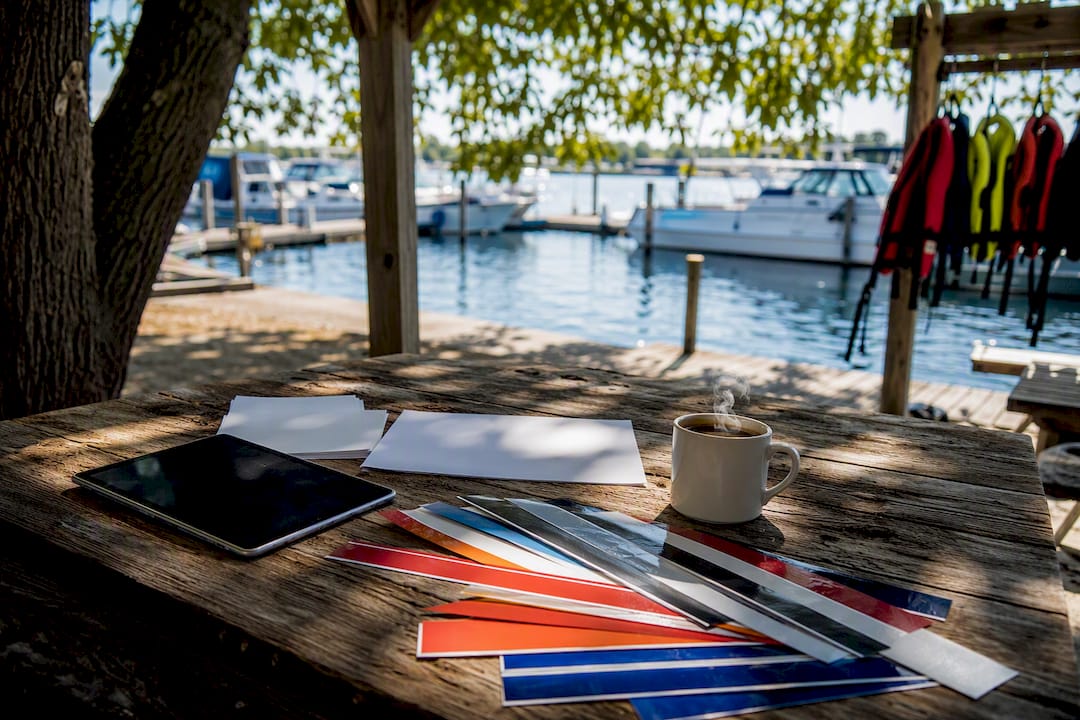
Marinas and dealerships sometimes keep basic decal stock on hand for emergency replacements. It's the fastest option if you're stranded at the ramp with an illegible number, but selection is usually limited to whatever blank stock they carry, and pricing tends to run higher for the convenience.
A few practical notes on choosing between them:
- If you need an official registration certificate reissued, that's an agency-only process, no vendor substitutes.
- If you just need the physical numbers redone and your state allows vendor decals, online ordering usually wins on speed and customization.
- If you're leaving on a trip tomorrow, a marina emergency stock might be your only realistic option, cost aside.
- Always verify your state's specific placement and format rules before ordering from any source, since requirements on character height and spacing vary.
How Do You Order and Install Boat Registration Decals?
Getting this right the first time saves you the cost of a reorder. Here's the checklist before you place any order:
- Confirm your exact registration number as it appears on your certificate, including letters and hyphens.
- Know your state code prefix (like "FL" or "TX") and whether it needs to be separated from the numbers.
- Check your state's minimum character height, usually three inches, and required spacing between characters.
- Make sure your hull surface is clean, dry, and free of wax residue before your decals arrive.
- Take photos of your current registration card if your vendor requests them for accuracy verification.
Installation is straightforward if you follow the sequence in order rather than winging it:
- Clean the application area with rubbing alcohol and let it dry completely.
- Measure and mark placement with painter's tape so both sides of the hull match.
- Peel a small section of the backing paper, align the decal, and press down as you slowly remove the rest of the backing.
- Use a squeegee or credit card to push out air bubbles, working from the center outward.
- Peel away the transfer tape slowly and at a low angle once the vinyl has fully adhered.
Bubbles that won't push out usually mean you applied too fast. A pin prick at the bubble's edge, followed by pressing the air out, fixes most of them without ruining the decal. Misaligned lettering is almost always a measuring problem, not an application problem, so double-check your painter's tape marks before you commit to the first side. For the full walkthrough with photos, Registrationdecals' installation guide covers transfer-tape technique in more detail, and the placement rules page breaks down exactly where your state requires the numbers to sit relative to your hull's waterline and registration decal.
Why Registrationdecals Backs Its Compliance and Materials
Getting the decal wrong the first time, wrong size, wrong state format, wrong material, means paying twice. Registrationdecals built its process around avoiding that. The online design tool lets you enter your exact registration number, pick your state's required format, and choose colors and fonts, so what you approve on screen matches what ships.
Every set uses marine-grade vinyl rated for UV and saltwater exposure, the same spec discussed in the materials section above, with a documented lifespan that outperforms bargain vinyl by several years in most conditions. Production runs 3 to 5 business days, with free shipping across the contiguous United States, whether you're ordering one set for a personal boat or a bulk order for a marina fleet. State-specific regulation pages cover formatting requirements for all 50 states, which cuts down on the back-and-forth that leads to reorders and wasted money.
The Real Mistake Boat Owners Make on Decals
Most owners treat decal shopping as an afterthought, something to knock out cheaply right after registration paperwork clears. That's backwards. The paperwork is the easy part. The decal is the thing sitting in saltwater spray and full sun for the next several years, and a $10 savings on a bargain set often turns into a $30 reorder eighteen months later when the vinyl cracks. Check your state's exact format rules first, then buy quality once. It's cheaper in the long run and it's one less thing you'll think about at the ramp.
— Taylor
Get Your Compliant Decals Made Right, Fast
Registrationdecals is the direct alternative to guessing at generic decal templates or waiting weeks on a state office reissue. You design your exact registration number, state format, and color scheme online in minutes, and it ships already built to your state's spacing and size rules, not a one-size-fits-all template.
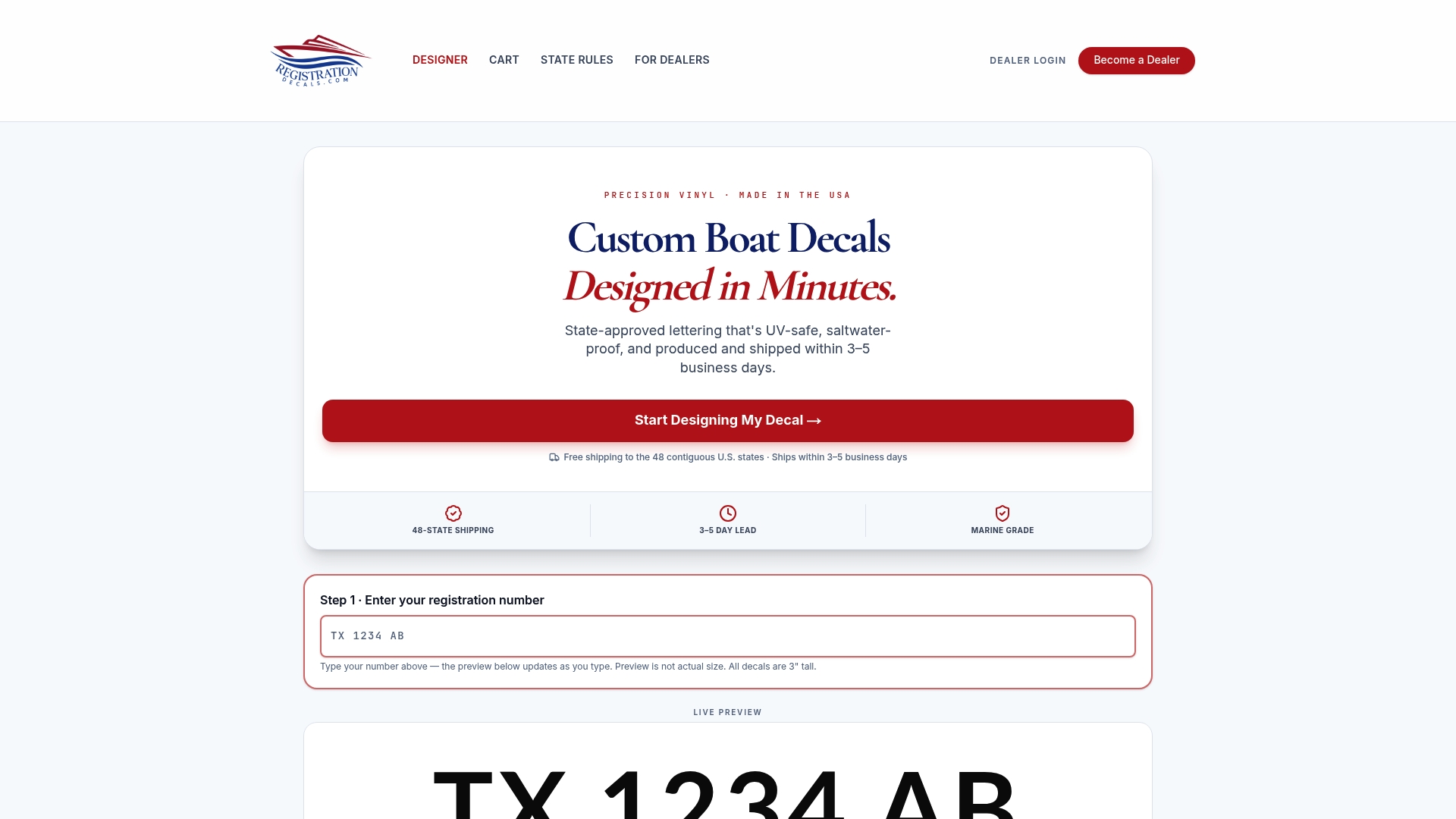
A basic set starts around $12 to $25, built from marine-grade vinyl rated for UV and saltwater exposure, with production in 3 to 5 business days and free shipping across the contiguous United States. Whether you're replacing a faded set or registering a new boat for the first time, design your decals now and get the numbers right the first time.
Sources
- Boat registration cost by state — BoatRegistrationUSA
- Dmv
- Fee Chart for Boats and Outboard Motors — Texas Parks & Wildlife Department
- Apply & Buy - Nevada Boating
- Registration fees — Wisconsin DNR