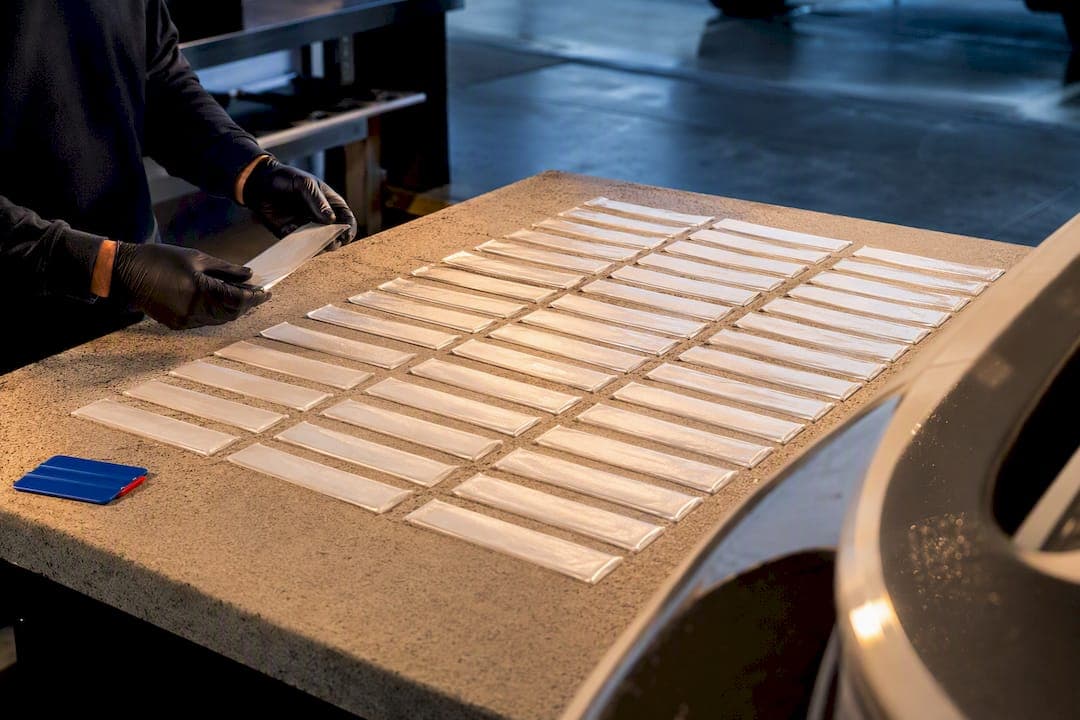
Federal law sets the floor: plain block numbers at least 3 inches tall, on both sides of the forward half of the hull, with a validation decal within 6 inches. For a bulk job, that's the easy part. The real work is mapping every boat to its issuing state, confirming that state's specific quirks, and running production through pre-spaced marine-grade vinyl kits instead of one-off custom art files. Do that in order and a 40-boat fleet job takes days, not weeks.
TL;DR:
- Most states require registration numbers to be at least 3 inches tall with a clear space or hyphen separating the prefix, number, and suffix; federal rules set this baseline.
- Placement of decals must be within 6 inches of the registration number and on the side of the hull specified by the state's rules; documented vessels typically display only a federal documentation number.
- Accurate data collection during bulk orders—including owner info, registration details, and vessel type—is critical to prevent costly reprints and compliance errors.
- Vinyl decals must be pre-spaced, made from marine-grade material, and applied on a clean, properly prepared hull in optimal temperature conditions for durability.
- Final checks before launch include verifying correct registration format, spacing, placement, and contrast; photographing and signing off on each boat ensures compliance and reduces future disputes.
Table of Contents
- What Does the Coast Guard Require for Boat Registration Numbers?
- How Do State Rules Differ From the Federal Baseline?
- What Are the Exact Size and Font Rules for Registration Numbers?
- Where Exactly Do Numbers and Decals Go on the Hull?
- What Materials and Application Steps Give You Durable Results?
- How Do You Manage Registration Data for a Fleet-Wide Order?
- What Should You Check Before Every Boat Leaves the Dock?
- Where Bulk Jobs Actually Go Wrong
- Get Your Fleet's Decals Made Right the First Time
- Sources
What Does the Coast Guard Require for Boat Registration Numbers?
Every state registration scheme in the country sits on top of the same federal skeleton. The U.S. Coast Guard's rule at 33 CFR 173.27 requires plain, vertical block letters and numerals, at least 3 inches tall, painted or affixed to both sides of the forward half of the hull. Numbers have to read left to right, and there needs to be a space or hyphen equal to the width of a letter between the state prefix, the numeric sequence, and the state suffix. So "FL 1234 AB" or "FL1234AB" formats correctly; smashing the characters together does not.
That single federal citation is why registration numbers look almost identical from a Bayliner in Michigan to a pontoon boat in Texas. States can add restrictions, but none can go below this baseline.
Two connected rules matter just as much for a fleet job:
- Validation decal placement (33 CFR 173.35): the annual validation decal (or sticker) has to sit within 6 inches of the registration number, usually right after the last character.
- Certificate carry requirement (33 CFR 173.21): the operator must have the certificate of number on board whenever the vessel is in use. Registration numbers get displayed on the hull; the paperwork rides in the boat.
There's one carve-out worth knowing before you quote a bulk job: documented vessels. A boat documented with the National Vessel Documentation Center instead of a state doesn't display state-issued registration numbers at all. It shows its official documentation number on the hull instead, typically inside the boat near the helm or on a structural member, following a separate marking spec. If a marina's fleet mixes documented and state-registered hulls, that split changes what gets ordered and where it gets applied, so flag it during data collection, not during installation.
How Do State Rules Differ From the Federal Baseline?
The federal rule is the floor. States build on top of it, and the differences are exactly where bulk jobs go sideways if nobody checks them first.
Four areas account for almost every state-level variation you'll run into:
- Minimum height language. Most states simply restate the federal 3 inch minimum, but a handful specify it more precisely (measuring the character itself, not including any decorative outline) or set a higher minimum for larger vessels.
- Separator style. Some states are strict about hyphens versus spaces; others accept either as long as the gap equals one letter width.
- Decal placement variants. The federal rule says within 6 inches of the number, but some states specify which side the decal goes on relative to the numbers, or require it on a specific location on the hull rather than "near the numbers."
- Exemptions. Documented vessels, certain government or law-enforcement boats, and in some states, boats under a certain length used exclusively on private water, may be exempt from standard display rules.
Florida is a useful example of how a state agency frames all of this. The Florida Department of Highway Safety and Motor Vehicles requires every motorized vessel operating on the state's public waterways to be titled and registered, and it processes that registration through county tax collector offices or licensed plate agents rather than a single centralized office. That matters for a dealer selling into Florida: the paperwork trail runs through county-level offices, so your data collection has to capture which county issued the registration, not just "Florida," if you ever need to trace a number back to its source.
Pro Tip: Build a one-page rule card per state the first time you handle an order from it, and keep the cards in a shared folder. The second order from that state becomes a five-minute lookup instead of a fresh research project.
A practical mapping workflow for a mixed-state bulk order looks like this:
- Pull the state code from each owner's registration paperwork, not from the address on file. A boat titled in one state and slipped in another is common at marinas near state lines.
- Record the exact registration number as issued, character for character, including whatever separator that state's documentation shows.
- Confirm the validation decal placement rule for that state; default to "within 6 inches, trailing the last character" unless the state agency specifies otherwise.
- Note any state-specific restriction (a required color, a prohibited font style, an exemption category) directly against that boat's record.
- Flag documented vessels immediately so they route to a different production spec entirely.
For sourcing the actual rules, go to the state's own motor vehicle or wildlife/parks agency page. Florida's site linked above is a solid model of what a state page usually covers. For a fast cross-state reference without hopping between fifty agency sites, Registrationdecals's state-by-state regulation guide compiles the display rules and formatting quirks by state, which is useful for a first pass before you confirm against the primary source.
One more variable that trips up bulk orders more than it should: registration number format from a vendor's perspective. State vendor systems don't always require every field filled in manually. Idaho's vendor guide for new boat registration shows a system where, if a dealer leaves the registration number field blank at the point of sale, the state's system auto-assigns one. That's convenient at the point of sale, but it means a decal order placed before the state finishes processing can end up chasing a number that hasn't been issued yet. Build a hold step into your workflow for any boat whose registration number isn't locked yet, rather than guessing at a number and reordering later.
What Are the Exact Size and Font Rules for Registration Numbers?
Measure the 3-inch minimum from the bottom of the character to the top, not including any drop shadow, outline, or decorative flourish. A font with a heavy outline can look like it clears 3 inches while the actual letterform underneath measures closer to 2.75 inches, which fails inspection even though the sticker looks big enough. Most compliance guidance treats anything below 3 inches as a fail with essentially no tolerance, so round up rather than aiming for exactly 3.0 inches when you're setting up a template.
Spacing is where DIY decal jobs fall apart. The rule is a gap equal to one letter width between the state prefix, the number sequence, and the suffix, and that gap can be either a blank space or a hyphen. What trips people up is applying that spacing rule unevenly across a six-character versus an eight-character registration string. A pre-spaced kit solves this because the spacing is baked into the file before it ever gets cut, so the applicator isn't eyeballing gaps between characters on a curved hull.
Font and style rules are short but strict:
- Plain vertical block letters and numerals only. That means no italics, no script, no hand-lettered or "vintage" styles.
- Stroke width has to stay consistent across the character. Fonts with dramatic thick/thin contrast (the kind used in a lot of decorative marine lettering) can read as noncompliant even at the right height.
- Characters read left to right, upright, not slanted or stacked vertically.
If you're unsure whether a specific font qualifies, Registrationdecals's guide to required registration number fonts breaks down which styles pass and which get flagged during inspection.
Contrast matters more than most owners realize. The rule doesn't specify an exact color pairing, but the underlying intent, driven by law enforcement legibility, means low-contrast combinations (white numbers on a light gray hull, for example) tend to draw more scrutiny even when the letter height is technically correct. A quick field test: photograph the hull from about 30 feet in daylight and check whether the numbers are instantly legible in the thumbnail. If you have to squint at a full-size photo, an officer on the water will have the same problem.
Pro Tip: Order a sample kit at the actual specified color combination before locking in a fleet order. Screen colors and vinyl colors don't always match, and a "close enough" color call on 40 boats is an expensive mistake to unwind.
Where Exactly Do Numbers and Decals Go on the Hull?
The forward half of the hull, both sides, is the fixed rule everywhere. In practice, that means measuring the boat's total length from bow to stern, marking the midpoint, and keeping the entire registration number within that forward section rather than centering it on the midpoint itself.
- Measure from the correct reference line. Most applicators measure up from the waterline or down from the gunwale, whichever gives a cleaner, more visible line on that specific hull shape. Consistency across a fleet matters more than which reference you pick.
- Place port and starboard identically. Numbers on both sides should sit at the same height and the same distance from the bow, so the boat reads correctly whether it's viewed from either side or from directly overhead.
- Position the validation decal within 6 inches. The federal proximity rule puts the annual sticker close enough to the number that an officer can check both in one glance; check the state's guidance for which side of the number the decal belongs on, since that detail is one of the more common state-specific variants.
- Solve curved bows with backer plates or panel placement. On steeply raked bows, pontoon tubes, or PWC hulls where a flat 3-inch-tall run of characters won't sit cleanly, a rigid backer plate mounted to a flatter section of the hull, still within the forward half, keeps the numbers straight and legible instead of warping around a curve.
- Remove state numbers entirely on documented vessels. Once a boat is federally documented, state-issued registration numbers come off the hull and the official documentation number takes their place, marked according to the Coast Guard's separate documentation spec rather than the state numbering rule.
Pontoons and PWCs are the two hull types that generate the most placement questions in a bulk order. Pontoon tubes curve away almost immediately, so numbers often end up smaller-looking than they are unless you account for the visual foreshortening. PWCs simply don't have much flat forward hull to work with, which is where a backer plate earns its cost even on a single unit, let alone across a rental fleet of a dozen.
What Materials and Application Steps Give You Durable Results?
Marine-grade vinyl is not the same product as the calendared vinyl sold for indoor signage, and using the wrong stock is the single biggest reason bulk decal jobs fail early. Real marine-grade vinyl carries UV inhibitors that keep colors from fading under sustained sun exposure and a saltwater-resistant adhesive formulated to hold against constant moisture, spray, and hull flex, conditions that break down consumer-grade vinyl within a season.
Surface prep is where a rushed bulk job loses its warranty before it even gets applied. Soap and water removes dirt, but it leaves behind wax, mold-release residue, or a thin film of oxidized gelcoat that soap simply can't cut through. Applying decals over that residue gives you a bond that looks fine on day one and starts lifting at the edges within weeks. Wipe the application area with isopropyl alcohol or a marine degreaser, let it flash dry, and only then start positioning the decal.
Application itself follows a fairly forgiving sequence once the surface is clean:
- Mask the position with low-tack tape as a guide line before removing any backing paper.
- Peel back the backing a few inches at a time rather than all at once, positioning as you go.
- Squeegee from the center outward to push air toward the edges, then pull the transfer tape away at a low angle rather than straight up.
- If a small bubble survives, a pin prick and a firm squeegee pass over the spot usually clears it without lifting the vinyl.
Temperature governs adhesive activation more than most applicators expect. Working in roughly a 50°F to 90°F range gives the adhesive the flexibility to bond properly; apply below that window and the vinyl gets stiff and resists conforming to any hull curve, apply above it and you risk premature tack that makes repositioning impossible.
For fleet orders shipping to a marina or dealership ahead of an install date, store rolled or flat-packed kits somewhere climate-controlled rather than in a hot truck bed or an unheated warehouse in winter. Extreme storage temperatures can pre-stress the adhesive layer before the decal ever touches a hull. If you're deciding between vinyl and painted numbers for a specific fleet, Registrationdecals's comparison of vinyl versus painted registration numbers and its breakdown of vinyl grades for marine use both cover the durability tradeoffs in more depth. Gelcoat condition also affects how long any decal holds; a hull with properly maintained gelcoat protection gives vinyl a cleaner, more stable surface to bond to than a chalky, oxidized one.
Pro Tip: Keep one extra decal set per ten boats in a bulk order. Field damage during installation, a torn corner, a misaligned first attempt, is common enough that reordering mid-project stalls an entire fleet timeline.
How Do You Manage Registration Data for a Fleet-Wide Order?
A bulk order lives or dies on the data collected before a single decal gets cut. The standard registration sequence, choosing the state, gathering ownership and HIN records, checking title and tax status, filing with the agency, then displaying the issued numbers, gives you a natural template for what to collect per boat before production starts.
A pre-order data template for a fleet or dealer job should capture, per vessel:
- Owner name and contact email. Vendor guidance recommends collecting email specifically because states increasingly send renewal notices and electronic receipts that way, and having it on file speeds up any correction request later.
- Issuing state and county or agency of record, since some states process through local offices rather than a central one.
- Registration number exactly as issued, including the separator style that state uses.
- Hull Identification Number (HIN). Note that the HIN is a manufacturer-assigned identifier separate from the state-issued registration number, and mixing the two up in a data sheet is a common source of production errors.
- Hull color and finish, which determines vinyl color selection and contrast.
- Vessel length and hull type (pontoon, PWC, deep-V, and so on), which determines placement strategy before a single measurement is taken on the water.
Once that data is in hand, run it against each state's formatting rules before anything goes to production. A simple validation pass, even something as basic as a spreadsheet formula checking character count and separator type against a lookup table by state, catches format mismatches before they become forty scrapped decals. Require a signed owner confirmation of the exact registration string before cutting vinyl; an owner-approved email or CSV line for each boat is cheap insurance against a costly reprint.
For staging production and installation across a large order:
- Group boats by hull color and vinyl color first, then by size, so proofing stays consistent and installation crews aren't switching material mid-shift.
- Run a physical proof sample against the actual hull color before committing the full batch, screen colors and gelcoat colors don't always match under real daylight.
- Deploy install teams by dock or row rather than by boat model, which cuts walking time and keeps a crew's tools and materials in one place.
- Photograph each completed installation, both sides, plus a close-up of the validation decal placement, and log it against that boat's record.
A typical bulk turnaround, once data is validated, runs through design proofing, a production window of a few business days, then a staged install period sized to the fleet. The photo and sign-off records aren't just good practice, they're the paper trail you want on hand if a registration number is ever questioned by an inspecting officer months later.
What Should You Check Before Every Boat Leaves the Dock?
Run this list against every vessel in a bulk order before it goes back in the water. It takes a few minutes per boat and catches the mistakes that actually generate citations.
- State prefix and format match the issued registration exactly, including separator style (hyphen or space).
- Character height clears 3 inches, measured on the actual letterform, not including any outline.
- Spacing between groups equals one letter width, consistent on both port and starboard.
- Numbers sit on both sides of the forward half of the hull, at matching height and distance from the bow.
- Validation decal is within 6 inches of the registration number, on the side that state specifies.
- Certificate of number is on board, not just filed at the office.
- Font is plain block style, no script, italic, or variable stroke width.
- Color contrast is legible from a distance in normal daylight.
Basic measurement tolerance is tight: treat anything under 3 inches as a fail, and treat spacing that's obviously uneven (one gap visibly wider than another on the same hull) as a redo rather than a judgment call. A cloth tape measure and a level line marked in low-tack tape before application solves most of this before it becomes a problem.
Photograph every completed boat, both sides plus the decal proximity, and get a quick owner or dock manager sign-off on the finished install. That combination, photo plus signature, is the fastest way to resolve a dispute or an insurance question six months down the line.
Where Bulk Jobs Actually Go Wrong
Most compliance failures on fleet orders trace back to three repeatable mistakes: guessing at spacing instead of measuring it, applying decals to a hull that was only wiped with soap, and locking in a registration number before the state has actually finalized it. Each one is avoidable with a five-minute check earlier in the process, not a bigger budget.
The gap between a decal that looks compliant and one that actually is comes down to whether someone measured the letterform itself, not the sticker's outer edge. Registrationdecals builds pre-spaced marine-grade vinyl kits specifically to remove that guesswork from bulk production, since spacing and height are locked into the file before a boat ever gets touched.
— Taylor
Get Your Fleet's Decals Made Right the First Time
Registrationdecals turns a state's registration string into a compliant, pre-spaced decal set in one online session, no design software, no guessing at spacing. Enter each boat's registration number, HIN, and hull color into the design tool, pick from state-compliant templates, and the layout locks the 3-inch minimum and correct letter spacing automatically.
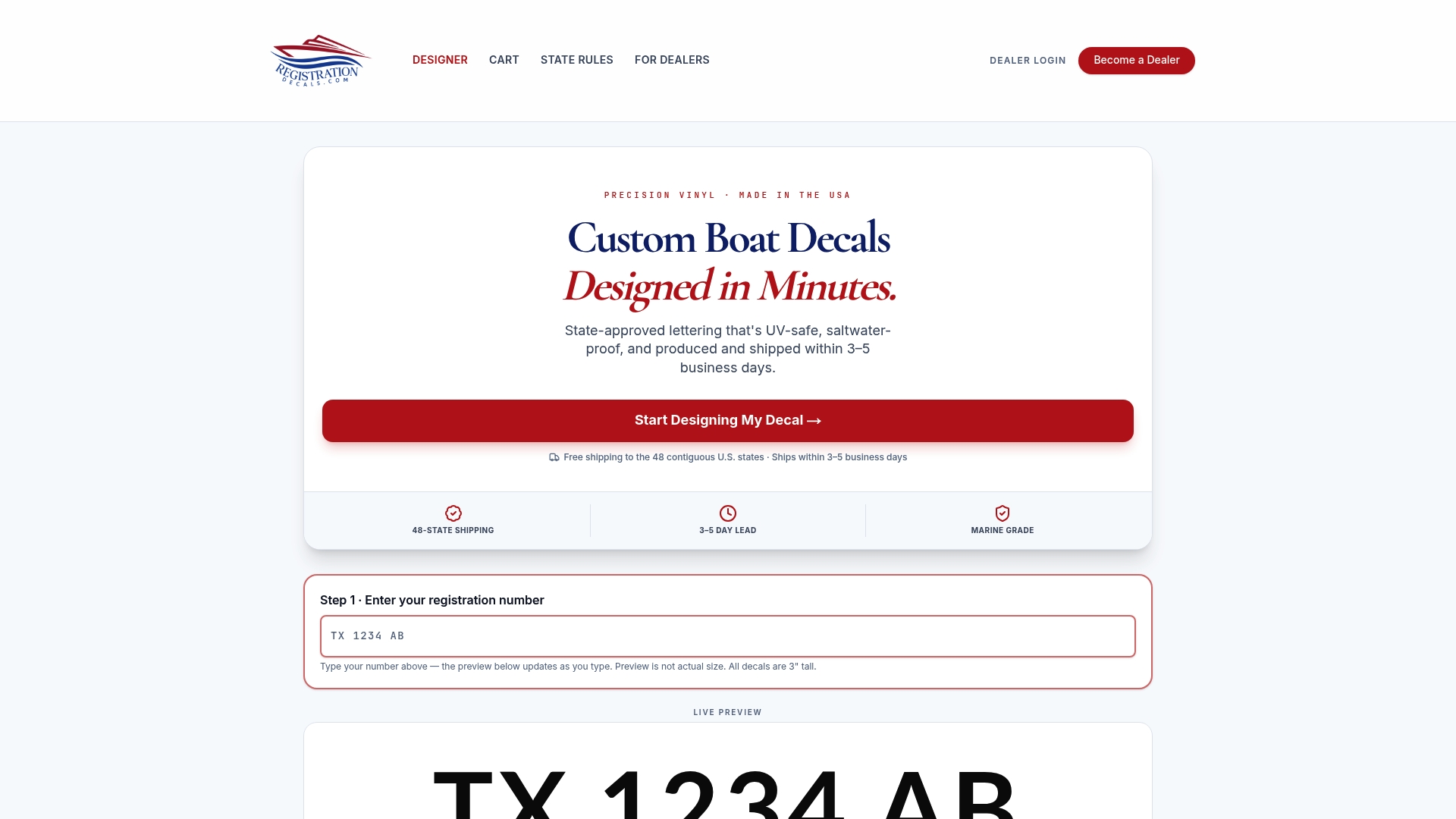
For a bulk order, have your registration data ready before you start: state, exact registration string as issued, hull color, and vessel count. That single spreadsheet turns a fifty-boat order into one submission instead of fifty separate ones. Every kit ships in marine-grade vinyl built for UV and saltwater exposure, with production running a few business days and shipping available across the contiguous United States. Proofs come back for your review before anything goes to print, so color and spacing get confirmed before decals are cut.
If you're deciding between vinyl and paint for a fleet, the vinyl versus painted numbers breakdown covers the tradeoff, and the durability page on marine vinyl lifespan shows what to expect over multiple boating seasons. Start your fleet's order on the Registrationdecals design tool and get a proof back before your next haul-out.
Sources
- How to Apply Boat Registration Numbers: Placement Rules - LegalClarity
- Vessel Titling and Registrations - Florida Department of Highway Safety and Motor Vehicles
- VENDORS - How to Register a New Boat (Idaho vendor guide)
- How to Register a Boat: 5 Steps 2026 | BoatRegistrationUSA