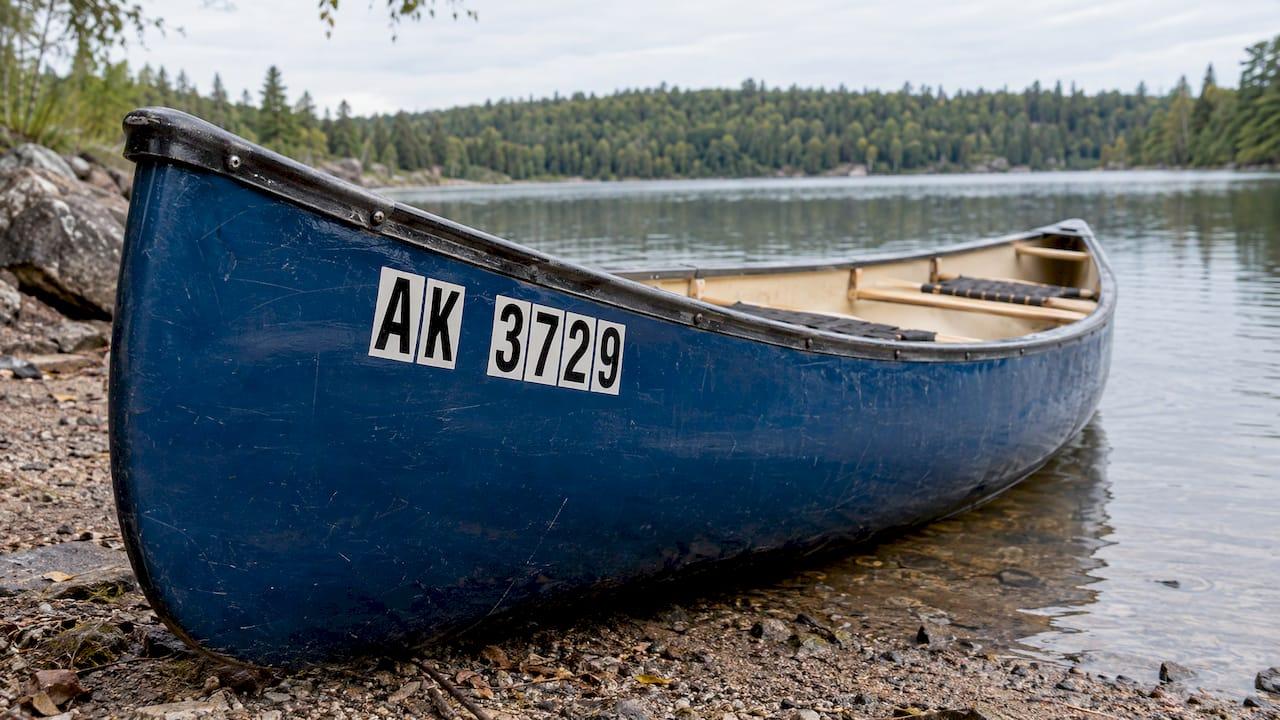
Whether your canoe needs registration numbers depends on your state and on whether the canoe has a motor. If it does need them, the federal standard is plain block characters at least 3 inches tall, in a color that contrasts with the hull, on each side of the forward half. A canoe with a motor or sail is the usual case for numbers. A paddle-only canoe may carry state decals, an owner name, or nothing, depending on where you boat. This guide covers the formats, the placement rules and how to confirm your state's current requirements.
TL;DR
- Federal rules (33 CFR 173.27) call for plain vertical block characters at least 3 inches high, contrasting with the hull, on both sides of the forward half, reading left to right.
- States set the prefix, the decal position and the rules for paddle-only boats. Some exempt them, and Minnesota requires DNR-issued decals on nonmotorized canoes.
- Put numbers on clean, dry hull material and use solid, high-contrast colors. Avoid script, slanted or shaded styles.
- Your state boating agency's page is the final word. Check it before you order anything.
- A custom set of state-compliant canoe numbers from us is $35.99 per set.
Table of Contents
- Does a canoe need registration numbers?
- What a registration number looks like
- The federal display standard
- Where the numbers and decals go on a canoe
- Size, color and legibility
- Vinyl decals on a canoe
- How to check your state's current rules
- Order canoe numbers that fit your state
- Our perspective
- FAQ
- Sources
Does a canoe need registration numbers?
It depends on the state and on propulsion. The clearest pattern in state law is that unpowered, low-volume boats get different treatment from motorized ones.
Pennsylvania, for example, exempts unpowered kayaks, sculls, sailboards and other low-volume boats of similar design from displaying registration numbers. Minnesota goes another way. Its rule requires all nonmotorized canoes, kayaks, paddle boards, paddle boats and rowing shells to display decals furnished by the Department of Natural Resources, affixed on each side of the forward half of the craft where they can be clearly read.
So three situations come up for canoe owners:
- A canoe with an outboard or electric motor. This is the case where you expect a state number on the bow, plus a validation decal.
- A paddle-only canoe in a state that exempts it. No registration number is displayed.
- A paddle-only canoe in a state with its own program. You display what the state issues, which may be a decal, not a custom number.
We keep a plain-language answer on this at do kayaks and canoes need registration numbers, and a related walkthrough in our kayak registration numbers guide, since the two craft are treated similarly in most state codes.
What a registration number looks like
Most states follow one three-part pattern: a state prefix, a block of numerals, and a letter suffix. The parts are separated by hyphens or equivalent spaces.
Examples from state sources:
- California numbers are prefixed CF, followed by four numbers and a two-letter suffix, such as CF 1234 AB. The letters I, O and Q are not issued.
- New Jersey uses the letters NJ, no more than four numerals and no more than two letters. I, O and Q are not used in the suffix.
- Ohio numbers are OH followed by four numbers and two letters. The number stays with the boat for its lifetime in Ohio regardless of ownership changes.
- Kansas numbers use the prefix KA, one to four numerals and two suffix letters, written like KA 123 AA or KA-123-AA.
- Alabama divides its number into the capital letters AL, no more than four numerals and no more than two capital letters, separated by a hyphen or equivalent space.
Do not confuse the registration number with the hull identification number (HIN). The HIN is the boat's serial identifier. A current manufacturer's HIN has 12 characters: a three-character manufacturer ID, a five-character serial number, a month code, a year digit and two model-year digits, per the California DMV vessel number handbook. The registration number is what goes on the bow. The HIN is molded or affixed to the hull by the builder, and many canoes, especially older ones, never had a registration number at all.
The federal display standard
The baseline for any numbered vessel is 33 CFR 173.27. It says each number must be:
- Painted on or permanently attached to each side of the forward half of the vessel.
- In plain vertical block characters not less than 3 inches in height.
- A color that contrasts with the background and is distinctly visible and legible.
- Spaced with a gap or hyphen between letter and number groupings equal to the width of a letter other than "I" or a number other than "1".
- Read from left to right.
Our boat number design guide shows how to check that your characters really stand three inches tall once they are on a curved canoe hull.
Where the numbers and decals go on a canoe
The number goes on the forward half of the hull, on both sides. A canoe has a narrow bow with a lot of curve, so the practical question is where you find a flat, usable stretch within that forward half. Mark the spot with painter's tape before you peel anything.
Registration number placement
Our own explainer on where registration numbers go on a boat covers the general case, and numbers on both sides is the follow-up. Washington State is a good example of how specific a state can be. It wants the number on both sides of the bow, in block style, at least 3 inches high, contrasting with the background, with a hyphen or equivalent space between the three segments.
Validation decal placement
The decal that shows your registration period is separate from the number, and states place it differently:
The differences are small but real: three inches in one state, six in the next. Our validation sticker placement answer and state sticker placement guide go through them in more detail.
Two more rules matter on a small craft. Alabama allows only the current-year decal to be displayed. Pennsylvania lets you apply a validation decal before January 1 of the period it is issued for, and it prohibits anyone without authority from erasing, defacing or tampering with a registration number or decal. That means peel old decals cleanly rather than painting over them.
Size, color and legibility
The 3-inch minimum is the same across the state rules in our research. Where states differ is in how they describe readability. Hawaii says numbers must be clearly visible and legible at a distance of at least 100 feet. Indiana asks for a single color, legible from 100 feet, with a two-inch space between letters and numbers.
Color is a hull-by-hull decision. Hawaii's guidance recommends solid-color characters, steering clear of shaded, slanted or script styles, and choosing the colors that give the greatest contrast. It also notes that if you use a backing plate of a different color, the plate must extend far enough beyond the number to give enough background for contrast.
In practice:
| Canoe hull | Contrast approach |
|---|---|
| Green, red or blue | White or another light color |
| White, tan or yellow | Black or navy |
| Wood-look or varnished | A solid color that stands out from the grain, or a backing plate |
Our answer on what color registration numbers have to be covers the contrast rule in more detail.
Vinyl decals on a canoe
A federal rule allows numbers to be painted on or permanently attached, and vinyl is the common way to attach them. We explain this in can registration numbers be vinyl decals. A canoe is a good candidate for vinyl: you avoid painting and masking a curved hull, and you can place the characters exactly where you measured.
Apply them the way Hawaii's guidance suggests: to a clean, dry surface, pressed firmly in place. A clear spray coating may help secure them. Canoes spend time in sun, in the water, and on roof racks, so the material matters. Ours are cut from marine-grade vinyl chosen for UV and saltwater resistance.

How to check your state's current rules
State rules change, and the pages above are examples, not a substitute for your own state's page. A quick routine:
- Find the state agency. It is usually a department of natural resources, fish and wildlife, parks or motor vehicles. Search for its name plus "boat registration".
- Look for the exemption language. Find how the state treats nonmotorized or paddle-only craft, and whether it issues its own decal for them.
- Note the format. Prefix, number of digits, suffix letters, and the exact spacing.
- Note decal position. Distance from the number, and whether it goes before or after it.
- Match it to the hull. Measure your forward half, tape the layout, then order.
Our 50-state decal regulations page collects this guidance by state, which saves time when you boat in more than one.
Order canoe numbers that fit your state
If your canoe carries a motor, or your state wants a displayed number, our online design tool takes a couple of minutes. You enter your registration number, pick colors and a font, and we produce the decals in-house in 3 to 5 business days. Shipping is free in the contiguous United States. A custom set is $35.99.
Start on our custom boat registration numbers page, and read the sizing and placement answers before you finalize the layout. Marinas and dealerships ordering for many boats can use the same tool for bulk orders.
Our perspective
Most canoe owners come to us after a warning or a puzzling state letter, not because they love paperwork. The mistake we see most often is not the number itself. It is the layout: letters that are a little under three inches, a gap that is too tight, or a color that disappears against a faded hull.
Our approach is to take the guesswork out of the part you control. The design tool is built around the standard block format, so you enter your number and choose a color that contrasts with the hull. The vinyl is marine-grade, picked for UV and saltwater exposure, because a decal that peels or fades after a season defeats the point.
Check your state's page, measure your bow, and then let us handle the lettering.
Taylor
FAQ
What do the letters and numbers in a registration number mean?
The letters at the start identify the state, such as CF for California or OH for Ohio. The numerals and the suffix letters are assigned to your boat. Some states leave out certain suffix letters: California and New Jersey do not use I, O or Q, which avoids confusion with 1 and 0.
Can I put registration numbers on a canoe myself?
Yes. Federal rules allow numbers to be painted on or permanently attached. Vinyl decals applied to a clean, dry hull are a straightforward way to do it, as long as the size, color and spacing meet the standard.
How tall do the numbers need to be?
At least 3 inches, in plain vertical block characters, under federal rules and the state rules in our research. Spacing between letter and number groups should equal the width of a letter other than "I" or a number other than "1".
Do both sides of the canoe need numbers?
Where numbers are required, they go on each side of the forward half of the vessel. Washington and Alabama, for example, both specify both sides of the bow.
Sources
- eCFR: 33 CFR 173.27, Numbers: Display; size; color
- California DMV: Vessel Numbers
- N.J. Admin. Code § 13:82-8.2, Numbering pattern
- Hawaii DLNR DOBOR: Numbering Your Vessel
- Texas Parks & Wildlife: Numbers and Decals on Vessels
- Washington DOL: Boat registration and hull identification numbers
- 58 Pa. Code § 93.5
- Minnesota Rule 6110.0400
- Ohio DNR: Displaying Your Numbers & Decals
- Alabama Admin Code Chapter 220-6
- Kansas Department of Wildlife and Parks: registration decals and assigned numbers
- Boat-Ed Indiana: Displaying the Registration Number and Excise Tax Decals