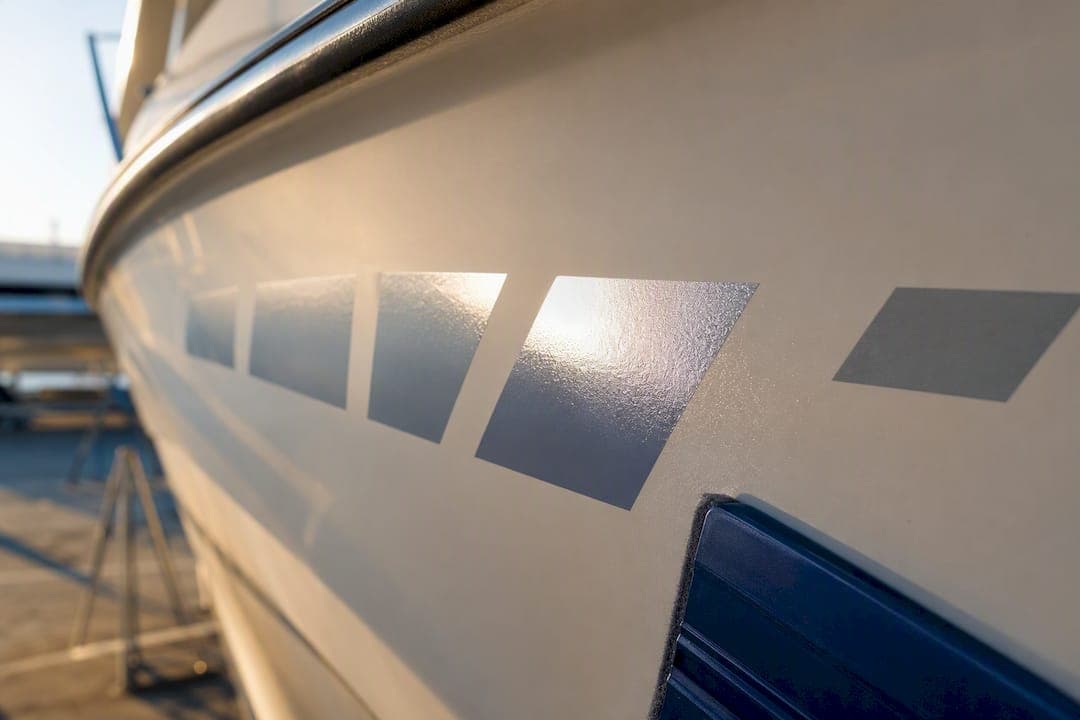
The fastest way to get state-compliant, long-lasting boat registration decals is to order custom marine-grade vinyl decals through an online design tool rather than settling for standard adhesive vinyl from a hardware store. Marine-grade material resists UV fading and saltwater corrosion, and Registrationdecals builds each decal to your state's exact size and number specs. Enter your registration number, pick your colors, and production starts within days.
TL;DR:
- Marine-grade decals with full UV stabilizers and mildew inhibitors last up to 10 years, especially if paired with a protective overlaminate and properly applied.
- State registration rules specify exact size, placement, and character matching, requiring careful verification before ordering to avoid costly reprints.
- Custom orders can be previewed online to ensure correct contrast, font size, and alignment, significantly reducing mismatches and installation issues.
- Bulk and fleet orders should request proofs beforehand, and planning ahead for peak registration seasons minimizes delays and reordering costs.
- Proper surface preparation, including complete removal of old decals and thorough cleaning, ensures optimal adhesion and prevents bubbling or peeling over time.
Table of Contents
- What Makes a Registration Decal Truly "Marine-Grade"?
- How Do State Rules Affect What Decal You Order?
- How Do You Order Custom Decals Online?
- How Long Do Marine-Grade Decals Actually Last?
- How Fast Can You Get Decals, and What About Bulk Orders?
- How Do You Install a Decal Without Bubbles or Peeling?
- Why Getting the Decal Right the First Time Matters
- Order Compliant Marine-Grade Decals Without the Guesswork
- Sources
- FAQ
What Makes a Registration Decal Truly "Marine-Grade"?
Not all vinyl decals are built the same, and that distinction matters more than most boat owners realize when they order online. Real marine-grade vinyl runs UV stabilizers through the entire compound rather than just coating the surface, and it pairs that with mildew inhibitors, a reinforced backing layer, and a protective topcoat. Skip any one of these and you get a decal that looks fine on day one and peels, cracks, or fades within a season or two on the water, as Carolyn Fabrics explains in its marine vinyl buying guide.
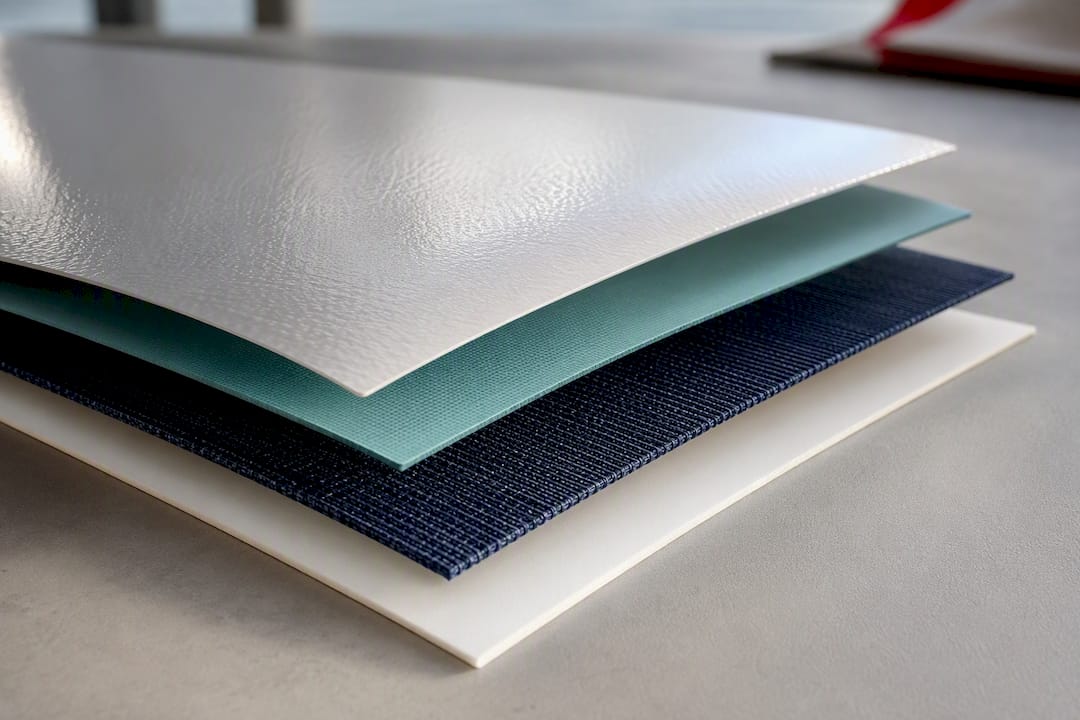
Manufacturers test durability with UV-hour ratings or xenon-arc exposure testing, and boats stored outdoors year-round should look for materials rated at high UV resistance levels, according to D and G Flooring's marine vinyl guide. Coastal boaters should weight salt-air and mildew resistance heavily, while freshwater and covered-storage boaters get more mileage out of UV and abrasion resistance.
Pro Tip: Ask any decal supplier for their material's UV rating and salt-spray test results before you order. If they can't answer, assume it's decorative vinyl, not marine-grade.
Before ordering, check the spec sheet for:
- UV stabilizer content throughout the vinyl, not just a surface coating
- A documented UV-hour or xenon-arc test rating
- Mildew and antimicrobial treatment
- Reinforced backing designed for hull and console surfaces
- A protective topcoat or overlaminate option
How Do State Rules Affect What Decal You Order?
Every state ties its registration decal to a specific number, size, and placement, and getting any of those wrong means reordering. Most states require the validation decal to sit close to the registration number on the hull, and the number printed on the decal has to match your registration certificate exactly, character for character.
Placement rules vary by state, and two examples show why you can't assume your neighbor's setup applies to you. Florida statute governs how decals are issued and where they can be placed, including different allowances for documented vessels. In Texas, guidance specifies the validation decal sits three inches toward the rear of the registration number, with a separate placement option for documented vessels, according to the Texas Parks & Wildlife Department.
Design choices affect compliance too. Consider these before finalizing colors:
- Contrast between the numbers and the hull color, since most states require the registration number to be easily readable from a distance
- Minimum letter height, which most states set around three inches
- Block-style lettering, since most states require block letters rather than script
Always confirm current placement and sizing rules with your issuing agency before you submit an order.
How Do You Order Custom Decals Online?
Ordering a compliant decal set takes a few minutes once you have the right information in hand. Here's the sequence that gets it right the first time:
- Gather your details. You'll need your exact registration number, the issuing state, and your boat type (pontoon, bass boat, center console, aluminum hull, or personal watercraft).
- Choose colors and finish. Pick a color combination that contrasts against your hull, then decide between standard or reflective finish.
- Preview before you approve. A design tool that lets you enter your number and colors and see a live preview reduces mismatched orders significantly, since you catch spacing, contrast, or sizing problems before production starts, a workflow Registrationdecals builds directly into its ordering system.
- Check sizing against your state's minimum. Confirm the preview shows letters at or above your state's required height.
- Decide on quantity and options. Order a duplicate set if you plan to reapply on both sides, and consider a proof copy for a large or first-time order.
Pro Tip: If you're ordering for a fleet or a new boat model, request a proof before committing to the full batch. It catches font or color mismatches before they become 20 wrong decals instead of one.
How Long Do Marine-Grade Decals Actually Last?
A properly specified marine-grade decal can last several years when paired with a protective overlaminate, according to Registrationdecals' own guidance on decal longevity. Without that overlaminate, expect the lower end of that range, especially in saltwater environments where UV exposure and salt spray both attack the vinyl edge and adhesive layer at the same time.
Three factors shorten decal life faster than anything else:
- Constant saltwater exposure without freshwater rinsing
- Uncovered outdoor storage in high UV climates
- Applying decals to a poorly cleaned or oily surface
Overlaminate adds a clear protective layer over the printed vinyl, shielding the color and text from abrasion and sun exposure. It's worth the small added cost for any boat kept outdoors or used in saltwater. Before you buy, confirm what warranty coverage applies and whether it covers fading, lifting, or cracking, and for how long. Check the full lifespan breakdown here.
How Fast Can You Get Decals, and What About Bulk Orders?
Standard turnaround runs 3 to 5 business days for production, with free shipping across the contiguous United States for many orders. That's a realistic window to plan around whether you're registering one new boat or restocking a dealership's inventory.
For marinas and dealerships, bulk ordering works differently than a single retail purchase:
- Request a proof for the full batch before production runs, especially when numbers and colors vary across units
- Build in extra lead time for orders placed during peak spring registration season (March through May)
- Consolidate multiple boat orders into one shipment when possible to simplify receiving
Order ahead of your busiest registration months rather than during them. A dealership that waits until the first warm weekend to order 40 decal sets is competing with every other buyer doing the same thing.
How Do You Install a Decal Without Bubbles or Peeling?
Good adhesion starts before the new decal ever touches the hull. Follow this sequence:
- Remove the old decal completely. Peel off any existing registration decal and clean off adhesive residue with a plastic scraper and adhesive remover, never a metal blade that can scratch the hull.
- Clean and dry the surface. Wash with soap and water, rinse, and let the area dry completely. Any moisture or residue under the vinyl causes bubbling within days.
- Position before you commit. Use painter's tape to mark the exact placement and check it against your state's spacing rules.
- Apply from center outward. Peel the backing partway, press the decal down, and squeegee from the center toward the edges to push out air.
- Let it cure before water exposure. Give the adhesive at least 24 hours before the boat goes back in the water.
- Check readability from a distance. Step back and confirm the number is legible and correctly matched to your registration certificate.
Pro Tip: Apply decals on a dry day above 50°F. Cold or damp air weakens adhesive bond and is the single most common cause of early lifting.
For surface-specific guidance, aluminum hulls need extra attention to oxidation before application, covered in Registrationdecals' aluminum boat installation notes.
Why Getting the Decal Right the First Time Matters
Boat owners rarely think about their registration decal until it's peeling, faded, or flagged during an inspection, and by then they're usually in a hurry. That urgency is exactly why in-house production and a fast turnaround matter more than they seem to on paper. Order a set, catch a mismatch in the preview, and fix it before it becomes a wasted shipment. Marinas placing bulk orders benefit even more from that proof step, since one caught error saves reprinting dozens of units. Good decals aren't glamorous, but they're the difference between passing an inspection without a second thought and getting pulled aside on the water.
— Taylor
Order Compliant Marine-Grade Decals Without the Guesswork
Registrationdecals is the direct route to state-compliant boat registration decals without piecing together specs from a hardware-store vinyl roll and hoping it holds up. Every set is produced in-house from marine-grade vinyl built for UV and saltwater resistance, and the online design tool lets you enter your registration number, choose colors and fonts, and preview the layout before it goes into production.
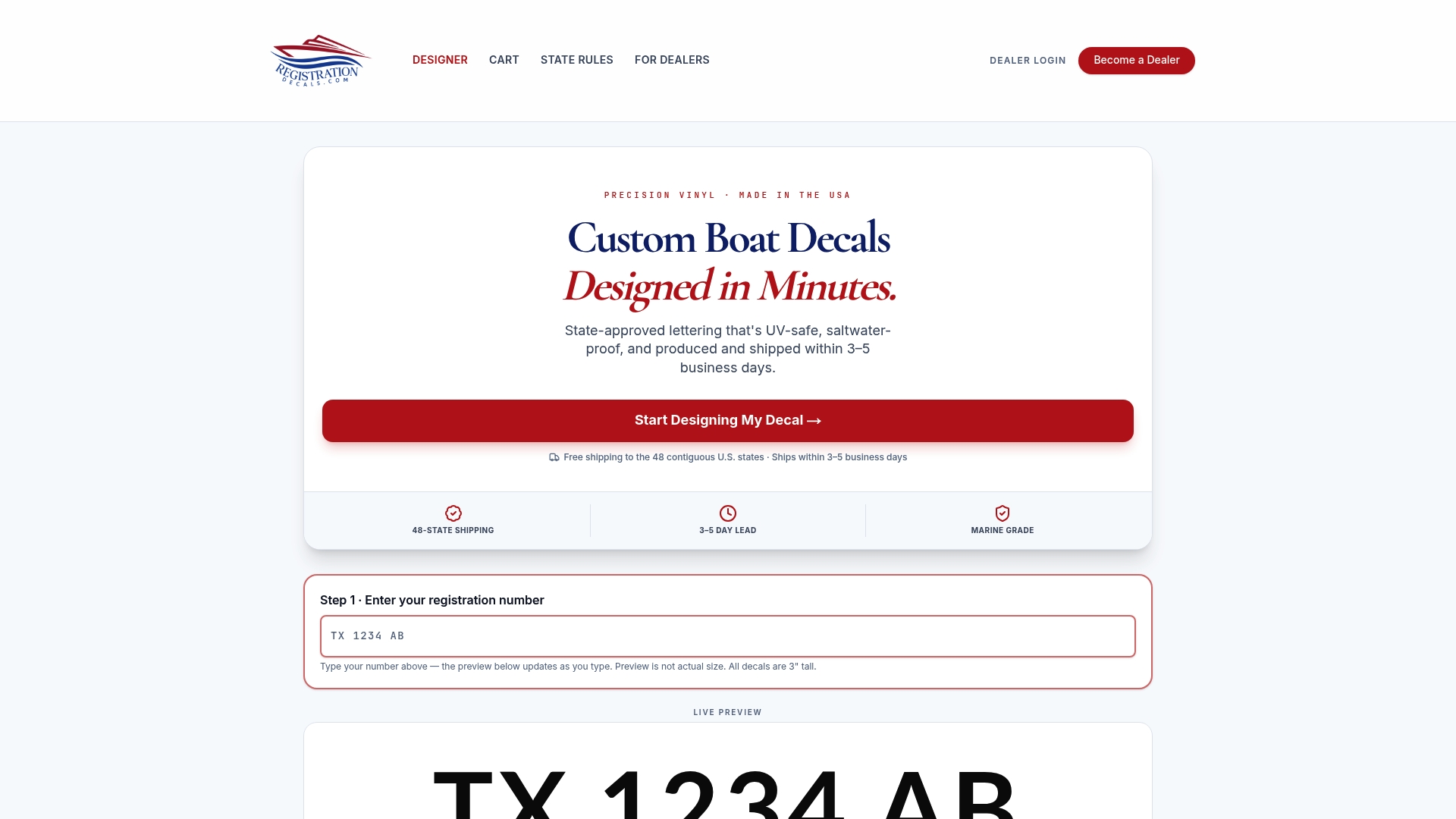
Standard sets ship in a few business days with free shipping across the contiguous United States. Bulk orders may be placed through the same system. A custom Custom Boat Registration Numbers & Decals set runs $35.99 per set. If you run pontoons, bass boats, aluminum hulls, or center consoles, dedicated product pages like Pontoon Numbers and Aluminum Boat Numbers match sizing to your hull type. Start your design now and have compliant decals in hand within the week. And once the decals are on, a policy check with a marine insurer like Diamondback Insurance is a smart next step to protect the rest of the boat.
Sources
- How to Choose Marine Vinyl for Your Boat (Without Getting It Wrong) - Carolyn Fabrics
- Marine Vinyl Flooring: The Complete Guide to Boat Flooring - D and G Flooring
- Chapter 328 Section 48 - 2024 Florida Statutes - The Florida Senate
- Numbers and Decals on Vessels — Texas Parks & Wildlife Department
FAQ
How Much Does a Custom Boat Registration Decal Set Cost?
A Custom Boat Registration Numbers & Decals set from Registrationdecals costs $35.99 per set. Pricing for specialty product lines like jet ski or pontoon numbers is available on the respective product pages.
How Long Do Marine-Grade Vinyl Decals Last?
Marine-grade decals paired with a protective overlaminate typically last 7 to 10 years, according to Registrationdecals' guidance on decal longevity. Saltwater exposure and constant sun without overlaminate protection shorten that range.
Can I Put New Decals Over Old Ones?
No. Old decals and adhesive residue need to come off completely before applying a new set, since leftover residue causes bubbling and poor adhesion. Full removal steps are covered in Registrationdecals' removal guide.
Do Registration Numbers Have to Match My Certificate Exactly?
Yes. The number on your decal must match the number on your registration certificate character for character, and most states require the decal to sit near that number on the hull, per Florida's decal statute.
How Fast Can I Get My Decals Shipped?
Standard production runs 3 to 5 business days, with free shipping across the contiguous United States for both individual and bulk orders. Order ahead of peak spring registration season if you need decals for a specific launch date.