
A dealer may assign a temporary registration number only after collecting the required ownership documents and applicable sales or excise tax, then recording that number in sequence for the state file. Temporary certificates typically stay valid 45 to 60 days, depending on the state and transaction type. Skip the tax step or file out of sequence, and you risk a rejected application or an audit flag down the road.
TL;DR:
- Temporary registration numbers are valid for 45 to 60 days and require proper documentation, tax payment, and logging to remain valid.
- Dealers must verify ownership documents, confirm the Hull Identification Number, and ensure tax is collected before issuing temporary numbers.
- State-specific rules vary on temporary window lengths, fee amounts, and form names, requiring dealers to verify current regulations before issuing registrations.
- Proper placement of registration decals requires clean, dry surfaces, UV-resistant vinyl, and adherence to size and spacing rules specific to each state.
- Daily, dealers should verify documents and HINs, and maintain accurate logs and monthly reports to ensure compliance and avoid audits.
Table of Contents
- What Is the Dealership Boat Numbers Process?
- How Do Registration Rules Differ by State?
- What Documents Does a Dealer Need to Verify?
- What Are the Rules for Dealer and Demo Numbers?
- How Should Dealers Handle Monthly Reporting?
- How Do You Correctly Install Registration Numbers?
- What Should a Compliance Lead Check Every Day?
- Where to Get Compliant Decals for Your Dealership
- Where to Confirm Exact Rules for Your State
- Sources
- FAQ
What Is the Dealership Boat Numbers Process?
The dealership boat numbers process is the sequence a dealer follows to issue a temporary registration at the point of sale, then hand off documentation so the buyer receives permanent numbers. It runs through four gates: verified ownership documents, a confirmed Hull Identification Number, collected tax, and a properly logged form. Miss any one of those, and the number you issue is not valid, even if the boat leaves the lot with a sticker on it.
Here's the checklist your title clerk or salesperson should run at every closing:
- Verify identity and ownership documents. Confirm the buyer's ID matches the bill of sale, and pull the Manufacturer's Statement of Origin for new boats or the signed title for used ones.
- Confirm the Hull Identification Number. Match the HIN on the hull to the HIN on the MSO or title, photograph it, and record it exactly on the application form. Some states, including Massachusetts, accept a pencil tracing or digital photo as proof when the number is hard to read.
- Calculate and collect tax. Use the actual date of sale as the taxable event date on every form. Maryland's dealer manual treats tax collection as a gating condition before a number can be issued at all.
- Complete the temporary certificate. Fill in the multi-copy form (New York's MV-53 is a common example), affix the sticker number, and distribute copies to the buyer, the dealer file, and the state submission packet.
- Queue the paperwork. File the retained control copy, route the submission packet to the state processing office, and log the decal control number before the boat leaves the lot.
Pro Tip: Never let a boat leave the lot before the tax line on the form is signed off. A number issued ahead of tax collection is one of the fastest ways to trigger a dealer audit.
How Do Registration Rules Differ by State?
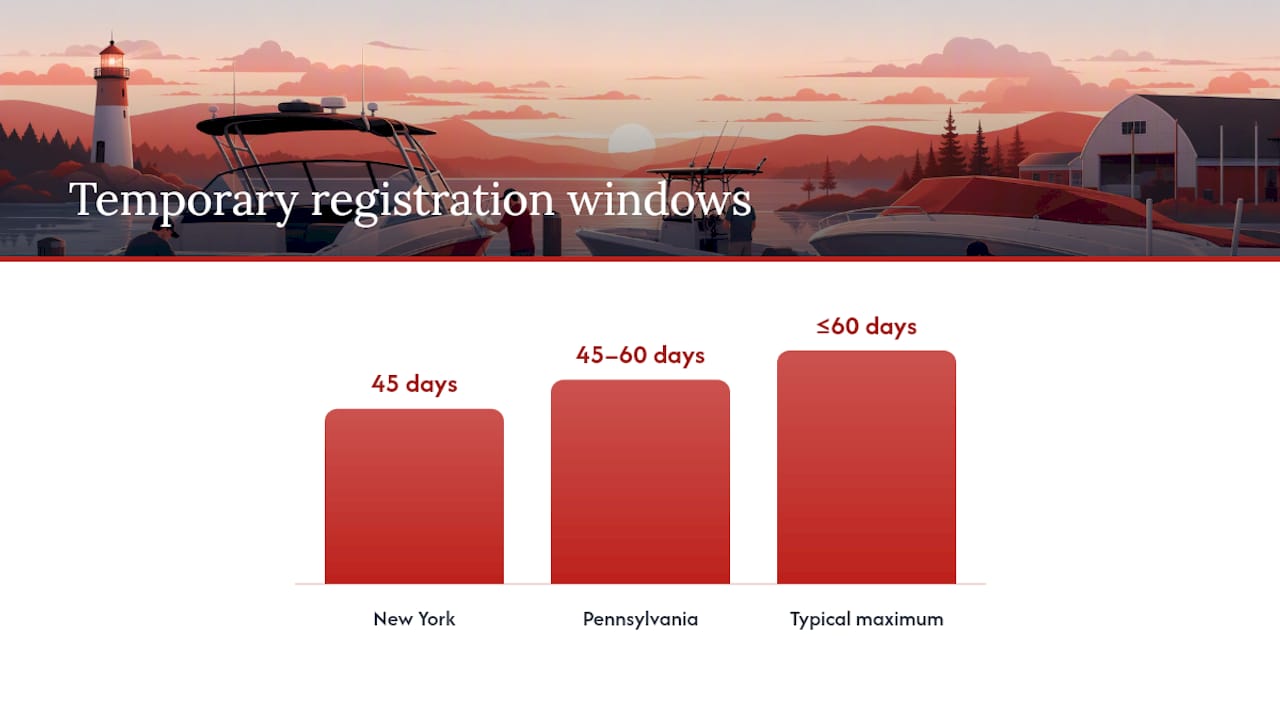
Every state runs its own version of this process, and the differences that trip up dealers most are temporary registration windows, demo-number eligibility, and fee schedules. New York issues a 45-day temporary registration, while Pennsylvania's window runs 45 to 60 days depending on the transaction type. Maryland requires dealers to file monthly reports on DNR Form B-207, listing every number and decal issued that month.
A few patterns worth flagging before you issue a single number:
- Temporary windows vary but rarely exceed 60 days, and most states do not grant extensions without a new application.
- Demo-number eligibility often requires separate enrollment. Wisconsin's dealer registration option charges a flat $75 dealer fee and exempts boats used strictly for advertisement from certificate fees.
- Fee structures shift year to year, so confirm current amounts directly on the issuing state's DMV or DNR site rather than relying on a printed manual.
- Form names are not interchangeable across states. New York's PD-1 requests numbers, while its MV-82B handles the actual application. Maryland uses entirely different form numbers for the same functions.
The action item here is simple: before you issue anything, pull up the specific state's dealer manual page and confirm the exact form name and current fee. A form that worked last year may have a new revision number this year, and submitting an outdated version is a common cause of processing delays. If your dealership operates in Florida, Florida's registration number requirements walk through that state's specific placement and application rules in more detail.
What Documents Does a Dealer Need to Verify?
New boats and used boats require different paperwork, and mixing them up is one of the most common reasons a state office kicks a submission back. New boats need the Manufacturer's Statement of Origin. Used boats typically need the original signed title, or in states without titling, the previous registration card.
Here's what your paperwork stack should include before you touch the temporary certificate form:
- MSO for new vessels, signed and matched to the HIN stamped on the hull.
- Signed title or prior registration for used vessels, with the seller's signature matching the name on the document exactly.
- Bill of sale showing the sale price, date, and buyer/seller names for tax calculation purposes.
- Lienholder information, if applicable, including the lien release or the lender's authorization to transfer.
- HIN verification record, either a photograph or a pencil tracing attached to the file, following the Massachusetts model many states use as a baseline.
One detail dealers overlook constantly: if the boat was already registered in that same state under a prior owner, reuse the existing registration number instead of issuing a new one. Assigning a fresh number to an already-registered hull creates a mismatch that usually requires a correction filing later, and that filing takes longer than getting it right the first time. Watch lienholder codes closely too. A missing signature or an incorrectly entered lien code is one of the most common reasons a state office bounces a submission back to the dealer.
What Are the Rules for Dealer and Demo Numbers?
Dealer and demo numbers exist for one purpose: demonstration, testing, and sales activity. They cannot be used for rentals, charters, or leasing, and using them that way is a compliance trap that catches dealers who treat demo numbers as a convenient workaround.
- Know the scope of use. Florida Statute 328.52 defines special manufacturer and dealer numbers and restricts them to demonstration and sale purposes only, not for generating rental income.
- Check the cap on demo numbers. Some states limit how many demo numbers a single dealership can hold at once and require a separate application with its own fee, similar to Wisconsin's dealer registration option.
- Follow mounting and display rules. Demo numbers still need removable but secure mounting, and the registration card must stay onboard while the vessel is being operated.
- Correct misuse immediately. If a demo number gets used outside its permitted scope, whether by accident or by an employee cutting a corner, void it and report the correction rather than letting it sit unresolved. States can suspend a dealership's entire demo-number privilege over repeated misuse, and reinstating that privilege takes far longer than the original application did.
How Should Dealers Handle Monthly Reporting?
Every number you issue needs a paper trail that survives an audit six months later, not just the day of the sale. Record each temporary number and decal control number in strict numeric order the moment it's issued, and never skip a number even if a sale falls through.
- File monthly dealer reports on schedule. Maryland's DNR Form B-207 requires monthly reporting of every vessel number and decal control number issued, including voids.
- Report voided decals and no-sale months. A month with zero sales still typically requires a report confirming nothing was issued.
- Keep an internal sequential log even in states that don't mandate a specific format. A dealer management system or a shared spreadsheet works, as long as every entry gets reconciled against actual sales weekly.
- Retain copies of everything. Tax proof, signed forms, and sticker logs should stay on file for the retention window your state specifies, ready to hand over if an auditor asks.
Pro Tip: Reconcile your decal log against actual sales every week, not just at month's end. Catching a skipped number on day seven is a five-minute fix. Catching it during a state audit six months later is a much longer conversation.
How Do You Correctly Install Registration Numbers?
Placement rules are stricter than most new dealership staff expect. Numbers go on both sides of the bow, forward of the midline, and most states enforce a minimum 3-inch character height, a threshold covered in more detail in this breakdown of temporary number display rules. Spacing and hyphenation between the letter and number blocks also follow state-specific patterns, so check the exact format before cutting a decal.
Stick to marine-grade, UV-resistant, saltwater-proof vinyl rather than handwritten markings, which fade and peel long before the boat's first haul-out season. Handwritten numbers are only acceptable where a state explicitly permits them for temporary use, and that's rare.
A clean installation follows a short sequence:
- Clean and dry the hull surface where the decal will sit, removing any wax or residue that prevents adhesion.
- Dry-fit the decal to confirm placement and spacing before removing the backing.
- Apply from one edge, smoothing out air bubbles as you go rather than pressing the whole decal down at once.
- Store the temporary certificate onboard, where it stays accessible whenever the vessel is on the water.
For a full walk-through, the vinyl decal application guide covers surface prep and alignment step by step, and confirming whether numbers belong on both sides of the hull takes thirty seconds before your first cut.
What Should a Compliance Lead Check Every Day?
Running a clean dealership boat numbers process comes down to habit, not paperwork sophistication. Daily, verify documents and the HIN at the point of sale, and don't issue a temporary certificate until tax is actually collected, not just calculated. Weekly, reconcile every issued decal control number against your actual sold and voided records so nothing slips through unlogged.
Monthly, file the required dealer reports and keep copies where an auditor can find them without a scavenger hunt. The cultural fix that solves most of this before it becomes a problem: train floor staff to gather complete paperwork before a boat physically leaves the lot, not after. A salesperson excited about a closed deal will happily let a customer drive off with an incomplete file, and that's exactly the moment a dealership's compliance record starts slipping.
— Taylor
Where to Get Compliant Decals for Your Dealership
Once the paperwork clears and a number is assigned, the decal itself has to hold up to years of sun, salt spray, and marina wear. There are services offering marine-grade, UV-resistant, saltwater-proof vinyl decals designed through an online tool where you enter the assigned numbers, pick colors and fonts, and get a proof in minutes.
Production may run 3 to 5 business days with free shipping across the contiguous United States, which matters when a buyer is waiting on a lot for their boat to be ready. Dealerships processing multiple sales a week can set up bulk orders instead of one-off checkouts, keeping decal turnaround in step with registration paperwork rather than trailing behind it. Pair a fresh set with the vinyl decal application guide so your team installs them correctly the first time.
Start a design at Registrationdecals and get your dealership's next set of compliant numbers ordered before the next closing.

Where to Confirm Exact Rules for Your State
Form names, fees, and filing addresses change, so confirm them directly against the source before issuing a single number.
- Boat Dealer Manual — Maryland DNR
- Boat Dealer Registration Instructions — NYS DMV
- Boat Dealer — Wisconsin DNR
- How to Register a Boat — Massachusetts
- Registration Decals — Ohio DNR
Always check the current form number and fee amount on the issuing state's own site before printing anything for a customer.
Sources
- Boat Dealer Manual — Maryland DNR
- Boat Dealer Registration Instructions — NYS DMV
- How to register a boat — Massachusetts
- Boat Dealer — Wisconsin DNR
- Register a boat — New York DMV
FAQ
How Do You Apply Boat Registration Numbers?
Numbers go on both sides of the bow, forward of the midline, spaced according to your state's format, using marine-grade vinyl decals rather than handwritten markings in most jurisdictions.
What Is the 1/3 Rule in Boating?
The "1/3 rule" isn't a standard registration term. Dealers should rely on their state's specific placement and sizing rules, such as the commonly enforced 3 inch minimum character height, rather than a general fraction-based guideline.
Can You Look Up a Boat Registration Number Online?
Many states offer an online registration lookup tool through their DMV or DNR site, though availability and the information shown vary by state.
What Happens if a Boat Doesn't Have a Hull Identification Number?
A boat without a visible or verifiable HIN typically can't be registered until the owner obtains one through the state agency, since dealers and states rely on the HIN to confirm identity and prevent duplicate or fraudulent numbering.