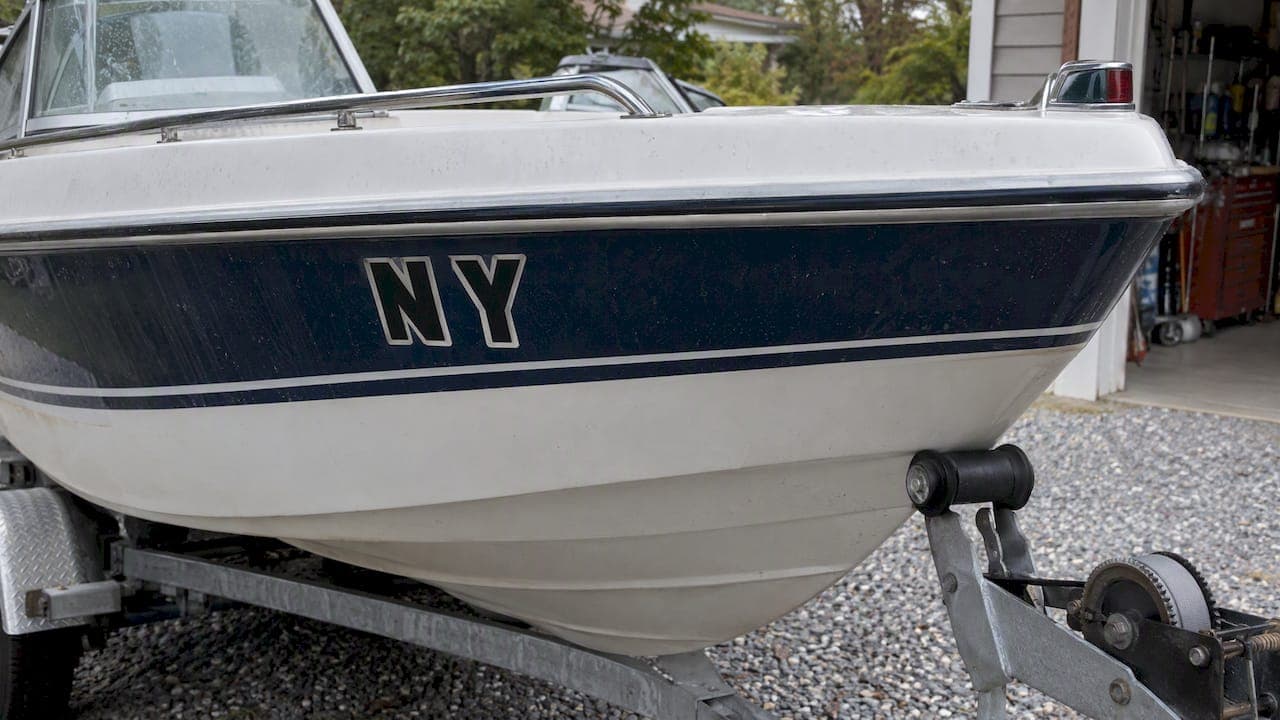
Yes, two-color registration numbers can be legal if the characters themselves meet federal and state requirements for size, style, placement, and contrast. Under 33 CFR §173.27, the primary fill color has to contrast sharply with the hull. States like Florida and Pennsylvania add their own spacing and placement language, so always confirm against your issuing state's page before ordering.
TL;DR:
- Measure only the plain block face of each character; outlines and shadows do not count toward the federal minimum height of three inches.
- Florida requires numbers on both sides of the vessel’s forward half and places the annual validation decal within six inches of the registration number.
- Choose a primary fill that contrasts sharply with the hull; an outline or shadow cannot provide the required contrast, especially on reflective surfaces.
- Pennsylvania requires the letter and number groups to read left to right, separated by a hyphen or a space as wide as one letter.
- Wisconsin bars other numerals on the bow if they could be mistaken for the registration number, so decorative digits may create a compliance problem.
Table of Contents
- 1. What does federal law actually require?
- 2. How do state rules build on the federal standard?
- 3. How do you make a two-color design pass inspection?
- 4. How do you install and measure two-color decals the right way?
- 5. How do decal makers keep two-color designs compliant?
- 6. Finding the balance between style and legibility
- Where to get compliant two-color decals built right
- FAQ
- Sources
1. What does federal law actually require?
The federal baseline comes from 33 CFR §173.27, and it sets the floor every state builds on. The rule calls for plain vertical block characters, no cursive, no decorative serifs, no stylized fonts, and those characters must be at least 3 inches high. The CFR Title 33, Part 173 compilation lays out the full text if you want to read the official wording yourself.
Color is where a lot of owners get confused. The regulation does not name a required color pairing. It simply says the numbers must contrast sharply with the background color of the hull. That single sentence is what makes two-color decals legal in principle: nothing in the federal text bans a two-tone design, as long as the characters you actually read are the ones doing the contrasting, not a decorative accent.
The federal rule also covers format:
- Characters must read left to right across the hull, not top to bottom or reversed.
- A hyphen or space equal to the width of a letter must separate the letter group from the number group.
- Letters I, O, and Q are typically excluded from the trailing suffix because they can be mistaken for the numerals 1, 0, and 9.
- Numbers must be painted on or permanently attached, not written in temporary marker or chalk.
33 CFR §173.27 sets the national floor: 3-inch plain block characters with sharp hull contrast. This is the rule every state marine patrol officer is trained to check first, before looking at any state-specific addition.
Enforcement tends to focus on two failure points. The first is measurement: officers sometimes find that a decorative outline or shadow was counted toward the 3-inch minimum, when only the plain block face of the character counts. The second is contrast: a decal that looks fine in a catalog photo can disappear against a similarly toned hull in direct sunlight. Noncompliance can carry civil penalties, and the state agency that issued your registration is the one that enforces it, not the Coast Guard directly.
2. How do state rules build on the federal standard?
States generally repeat the federal baseline, then add their own phrasing about placement, spacing, and what happens if your numbers do not match your registration card. Reading your state's actual page matters because the specific wording (how many inches from a validation decal, for example) varies.
Florida's Department of Highway Safety and Motor Vehicles requires block letters at least 3 inches high, painted or permanently attached to both sides of the forward half of the vessel, contrasting with the hull color. Florida also requires the annual validation decal to sit within 6 inches of the registration number, which is a detail that trips up a lot of DIY installs.
Pennsylvania's Fish and Boat Commission echoes the same core requirement: 3-inch bold block lettering that contrasts with the background, read left to right, separated by a dash or a space equal to the width of a letter, placed on each side of the forward half of the boat.
Wisconsin's administrative code (NR 5.06) adds an exclusivity clause: no other numbers may be displayed on the bow that could be confused with the registration number. That is a detail worth knowing if you were thinking about adding a second numeral sequence for decoration.
Here is what tends to signal a stricter-than-average state page:
- Specific language about validation decal placement distance (like Florida's 6-inch rule).
- An exclusivity clause barring any other numerals on the bow (Wisconsin's approach).
- Explicit mention that the agency does not supply the physical numbers, meaning compliance is entirely on the owner.
Other states, including New Jersey, New York, California, and Texas, use nearly identical language to the federal text: 3-inch block letters, hull contrast, forward-half placement. If your state's page uses softer language like "recommended" instead of "required," read it carefully. That softer wording usually applies to optional elements like boat name lettering, not the registration number itself. For a deeper look at exactly where those numbers need to sit, our guide on whether boat registration numbers go on both sides breaks down the forward-half rule in more detail.
3. How do you make a two-color design pass inspection?
A two-color decal is legal only when the primary character fill, not the outline or a drop shadow, is what provides the contrast against your hull. Here is the order to work through when you are designing or ordering one:
- Confirm character height first. Measure only the plain block face of each character, excluding any decorative outline or border, and make sure it clears 3 inches as required by 33 CFR §173.27. Our guide on how tall boat registration numbers need to be walks through the measuring process step by step.
- Pick the primary fill for contrast, not the accent. If your hull is white, a navy or black primary fill with a thin red outline is fine, because the primary color is doing the contrast work. If you flip that, with red as primary on a light hull, check that the red itself still reads clearly from a distance.
- Check spacing and reading direction. Groups must read left to right and be separated by a hyphen or space equal to one letter width, matching Pennsylvania and Wisconsin's published language.
- Confirm placement near the validation decal. Some states, Florida among them, specify a maximum distance (6 inches) between your registration number and the annual decal.
- Test a mockup before permanent application. Print or tape a life-size paper version onto the hull and view it from typical boarding distance in direct sunlight before committing to adhesive.
- Keep proof of compliance on board. Carry your registration card and consider a dated photo of the installed numbers, useful if a stop ever turns into a dispute over legibility.
Pro Tip: Photograph your finished numbers in both bright sun and shade before your first trip out, so you have your own record of legibility if it's ever questioned.
Skipping step 1 is the most common mistake. A character that measures 3 inches including a thick decorative border might measure only 2.6 inches once you isolate the plain block face, which falls short of the federal minimum.

4. How do you install and measure two-color decals the right way?
Getting the design right on paper is one thing. Getting it to read correctly once it is on a curved, reflective hull is another.
- Measure stroke thickness separately from height. A bold two-color character can look taller than it is if the stroke width tricks the eye; use a ruler against the actual vinyl, not a screen mockup.
- Use an alignment template or low-tack tape to keep both number sets level and symmetrically placed on each side of the bow.
- Position relative to your validation decal first, then build your registration number placement around it, especially in states with a fixed distance requirement like Florida's 6 inches.
- On metallic or silver hulls, test before you commit. A dark primary fill color that looks high-contrast on a screen can wash out against a reflective metallic finish in full sun; a temporary printed mockup held against the hull in daylight is the only reliable test.
- Clean and dry the surface thoroughly before application. Marine environments leave salt film and oxidized gelcoat residue that stops vinyl from bonding evenly, which can cause premature lifting at the edges. Products designed for gelcoat protection can help maintain a clean, stable surface between applications.
- Call your issuing agency if you're unsure, particularly if your hull color sits in a gray zone where contrast is debatable; a quick question before installation is cheaper than a redo after a failed inspection.
Pro Tip: Apply decals on a calm, shaded day, around 60 to 80 degrees, since vinyl adhesive bonds unevenly in direct heat or cold.
5. How do decal makers keep two-color designs compliant?
Getting a two-color design right on the first try comes down to the production process behind it as much as the design itself. Marine-grade vinyl matters here because UV exposure and saltwater fade ordinary vinyl within a season or two, which quietly erodes the contrast that made a decal legal in the first place.
A few practices separate a compliant two-color decal from one that only looks good in a preview image:
- Choosing the primary fill color first for contrast against the stated hull color, then treating any second color strictly as an outline or accent.
- Building proof or mockup stages into the ordering process so the owner sees the actual sizing and color pairing before production.
- Using templates that are pre-checked against federal block-character standards rather than decorative fonts.
- Keeping production turnaround fast enough that owners are not tempted to use a temporary, non-compliant marker while waiting.
We built our design tool around exactly this workflow: you enter your registration number, pick a primary and accent color, and see a proof before anything goes into production. For specific two-color layouts that are built to standard, our post on two-color boat number templates that meet U.S. law shows several pairings that keep the contrast rule intact. If you are unsure what colors are actually allowed for your hull, our explainer on what color boat registration numbers have to be covers the contrast rule in plain terms. We also publish state-specific guidance pages so you can check your state's exact spacing and placement language before you finalize a design.
6. Finding the balance between style and legibility
Owners ask for two-color numbers for a simple reason: a single flat color on a hull can look like an afterthought, while a primary color with a contrasting outline looks intentional, like it belongs with the rest of the boat's paint scheme. That instinct is reasonable. The mistake is letting the accent color become the character's real identity instead of a trim detail.
My practical rule after looking at how these designs actually fail inspection: treat the outline as jewelry, not as the outfit. The primary fill has to do all the legal work of contrasting with your hull. If you squint at your design and the outline color is what your eye catches first, flip the weighting before you order.
Test it outdoors, not on a monitor. Screens render colors brighter and more saturated than marine vinyl in direct sun ever will. And if your hull color sits anywhere near your planned primary fill on a gray or metallic scale, call your state boating agency and ask directly rather than guessing. A five-minute phone call is cheaper than a redo, and far cheaper than a citation.
— Taylor
Where to get compliant two-color decals built right
We make this easier by handling the compliance math for you. Every Custom Boat Registration Numbers & Decals set we produce starts at $35.99 per set and ships from marine-grade vinyl chosen specifically for UV and saltwater resistance, so the contrast that passed inspection on day one still reads clearly years later.
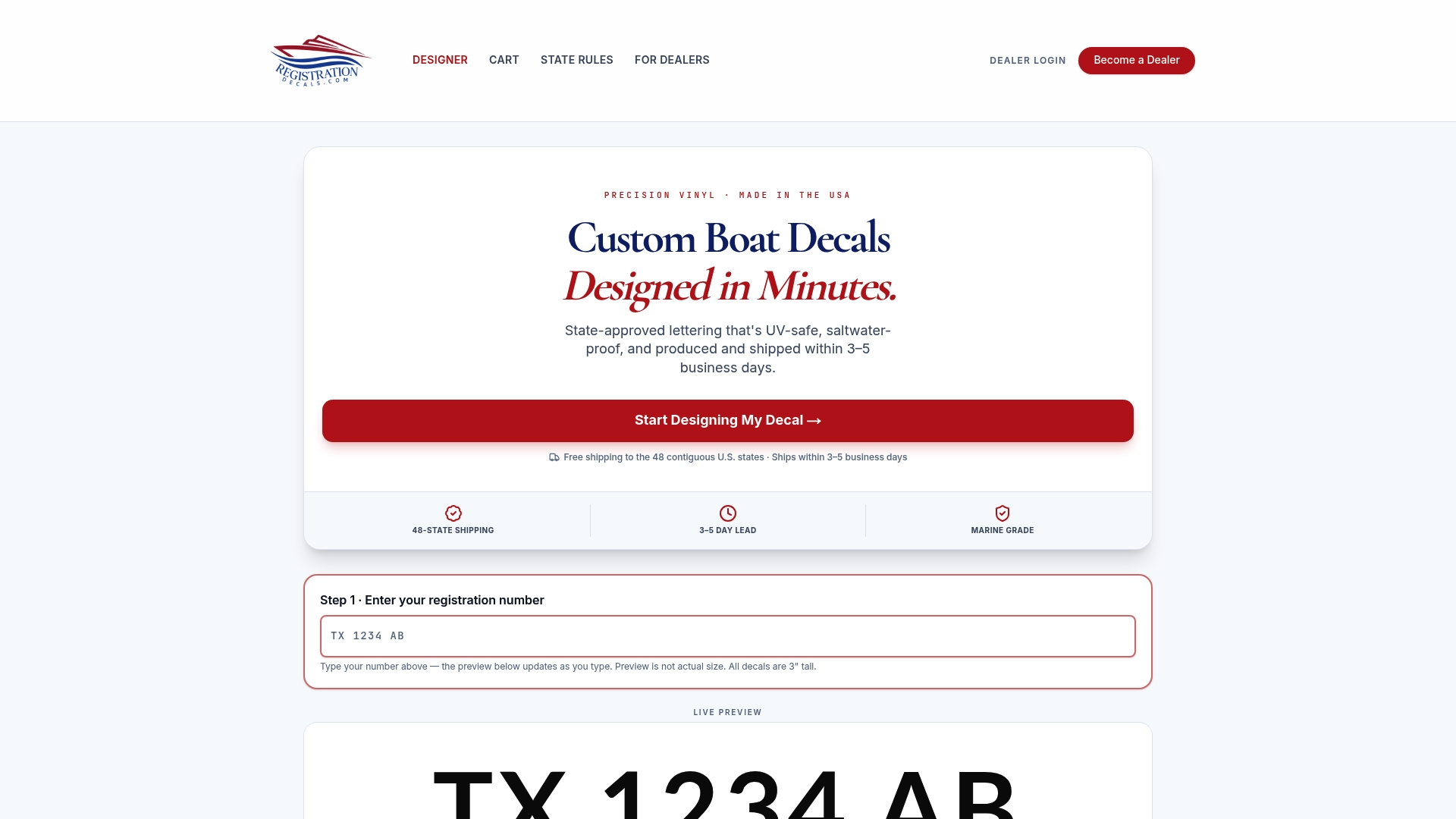
Our online design tool lets you enter your exact registration number, choose a primary fill and an accent color, and preview the proof before anything goes into production, which is the same mockup step that catches contrast problems before they become a citation. Production runs within a few business days with free shipping across the contiguous United States.
- Enter your state and registration number and we apply the correct spacing and character style automatically.
- Choose a primary fill color built for contrast, then add an accent or outline without weakening that contrast.
- Review a digital proof before production starts, so there is no guesswork once the vinyl ships.
We also offer dedicated product lines for Jet Ski Numbers, Pontoon Numbers, Bass Boat Numbers, Aluminum Boat Numbers, and Center Console Numbers, each sized and templated for that hull type. Order today and have compliant, durable numbers on the water within the week.
FAQ
Can boat numbers be any color?
No. Federal rule 33 CFR §173.27 does not mandate a specific color, but it requires the characters to contrast sharply with the hull color. A two-color design is legal as long as the primary fill, not the accent, provides that contrast.
What are the rules for boat numbers in Florida?
Florida requires block letters at least 3 inches high, painted on or permanently attached to both sides of the forward half of the vessel, and contrasting with the hull, according to the Florida Department of Highway Safety and Motor Vehicles. Florida also requires the annual validation decal to be placed within 6 inches of the registration number.
What are the USCG boat lettering requirements?
The federal standard under 33 CFR §173.27 requires plain vertical block characters at least 3 inches high, with a hyphen or space equal to a letter's width separating the letter and number groups, read left to right, and contrasting sharply with the hull. These apply nationwide as the baseline states build their own rules on.
What are the requirements for boat numbers in Pennsylvania?
Pennsylvania requires 3-inch bold block lettering that contrasts with the background, reads left to right, and is separated by a dash or space equal to the width of a letter, according to the Pennsylvania Fish and Boat Commission. Numbers must be placed on each side of the forward half of the boat.
How much do compliant two-color decals cost?
Our Custom Boat Registration Numbers & Decals sets cost $35.99 per set and arrive within 3 to 5 business days, with free shipping across the contiguous United States.
Sources
- Electronic Code of Federal Regulations — 33 CFR §173.27
- Govinfo
- Numbering and decals — Florida Department of Highway Safety and Motor Vehicles
- Register/Title a boat — Pennsylvania Fish and Boat Commission