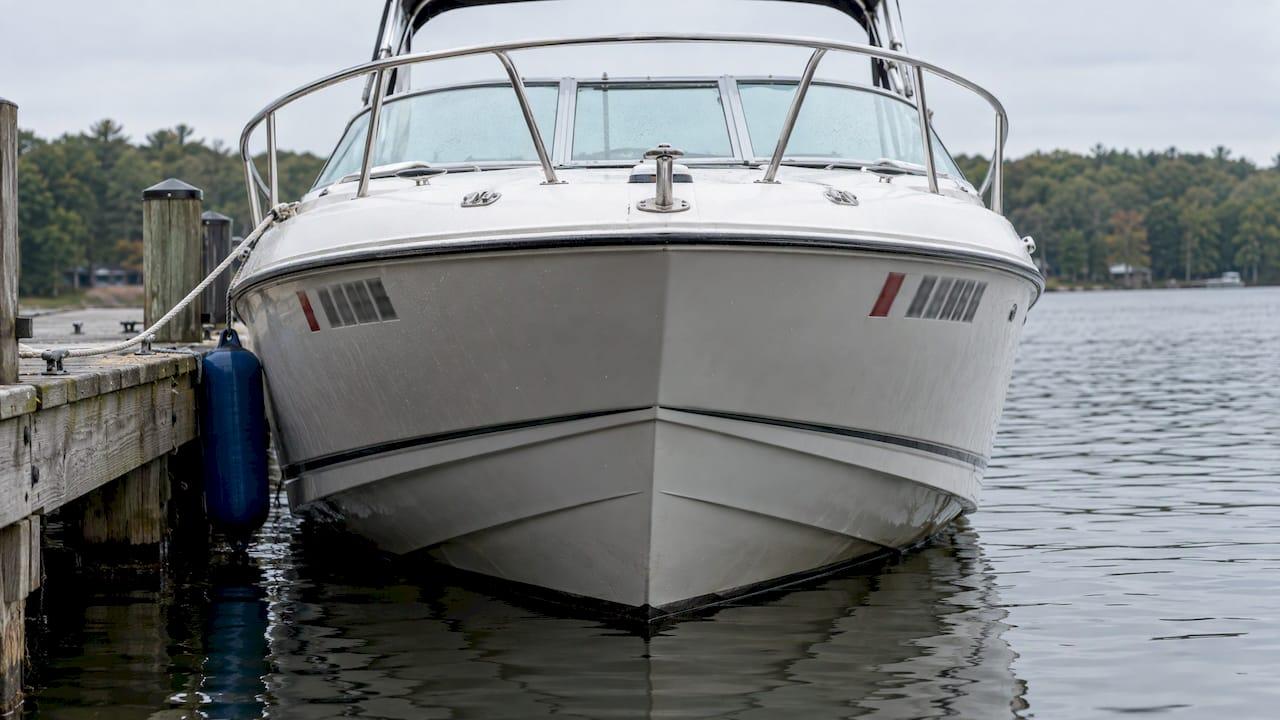
Yes, your registration number goes on both sides of the boat. Federal regulation requires it to be painted on or permanently attached to each side of the forward half of the vessel, in plain block characters at least 3 inches tall, in a color that contrasts with the hull. This guide covers what that means for the hull you own, where the states add their own wrinkles, and how to get a matching pair on the boat without redoing it.
TL;DR
- The number goes on each side of the forward half of the boat, so you need a mirrored pair, not a single set.
- Characters must be plain, vertical, block-style and at least 3 inches high, in a color that contrasts with the background.
- Groups of letters and numbers are separated by a hyphen or a space about the width of a letter, and the number reads left to right.
- States add rules for validation decals, spacing, colors and exemptions, so check your state agency before you order.
- Our custom sets are $35.99 per set and ship free in the contiguous US. You pick the number, color and font in an online design tool.
Table of Contents
- Why the number has to appear on both sides
- Where on each side the numbers go
- Size, font, spacing and color
- Where states add their own rules
- Validation decals also go on both sides
- Special cases: jet skis, pontoons, tenders and kayaks
- Can vinyl decals be the number?
- Applying a matched pair on both sides
- Order a matching pair
- FAQ
- Sources
Why the number has to appear on both sides
The federal rule is short. Under 33 CFR 173.27, each number must be painted on or permanently attached to each side of the forward half of the vessel. The statute behind it, 46 U.S.C. § 12305, says the same thing about the number being painted on or attached to each side of the forward half, and adds that no other number may be carried on the forward half.
The reason is practical. A marine patrol officer, a dockmaster or another boater should be able to read your number from whichever side the boat presents. A single number on the port side leaves the starboard side anonymous. That is why a "set of two" is the normal unit when you buy registration numbers, and why you should plan for a left and a right piece from the start.
If you want the short version of this on our own site, see our answer on whether boat registration numbers go on both sides.

Where on each side the numbers go
"Forward half" means the front half of the hull measured along its length. Most owners place the number on the bow section of the hull side, above the waterline, where it is flat enough to read and clear of rub rails, cleats and graphics.
A few practical points follow from the rules:
- Keep it on the hull side, not the deck or transom. The transom is not the forward half, so a number there does not satisfy the rule.
- Avoid curved or hidden areas. Hawaii's boating division, for example, says the number should not be placed on the obscure underside of a flared bow where the angle prevents it from being seen from another vessel or from shore. The principle applies everywhere: if an observer cannot read it, it is not doing its job.
- Keep other numbers off the forward half. The federal statute prohibits carrying any other number there, so older registration numbers, dealer numbers or unrelated digits should come off before you apply new ones.
- Mirror the placement. Measure from the bow or a fixed point such as a hull seam so the port and starboard numbers sit at the same height and distance.
Our page on where boat registration numbers go walks through typical hull types in more detail.
Size, font, spacing and color
The federal baseline, from 33 CFR 173.27, has four parts.
Height and style
Characters must be plain, vertical block characters not less than 3 inches high. That rules out script fonts, italics, outlined letters and decorative typefaces. The U.S. Coast Guard Auxiliary's vessel safety check checklist uses the same standard: plain, vertical, block style, at least three inches high. Three inches is a minimum. Many owners go larger on bigger hulls because the extra height is easier to read from a distance. See our guide on how tall registration numbers need to be and our walkthrough of 3 inch block letters that pass inspection.
Spacing
The number is made of groups, usually a state prefix, a block of digits and a block of letters. Spaces or hyphens between those groups must equal the width of a letter other than "I" or a number other than "1". Some states are more specific. Wisconsin's DNR says letters must be separated from the numbers by a space at least two inches wide. Mississippi's wildlife agency says each part of the number shall be separated by hyphens or equivalent spaces. Our page on spacing between boat registration numbers shows what that looks like.
Color and contrast
The number must contrast with the background and be distinctly visible and legible. White numbers on a white hull fail, and so does dark blue on black. Black or white on a light or dark hull is the usual answer. Wisconsin adds that two-toned and camouflage numbers are not legal, so choose one solid color per number. Our page on what color registration numbers have to be covers pairings by hull color.
Reading direction
The number reads from left to right on both sides. South Carolina's rule says so explicitly, along with the same height, contrast and spacing requirements, in DNR Rule 123-6. On the starboard side, do not mirror the characters. Both sides read normally as you face the hull.
Quick reference
| Requirement | Federal baseline |
|---|---|
| Location | Each side of the forward half of the hull |
| Height | At least 3 inches |
| Style | Plain, vertical block characters |
| Color | Contrasts with the background, easy to read |
| Group spacing | Hyphen or space equal to a letter's width |
| Attachment | Painted on or permanently attached |
| Other numbers on forward half | Not allowed |
Where states add their own rules
Federal rules set the floor. Each state runs its own numbering system and can add detail. Before ordering, read your state's boating agency page. These examples show how much the details differ.
| State | What it adds |
|---|---|
| Texas | The validation decal goes in line with the TX number and three inches toward the rear of the boat |
| Pennsylvania | The number goes above the waterline on both sides of the bow, and unpowered kayaks and similar low-volume boats are exempt |
| Hawaii | Numbers must stay legible from at least 100 feet, with no other numerals or devices near them |
| Wisconsin | Two-inch minimum gap between letters and numbers, no two-toned or camouflage numbers |
| Washington | Federally documented vessels may not display the WN number, and decals go on the forward half |
| Oregon | Improper display of numbers or decals is a Class D violation with a $110 fine |
Two patterns are worth knowing. First, the registration number stays with the boat. Mississippi's agency says the same number is used if the boat is transferred, and Washington says numbers remain with the vessel permanently. When you buy a used boat with old lettering, you often reuse the number as is. Second, fines and rules can change, so confirm the current figure on your state's page before you act on a number from a summary like this one.
Our article on boat registration sticker placement by state goes deeper on the decal side of the rules.
Validation decals also go on both sides
The number is one thing and the validation or excise decal is another. Many states ask for a decal showing the year of expiration, and they usually ask for it on both sides of the bow near the number. Where it sits depends on the state: Texas puts it three inches behind the number, and Indiana's boater course material says excise tax decals go on both sides of the bow, to the right of the number and within three inches of it.
Because validation decals sit beside the number, leave room for them when you plan the layout. If you place the number too close to a rub rail, the decal may not fit within the allowed distance. Our answer on where the validation sticker goes helps you plan that space.
Special cases: jet skis, pontoons, tenders and kayaks
Jet skis. Personal watercraft generally need numbers too, usually on both sides of the forward hull. Because the hulls are small and heavily curved, the sizing and spacing rules matter more. See whether jet skis need registration numbers and our jet ski number sets.
Pontoons. The flat, painted side of a pontoon is often the best place for numbers, but the fence or rail panels differ by model. Our guide to applying registration numbers to a pontoon boat covers the choices, and we offer pontoon numbers for that layout.
Tenders. Washington's licensing department says a tender with a motor under 10 horsepower may carry the parent vessel's number followed by "1" on both sides of the bow. Other states handle dinghies differently, so check yours.
Kayaks and canoes. Unpowered boats are often exempt. Pennsylvania exempts unpowered kayaks and other low-volume craft, but exemptions vary. Read our answer on whether kayaks and canoes need registration numbers and then confirm with your state.

Can vinyl decals be the number?
The federal wording is "painted on or permanently attached," which is why many owners choose vinyl lettering over a paint job. Permanence is the key word: the characters have to stay put and stay legible through sun, spray and washdowns. That points to marine-grade vinyl rated for UV and saltwater, not a general-purpose sticker. Our page on whether registration numbers can be vinyl decals instead of painted explains how owners approach it.
If you are weighing flat vinyl against raised or domed styles, our overview of alternatives for domed registration numbers compares the options by type. Whichever you choose, the 3-inch height, block shape and contrast rules still apply.
Applying a matched pair on both sides
A clean, level application is what makes a pair look like it belongs on the boat. Here is a process that works for most hulls. Our installation guide has the full step-by-step.
- Check the rules first. Confirm your state's spacing, color and decal placement so the number and validation decal both fit.
- Prepare the surface. Wash the hull side, remove wax and oxidation, and let it dry fully. If the gelcoat is heavily chalked or dirty, a pass from a mobile boat detailing service leaves a clean base for the adhesive.
- Mark a level line. Use painter's tape and a level or a measured offset from the waterline or a hull seam. Mark the same reference on both sides.
- Position the port side. Measure the distance from the bow so you have a repeatable number for the other side.
- Mirror the starboard side. Use the same distance and height. Check the reading direction: left to right on both sides.
- Apply with firm, even pressure. Work from the center outward to push out air, then press the edges down.
- Leave room for the validation decal. Keep the required gap in your state, such as three inches.
- Step back and read it. Walk about 20 feet away and check that each side is legible. Our number design guide shows how to verify the three-inch height.
Common errors are simple: numbers too close to the waterline, a sloping baseline, decals applied over rough texture, and low-contrast color choices. A tape-guided layout avoids most of them.
Our take on matched pairs
Most failed inspections we hear about are not about the big rule. Owners know the number goes on both sides. The trouble is the details: a gap that is too narrow, a color that fades into a darker hull, or a decal that no longer sticks after a season of sun.
That is why we make our decals in-house from marine-grade vinyl chosen for UV and saltwater resistance, and why our design tool asks for your registration number, color and font in one pass. Our sets are designed to meet state regulations, so you are not guessing at the spacing between groups. We would rather you spend ten minutes on a layout than a weekend redoing it.
For marinas and dealerships, the same logic scales. A consistent look across a fleet, with the right numbers on the right hulls, saves time at delivery and at launch.
Taylor
Order a matching pair
Our custom boat registration numbers and decals are $35.99 per set. You enter your registration number, choose a color and font, and see the result before you order. Production takes 3 to 5 business days, and shipping is free across the contiguous United States.
Start on our custom boat registration numbers page, or go straight to your hull type: center console, bass boat, aluminum boat, pontoon or jet ski. Marinas and dealerships managing many hulls can use the same design process for bulk orders. For more answers on sizing, font and placement, browse our registration number answers.
FAQ
Do I need a number on both sides if my boat is small?
Yes, for a motorized boat the federal rule applies regardless of hull size. The number goes on each side of the forward half. Small hulls such as jet skis still need the 3-inch characters, so plan the layout carefully. Some unpowered craft are exempt in some states, so check your state's rules.
Does the number go on the transom or the deck?
No. The rule refers to the forward half of the hull sides, and the transom is not part of it. The numbers should sit on a hull surface where they can be read from another vessel or from shore.
Can I use a fancy font or two colors?
No. Federal rules call for plain, vertical block characters, and Wisconsin specifically says two-toned and camouflage numbers are not legal. Pick one solid color that contrasts with the hull, such as white on a dark hull or black on a light one.
Do I need new numbers when I buy a used boat?
Not necessarily. In states like Mississippi and Washington, the number stays with the boat and carries over to the new owner. If the existing lettering is worn, faded or out of spec, a fresh matched pair keeps the boat compliant. Confirm your state's transfer process with its boating agency.
What happens if my numbers are not displayed correctly?
Penalties depend on the state. Oregon, for instance, treats improper display of numbers or current decals as a Class D violation with a $110 fine. Check your state's current figures on its official page.
Sources
- 33 CFR 173.27, Numbers: Display; size; color (eCFR)
- 46 U.S.C. § 12305, Displaying numbers
- USCG Auxiliary Vessel Safety Check checklist
- Hawaii DOBOR, Numbering Your Vessel
- Wisconsin DNR, What you should know before you operate your boat
- Mississippi MDWFP, Boat Registration & Renewal
- South Carolina DNR Rule 123-6
- Texas Parks & Wildlife, Numbers and Decals on Vessels
- Pennsylvania Code, 58 Pa. Code § 93.5
- Washington DOL, Boat registration and hull identification numbers
- Oregon State Marine Board, OR Number Placement
- Indiana Boater Safety Course, Displaying the Registration Number and Excise Tax Decals