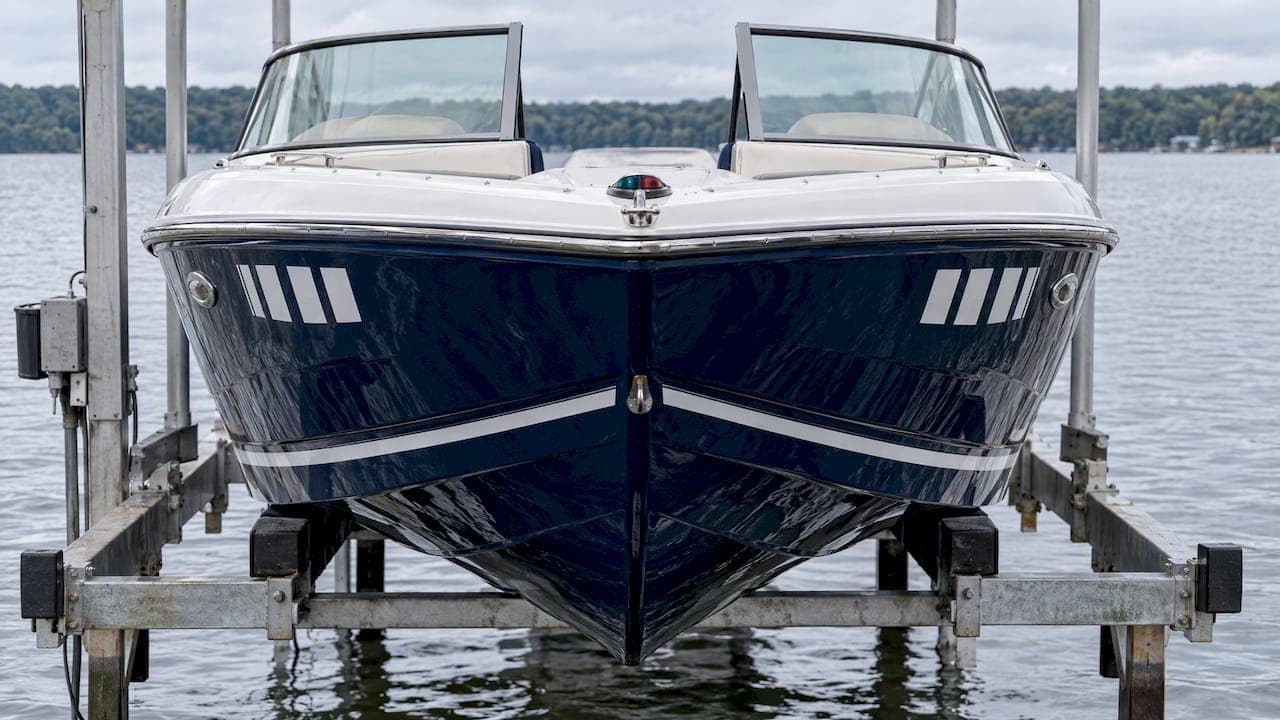
Under U.S. federal rules, boat registration numbers must be plain vertical block characters at least 3 inches tall, read left to right on both sides of the forward half of the hull, and contrast distinctly with the hull color. "Contrast" means a solid color that stays clearly visible and legible at a reasonable distance. A backing plate is required when the hull shape would otherwise hide the numbers.
TL;DR:
- The state that issued your registration sets the final requirements, including validation sticker placement, separator preference, position tolerances, and whether tenders need separate numbers.
- Separate letter and number groups with a space or hyphen at least as wide as an ordinary character; narrow gaps beside I or 1 can fail.
- Measure each character’s solid body, not its outline or shadow; decorative effects do not count toward the 3 inch minimum and can reduce legibility.
- If hull shape blocks visibility, attach the numbers to a backing plate on the forward half; use it to solve visibility, not as decoration.
- Federal rules allow decals only when permanently attached and legible; inspect them yearly and replace fading or peeling vinyl before characters become hard to read.
Table of Contents
- What the federal rules say about size, font, spacing and placement
- How states vary and how to confirm your exact requirements
- Choosing colors that pass the "distinctly visible" test
- Placement, size, spacing and exceptions: how to measure and install correctly
- Are vinyl decals acceptable, and how do you keep the contrast intact?
- Our checklist and the triggers we see most often
- How we help you get compliant, durable decals quickly
- FAQ
- Sources
What the federal rules say about size, font, spacing and placement
The federal baseline lives in 33 C.F.R. § 173.27, which covers how numbers are displayed, sized and colored. Every item below is something an officer can check from a dock or another boat, so it pays to confirm each one on your own hull.
Character type. The numbers must be plain, vertical block characters. Script, italic, slanted, decorative or stylized lettering does not qualify, no matter how good it looks.
Height. Each character must be at least 3 inches high. That is a floor, not a target, and larger characters are fine as long as they fit the hull and stay legible.
Contrast. The numbers must contrast with their background and be distinctly visible and legible. The regulation text is the baseline, and the full Part 173 on eCFR lets you read the surrounding rules in context.
Reading direction. The numbers read from left to right, the same way you read a sentence. That applies to both sides of the boat, so the characters on the port side are not mirrored or reversed.
Location. The numbers go on each side of the forward half of the vessel, painted on or permanently attached.
Separators. The letter and number groups must be divided by a space or a hyphen. That separator must be as wide as a letter other than "I" or a number other than "1". The rule exists because "I" and "1" are narrow, and a gap that narrow would make groups run together. The Dec. 31, 2025 text of Part 173 gives two accepted formats as examples: DC 5678 EF and DC-5678-EF. Both are valid because the separator, whether a gap or a hyphen, is as wide as a normal character.
Backing plates. Some hulls make direct display impossible. A raked bow, a curved flare or a pontoon fence can hide a number from one side. In that case the number goes on a backing plate attached to the forward half of the vessel so it is visible from each side. The same section explains that the plate solves a visibility problem, not a style preference. If your hull allows a clean, flat, visible surface, paint or decals applied directly to it are simpler.
Related identification numbers. Registration numbers are not the same as your hull identification number. The HIN is a separate identifier governed by 33 C.F.R. Part 181, Subpart C, which covers permanent affixation and format. If you are searching your hull for a stamped serial, you are looking for the HIN, not the number that has to contrast with your paint.
For readers who want the underlying statute, 46 U.S.C. § 12502 covers identification numbers, signal letters and markings, and it establishes that owners and manufacturers share marking responsibilities. The federal government also publishes the regulation text as Govinfo that agencies reference when they update policy or state guidance.

How states vary and how to confirm your exact requirements
Most states follow the federal baseline and then layer on their own details. Your boat is numbered by the state where it is registered, so that state's boating agency has the final word on what an enforcement officer expects to see. Treat the federal text as the minimum and your state's page as the finish line.
The differences tend to fall into a few predictable categories. States do not change the core idea of contrast and legibility, but they often add specifics about where things sit and how they are punctuated. Without quoting any state's statute, here are the kinds of additions boat owners commonly run into:
- Validation decal placement. Many states require a registration validation sticker and specify where it sits relative to the number, such as a set distance behind or beside the last character.
- Separator punctuation. The federal rule allows a space or a hyphen. A state may prefer or require one of the two.
- Font or style limits. Federal law says plain vertical block characters. A state may spell out how strictly it reads that phrase.
- Position tolerances. Some agencies describe how high above the waterline the numbers should sit or how close to the bow, beyond "forward half."
- Tender and secondary craft rules. States differ on whether a dinghy or tender needs its own display.
- Registration card carrying and renewal logistics. These sit next to the display rules in most state guides, so read the whole page.
You do not have to hunt through statute books to find the right answer. Work through it in this order:
- Identify the state that numbered your boat. That is the state on your registration certificate, not necessarily the state where you launch today.
- Open your state boating agency's page. Look for headings such as numbering, display of numbers or registration decals. Agency websites are the most current source because they are updated when rules change.
- Download the official guide or PDF, if one exists. Many agencies publish a boater's handbook that shows diagrams of acceptable layouts.
- Compare it to the federal list above. Mark anything the state adds, such as validation sticker placement or a stated separator preference.
- Check our consolidated page. We keep a boat registration decal regulations page covering all 50 states so you can see your state's decal requirements in one place, including state pages such as Delaware and Indiana.
- Confirm before you buy or install. If anything is unclear, contact the state boating authority and ask the specific question: what color, what placement, what font. Get the answer before you peel a backing or lay down a decal, because removing vinyl later costs time.
A practical habit: write down the exact wording your state uses next to the federal rule, then photograph your finished numbers beside that note. If you are ever stopped, you can show that you followed the published requirement instead of guessing.
One more point on tenders and unusual craft. If you operate a personal watercraft, a pontoon, a bass boat or a center console, the same contrast and size logic applies, but the hull geometry changes where numbers fit. We cover those hull types on our pages for jet ski numbers and pontoon numbers, and they show how the forward-half rule plays out on real boats.
Choosing colors that pass the "distinctly visible" test
Enforcement officers do not carry a contrast meter. The intent of the rule is that your numbers be distinctly visible and legible to a person looking at the hull from a reasonable distance in ordinary lighting. If a squint is required, the pairing probably fails.
The reliable approach is the old one: light numbers on a dark hull, dark numbers on a light hull. White or another bright color on a black, navy or deep green hull gives strong separation. Black or another very dark color on a white, cream or pale gray hull does the same job in reverse. Our guide on what color boat registration numbers have to be walks through the logic in more detail.
Subtle pairings are where owners get stopped. Navy on black looks fine in a showroom and disappears on the water. Light gray on white reads as a ghost of a number. Mid-tone numbers on mid-tone hulls, such as tan on sage or red on a faded maroon, flatten out in glare. The rule is a visibility standard, not a color list, so the question is never "is this color allowed?" but "is this number obvious?"
Run these three checks before you commit to a color pairing, and repeat them after installation:
- The photo test. Stand at a distance, roughly where another boat or a dock would put an observer, and take a photo of the hull side. Look at the photo on your phone screen. If you cannot read every character instantly, the contrast is too weak.
- The dawn and dusk test. Look at the numbers in low light, early in the morning or near sunset. Colors that pop at noon can sink into the hull when the sun is low. Pairings that stay readable here are the safest.
- The oblique-angle test. Walk along the dock and look at the numbers from a sharp angle, then from the bow side and the stern side. Glare and hull curvature can wash out numbers that look perfect head-on.
Pro Tip: Keep the characters a single solid color with clean edges. Multi-color fills, thin strokes, drop shadows and decorative outlines can shrink the visible body of each character below 3 inches and muddy the contrast.
That tip matters because the 3-inch height applies to the character body itself. A heavy outline or a shadow does not count toward that height, and it can make a number look smaller and fuzzier from a distance. If you like a two-tone look, see our two color boat number templates that meet U.S. law for approaches that keep the main character body high-contrast and compliant.
Some quick hull-by-hull thinking helps. On a white hull, black or dark navy numbers are the safest choice, and bright red can work if the shade is deep. On a black hull, white is the standard answer, and bright yellow works if you want a touch of color. On a blue hull, white or bright yellow stands out, while a lighter blue reads poorly. On a red hull, white is the clear winner, and black can work if the red is bright. On a gray or two-tone hull, test your choice in the photo test above before ordering.
Placement, size, spacing and exceptions: how to measure and install correctly
Getting the numbers right means measuring them the way an inspector would. The 3-inch rule is the one most often misjudged, usually because of decorative extras.
How to measure the 3-inch minimum. Measure the solid character body from the top edge to the bottom edge. Do not include a border, a shadow or an outline in that measurement. If your design has a thick outline that eats into the character, the usable height shrinks, so size up the characters instead of squeezing them.
Use this placement checklist before you apply anything:
- Forward half of the hull. The numbers sit toward the bow, not mid-hull or near the transom.
- Both sides. Each side of the boat carries its own copy of the number, with matching text.
- Horizontal. The characters run level, left to right, not tilted or stacked.
- Above the waterline. Place them high enough that spray, trim changes and wake do not cover them.
- Unobstructed. Rub rails, fenders, cleats, windshields, trim tabs and other gear cannot block any character.
- Consistent spacing. Groups are divided by a space or a hyphen as wide as a character other than "I" or "1."
- Clean baseline. Use a level or a straight edge, since a crooked line looks sloppy and can read poorly from an angle.
Our walkthrough on where boat registration numbers go and our note on whether numbers go on both sides cover the standard cases, and the guidance on how much space goes between registration number groups is useful when you are laying out a long number.
Validation decals. Many states want a validation sticker placed near the number, often just behind or after the final character. Check your state's exact phrasing, and plan the layout so the sticker has room without crowding the number or covering any part of a character.
When to use a backing plate. If the bow is raked, curved, heavily textured or otherwise unable to present a clear, flat, forward-facing surface, a backing plate lets you mount the number where it is visible from each side. This is the federal answer for a hull that prevents visibility. A removable plate can also help on boats where the shape changes, though you should confirm your state's view on removable mounting before relying on it. Pontoons are a common example, and our page on applying registration numbers to a pontoon boat shows how owners handle the fence and tube layout.
Other numbers on the bow. Boaters sometimes ask whether club numbers, event numbers or other markings can share the space. See our answer on whether other numbers can be on a boat's bow before you add anything that could be confused with the registration number.
Are vinyl decals acceptable, and how do you keep the contrast intact?
Yes, with the right conditions. Federal text allows numbers that are painted on or permanently attached, so a properly applied decal can serve as the display as long as it is permanent, legible and meets the size, font and contrast rules. We cover the question in detail in can registration numbers be vinyl decals instead of painted.
Material choice decides how long your contrast lasts. Standard signage vinyl can fade, chalk or peel on a boat, and once the color weakens, a compliant number slides toward a non-compliant one. We recommend marine-grade, UV-resistant vinyl because it is built to resist sun and saltwater, which is exactly what attacks contrast over time. Our guide to the best vinyl for boats explains what to look for, and our note on how long marine vinyl decals last sets expectations for real-world service life.
Good results depend on installation and upkeep:
- Prep the surface. Clean, degrease and dry the area so the adhesive bonds fully. Wax and oil residue are common causes of lifting edges.
- Avoid textured or molded areas. Raised textures, seams and sharp curves make vinyl bridge or wrinkle. Choose a smooth section of the forward half, or use a backing plate.
- Follow the install steps. Our step-by-step installation guide covers alignment, squeegee technique and edge sealing.
- Inspect annually. Walk the hull at the start of each season and look for fading, cracked edges, lifting corners and missing pieces.
- Replace early. If fading or peeling reduces contrast or makes a character hard to read, replace the set rather than waiting for a stop to prove the point.
Our checklist and the triggers we see most often
Before every launch, run four checks: measure the character height with a tape, confirm both sides match, step back and read the numbers from a dock-length distance, and verify the validation sticker is current and clear of the characters. If anyone fails, fix it on the trailer, not on the water.
In our experience, the things that get boaters questioned are low-contrast colors, decorative or slanted fonts, faded or peeling decals, and groups spaced too tightly or too loosely. Each one is a visibility problem, and each is cheap to fix before you launch.
— Taylor
How we help you get compliant, durable decals quickly
We build custom registration decals from marine-grade, UV-resistant vinyl, and our online design tool lets you enter your number and pick colors and fonts in minutes. Orders are produced in a few business days, with free shipping across the contiguous United States. Current prices are listed on our website.
Ready to put contrast and spacing worries behind you? Design your compliant numbers with our online tool, or check your state's rules first on our all 50 states regulations page.
This article is general information, not a substitute for advice from a qualified lawyer. Consult a qualified legal professional about your own circumstances before acting on anything here.
FAQ
Do boat registration numbers have to be a certain color?
No single color is required. Federal rules require the numbers to contrast with the hull and be distinctly visible and legible, so light numbers on dark hulls and dark numbers on light hulls are the safest choices. The text is in 33 C.F.R. § 173.27.
What is the 1/3 rule in boating?
It is not part of the federal registration-number rules covered here, and its meaning varies depending on who uses the term. For number display, the measurable standard is characters at least 3 inches high. Check your state boating agency if someone cites a different rule.
Do boat registration numbers go on both sides?
Yes. The numbers go on each side of the forward half of the vessel, read left to right. If the hull shape prevents visibility, a backing plate mounted on the forward half makes the number visible from each side, per 33 C.F.R. § 173.27.
What is the number one unspoken rule on a boat?
Boating culture has many informal courtesies, and there is no single official answer. For registration numbers, the practical rule is simple: if another person cannot read your numbers easily from a distance, fix them before you launch.