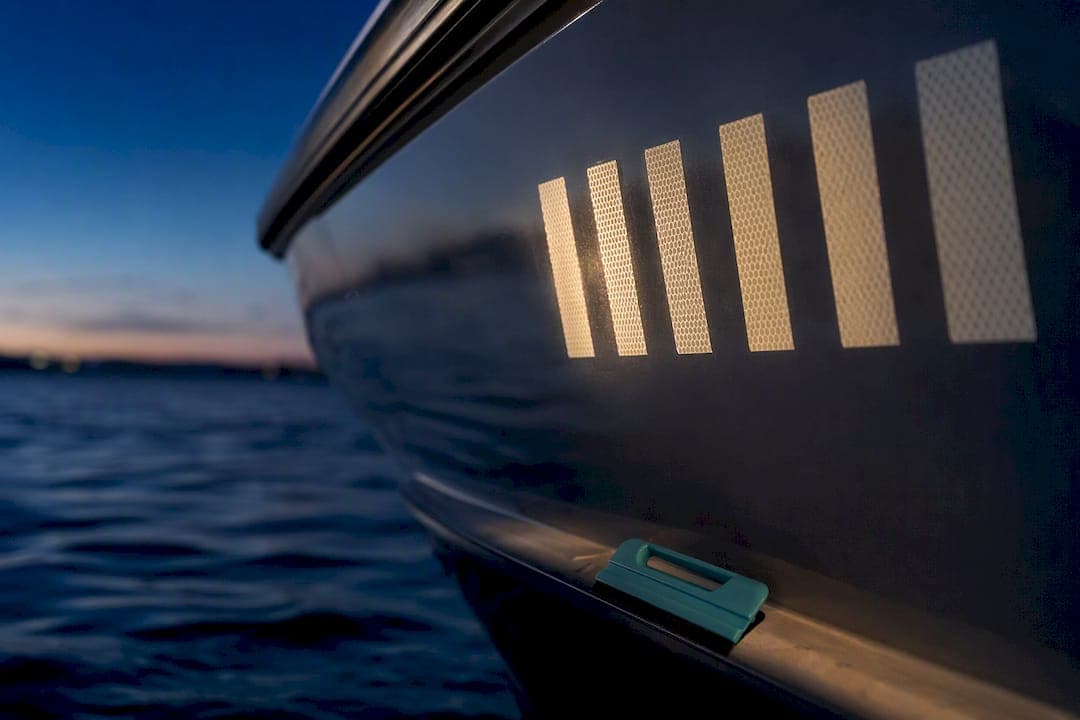
Yes, reflective registration numbers are legal on US boats, but only if they still meet the federal size, font, and contrast rules that apply to every registration number, reflective or not. The Coast Guard's 33 C.F.R. §173.27 doesn't ban or bless reflective materials by name. It just demands plain block characters at least 3 inches tall that contrast with the hull and read left to right. Check your state's specific placement rules, then use a checklist before you order or install anything.
TL;DR:
- Reflective registration numbers are legal as long as they meet federal size, contrast, and placement rules, but contrast remains essential regardless of reflectivity.
- State-specific rules can add detailed placement requirements, such as decal alignment and spacing, which may differ from federal standards and cause violations.
- Reflective sheeting is beneficial in low light or fog but cannot replace contrast; poor color contrast, especially in daylight, can lead to illegibility issues.
- Proper installation requires thorough surface cleaning, correct font choice, accurate measurement, and confirming placement and contrast before application.
- The most common compliance mistakes are using characters smaller than three inches, poor contrast, incorrect positioning, or applying decorative fonts and excess nearby markings.
Table of Contents
- Federal rules: what 33 C.F.R. §173.27 actually requires
- How do states add their own placement rules?
- Do reflective materials meet the contrast requirement?
- What's the compliance checklist before you order numbers?
- Marine vinyl vs. reflective film vs. paint: what should you actually order?
- How do you install numbers without failing inspection?
- What mistakes actually get boats cited?
- What patterns show up most in real installs?
- Get compliant numbers without the guesswork
- Where to verify these rules yourself
- Sources
Federal rules: what 33 C.F.R. §173.27 actually requires
The federal baseline comes from 33 C.F.R. part 173, and it applies to nearly every recreational vessel with propulsion machinery operating on federally controlled waters. If your boat is required to be numbered under §173.15, you're on the hook for these rules the moment you launch, not just when an officer flags you down.
The format itself is rigid by design. Every number follows the same structure: a two-letter state prefix, a string of numerals, and a suffix, separated so the whole thing reads cleanly from a distance. States generally require a space or hyphen of a defined width between the letter block, the numeral block, and the suffix, which is why a sloppy font choice can throw off legibility even when the letters are the right height.
Here's what the regulation actually locks down:
- Character style: plain vertical block characters only. No italics, no script fonts, no stylized lettering that could be mistaken for decoration.
- Minimum height: not less than 3 inches, measured after the numbers are applied, not before.
- Contrast: the numbers must contrast with the background color of the hull. A white boat needs dark numbers; a dark hull needs light ones.
- Orientation: read left to right, always, on both sides of the bow.
- Placement: displayed on each side of the forward half of the vessel, which rules out mounting them near the stern or tucking them under a rail where they're partially obscured.
- Attachment: painted on or permanently attached, meaning a temporary sticker that peels in a season doesn't cut it.
There's also a related requirement most owners overlook: the validation sticker. Under Part 174, when your state issues a validation decal, it has to sit within six inches of the registration number, typically right after the suffix. You also need to carry your certificate of number on board any time the boat is underway. It doesn't need to be laminated or framed, but it does need to be there if a marine patrol officer asks for it.
None of this says anything about reflective versus non-reflective material. That's the part people miss. The regulation cares about size, shape, contrast, and placement. Reflectivity is a manufacturing choice layered on top of a compliance requirement, not a substitute for one.
How do states add their own placement rules?
States can't lower the federal bar, but they routinely raise it or add specificity the CFR leaves vague. That's where a lot of owners get tripped up. They read the federal rule, assume they're covered, and then get a correction notice because their home state wants the validation decal positioned a specific way or wants the numbers spaced differently than they assumed.
Florida is a clean example. The FLHSMV numbering and decals page confirms the same 3 inch minimum height and contrast requirement as the federal rule, but it adds detail on decal placement and retention. The registration decal has to sit in line with the number, and Florida is explicit that expired decals need to come off, not just get covered by a new one. Leaving old decals stacked under new ones is a common reason boats fail a dockside check.
Texas runs its own variation. Texas Parks & Wildlife Department guidance requires block characters no smaller than 3 inches, contrasting color, and a validation decal placed in line with the number, positioned roughly 3 inches aft of the last character. That "in line" detail matters. A decal that's technically within six inches but sitting above or below the number line, rather than beside it, can still draw a citation in Texas even though it satisfies the federal spacing rule.
Multiply that pattern across 50 states and you get a patchwork of small but real differences: some states specify decal size down to the fraction of an inch, some allow more flexibility on hyphen width, and a few have unique rules about what else can appear near the bow.
The fix is straightforward, even if it takes ten minutes:
- Search your issuing authority directly. "Boat registration + [your state name]" usually surfaces the DMV, wildlife agency, or natural resources department that handles titling.
- Look specifically for a numbering and decals page, not just a general registration overview.
- Confirm the current decal placement rule and the minimum character height, since both are the two most commonly cited violations.
- If you recently moved states or bought a used boat with old decals, check whether your new state's placement rule differs from the one the boat was originally registered under.
A five minute check against your state's actual page beats guessing based on what a marina neighbor told you, since rules get updated and old advice circulates for years after it's outdated.
Do reflective materials meet the contrast requirement?
Reflective finishes are legal, but they don't get a free pass on contrast. The regulation's language about numbers being distinctly visible and legible applies whether the material glows in headlights or not, and that's the detail that trips up a lot of well-meaning DIY installs.
Reflective sheeting genuinely earns its keep in specific situations. Boats that spend time on the water at dusk, in fog, or in areas where search and rescue visibility matters benefit from retroreflective numbers that bounce a spotlight or flashlight beam back at a searcher or patrol boat. That's a real safety upgrade, not just a compliance formality.

Where it goes wrong is when reflectivity gets treated as a substitute for contrast rather than an addition to it. Silver or light-gray reflective numbers on a white or cream hull can look sharp in a product photo and then become nearly invisible in flat daylight, which is exactly when most routine dockside checks happen. The material reflects light back toward its source, but if there's no color separation between the number and the hull under normal viewing conditions, it fails the same legibility test a painted number would fail.
Two simple tests catch this before it becomes a problem:
- Daylight distance check: stand back 50 to 100 feet in regular daylight and see if the numbers read clearly without a flashlight or spotlight involved.
- Low-light and beam check: repeat the same test at dusk or with a flashlight/spotlight aimed at the numbers, since that's the scenario reflective material is actually built for.
If the numbers pass the low-light test but disappear in plain daylight, the material choice needs to change, not the placement.
Pro Tip: Choose retroreflective sheeting with a solid-color background or pair it with a contrasting backing plate, rather than relying on a metallic finish alone. The backing plate does double duty: it locks in contrast against any hull color and gives inspectors an unambiguous visual boundary around the number.
What's the compliance checklist before you order numbers?
Run through this sequence before you buy anything, and you'll catch nearly every issue that leads to a correction notice or a repeat purchase.
- Measure your intended character height as it will appear after application, not the size listed on a product page. Vinyl shrinks slightly during cutting and application, so order slightly generous if you're near the 3 inch floor.
- Confirm the font is a plain vertical block style. Skip anything the manufacturer markets as "bold," "italic," or "decorative," even if it still technically measures 3 inches tall.
- Check spacing and hyphen width against your state's rule, and make sure the full sequence reads left to right without any character rotated or mirrored.
- Plan placement on both port and starboard sides, on the forward half of the hull, then measure where your validation sticker will land, keeping it within six inches of the number and in line with it, not floating above or below the row.
- Scan the bow area for anything else nearby that could be mistaken for a registration number. Model names, decorative graphics, or a second decal set from a previous owner can create confusion during an inspection even if your actual numbers are compliant.
- If your hull color makes contrast borderline, order a backing plate sized to extend past the character edges on all sides, rather than hoping the reflective material alone reads clearly.
Working the list in this order, measure first, then font, then spacing, then placement, then surroundings, catches problems while they're still cheap to fix, before vinyl is cut or adhesive has touched the hull.
Marine vinyl vs. reflective film vs. paint: what should you actually order?
Material choice is where compliance and durability intersect, and it's worth getting specific rather than picking whatever shows up first in a search result.
Marine-grade vinyl remains the standard recommendation for a reason. It's built to handle UV exposure without chalking or fading over a season of sun, and it resists the lifting and edge curl that saltwater causes in lower-grade adhesive vinyl. That combination, UV stability plus saltwater resistance, is exactly what separates a decal that lasts several seasons from one that needs replacing by midsummer.
Within vinyl, there's a real distinction between retroreflective sheeting and metallic reflective finishes, and it matters more than most first-time buyers realize.
Retroreflective sheeting, the kind engineered for road signage and safety applications, is designed to preserve color and contrast under normal light while still bouncing a beam back at night. Metallic reflective finishes, by contrast, often prioritize shine and can wash out contrast in flat daylight, which is the exact failure mode covered in the previous section. If reflectivity matters to you, ask specifically for sheeting rated for signage use, not a decorative metallic laminate.
When you're comparing vendors or specs, a short list of questions will tell you more than a product photo ever will:
- What's the UV rating, and is it tested for multi-season sun exposure rather than just indoor durability?
- Is the material rated for saltwater exposure specifically, or only general outdoor use?
- Does it come with an edge-seal or laminate layer to prevent lifting at the corners, which is where most marine decals start to fail first?
- Are the numbers offered as a pre-spaced transfer set, so the whole registration string applies as one aligned unit instead of individual characters you have to eyeball?
- Is a backing plate available as an add-on for hulls where contrast is borderline?
On durability and upkeep, expect a well-made marine vinyl decal to hold up for multiple seasons before edges start to show wear. Spot-repair a lifted corner with fresh adhesive or a small patch if the core numbers are still legible; replace the full set once fading pulls the contrast below a clean pass on the daylight visibility test. Painted numbers, for comparison, can meet the same federal requirements but demand more skill to keep straight, evenly spaced, and properly sized, and touch-ups are harder to blend invisibly.
How do you install numbers without failing inspection?
Installation mistakes cause more compliance failures than material choice does. A perfectly rated vinyl set applied crooked, too small, or on a bad surface will fail the same visual test as a cheap decal.
- Prep the surface first. Clean the hull section thoroughly, let it dry completely, and check the ambient temperature against the adhesive's rated application range. Cold, damp conditions are the number one cause of bubbling and premature lifting.
- Avoid flared or heavily curved bow panels when you have a choice of mounting spot. A steep viewing angle on a flared panel can make even correctly sized numbers hard to read from a boat approaching at a normal angle, which is exactly the angle an enforcement officer will usually see first.
- Use a pre-spaced transfer set with transfer tape rather than applying individual characters freehand. This keeps letter spacing and hyphen width consistent without measuring each gap by eye.
- Apply and squeegee outward from the center, working air bubbles toward the edges rather than trapping them under the middle of a character.
- Add a backing plate now if contrast is borderline, before the adhesive fully cures, since repositioning after full cure risks damaging the vinyl.
- Run the post-install check immediately. Measure actual character height with a tape measure, don't eyeball it. Step back 50 to 100 feet in daylight to confirm the contrast test passes. Confirm the validation decal sits within six inches and in line with the number sequence.
- Set a maintenance reminder for periodic cleaning, and plan on a full replacement once you notice fading has started pulling contrast down rather than waiting until the numbers are already hard to read.
A detailed step-by-step installation guide is worth reviewing in full before your first application, especially the section on temperature ranges, since that's the variable most owners skip.
What mistakes actually get boats cited?
The same handful of errors show up again and again in enforcement reports, and nearly all of them are fixable in an afternoon once you know what to look for.
- Characters under 3 inches, usually because the buyer measured the product listing instead of the number as it actually sits on the hull.
- Low contrast, most often light numbers on a light hull or a reflective finish that disappears in daylight.
- Wrong placement, numbers mounted too far aft, too close to the waterline, or split across a rub rail so part of the character is obscured.
- Decorative or italic fonts that technically meet the height requirement but violate the plain block character rule.
- Extra numbers or lettering near the bow that create ambiguity about which sequence is the actual registration number.
Enforcement responses vary by state, but a first offense for a display violation is often a modest fine in the $25 to $250 range, while operating with no registration numbers at all can escalate to a steeper fine or, in some jurisdictions, impoundment. If you get flagged, ask the officer exactly which requirement failed. Carry your certificate of number and a photo of your current numbering while you order a fix, and treat the correction window as your deadline, not a suggestion.
Running the compliance checklist from earlier before you ever launch is the cheapest insurance against all five of these.
What patterns show up most in real installs?
The contrast problem shows up more than anything else. Owners fall in love with a reflective or metallic finish because it looks sharp in a sample photo, then discover in daylight that it barely separates from the hull color. The fix is almost always the same: pair reflective sheeting with a solid backing color rather than letting the hull itself act as the background.
Curved and flared bows cause the second most common headache. A number that measures 3 inches on a flat template can read shorter or distorted once it wraps a compound curve, and a viewing angle that looks fine from the dock can hide the number entirely from a boat approaching head on. A backing plate sized to extend past the character edges solves both the contrast and the distortion problem in one move.
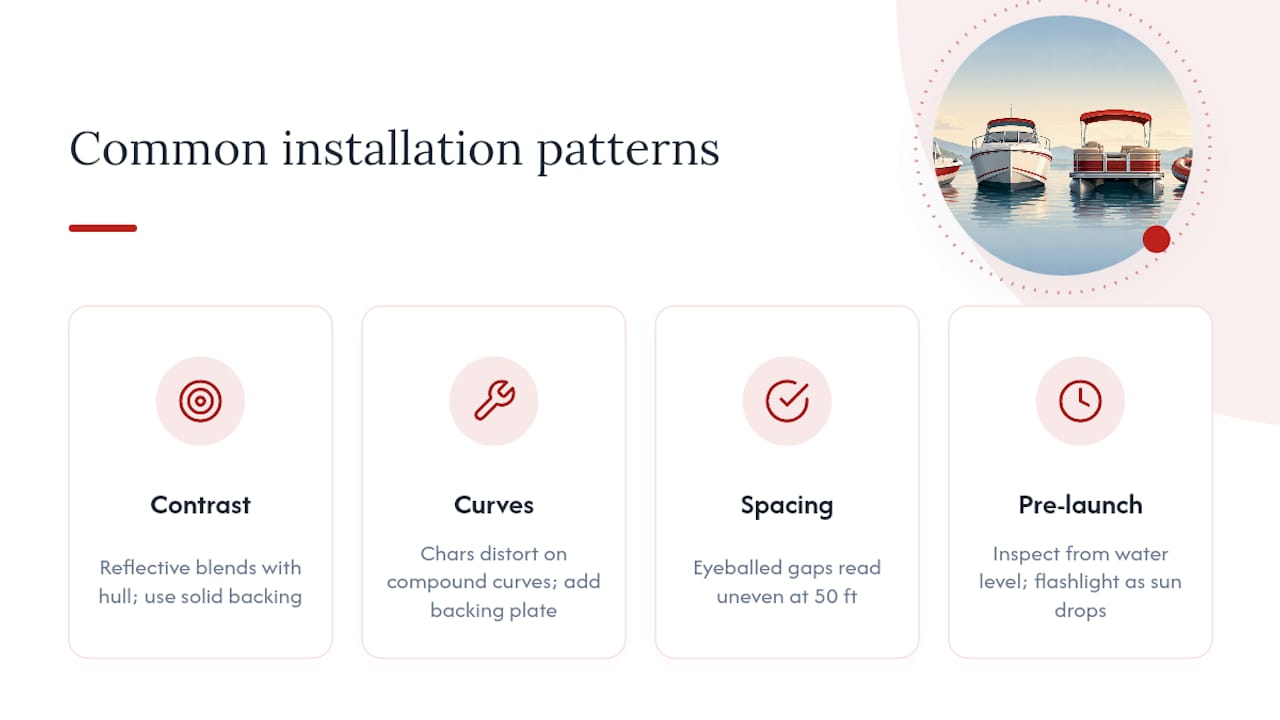
Spacing errors round out the list, usually from buyers who ordered individual characters instead of a pre-spaced set and then eyeballed the gaps during application. It looks close enough standing at the hull, and then it reads unevenly from 50 feet away, which is exactly the distance that matters.
If there's one habit worth building before every launch, it's this: check your numbers from water level, ideally with someone else at the helm, and shine a flashlight on them once the sun starts dropping. That two-minute check catches almost everything a dockside inspection would catch, before anyone official is standing there watching.
— Taylor
Get compliant numbers without the guesswork
Custom boat registration numbers can be made to meet federal size and contrast rules using marine-grade vinyl that is UV-resistant and saltwater-rated, balancing compliance and durability. The online design tool walks you through entering your state prefix, numerals, and suffix, then lets you pick a font, color, and layout that clears the contrast test before you ever apply it to the hull.
Pre-spaced transfer sets with optional backing plates for borderline contrast are available, with typical production and shipping times that aim to be rapid and include free shipping within the contiguous US. If you're not sure whether your validation sticker placement matches your state's exact rule, the validation sticker placement guide walks through it before you order. Marinas and dealerships ordering in volume can work through the dealer program instead of placing individual orders one boat at a time. Start your design now and have compliant numbers on the water before your next inspection.
Where to verify these rules yourself
Regulations change, and the safest habit is checking the primary source rather than relying on a summary, including this one.
- 33 C.F.R. part 173 covers the federal baseline on number size, font, contrast, and placement.
- 33 C.F.R. part 174 governs state numbering systems and validation sticker placement.
- Florida's FLHSMV numbering and decals page and Texas Parks & Wildlife's placement guidance show how two large states apply the federal baseline.
Confirm the current version of your own state's rule with your issuing authority before you order or install anything, since state pages get updated more often than federal code.
Sources
- Subchapter S—Boating Safety, 33 C.F.R. part 173 (govinfo)
- Part 174 - State Numbering and Casualty Reporting Systems (eLaws)
- Numbering and Decals - Florida Department of Highway Safety and Motor Vehicles
- Numbers and Decals on Vessels — Texas Parks & Wildlife Department
- Boat Registration Number Display Rules: Size, Placement & Format (2026)