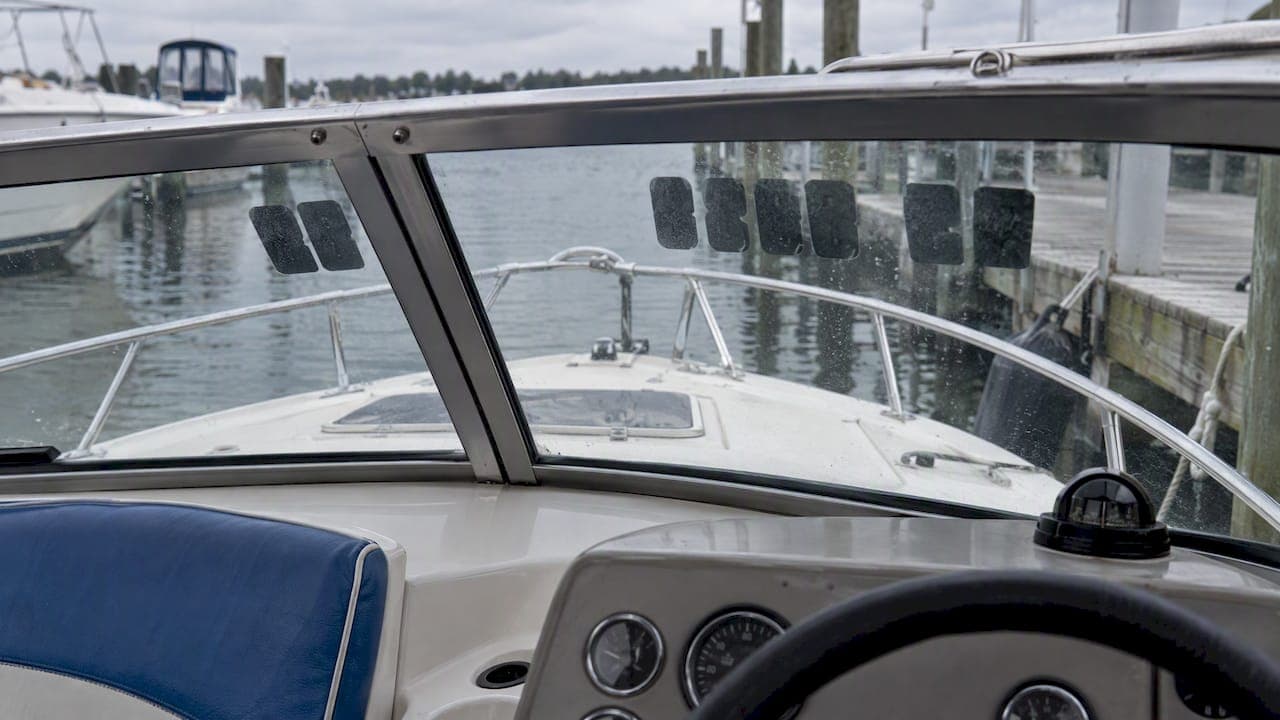
In the U.S., registration numbers must normally go on the forward half of each hull side, not as the main display on the windshield. Federal rules call for plain vertical block characters at least three inches high, in a color that contrasts with the hull, readable left to right. Before you apply anything, confirm the exact rule for your state of principal use.
TL;DR:
- Federal requirements mandate registration numbers on both sides of the hull's forward half, at least three inches high in contrasting, plain vertical block characters.
- State regulations often add specific placement rules, including decal position immediately after the number and tighter spacing or color requirements, requiring verification with local authorities.
- Placing registration numbers on the windshield usually fails inspection because they are hard to read from outside and do not meet the required placement or viewing angle criteria.
- Proper measurement, cleaning, and alignment before application prevent compliance issues and reduce the need for decal reordering or correction.
- Boats with certain types of propulsion, documentation, or usage may be exempt from displaying registration numbers, but confirmation with the specific state's authority is necessary.
Table of Contents
- What federal rules actually require
- How state rules differ from the federal floor
- Why windshield-only display usually fails inspection
- How to measure, prepare, and apply your numbers correctly
- When a boat legally has no visible registration number
- Choosing decal materials that hold up and stay compliant
- Compliance first, neatness second
- How RegistrationDecals.com helps you get it right
- FAQ
- Sources
What federal rules actually require
The federal baseline comes from the Coast Guard and the Code of Federal Regulations, and most states build their own rules on top of it. 33 CFR Part 173 spells out the display requirements that apply to recreational boats nationwide.
- Numbers go on both sides of the forward half of the vessel, read left to right.
- Characters must be plain vertical block style, at least three inches tall, in a color that contrasts with the background.
- A space or hyphen separates the letter prefix, number sequence, and letter suffix (for example, FL 1234 AB rather than FL1234AB).
- No other numbers or letters may be displayed near enough to be confused with the registration number.
- The state validation decal generally sits within six inches of the number, though exact placement varies by state.
Operators must also carry the Certificate of Number aboard the boat, and the number on the hull has to match the number on that certificate exactly. That's separate from the Hull Identification Number, a permanent 12-character code assigned at manufacture. Part 181 requires two identical HINs, with the primary one typically on the starboard side of the transom. The HIN identifies the boat for life; the registration number identifies current, valid registration, and the two should never be confused with each other.
How state rules differ from the federal floor
States adopt the federal minimums, then add their own details, so the forward-half, 3-inch rule is only the starting point. Some states specify the decal must sit immediately after the number rather than before it. Others tighten the tolerance on letter spacing or require a specific shade of contrasting paint rather than any contrasting color.
- Vessel type matters: some states exempt certain manually propelled craft or small dinghies used as tenders.
- Documented vessels (those with Coast Guard documentation instead of, or alongside, state registration) sometimes follow different display rules.
- Search your state boating authority's site for terms like "vessel registration number display" or "decal placement requirements" rather than generic boating guides.
- Cross-check your find against your state's specific regulation page before you buy or apply anything.
A rule that's accurate for Florida may be wrong for Michigan, so treat any general guide, including this one, as a starting point rather than the final word.
Why windshield-only display usually fails inspection
Windshield placement runs into a simple problem: the federal rule exists so an officer approaching from outside the boat can read the number without boarding it. A number stuck to the inside or outside of the windshield is often angled, reflective, or only visible from specific positions, which defeats that purpose even when the boat owner can read it fine from the helm.
- Glare and curved glass distort block characters, making them hard to read from a patrol boat or dock.
- Numbers on glass often fall outside the "forward half of the hull" zone the regulation specifies.
- A windshield-mounted number does nothing to satisfy the requirement for matching displays on both port and starboard sides.
- Officers who can't confirm a number from outside the vessel may stop the boat to check it directly, which defeats the purpose of displaying it at all.
There are narrow exceptions. Dealers and manufacturers sometimes use temporary, removable plates for demo or transport purposes, and the regulation allows a backing plate when the hull shape genuinely makes side placement impractical, as long as that plate sits on the forward half and meets the same size and spacing rules. That's a workaround for unusual hull geometry, not a substitute for proper placement when a flat hull surface is available.
Pro Tip: If rails, rub strips, or hardware block the ideal spot on your hull, a backing plate mounted nearby on the forward half usually solves the problem without creating a compliance issue.

How to measure, prepare, and apply your numbers correctly
Getting the number right the first time saves you a second decal order and avoids a conversation with a marine patrol officer.
- Pull your Certificate of Number and copy the registration number exactly, including spacing and hyphens.
- Choose a decal height of at least 3 inches, a plain vertical block font, and a color that visibly contrasts with your hull, matching whatever spacing or hyphen convention your state specifies.
- Measure and mark matching locations on the forward half of both the port and starboard sides, checking that each number will be readable from directly outside the hull.
- Clean and dry the application area thoroughly, removing wax or polish residue so the adhesive bonds properly.
- Apply the decals following the manufacturer's instructions, then place your state validation decal at the required distance, commonly within six inches and in line with the registration number.
- Stand back and read each side left to right, confirm both sides match, and keep the Certificate of Number aboard the boat at all times.
Pro Tip: Lay out your decals with removable tape before peeling any adhesive backing, so you can check spacing and alignment on both sides before committing.
For a closer look at matched port-and-starboard placement, see how registration numbers go on both sides of a boat.
When a boat legally has no visible registration number
Some boats on the water genuinely don't carry a state-issued number, and that's not automatically a violation. A handful of vessel categories are commonly exempt, though the exact list depends entirely on the state.
- Certain manually propelled craft, like some canoes and small rowboats, fall outside registration requirements in several states.
- Documented vessels sometimes skip state numbering, though many states still require a decal or separate state fee even with Coast Guard documentation.
- Small tenders used only to reach a larger documented or registered vessel are exempt in some jurisdictions.
If you're unsure whether your boat qualifies, call or check your state boating authority directly rather than assuming based on boat type alone, since the exemption list is one of the areas where states diverge the most.
Choosing decal materials that hold up and stay compliant
A compliant layout only matters if the decal survives sun, salt spray, and trailering. Marine-grade vinyl resists UV fading and stays bonded in saltwater, which keeps the characters legible and the contrast sharp for years rather than fading into a washed-out gray after one season.
- Ask any vendor for a mockup sized to your exact state rule before you order, not a generic template.
- Request the material spec sheet so you know it's rated for UV and saltwater exposure, not just general outdoor use.
- Confirm production turnaround and the returns policy in case a digit needs correcting after you place the order.
- Compare the mockup side by side against your state's height, spacing, and hyphen requirements before approving it.
Pair decals with weather-resistant conspicuity tape elsewhere on the hull if you want extra visibility in low light, since both rely on the same UV and saltwater resistance principles.
Pro Tip: Keep a photo of your approved mockup next to your Certificate of Number so you have a quick reference if an officer asks about your display.
Compliance first, neatness second
A tidy windshield sticker looks clean, but a correctly placed hull number is what actually protects you on the water. Confirm your state's exact rule, keep your Certificate of Number aboard, and let legibility win over looks.
— Taylor
How RegistrationDecals.com helps you get it right
Once you've confirmed your state's rule, Registrationdecals turns that spec into a decal set in minutes. The online design tool lets you enter your exact registration number, pick a contrasting color, and preview the layout before you order, and Custom Boat Registration Numbers & Decals are available per set, produced in marine-grade vinyl and shipped free across the contiguous United States in 3 to 5 business days.
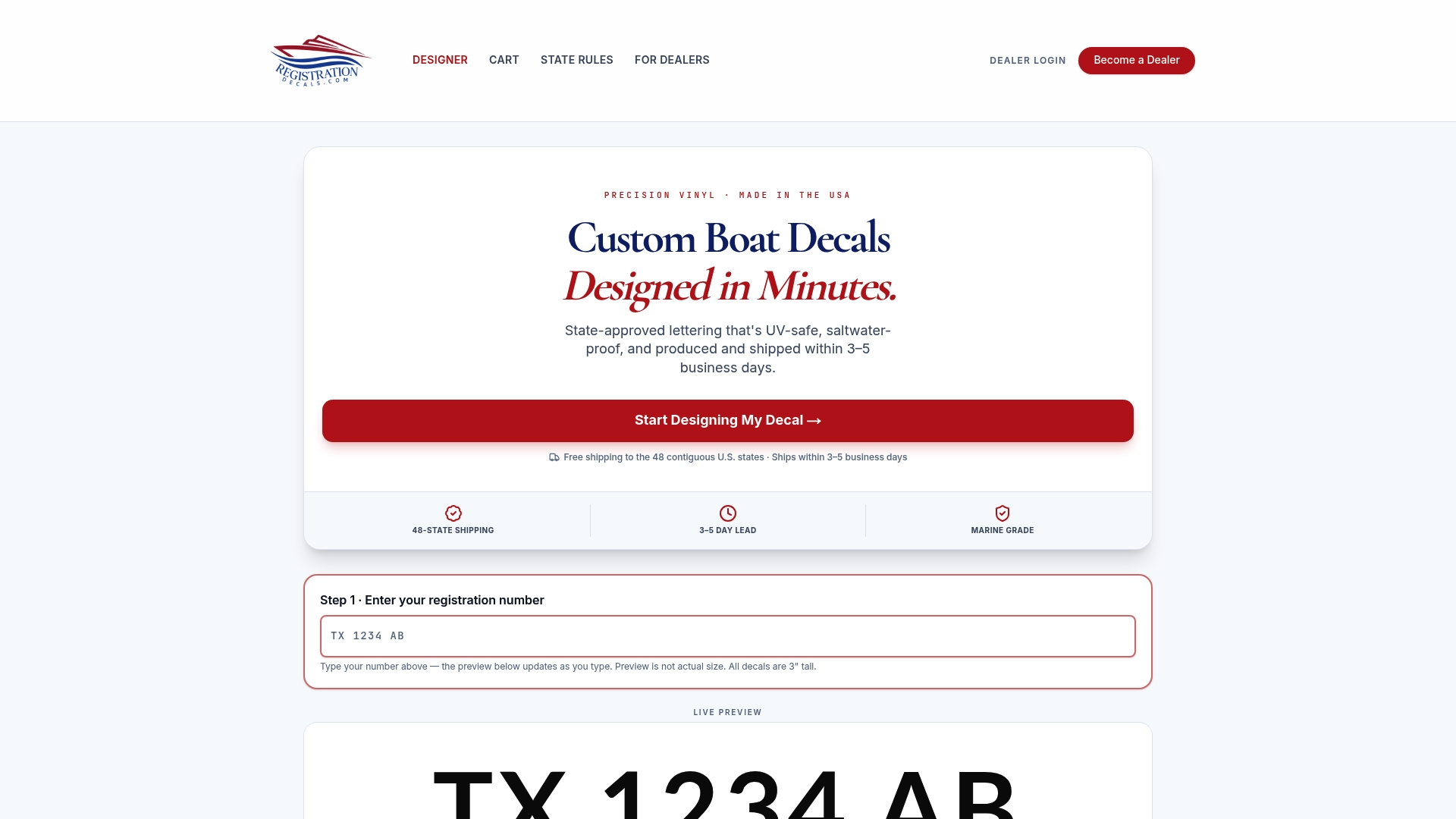
The workflow is simple: check your state page, build your mockup, and order. Dedicated product lines exist for Jet Ski Numbers, Pontoon Numbers, Bass Boat Numbers, Aluminum Boat Numbers, and Center Console Numbers, each sized to fit that hull type's typical display area. Start your mockup and get a compliant set on the water before your next trip.
FAQ
Where should boat numbers go?
Registration numbers belong on the forward half of both the port and starboard hull sides, in plain vertical block characters at least three inches high, readable left to right. For more detail on exact placement, see where boat registration numbers go on a boat.
When did hull identification numbers start appearing on boats?
The Hull Identification Number system is a federal requirement tied to boat manufacturing, and it's distinct from a state registration number. The HIN is permanent and typically placed on the starboard side of the transom, while registration numbers change when you renew or transfer your registration.
Why do some boats not have registration numbers?
Some vessel types, including certain manually propelled craft, documented vessels, and small tenders, are exempt from state numbering requirements in some states. Exemptions vary significantly by state, so check your state boating authority directly rather than assuming based on boat type.
Where can I get boat number stickers?
You can get compliant decal sets from marine decal vendors like Registrationdecals, which offers marine-grade vinyl decals built from your exact registration number and state specs. Always verify the mockup against your state's placement rule before applying the decal to your hull.
Sources
- A Boater's Guide to the Federal Requirements for Recreational Boats (U.S. Coast Guard)
- eCFR :: 33 CFR Part 173 -- Vessel Numbering and Casualty and Accident Reporting