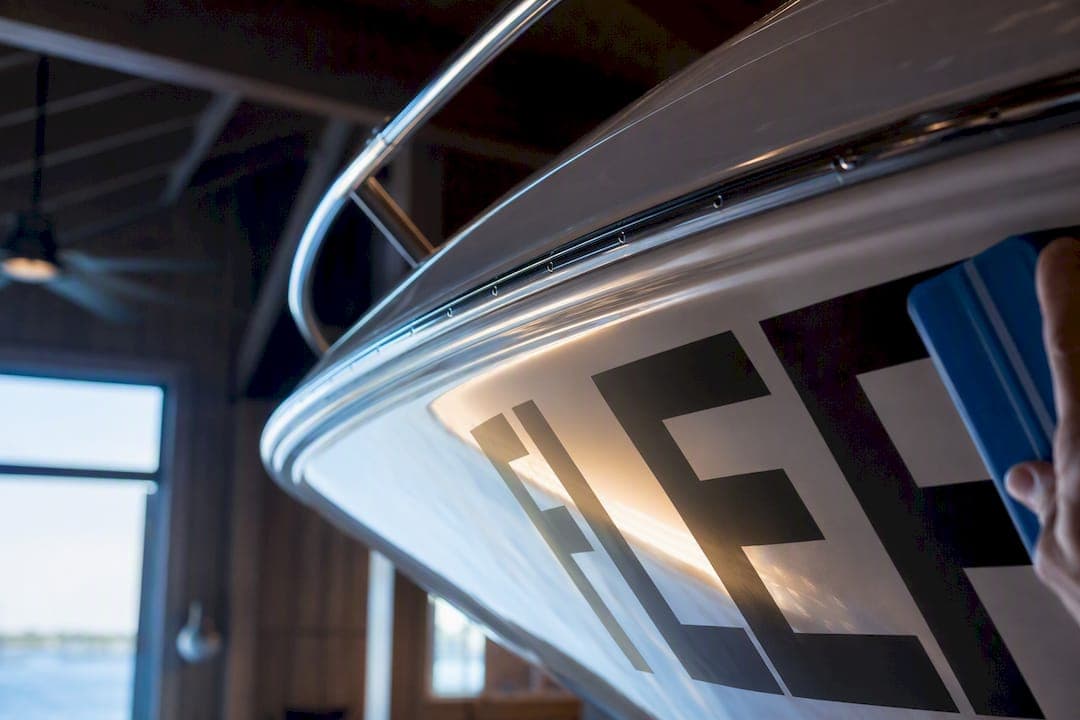
Curved hull numbers pass inspection when they stay legible, plain, and correctly sized despite the contour they follow, since federal rules judge the finished appearance of a registration number, not whether the decal was cut flat or shaped to a bow. The character height, contrast, and spacing requirements under 33 CFR §173.27 still apply after the curve is factored in. One separate rule matters just as much: your Hull Identification Number is a different, permanently affixed marking, and no amount of decal styling changes that requirement.
TL;DR:
- Curved hull numbers are compliant if they remain legible, contrast with the hull, and meet size and spacing standards, despite following the hull's contour.
- They should be designed slightly larger than 3 inches before wrapping to account for potential height shrinkage on tight curves.
- Material choice is critical; marine-grade vinyl resists UV and saltwater and should be applied with proper backing plates on sharp curves to preserve legibility.
- The registration number must be read from left to right and displayed on the forward half of the hull, but the hull identification number (HIN) remains a fixed, separate marking.
- Inspection failures often occur due to decorative fonts, improper sizing on curves, or poor surface preparation; professional installation or backing plates can prevent common issues.
Table of Contents
- What Are Curved Hull Numbers?
- Federal Display Rules That Determine Compliance
- Design and Material Guidance for Curved Hull Numbers
- How to Measure, Design, and Apply Curved Hull Numbers
- Curved Numbers by Hull Type
- Inspection Checklist and Common Mistakes
- How Experienced Suppliers Handle Curved Number Challenges
- Order Compliant Curved Hull Numbers Online
- Regulations and Resources
- Sources
- FAQ
What Are Curved Hull Numbers?
Curved hull numbers are registration-number decals cut or produced to follow the contour of a bow or hull section, rather than sitting on a flat panel. Boat owners choose them for one obvious reason: not every bow is flat, and a rigid straight-line decal can wrinkle, gap, or look sloppy on a rounded surface.
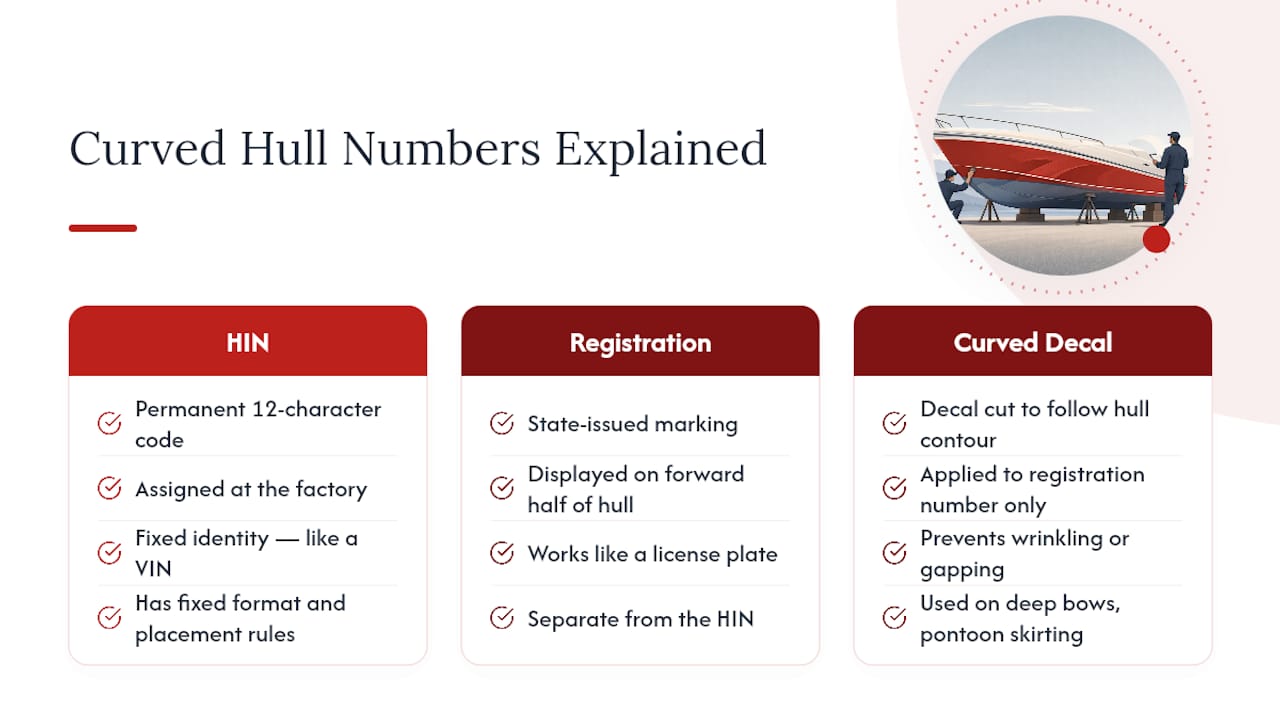
It helps to separate two things that get confused constantly. The Hull Identification Number, or HIN, is a permanent 12-character code assigned at the factory, and it functions as your boat's fixed identity, similar to a VIN on a car, according to J.D. Power's HIN lookup guide. Your registration number is a separate, state-issued marking, displayed on the forward half of the hull, that works more like a license plate. Curved hull numbers apply to the registration number, never to the HIN, which has its own fixed format and placement rules.
Owners pick curved decals for fit and looks, especially on pontoon skirting, deep bows, or hulls with heavy flare, where a straight decal simply does not sit right.
Federal Display Rules That Determine Compliance
The registration number itself is governed by a fairly short list of federal requirements, and every state builds its own rule set on top of that baseline. Under 33 CFR §173.27, a compliant registration number must meet these conditions:
- At least 3 inches high, measured on the applied surface
- Plain vertical block characters, no script, italics, or decorative styling
- A color that contrasts clearly with the hull background
- Even spacing or hyphens separating the letter and number groups
- Read left to right
- Displayed on the forward half of the vessel, one side each
The HIN follows a different standard entirely. Under 33 CFR §181.29, two identical HINs must be permanently affixed to the hull, each at least a quarter inch high, with specific rules on primary and duplicate placement. Nobody applies a HIN as a decorative decal.
Marine patrol officers rely on a practical test: can the number be read clearly from a normal boarding or dock distance? That's the standard your curved lettering actually has to clear, not just a tape-measure check at the workbench.
Design and Material Guidance for Curved Hull Numbers
Getting curved numbers to hold up starts with the material. Marine-grade vinyl built to resist UV fading and saltwater degradation lasts far longer on exposed hull surfaces than standard vinyl, which is why suppliers specializing in center-console registration numbers build decals from that grade of vinyl by default.
Font choice matters more on a curve than on a flat panel, because bending a letter shape can distort its proportions and quietly shrink its effective height. A few practical guardrails:
- Stick to genuine block-style fonts with consistent stroke width, since the "plain vertical block characters" standard doesn't bend for style
- Choose contrasting colors, checking what color boat registration numbers can legally be before finalizing a scheme that looks great but fails inspection
- Consider a backing plate or flat mounting panel when the hull curvature is too aggressive for direct application, since a flat plate preserves letter geometry that a compound curve would distort
- Match adhesive strength to the surface. Gelcoat, aluminum, and pontoon tubing all cure and bond differently
Pro Tip: Oversize your lettering slightly before curving. A number that measures 3 inches flat can lose a fraction of an inch of effective height once it wraps a bow, and that's often enough to fall short of the legal minimum.
How to Measure, Design, and Apply Curved Hull Numbers
- Measure the forward half of the hull where the numbers will sit, and map the actual curve radius, not just the straight-line distance.
- Account for curvature in your height calculation. If the surface bends sharply, add extra height in the design stage so the number reads at 3 inches or more once applied.
- Cut a paper template first, wrap it around the actual hull section, and step back to test legibility at a normal dock distance before committing to vinyl.
- Clean and de-grease the surface thoroughly, ideally in mild, dry conditions, since temperature and moisture both affect adhesive cure.
- Align and apply in sections if the curve is tight, smoothing from center outward to avoid trapped air.
- Inspect for bubbles or wrinkles once cured, and if the curve keeps distorting the letters, that's the signal to switch to a backing plate or call in a professional installer.
Full step-by-step photos and technique notes are in the installation guide if you want a visual reference before you start cutting vinyl.
Curved Numbers by Hull Type
Hull shape changes what actually works, and treating every boat the same is where a lot of owners waste vinyl.
- Pontoon boats often mount numbers on the skirting, and curved decals can work well there since pontoon tubes have a gentler, more consistent radius. Specific pontoon placement guidance is worth checking before you order, since pontoon registration number rules cover skirting placement in more detail than the general federal standard.
- V-hull and deep-vee bows curve more sharply near the waterline, and that's exactly where tall block letters start losing effective height. A backing plate solves this cleanly.
- Boats without a conventional transom still need forward-half placement, and distance-from-stern rules that apply to standard hulls carry over. Confirm placement questions like whether numbers go on both sides of the boat before finalizing your layout.
Inspection Checklist and Common Mistakes
Before you head out on the water, run through this self-check the way an officer would:
- Measure the applied letter height, not the pre-curve design height
- Confirm real contrast against the hull color in daylight
- Check for plain block style, no script or stylized fonts
- Verify even spacing or hyphens between number groups
- Read the sequence left to right exactly as registered
The most common failures are decorative fonts that look sharp but violate the plain-block rule, letters that shrink below 3 inches once wrapped around a curve, and decals that lift at the edges from poor surface prep. Each has a fix: remount on a flat backing plate, switch to genuine block lettering, or bring in a professional installer for tight or compound curves.
Pro Tip: If you're ever unsure whether your curve is too aggressive for a direct decal, a flat backing plate costs far less than a second decal order and a failed inspection.
How Experienced Suppliers Handle Curved Number Challenges
A reliable supplier workflow runs through design mockup, template testing, material selection, then a finishing quality check before anything ships. That sequence exists because curvature is where compliance quietly breaks down, not at the design stage. Before ordering from any supplier, ask about production timeline, the vinyl grade used, and whether they'll flag a design that risks falling short of the legal minimum height once applied.

Order Compliant Curved Hull Numbers Online
A practical alternative to guessing your way through a compound curve, some suppliers cut decals from marine-grade vinyl rated for UV and saltwater exposure, and may offer an online design tool to enter your registration number, pick contrasting colors, and preview the layout before application.
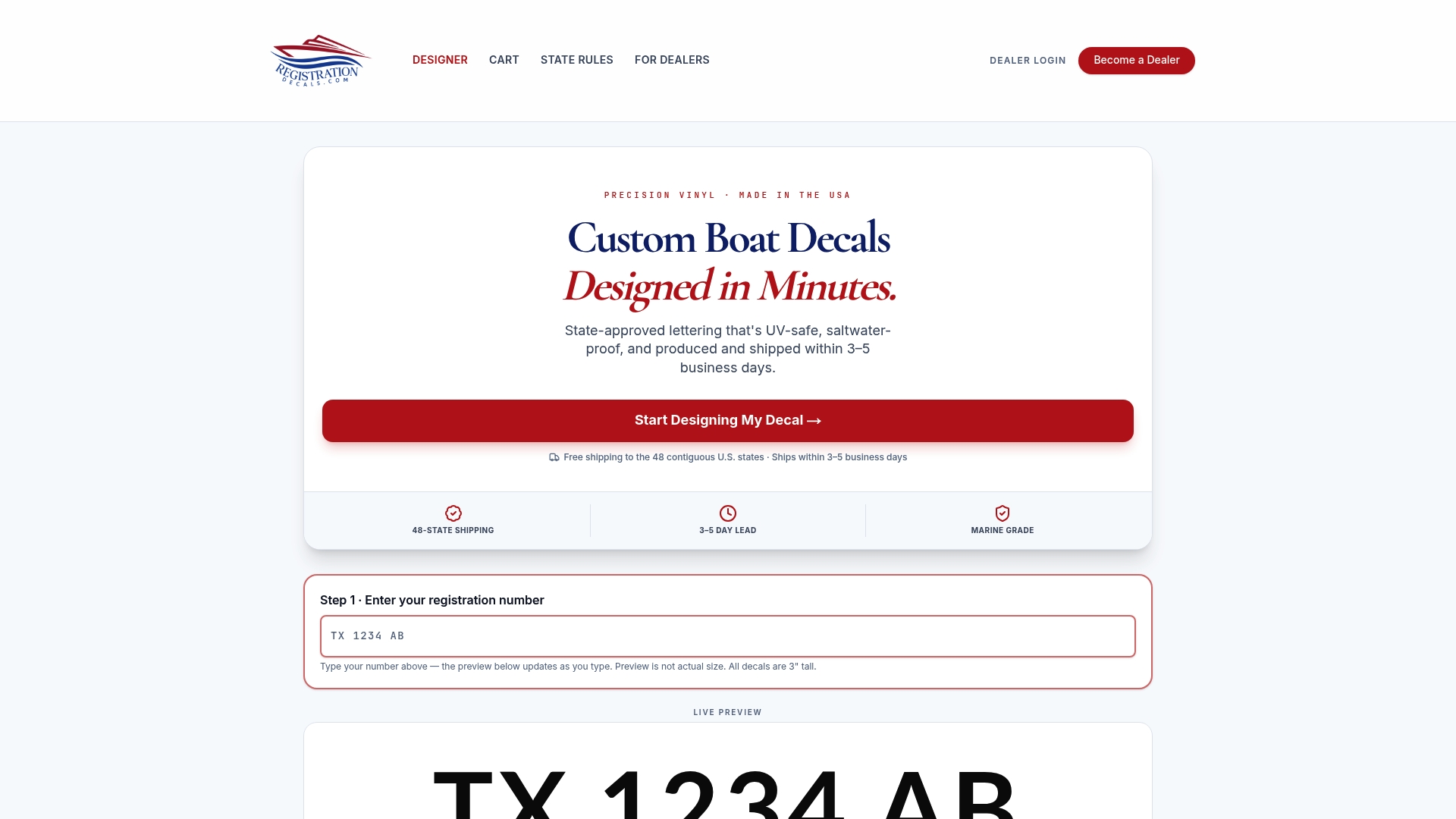
That preview step matters more on curved surfaces than flat ones, since it catches sizing problems before you've committed to vinyl. Orders ship quickly with free shipping within the contiguous United States, whether you're a single boat owner or placing a bulk order. If you're not sure your state's rules match the federal baseline, check the regulations by state before finalizing your design, or head straight to the decal design tool and build your curved hull numbers now.
Regulations and Resources
Primary sources: 33 CFR part 173 covers numbering and display; 33 CFR §181.29 covers HIN rules. For the difference in plain terms, see this HIN vs registration number explainer. For durability questions on curved vinyl in marine environments, Bodaq's vinyl film guide covers how film properties hold up on contoured surfaces.
Sources
- SUBCHAPTER S—BOATING SAFETY (33 CFR part 173)
- 33 CFR § 181.29 - Hull identification number display (LII / Cornell)
FAQ
Are Curved Hull Numbers Legal?
Yes, as long as the applied letters meet the federal minimum height, use plain vertical block style, contrast with the hull, and read left to right per 33 CFR §173.27.
Do Curved Numbers Apply to the HIN Too?
No. The HIN is a separate, permanently affixed 12-character code with its own placement and minimum height rules under 33 CFR §181.29, and it is never produced as a curved decorative decal.
What Height Should I Design for Before Curving?
Design slightly taller than the 3-inch federal minimum, since wrapping a letter around a bow can shrink its effective height once applied.
When Should I Use a Backing Plate Instead of a Direct Curve?
Use one whenever the hull curvature is sharp enough to distort letter shape or reduce legibility, which is common on deep-vee bows.
Can Registrationdecals Make Curved Numbers for My Boat?
Yes. Registrationdecals produces custom, state-compliant registration decals from marine-grade vinyl using an online design tool, with production in 3 to 5 business days.