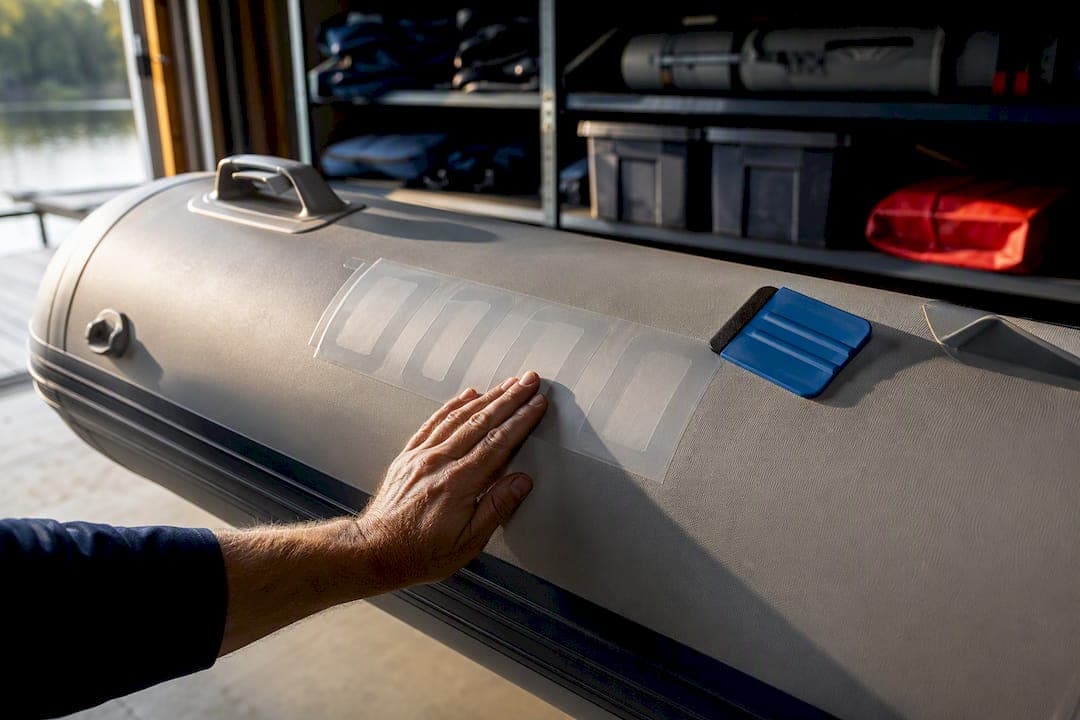
Yes, marine-grade, pressure-sensitive registration decals will work on Hypalon in many cases, especially on smooth, regularly inflated tubes that see moderate handling. For boats that get deflated often or dragged over rough surfaces, a bonded Hypalon panel holds up better over time and resists the creasing that peels stickers loose.
TL;DR:
- Pressure-sensitive decals work best on smooth, inflated tubes with light use, while bonded panels are more suitable for deflated or abrasion-prone boats.
- Proper surface preparation of Hypalon involves cleaning, light abrading, and avoiding harsh solvents like acetone or MEK to ensure effective adhesion.
- Decals should be installed in dry, shaded environments at 60 to 90°F, following specific steps for pressure-sensitive or bonded application, and require about a week to reach full bond strength.
- Registration numbers must follow federal and state rules, placed on both sides of the hull in clear, high-contrast, vertical block characters at least 3 inches tall, avoiding high-wear zones.
- For durability, seal decal edges, avoid pressure washing directly on them, and replace decals promptly if edges lift or fade to maintain readability over years.
Table of Contents
- Peel-and-stick decals vs. bonded Hypalon panels
- Getting the Hypalon surface ready before you stick anything
- Installing registration numbers on Hypalon step by step
- Where registration numbers and decals legally belong
- Keeping decals readable and intact for years
- How RegistrationDecals.com helps owners mark Hypalon inflatables
- What actually works, based on how owners use their boats
- Order compliant registration decals built for your boat
- Sources
- FAQ
Peel-and-stick decals vs. bonded Hypalon panels
Both methods can meet registration requirements, but they suit different boats. A pressure-sensitive decal is fast to apply, easy to reposition before it sets, and simple to replace if your numbers change. It works best on tubes that stay inflated most of the season and get light use.
A bonded panel takes longer to install and can't be repositioned once the adhesive grabs, but it becomes part of the fabric rather than sitting on top of it. That makes it the better call for dinghies that get rolled up for storage, deflated for transport, or dragged onto beaches.
- Pressure-sensitive vinyl: best for smooth, inflated tubes with light wear.
- Bonded panel: best for boats deflated often or exposed to abrasion.
- Removable plate: a middle ground when you want compliance without a permanent bond, useful for rental fleets or boats swapped between hulls.
Repairability favors the decal. If it lifts at an edge, you can reseal or replace it in minutes. A damaged bonded panel usually means cutting it away and starting the Polymarine adhesive process over.
Getting the Hypalon surface ready before you stick anything
Before prep starts, confirm what you actually have. Hypalon (also called CSM) has a slightly rubbery, matte feel and doesn't smell like vinyl solvent the way PVC does. This matters because Polymarine's adhesive guidance is explicit that Hypalon-specific adhesives are not suitable for plasticized PVC, so misidentifying the fabric can ruin an otherwise careful installation.
Once you've confirmed the material, work through prep in order:
- Wash the area with mild soap and water to remove salt, sunscreen, and grime.
- Lightly abrade the surface so it loses its glossy sheen and feels slightly suede-like.
- Degrease with a solvent recommended for Hypalon, applied sparingly and wiped before it dries.
- Wipe again with a clean, lint-free towel and check that no residue transfers.
Skip acetone, MEK, and lacquer thinner. Arlon's application guidance warns against these for marine-marking vinyl because they can attack the fabric or leave a film that stops adhesive from grabbing. Removing oxidation, the chalky residue that forms on aging Hypalon, matters just as much as the cleaning itself, since a chalky surface de-tackifies adhesive almost immediately.
Pro Tip: Rub a clean white cloth over the prepped area. If it comes away gray or chalky, keep abrading and cleaning before you apply anything.

Installing registration numbers on Hypalon step by step

Environment matters as much as technique. Aim for 60 to 90°F, low humidity, and a dry, shaded surface, since Arlon recommends dry application above the waterline rather than wet application for films with air-egress. Have lint-free towels, a squeegee, and alignment tape ready before you start.
For pressure-sensitive decals:
- Tape the decal in place and use it as a hinge to peel back the backing gradually.
- Press from the center outward with a squeegee to avoid trapped air.
- Seal the edges by hand, then apply gentle heat if the film allows it.
- Leave the decal undisturbed for 48 hours to let the adhesive fully wet out.
For bonded panels, deflate the tube, abrade and solvent-clean the bond area, then apply two thin adhesive coats per Polymarine's process, pressing out trapped air and rolling the panel firmly. Cure for 48 to 72 hours before handling and avoid full load or water contact until close to a week, since maximum bond strength develops about one week after application, according to Polymarine's guidance. Check bond edges for lift daily during cure, and keep the boat dry and out of direct sun while the adhesive sets.
Where registration numbers and decals legally belong
The USCG's federal boating guide sets the baseline: numbers go on both sides of the forward half of the hull, read left to right, in plain vertical block characters at least 3 inches high, and contrast clearly with the background color. Validation decals typically sit within 6 inches of the numbers, though placement details vary enough by state that it's worth checking your own boat registration rules before you commit to a spot.
On an inflatable, placement is also about avoiding failure points:
- Keep numbers off seams, where flexing stresses the adhesive bond.
- Avoid rubbing strakes and other high-contact wear zones.
- Steer clear of lift handles and hardware that crease the fabric.
- Skip areas that fold sharply when the tube is deflated.
For a closer look at exact placement and how port and starboard sides should mirror each other, our registration number placement guide walks through the specifics, including the both-sides rule.
Keeping decals readable and intact for years
A few habits determine whether your numbers last one season or five. Overlaminate film adds abrasion resistance, and sealing the decal's edges by hand reduces the lifting that starts most failures. Arlon's wrap guidance notes that post-heating edges after application relieves stress in the film and helps prevent that same edge lift over time.
- Wash decals with mild soap, not harsh solvents or degreasers.
- Skip the pressure washer directly on decal edges; use a wide fan tip from a distance if needed.
- Store deflated tubes rolled loosely rather than folded tightly across a decal.
- Replace a decal at the first sign of edge lift rather than waiting for full failure.
Pro Tip: If you deflate and roll your boat often, a removable plate saves you from redoing decals every time the fabric creases in a new spot.
Bubbling or fading usually traces back to incomplete cleaning or UV-heavy exposure rather than a bad decal. When damage is limited to one corner, a small repair beats a full replacement; when the whole decal has lifted or faded past legibility, swap it out.
How RegistrationDecals.com helps owners mark Hypalon inflatables
Custom decals can be produced from marine-grade vinyl selected for UV and saltwater resistance, important for inflatables exposed to sun and spray over long periods. The online design tool lets you enter your registration numbers and pick colors and fonts in a few minutes, and orders ship in 3 to 5 business days with free shipping across the contiguous states.
A ready-made decal is the right call when you want a compliant, durable option without managing adhesive chemistry yourself. If your boat sees heavy abrasion or frequent deflation, pair a decal from Jet Ski Numbers or Pontoon Numbers with the placement guidance in our installation walkthrough rather than defaulting to a bonded panel you'll need to redo later.
What actually works, based on how owners use their boats
For most owners, a well-prepped, pressure-sensitive marine decal is the simpler and perfectly durable choice. Save the bonded panel for boats that get rolled, deflated, or beached often, since that's where a flexible decal is most likely to fail at the fold lines. Match the method to how you actually use the boat, not to whichever option sounds more permanent.
— Taylor
Order compliant registration decals built for your boat
Once you know your placement and prep, ordering takes less effort than installing. RegistrationDecals.com's design tool lets you enter your state-issued numbers, pick a font and color that contrasts with your hull, and check sizing against the guidance in our answers hub before you finalize the order.
- Enter your registration numbers and choose colors and fonts in the online tool.
- Confirm placement against your state's rules using our regulations page.
- Orders ship in 3 to 5 business days with free shipping across the contiguous states.
Whether you're marking a pontoon, a bass boat, or a small inflatable, start your order on the Custom Boat Registration Numbers & Decals page and have compliant numbers ready before your next trip out.
Sources
Placement rules come from the USCG's federal boating guide. Application and adhesive guidance draw on Arlon's marine-marking tips and Polymarine's Hypalon adhesive guide, with additional environmental cautions from Forespar/West Marine adhesive instructions. For broader registration context, see this boat registration process guide.
- A Boater's Guide to the Federal Requirements for Recreational Boats
- Application tips for marine marking approved vinyl — Arlon
- Polymarine adhesive guidance for inflatable boats
FAQ
How do I put registration numbers on an inflatable boat?
Clean and lightly abrade the mounting area, then apply a pressure-sensitive marine decal using dry application and firm squeegee pressure, following the USCG's placement rules for size and positioning. Boats that deflate often may hold numbers longer with a bonded panel instead of a direct decal.
What vinyl works best for boat decals?
Marine-grade, UV-resistant, saltwater-proof vinyl designed for exterior boat use holds up best, since it resists the fading and lifting that standard vinyl suffers in constant sun and spray. RegistrationDecals.com produces its decals from this type of marine-grade vinyl specifically for that reason.
How can I restore faded boat decals?
Faded decals usually can't be restored to their original color and are best replaced rather than repaired, since UV damage breaks down the vinyl's pigment permanently. Clean the mounting area thoroughly before installing a replacement to avoid trapping old adhesive residue under the new decal.
Where should stickers go on my boat?
Registration numbers belong on both sides of the forward half of the hull, in contrasting vertical block characters at least 3 inches high, per federal guidance. Validation decals usually go within a few inches of the numbers, but checking your state's specific rules before installing avoids a placement that fails inspection.