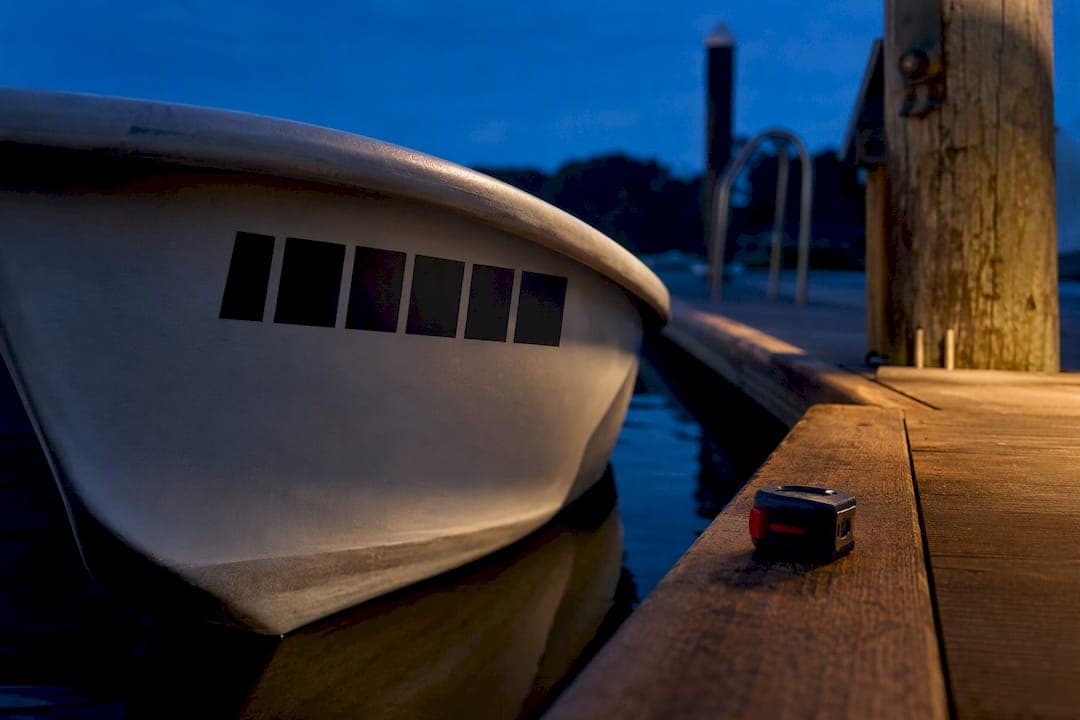
Most dinghies used as tenders still need state registration numbers unless they qualify for a narrow federal exemption, and getting compliant comes down to one move: copy the number exactly as it appears on your certificate of number and display it on both sides of the bow using the spacing, size, and lettering rules your state requires.
TL;DR:
- Scribbling the registration number exactly as on the certificate, including hyphens and suffixes, is critical to avoid citations.
- Most small tenders used solely for shuttle purposes qualify for exemptions, but usage outside this scope requires full registration.
- Displaying the number on both sides of the bow in block characters at least 3 inches tall, with proper spacing and contrast, is mandatory by law.
- State-specific rules, such as sticker placement and renewal timelines, often change; owners should verify current requirements directly with their agency.
- Vinyl decals built for saltwater and UV resistance are legal alternatives to paint for displaying registration numbers, provided they meet size and style standards.
Table of Contents
- What Are Dinghy Registration Numbers and Do You Need Them?
- Quick Compliance Checklist for Dinghy Owners
- How State Rules Build on the Federal Baseline
- Display Rules: Size, Font, Spacing, and Materials
- Dinghy and Tender Exceptions: What USCG Rules Actually Say
- How to Verify or Transfer a Dinghy Registration Number
- Choosing and Installing Decals That Meet Every State's Rules
- Compliance, Readability, and Longevity: What Actually Matters
- Get State-Compliant Dinghy Decals Without the Guesswork
- Sources
- FAQ
What Are Dinghy Registration Numbers and Do You Need Them?
The federal government sets the floor. States build the actual rule on top of it. Under 33 CFR Part 173, every numbered vessel gets a number issued through a certificate of number, and that number has to follow specific display and formatting rules no matter which state issued it.
Your dinghy registration number is not something you invent or guess at. It is assigned by your state's boating agency (or DMV, depending on the state) when you register the vessel, and it typically looks like a two-letter state prefix, a string of numerals, and sometimes a trailing letter pair, such as CF 1234 AB in California. Once assigned, that exact sequence, spaces, and hyphens included, is the only version that belongs on your hull.
Whether you actually need one depends on how the dinghy is used. A small tender used only to shuttle people and gear between a moored vessel and shore may fall under a tender exemption specified in 33 CFR Part 173. Outside that narrow use case, most states treat a dinghy with a motor, and often even an oar-powered one above a certain length, as a vessel that needs its own registration. The standard industry term for this whole process, "vessel numbering," covers what most owners casually call "boat registration" or "dinghy registration," and you will see both phrases used interchangeably by state agencies.
Quick Compliance Checklist for Dinghy Owners
Before you touch a decal or a paintbrush, run through this list. It catches the mistakes that cause the most citations at boat ramps and marina inspections.
- Confirm which state counts as your dinghy's state of principal operation, since that is the agency that issues your number, not necessarily where you bought the boat.
- Copy the number from your certificate of number character for character, including every hyphen, space, and suffix letter.
- Display the number on both sides of the forward half of the bow, reading left to right, in block characters that meet your state's minimum height (commonly 3 inches).
- Place the validation sticker within the distance your state specifies from the number, often within 6 inches, on both sides.
- Keep the physical certificate of number aboard the dinghy and ready to show, since Florida law and most other states require it be available for inspection.
- If you bought the dinghy secondhand, get the hull identification number (HIN) and a signed bill of sale or title before you ever put it in the water.
Pro Tip: Before ordering any decal, read your certificate number aloud letter by letter against what you type into an order form. A single dropped hyphen or transposed digit can fail an inspection even though the boat is technically registered.
Skipping any one of these steps is how registered boats still end up with citations. Officers checking registrations are not looking at whether you paid your fee. They are checking whether the number on your hull matches the number on file, in the exact format the state expects.
How State Rules Build on the Federal Baseline
Every state's numbering system has to conform to Part 174 of the federal regulations, which spells out what a certificate of number must contain, how validation stickers work, and when temporary certificates are allowed. States then layer their own specifics on top: exact minimum letter height, which side the sticker goes on, how long a temporary permit lasts before you need the full certificate.
The federal number format itself is simple in concept. A two-letter prefix identifies the issuing state, followed by a string of numerals, and in many states an ending letter suffix. States are permitted some flexibility in how many digits or letters they use, which is why a Florida number and a Texas number will not look identical even though both follow the same federal skeleton. This is also where the "dinghy numbering requirements" search phrase gets murky online. The requirements are not really about dinghies specifically. They are the same vessel numbering rules applied to any small boat, dinghy or not, that does not qualify for a tender exemption.
Representative state examples
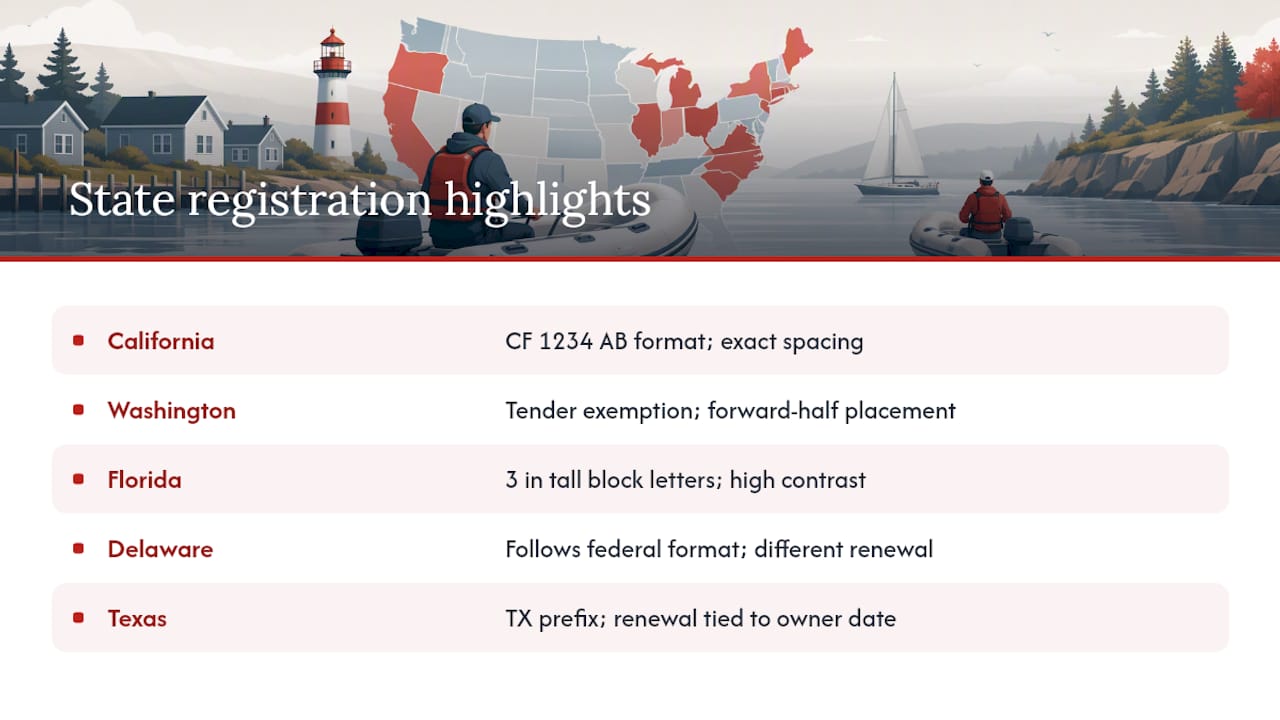
California. The California DMV explicitly requires dinghies to be registered, and issues numbers in the format CF 1234 AB. The DMV specifies exact spacing conventions, and enforcement checks tend to focus on whether the hyphen or space between number groups is wide enough to read as a break rather than running the digits together.
Washington. The Washington State Department of Licensing requires numbers and decals on the forward half of the vessel, but it also carves out a tender exemption for dinghies used exclusively to move people and gear between a parent vessel and shore, provided the motor and identification criteria are met. This is one of the clearer state-level examples of how the federal tender exception actually gets applied in practice.
Florida. Florida Statute 328.48 is unusually specific: numbers must appear on each side of the forward half of the vessel, stand at least 3 inches tall, use block characters, and contrast clearly against the hull color. The statute also requires that the certificate of number be small enough to carry in a pocket and be produced on demand.
Delaware. Delaware follows the federal numbering format closely but has its own renewal cycle and decal replacement schedule that differs from larger states. Owners moving a dinghy from another state into Delaware waters should check the Delaware-specific registration guidance before assuming their existing decals still comply.
Texas. Texas uses the standard TX prefix format and enforces the same forward-half bow placement most states use, but its validation sticker renewal cycle runs on a schedule tied to the owner's registration date rather than a fixed calendar year, which trips up owners used to states with flat annual deadlines.
A smaller state example. States with lower boat registration volume, such as several in New England, often publish simpler guidance pages with fewer visual examples, which makes it easy to assume the rules are looser. They are not. The format requirements are the same federal baseline; there are just fewer FAQ pages walking you through it.
How to find your state's exact rule
Search for your state name plus "boat registration" or "vessel numbering" and go directly to the state DMV or department of natural resources or licensing page, not a boat dealer's summary of it. Once there, check four things specifically: the exact prefix format and hyphen or space convention, the minimum letter height, where the validation sticker goes relative to the number, and whether a tender exemption exists and what qualifies for it. States update these pages more often than most owners realize, particularly sticker placement and renewal timelines, so a five-year-old forum post is not a reliable source.
Temporary certificates come up often for newly purchased dinghies. Most states allow you to operate for a limited window, frequently 30 to 60 days depending on the state, while your full certificate of number is processed, as long as you carry proof of application aboard. Part 174 authorizes this temporary certificate structure at the federal level, but each state sets its own exact window and paperwork requirements, so confirm the timeline with your issuing agency rather than assuming a national standard applies.
Display Rules: Size, Font, Spacing, and Materials
The baseline for every state's display rule traces back to 33 CFR 173.27, which governs how a number must appear on the vessel, and 174.23, which governs the form of the number itself. States adopt these provisions and then add their own specifics, but the core requirements repeat almost everywhere.
- Numbers must read left to right, painted or affixed on each side of the forward half of the vessel, most commonly the bow.
- Block characters are required. Script, italic, or decorative fonts do not meet the legibility standard most states enforce.
- Minimum height is commonly 3 inches, matching the standard Florida Statute 328.48 sets, though a handful of states allow slightly smaller sizes on very small craft.
- Color must contrast with the hull. A white number on a white hull, even if it is the right size, routinely fails inspection.
- Spaces or hyphens between the letter and number groupings must be as wide as a letter other than "I" or "1," which is a detail almost every owner gets wrong on a first attempt.
- Validation stickers typically must sit within 6 inches of the registration number, on both sides, matching the placement guidance BoatUS walks boaters through.
The insight most owners miss is that the hyphen or space requirement is not cosmetic. Part 174 specifically calls out that the width of that gap has to equal a character, because a crammed number can be misread by an officer or search-and-rescue team trying to identify a vessel quickly on the water. That is the actual purpose behind these seemingly picky spacing rules: fast, unambiguous identification.
Enforcement really does hinge on formatting, not just registration status. According to BoatUS, the most common compliance failures are not unregistered boats. They are registered boats with the wrong prefix copied, a missing hyphen, undersized lettering, or a validation sticker mounted too far from the number to satisfy proximity rules.
Decals versus painted numbers
Both are legal in every state that follows the federal display baseline, as long as the result meets the size, font, and contrast rules. Painted numbers last as long as the paint job holds up, which on a dinghy that gets dragged up beaches and stored on a trailer rack is often not very long. Marine-grade vinyl decals that carry UV and saltwater resistance tend to outlast paint in real-world conditions because they are engineered specifically to resist the fading and lifting that sun and salt spray cause over a season, a point Registrationdecals emphasizes in its material guidance.
If your hull has a busy pattern or low-contrast color, a backing plate under the decal set solves the contrast problem without repainting the boat. Check whether numbers belong on both sides of the boat if you are unsure, since some owners assume one side is enough for a small dinghy, and it never is.
Dinghy and Tender Exceptions: What USCG Rules Actually Say
"Dinghy" is not a legal category. It describes how a small boat is used, and whether it needs its own registration depends on propulsion, length, and whether it qualifies as a tender under federal rules, not on what you call it at the dock.
33 CFR 173.13 sets the tender exemption: a small boat used exclusively for direct transportation between a parent vessel and shore, or between the parent vessel and another location, can operate without its own separate registration in many states. The moment that same dinghy gets used independently, for fishing a cove on its own or running errands unrelated to shuttling people to the main boat, the exemption typically no longer applies, and the state can require full registration.

States are allowed to apply or expand this exemption differently. Washington's version, for instance, ties the exemption to specific motor and identification criteria rather than accepting "it's just my tender" at face value. That is why the same 8-foot inflatable with a small outboard might be exempt in one state and require registration in the state next door.
Here is where owners get confused about paperwork: the HIN and the certificate of number are not the same thing, and both matter for different reasons.
- The HIN is a permanent, unique identifier assigned to the hull at manufacture, similar in concept to a vehicle identification number on a car.
- The certificate of number is the state-issued registration proving the vessel is currently registered and displaying the correct number.
- A dinghy can have a valid HIN and still be unregistered if the owner never applied for a certificate of number.
- When buying a used dinghy, you need both: the HIN to confirm the boat's identity and manufacturing origin, and the certificate of number (or a clean transfer of the existing one) to confirm legal registration status.
For practical scenarios: an inflatable dinghy with a motor under 10 horsepower used strictly to reach a moored sailboat often qualifies for the tender exemption. The same inflatable used independently for weekend exploring typically needs its own registration. A trailer-transported dinghy that never touches water tied to a parent vessel usually still needs registration in its home state if it operates independently at all. If a tender is exempt but still carries a number for clarity, 173.27 still requires that number, if displayed, to meet the same formatting rules as a fully registered vessel, hyphen spacing and all. If you are weighing whether a kayak or canoe attached to a larger boat needs its own number, the same tender logic often applies, and state rules for nonmotorized small craft lay out the specifics.
How to Verify or Transfer a Dinghy Registration Number
There is no single nationwide database where you can type in a number and pull up ownership details. Verification runs through the issuing state's boating registration agency, and availability of an online lookup tool varies widely from state to state, with some offering instant search and others requiring a phone call or in-person request through law enforcement or DMV channels.
- Identify the issuing state from the two-letter prefix on the number, then go to that state's boating or DMV agency directly rather than a third-party site.
- Understand that a HIN check confirms the hull's manufacturing identity, while a registration lookup confirms whether a certificate of number is currently valid, and these are two separate processes handled differently depending on the state.
- Before completing any purchase or transfer, collect the certificate of number, a title or bill of sale, the HIN, proof of the seller's state of principal operation, and any transfer forms the new state requires.
- If a number looks altered, duplicated, or inconsistent with the paperwork, contact the issuing state agency and local law enforcement before completing the transaction.
Pro Tip: Ask the seller to text you a photo of the certificate of number next to the actual hull-mounted number before you drive out to see the boat. Mismatches show up immediately and save you a wasted trip.
Choosing and Installing Decals That Meet Every State's Rules
Getting the number right on paper is only half the job. The decal on the hull has to reproduce it exactly and survive months of sun, salt, and abrasion without turning into an unreadable smear by midsummer.
Marine-grade vinyl built for UV resistance and saltwater exposure holds color and adhesion far longer than standard signage vinyl or paint on a dinghy that spends its life half-submerged, beached, or bouncing on a trailer. That durability is not just about looks. A faded or peeling number is a compliance failure the same as a wrong prefix, because inspectors and rescue personnel need a number they can read from a distance.
Before ordering, run through this design checklist:
- Copy the certificate number exactly, prefix, hyphens or spaces, and any suffix, with zero abbreviation.
- Choose a color that contrasts clearly against your hull, and add a backing plate if your hull color is light, patterned, or low-contrast.
- Confirm the character height meets or exceeds your state's minimum, typically 3 inches, before finalizing the order.
- Double-check left-to-right orientation and spacing width against your state's specific formatting example if one is published.
Installation matters as much as the decal material itself. Clean the hull surface with isopropyl alcohol and let it dry fully. Work in a moderate temperature window, generally 50 to 90 degrees Fahrenheit, since vinyl applied in extreme heat or cold bonds poorly and can lift within weeks. Use painter's tape to set a straight, level guideline before peeling any backing paper, and apply the decal from center outward with firm, even pressure to push out air bubbles. Give the adhesive a full 24 hours before exposing the dinghy to water or heavy sun. Replace decals showing visible fading, edge lifting, or cracking, since a technically-present but unreadable number rarely satisfies an inspecting officer.
For a full walkthrough of surface prep and alignment, the installation guide covers the process step by step, and readers weighing local fabrication options can also check Custom Signs Today's vinyl decal resources for general material comparisons.
Compliance, Readability, and Longevity: What Actually Matters
Most guidance on dinghy registration treats the number itself as the finish line. It is not. A number that is technically correct but too small, too faded, or mounted with cramped spacing fails the same practical test as no number at all: nobody can read it fast enough for it to do its job.
That job is not paperwork. It is identification, during a routine check, and more urgently, during a search-and-rescue situation where a legible number on a drifting or capsized dinghy can be the difference between a quick recovery and a long search. The spacing and contrast rules that feel bureaucratic on paper exist because someone, somewhere, needed to read a number off a boat in bad light or rough water.
The mistakes that lead to citations are almost never about registration status. Owners register the boat, then get the number wrong on the hull: a missing hyphen, a font that is technically block-style but too thin to read, a sticker mounted an inch too far from the number. These are five-minute fixes that most owners never revisit because the decal looks fine from the dock.
Legibility fades faster than owners expect on a dinghy specifically, because dinghies get dragged onto beaches, stacked on trailers, and left exposed with none of the fitted covers a larger boat gets. Check your numbers each season, not just at renewal, and replace anything showing real fading or lifting before it becomes a problem at a boat ramp inspection.
— Taylor
Get State-Compliant Dinghy Decals Without the Guesswork
Copying a certificate number by hand onto a painted hull is where most compliance mistakes start. Registrationdecals built an online design tool that locks in your exact prefix, hyphen or space width, and suffix formatting as you enter it, so the layout you approve on screen is the layout that ships.
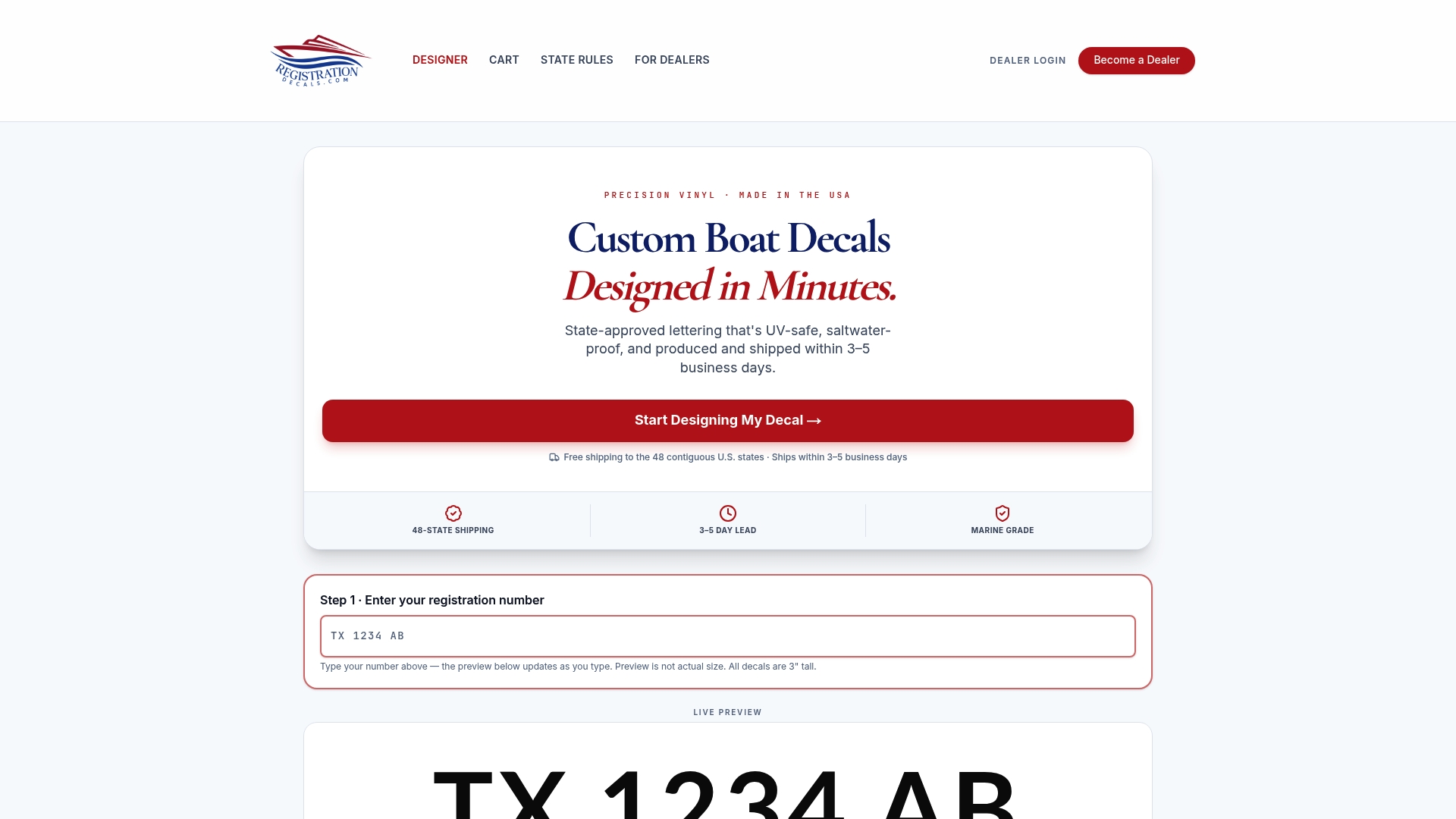
Every set is cut from marine-grade vinyl engineered to resist UV fading and saltwater breakdown, which matters more on a dinghy than almost any other boat type given how much sun and spray a tender takes on. Production runs 3 to 5 business days, with free shipping across the contiguous United States. If you are unsure how your numbers should look once installed, the placement and sizing answers page walks through the display rules by state, and the installation guide covers surface prep and alignment before you commit to a design. Start your order by entering your certificate number at Registrationdecals and confirm your layout before it goes into production.
Sources
The rules covered here trace back to federal regulation and a handful of state statutes that update periodically, so it is worth checking primary sources directly rather than relying on secondhand summaries. 33 CFR Part 173 governs vessel numbering, display, and tender exemptions at the federal level. Part 174 covers how states must structure their numbering systems, certificate contents, and validation stickers.
For state-specific detail, go directly to your state's DMV or boating agency page, such as the California DMV's vessel registration page, Washington's Department of Licensing boat registration guidance, or Florida Statute 328.48. The BoatUS Foundation's registration requirements guide offers practical, boater-facing summaries that translate the statutory language into plain display and placement guidance. Because states revise sticker placement and renewal timelines more often than most owners expect, recheck your issuing state's current page before ordering decals or renewing a certificate.
- eCFR :: 33 CFR Part 173 -- Vessel Numbering and Casualty and Accident Reporting
- PART 174—STATE NUMBERING AND CASUALTY REPORTING SYSTEMS (CFR PDF)
- Registration Requirements - BoatUS Foundation
- Boat/Vessel Registration - California DMV
- Chapter 328 Section 48 - 2026 Florida Statutes - The Florida Senate
FAQ
Where can I find registration numbers for inflatable dinghies?
Your assigned number appears on the certificate of number your state's boating agency issued when you registered the dinghy. If you cannot locate that paperwork, contact the issuing state's boating registration office directly, since there is no single nationwide public database for looking up assigned numbers.
Can you look up a boat's registration number online?
Some states offer an online lookup tool, but availability varies widely, and many require a phone call or in-person request through the DMV or a boating agency instead. A HIN check, which confirms the hull's manufacturing identity, is a separate process from confirming whether a certificate of number is currently valid.
What state has the most registered boats?
Registration volume varies significantly by state and shifts year to year, and no single figure in current federal or state data confirms one fixed leader. Larger coastal and lake-heavy states like Florida, California, and Texas consistently rank among the highest-volume states for recreational boat registration.
Why do some boats not have registration numbers displayed?
Some small craft qualify for a tender exemption under 33 CFR 173.13 when used exclusively to shuttle people or gear between a parent vessel and shore. Others may simply be out of compliance, which is a citable offense in nearly every state once a boat no longer meets an exemption's specific criteria.
Does a dinghy need its own registration if it stays attached to a larger boat?
It depends on how the dinghy is used, not whether it stays attached. If it is used strictly as a tender between the parent vessel and shore, it may qualify for an exemption; if it is used independently for any other purpose, most states require separate registration.
Are vinyl decals legally acceptable instead of painted numbers?
Yes, in every state that follows the federal display baseline, as long as the decal meets the required size, block lettering, and color contrast rules. Marine-grade vinyl decals, like those available through Registrationdecals, are widely used because they hold up to UV exposure and saltwater better than paint on a dinghy's hull.