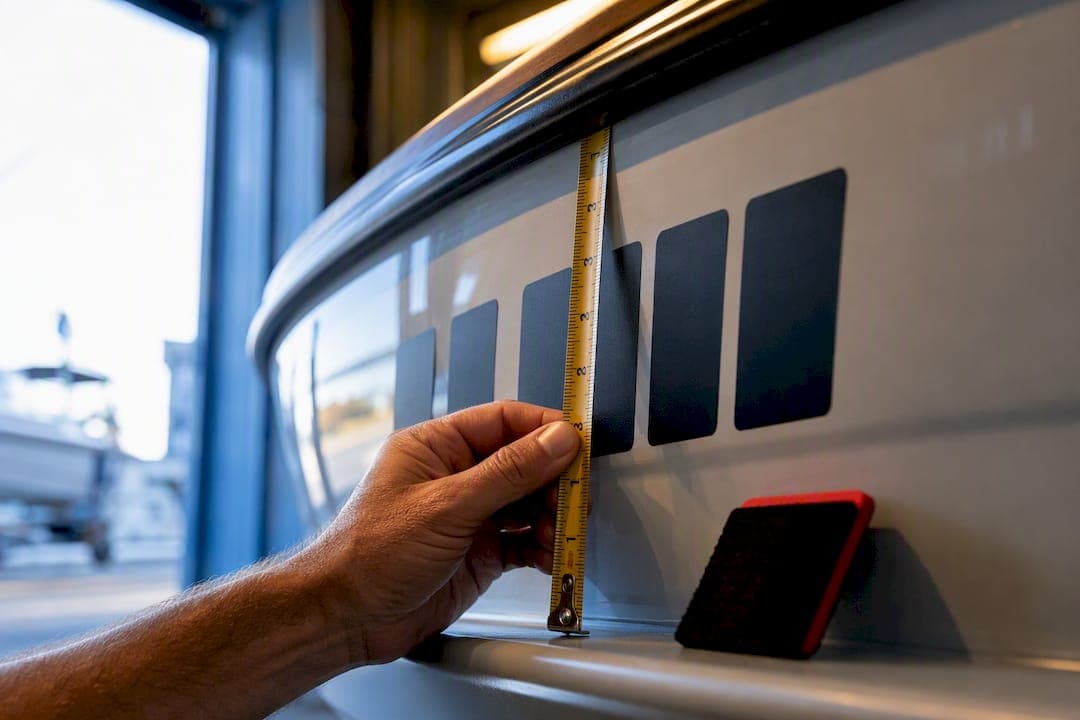
The federal minimum for boat registration lettering is 3-inch plain block characters, and that number governs almost every state program in the country. Numbers go on both sides of the vessel in the forward half, read left to right, and need enough contrast to be legible from a distance. Before you order or install anything, confirm three things: your characters measure at least 3 inches after application, they contrast clearly against the hull color, and your validation sticker sits within 6 inches of the registration number.
TL;DR:
- The federal minimum character height for boat registration numbers is 3 inches, but actual measurements must be taken on the installed decal after application.
- Registration numbers must be placed on both sides of the vessel's forward half, read left to right, with a space or hyphen width between sections, and the validation sticker within six inches of the numbers.
- Legible, high-contrast plain block letters are required, and patterned or dark hulls often need larger numbers and a solid background to ensure visibility.
- Most states adopt the federal 3-inch rule verbatim but may have specific placement or decal format details; owners should verify their state's requirements before ordering.
- Using UV and saltwater-resistant vinyl and pre-assembling decal sheets on a flat surface improves compliance and durability, preventing common errors like sizing or contrast issues.
Table of Contents
- Documented Vessel Lettering Size and the Federal Baseline
- Where Numbers Go and How Far Apart They Should Be
- What Font and Color Choices Actually Pass Inspection
- Do State Rules Ever Differ From the Federal Minimum?
- How to Measure, Apply, and Confirm Your Decals Are Compliant
- What Years of Decal Orders Teach You About Getting It Right
- Order Decals Built to Pass Inspection the First Time
- Sources
- FAQ
Documented Vessel Lettering Size and the Federal Baseline
Every state boat registration program in the country traces back to one federal rule. 33 C.F.R. § 173.27 sets the floor: plain block characters, minimum 3 inches in height, read left to right. That single measurement, 3 inches, is the number most boat owners search for, and it's the one number that almost never changes from state to state.
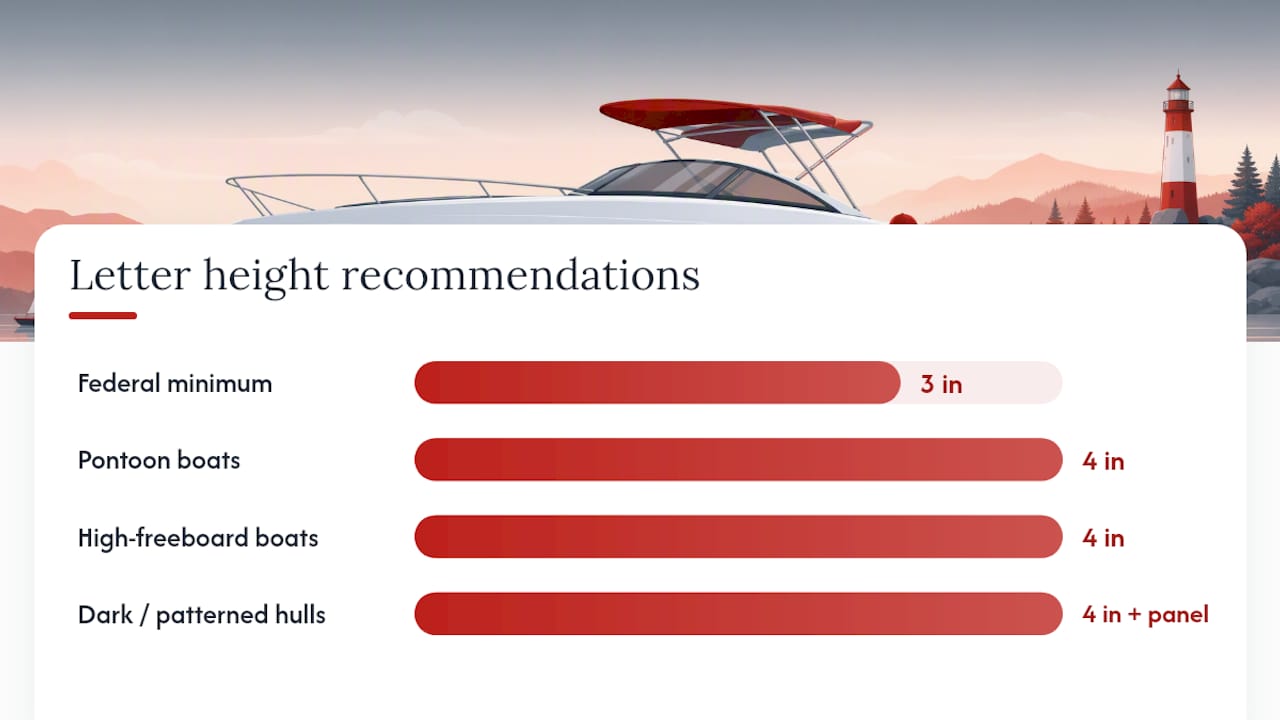
Here's where people get tripped up. The 3-inch minimum applies to the character as it appears on the hull, not the size printed on the sheet before you peel the backing off. Vinyl can shift slightly during application, and curved hulls sometimes distort a letter's apparent height. Measure vertically, base to top, on the boat itself, after the decal is set. Don't trust the spec sheet alone.
Larger sizing makes sense in a few common situations:
- Pontoon boats with high, flat sides often look better and read easier with characters closer to 4 inches, even though 3 inches remains the legal floor.
- High-freeboard boats, like some center consoles and offshore boats, benefit from bigger numbers simply because the registration area sits farther from the water and from other boaters' sightlines.
- Dark or heavily patterned hulls sometimes need a slightly larger character paired with a blockout panel to stay legible at a distance.
Inspectors most often flag two measurement mistakes: characters that shrank slightly during a rushed application, and owners who measured the digital file dimensions instead of the installed decal. Registrationdecals' guide to registration number height breaks downsizing by boat type if you want a deeper look before ordering.
Where Numbers Go and How Far Apart They Should Be
Placement and spacing trip up more boat owners than height ever does, mostly because the rules sound simple until you're standing at the hull with a tape measure.
- Mount on the forward half of the hull, on both sides. Federal guidance and most state rules require registration numbers on the forward half of the vessel, not the transom, so they're visible to another boat approaching from either side.
- Orient them to read left to right. Someone standing beside the bow, facing the boat, should be able to read the number normally, not upside down or reversed.
- Leave a gap equal to one character width, or use a hyphen or space, between the letter prefix, the numerals, and the letter suffix. The federal spacing rule carves out one exception: you don't need extra space around the letter "I" or the number "1," since their narrow shape already reads cleanly next to a hyphen.
- Place the validation sticker within 6 inches of the registration number. Some states want it placed after the last digit; others prefer it before the prefix. Check your state's specific instructions rather than assuming.
Pro Tip: Lay your decal set out on a flat surface exactly as it will appear on the hull before you peel a single backing sheet. It's the fastest way to catch a spacing or orientation mistake while it still costs you nothing to fix.
For a closer look at exactly how much room to leave, Registrationdecals' spacing breakdown walks through real examples, and the validation sticker placement guide covers state-by-state sticker positioning.
What Font and Color Choices Actually Pass Inspection
Inspectors care less about which specific typeface you pick and more about whether the number is instantly readable from a normal viewing distance. That's a low bar, but a surprising number of custom decal orders miss it.
Stick to plain block letters, vertical and sans-serif, with no slant, no script flourish, no drop shadow, and no outlined "hollow" style. Industry guidance on lettering standards is consistent on this point: decorative fonts are one of the most common reasons decals fail inspection, even when the height and spacing are otherwise correct.
Contrast matters as much as font choice:
- Dark numbers on a light hull, or light numbers on a dark hull, are both fine as long as the contrast is strong.
- Patterned, multicolor, or metallic-flake hulls need a solid blockout panel behind the numbers, since the registration digits can disappear into a busy background otherwise.
- A quick legibility test works well here: stand back roughly the length of a car and see if you can read the number without squinting. If you can't, an inspector on the water won't be able to either.
Registrationdecals' guide to registration number color rules covers blockout options in more depth if your hull isn't a simple solid color.
Do State Rules Ever Differ From the Federal Minimum?
Most states adopt the federal 3-inch baseline word for word and then layer on their own placement or documentation details. That's the part people miss. The height rarely changes, but the paperwork trail and a handful of placement specifics can.
Wisconsin's administrative code, for instance, spells out its own phrasing on decal display that mirrors the federal rule closely but adds state-specific clarifications on numbering format. South Carolina's code includes placement instructions for special cases, like decals on an outboard motor cowling, that go beyond what the federal rule addresses directly. Neither state lowers the 3-inch floor. Both add detail the federal rule leaves open.
Before you order a set of decals, run through this four-step check:
- Find your state's boating agency page and locate the section covering registration number display.
- Capture the exact citation number, not just a paraphrase from a forum or a dealer's flyer.
- Save a screenshot or PDF of that page, dated, in case the page changes or you need it for a dealership record.
- Note any placement quirks, like transom exceptions for certain hull types or specific sticker order requirements.
Registrationdecals maintains a state-by-state regulation reference that's a faster starting point than searching each agency site individually.
How to Measure, Apply, and Confirm Your Decals Are Compliant
- Build a paper template at the exact character height and spacing you plan to order, then tape it to the hull where the decal will go.
- Step back and check placement against the forward-half and both-sides rules before committing to adhesive.
- Apply the actual decal, then measure one character vertically, base to top, once it's fully set on the hull.
- Photograph both sides of the boat with the numbers visible, both for your records and in case a dealership or marina needs proof of compliance.
- Place the validation sticker within 6 inches of the number and confirm it's visible from a normal approach angle.
Pro Tip: Keep the photos from step four in your phone's cloud backup. If a marina or inspector ever questions your registration display, having dated proof of correct application saves an argument on the dock.
If your paper template doesn't match what your state agency describes, call the agency directly. If the question is about vinyl sizing, spacing, or blockout options instead, that's a question for your decal maker. Registrationdecals' installation walkthrough covers the application process step by step.
What Years of Decal Orders Teach You About Getting It Right
Most compliance failures Registrationdecals sees aren't about owners ignoring the rules. They're measurement errors, weak contrast on a tricky hull color, or a validation sticker placed a few inches outside where the state wants it.
Marine-grade vinyl matters more than people expect here, and not just for looks. UV and saltwater exposure degrade cheaper vinyl fast, and a faded or peeling number can fail an inspection just as easily as a wrong-sized one. Choosing UV-safe, saltwater-resistant material up front cuts down on reorders considerably.
If you're ordering decals, hand your vendor the exact state citation and a photo of your hull. A blockout recommendation for a patterned hull, or a size adjustment for a pontoon's flat panel, is much easier to get right the first time when the vendor can see what they're working with. Registrationdecals' blog post on the 3-inch rule goes deeper into inspection-pass strategies if you want more detail before ordering.
— Taylor
Order Decals Built to Pass Inspection the First Time
Registrationdecals cuts every set from marine-grade vinyl rated for UV exposure and saltwater, so the decal that passes inspection today still looks sharp two seasons from now instead of chalking or peeling at the edges. The online design tool lets you enter your registration number, pick colors and fonts, and preview the exact layout before you pay, with production running 3 to 5 business days and free shipping anywhere in the contiguous United States.
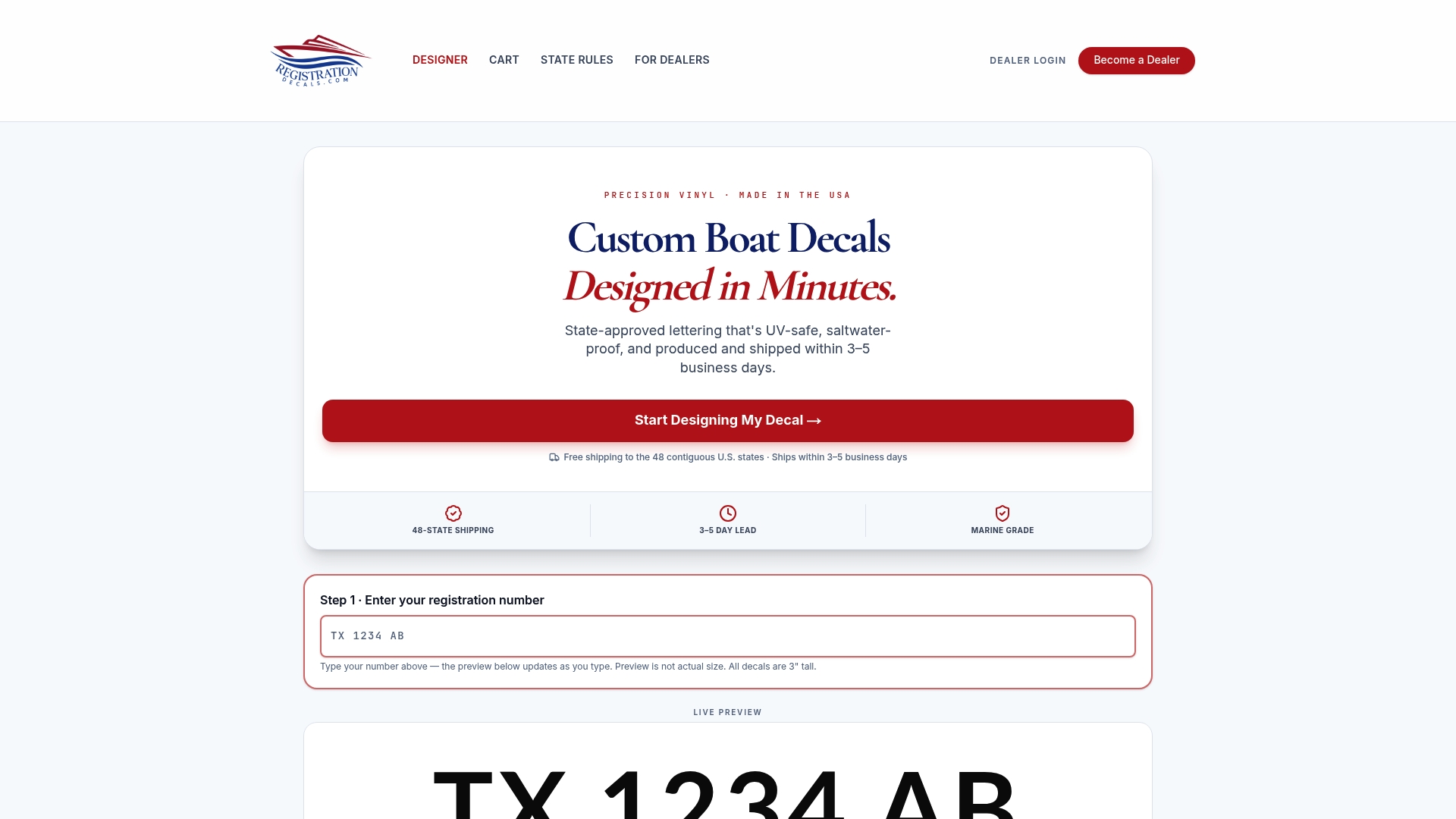
When you place an order, include four things: your state, your registration number exactly as issued, a photo of your hull, and your preferred color or blockout style if your boat has a pattern or metallic finish. That's usually enough for the design tool to flag any sizing or contrast issue before production starts. Custom Boat Registration Numbers & Decals start at $35.99 per set, and dedicated product lines exist for pontoon boats, jet skis, bass boats, and aluminum hulls if your vessel needs size or shape adjustments beyond a standard set. Head to the main ordering page to build your set now.
Sources
FAQ
What is the minimum lettering size for boat registration decals?
Federal regulation sets the floor at 3-inch plain block characters, and most states adopt that number directly. Measure the applied decal vertically, base to top, rather than relying on the digital file's listed dimensions, since federal law governs the installed height.
Do registration numbers need to go on both sides of the boat?
Yes. Numbers belong on both sides of the vessel, on the forward half, oriented to read left to right for anyone approaching the boat. Registrationdecals covers this in more detail in its both-sides placement guide.
How much space goes between the letters and numbers?
Leave a gap equal to one character width, or use a hyphen or space, between the letter prefix, the numerals, and the letter suffix. The letter "I" and the number "1" are exempt from that spacing rule under federal guidance.
Where does the validation sticker go?
Place the validation sticker within 6 inches of the registration number, though whether it goes before or after the number varies by state. Check your state boating agency's page for the exact order it expects.
What is the cost of a compliant decal set from Registrationdecals?
Custom Boat Registration Numbers & Decals from Registrationdecals cost $35.99 per set, made from marine-grade UV and saltwater-resistant vinyl. Production takes 3 to 5 business days, with free shipping across the contiguous United States.
Can decorative fonts or scripts be used for registration numbers?
No. Inspectors expect plain block, vertical, sans-serif characters, and industry guidance lists decorative, italic, or outlined fonts as a common cause of failed inspections. Stick to a simple block style for the best chance of passing on the first look.