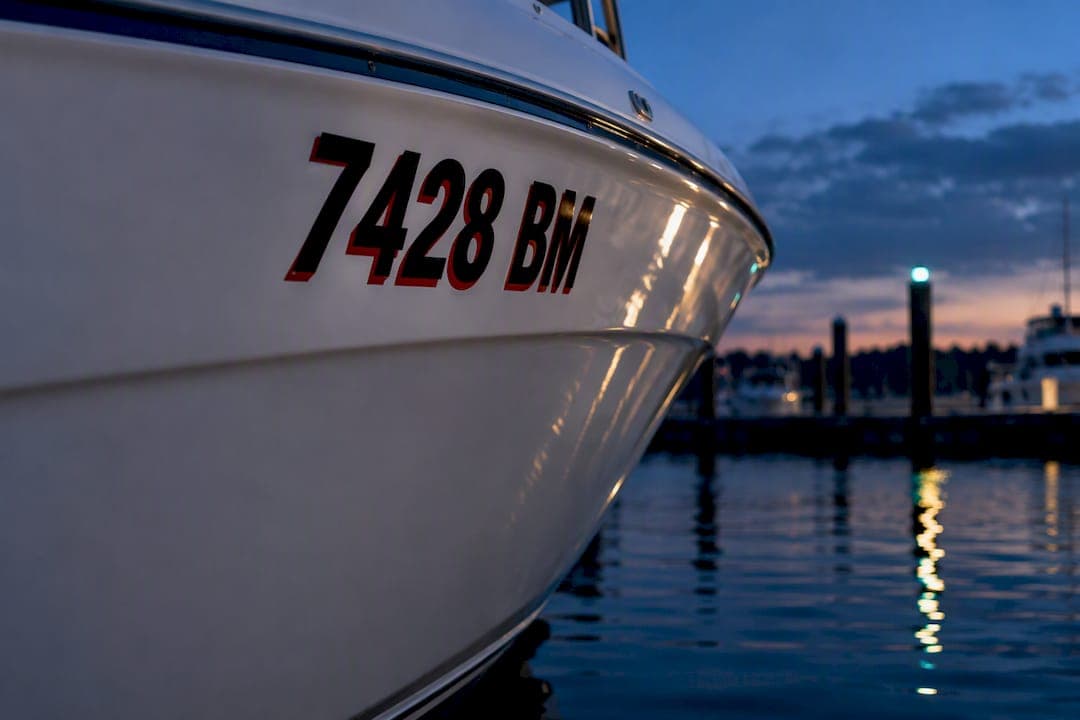
Yes, drop shadow registration numbers can be legal, but only when the primary characters stay plain vertical block letters that meet the size, contrast, and placement rules your state and federal law set. The shadow itself is decoration, not the registration mark. The compliance test is simple: a boating officer must be able to read your assigned number at a glance, and the validation decal must sit where the rules say it belongs.
TL;DR:
- Drop shadows are only legal if they do not obscure or weaken the primary block letters, which must be at least three inches high and clearly contrast with the hull.
- Federal regulations require registration numbers to be plain, left-to-right, and without decorative slant or rotation, with specific size, spacing, and placement rules.
- States like Pennsylvania and Illinois specify "solid" and "block" characters, emphasizing contrast and strict placement, with no allowance for shadows that soften or interrupt letter shapes.
- For compliance, shadows should be narrow, crisp, and secondary in color, avoiding soft, blurred, or multiple outline effects that can mimic additional characters.
- If numbers fail inspection, owners should promptly replace decals, keep records of corrections, and verify that shadow height, contrast, and placement conform to federal and state standards.
Table of Contents
- Federal rules set the baseline for size, style, and placement
- How Pennsylvania and Illinois write the same rule differently
- A checklist for designing shadowed numbers that still pass inspection
- Which drop shadow styles pass and which ones don't
- What happens if your numbers fail inspection
- What years of decal work taught me about compliance
- Order boat numbers built to pass inspection the first time
- Where to verify the rules for your own boat
- Sources
- FAQ
Federal rules set the baseline for size, style, and placement
Before you add any decorative touch, your numbers need to clear a federal floor. 33 CFR §173.27 requires registration numbers to appear in plain vertical block characters, at least 3 inches high, contrasting with the boat's background color, and read left to right. Spacing matters too: a hyphen or equivalent space separates the letter and number groupings, and the whole sequence needs to be permanently attached or mounted on a backing plate if the hull surface makes direct application impractical.
This is separate from your hull identification number. Federal HIN rules under 33 CFR part 181 govern a permanent, factory-assigned identifier that cannot substitute for your visible registration numbers or decals. They serve different purposes and live in different places on the boat.
Put together, the federal standard boils down to a short list:
- Characters at least three inches high, measured on the letter stroke itself.
- Plain vertical block style with strong contrast against the hull.
- Numbers read left to right without decorative rotation or slant.
- Proper spacing between the letter and number sequences.
- Permanent or securely backed attachment to the hull.
A drop shadow only survives scrutiny if it sits outside this baseline rather than replacing any part of it.
How Pennsylvania and Illinois write the same rule differently
States enforce the federal baseline with their own wording, and two examples show the pattern clearly. Under 58 Pa. Code §93.5, Pennsylvania requires "solid vertical block characters" at least three inches high, displayed above the waterline on both sides of the bow, with the validation decal placed within 6 inches of the number and on the same level. The code also bars other numbers from appearing on the bow, which matters if a decorative element could be mistaken for an additional character. The Pennsylvania boat registration handbook breaks this down further for owners registering a boat locally.
Illinois takes a similar approach. Its administrative rules call for block characters at least 3 inches high, contrasting with the background, placed on each side of the forward half of the boat, and read left to right. State guidance also shows the validation decal placed after a space at the end of the number sequence, a detail worth checking against your own installation.

Neither state names "drop shadow" or bans it outright. Instead, both lean on words like "solid" and "block," which puts the burden on the owner to keep the shadow from softening or interrupting the primary character shape. Illinois owners can check placement specifics through Illinois-specific decal requirements before finalizing a design.
A checklist for designing shadowed numbers that still pass inspection
Getting the decorative element right takes more guesswork out of the process than most owners expect. Work through this order before you commit to a design:
- Measure character height using the solid stroke, not the outer edge of any shadow, and confirm it clears 3 inches.
- Run a daylight contrast test: photograph the installed or mocked-up numbers from 15 to 20 feet and check that they read instantly.
- Keep shadow offset small and the shadow color clearly secondary, either noticeably darker or lighter than the main character, never a similar mid-tone.
- Confirm placement on both sides of the forward half of the hull, read left to right, matching the placement rule for both sides.
- Set the validation decal within 6 inches of the number and on the same level, with no extra numerals anywhere on the bow.
- Build a print-to-scale template or mockup against your actual hull color before ordering final decals, and photograph the result for your own records.
Pro Tip: Test your design against your hull color in direct sunlight, not on a screen; monitor contrast rarely matches how vinyl reads on gelcoat or aluminum. Reviewing block-letter sizing standards alongside your mockup helps confirm the core character shape hasn't shifted.
Which drop shadow styles pass and which ones don't
The difference between a compliant shadow and a citation usually comes down to sharpness and contrast, not the presence of a shadow itself.
- Do use a narrow, crisp shadow with a small offset that adds edge definition rather than blurring it.
- Do pick a shadow color that reads as clearly secondary, never close in tone to the main character.
- Don't use soft or blurred shadow effects that erode the stroke boundary of the letter or number.
- Don't stack multiple outlines or glow effects that can look like a second character from a distance.
- When a design falls in between, default to a plain block style or check with your state boating agency before ordering.
Document any borderline design decision with a photo and your measurements. If an officer or inspector ever questions the installation, having that record on hand speeds up the conversation considerably.
What happens if your numbers fail inspection
Officers generally use a quick-read test: can they identify your registration number at a glance from a normal approach angle, without squinting or guessing at a blurred edge? Common failures include characters under 3 inches, weak contrast against the hull color, soft or heavily blurred styling, an apparent extra numeral created by a shadow or outline, and validation decals placed outside the 6 inch, same-level rule.
If you're cited or notified of a violation, replace or reapply compliant decals as soon as possible, contact your state's boating authority for the specific remediation steps they require, and keep photos and receipts showing the correction. That documentation matters if the citation involves a follow-up inspection.

What years of decal work taught me about compliance
Reviewing boat number designs for a living teaches you fast that owners rarely get cited for wanting style. They get cited for shadows that blur the stroke or decals placed a few inches off. Every order runs through marine-grade vinyl and a design tool built around the size and contrast rules covered above, with production turned around in 3 to 5 business days. When a design falls into a gray area, the safer move is always a plain block character or a compliance preview before you commit to vinyl.
— Taylor
Order boat numbers built to pass inspection the first time
RegistrationDecals.com produces state-compliant registration decals from marine-grade, UV-resistant, saltwater-proof vinyl, with an online design tool that lets you set your registration number, choose colors, and preview the layout before you order.
The tool controls character height and contrast directly, so a decorative shadow you choose stays secondary to the plain block numbers underneath rather than fighting with them. That measured approach carries through to category-specific options:
- Browse Custom Boat Registration Numbers & Decals for the standard 35.99 USD set with free shipping across the contiguous United States.
- Check Pontoon Numbers or Aluminum Boat Numbers if your hull shape affects placement or contrast choices.
Order your decals with your exact registration number and preview the layout before it ships.
Where to verify the rules for your own boat
For the federal baseline, read 33 CFR §173.27 on display, size, and color, and 33 CFR part 181 on hull identification numbers. For state-level phrasing, 58 Pa. Code §93.5 and the Illinois administrative rules show how "solid" and "block" get enforced in practice. Before working on your hull surface, a quick hull cleaning routine helps vinyl adhere properly.
Sources
- 33 CFR part 173 — Numbers: display, size, color (current)
- 58 Pa. Code § 93.5. Display of registration number and validation decal
- Illinois administrative code — boat numbering/display rules
FAQ
What numbers must be displayed on a boat?
A boat must display its state-assigned registration number in plain vertical block characters at least 3 inches high on both sides of the forward half of the hull, according to federal display rules. The validation decal showing the registration's expiration also has to sit near the number, typically within 6 inches and on the same level.
What happens if my boat doesn't have a hull identification number?
A missing or invalid hull identification number is a separate problem from your visible registration numbers, since the HIN is a permanent identifier governed by federal HIN rules. Contact your state titling or boating agency directly, since remedies vary by manufacture date and vessel history.
What are the requirements for boat numbers in Pennsylvania?
Pennsylvania requires "solid vertical block characters" at least three inches high, displayed above the waterline on both sides of the bow, under 58 Pa. Code §93.5. The validation decal must be placed within 6 inches of the number and on the same level, with no other numbers allowed on the bow.
What are the requirements for boat numbers in Illinois?
Illinois requires block characters at least 3 inches high that contrast with the hull background, placed on each side of the forward half of the boat and read left to right, per Illinois administrative rules. The state handbook also shows the validation decal placed after a space at the end of the number sequence.
Do boat numbers need drop shadows to be legible?
No, a drop shadow is never required for compliance and a plain block character alone satisfies every federal and state display rule covered here. A shadow is purely decorative, and it only remains legal when it doesn't reduce contrast or blur the primary character shape.