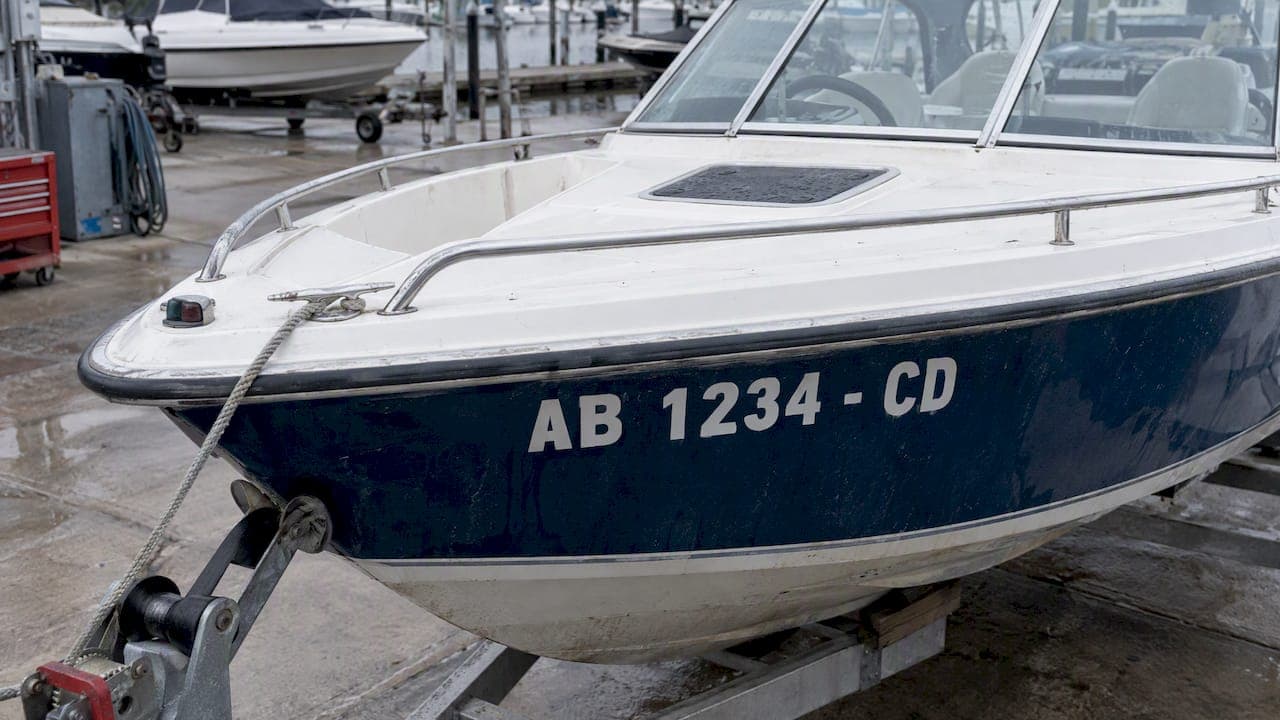
Yes, the groups in a boat registration number have to be separated, but you can use either a hyphen or a blank space. Under 33 CFR 173.27, the number is split into a prefix, a numeral group and a suffix, and the gap between them must be as wide as a letter (except "I") or a numeral (except "1"). So DC-5678-EF and DC 5678 EF are both legal. DC5678EF is not, and neither is a hyphen so tiny it disappears from 50 feet away.
This guide covers what that gap should look like, how to measure it, where state prefixes trip people up, and what to check before you put a decal on your hull.
TL;DR
- A hyphen or a space is allowed between the prefix, numerals and suffix. Both satisfy the federal rule.
- The separator must be about as wide as a letter (not "I") or a numeral (not "1"). A narrow dash or a single typed space is the most common mistake.
- Use your state's boating prefix, which is not always the postal abbreviation. Michigan boats use MC, California boats use CF.
- Characters must be at least 3 inches tall, plain block style, and in a color that contrasts with the hull.
- If you order decals, give the exact registration number from your certificate and check the preview before you pay.
Table of Contents
- What the federal rule actually says
- Hyphen or space: which one should you choose?
- How wide the gap has to be
- Use your state's prefix, not the postal code
- Other display rules that sit next to the hyphen
- Five mistakes we see with hyphens and spacing
- Our view: why the separator is worth getting exactly right
- Order a set with the spacing done for you
- FAQ
- Sources
What the federal rule actually says
Every state follows the federal baseline in 33 CFR 173.27. The regulation requires that your number be painted on or permanently attached to each side of the forward half of the vessel. It must be in plain vertical block characters, at least 3 inches high, in a single solid color that contrasts with the hull. Outlined, shadowed or script styles are not allowed, and the number reads left to right.
A registration number has three parts:
- Prefix: two letters identifying the state.
- Numerals: a group of digits, up to four in many states.
- Suffix: two letters.
The parts must be divided by a hyphen or an equivalent space. The federal example reads DC-5678-EF. State agencies repeat the same rule in their own words. The Washington State Department of Licensing says the numbers and letters need a hyphen or equivalent space between the three segments and must be at least 3 inches high.
Notice what the rule does not say. It does not say you must use a hyphen, and it does not say you must use a space. The choice is yours, as long as the three groups read as three groups.
Hyphen or space: which one should you choose?
Both are compliant, so the decision is practical.
| Hyphen | Blank space | |
|---|---|---|
| Legal under federal rule | Yes | Yes |
| Easy to read from a distance | Very. It marks the break clearly | Good, if the gap is wide enough |
| Risk of being too narrow | Low if sized like a character | High. Gaps tend to shrink when numbers are applied by hand |
| Looks like | TX-1234-AB | TX 1234 AB |
| Best for | Most owners, and anyone who wants an obvious, inspection-proof gap | Boats with a clean, modern look and enough bow space |
We lean toward the hyphen for most boats. A space depends entirely on the installer's accuracy. When you apply separate groups by hand, it is easy to leave a gap that looks fine up close but fails the width test. A hyphen gives an officer something visible to point to.
If you apply one-piece decals with the spacing built in, a space works equally well, because the spacing is fixed at the factory and cannot drift.
How wide the gap has to be
The rule is proportional. The separator must equal the width of a letter other than "I" or a numeral other than "1". Those two characters are narrow, so they are excluded as a yardstick.
A worked example: say your characters are 3 inches tall in a standard block font. A capital "B" or a "4" in that style is typically a little over 2 inches wide. That means the gap between TX and 1234, and between 1234 and AB, should be roughly that wide, whether it is blank or holds a hyphen. A hyphen drawn with a thin 1-inch dash and tiny margins on each side is likely to fall short.
The quickest way to check yourself:
- Pick a wide character in your number, such as an "M", "B", "4" or "8".
- Measure its width.
- Measure the total gap from the last character of one group to the first character of the next.
- If the gap is clearly narrower than that character, widen it.
This matters in practice. Many boaters assume any dash or space is enough, and an enforcement officer can require a re-application when the gap is visibly too small. We cover the measuring question in more detail in our answer on how much space goes between boat registration numbers.
Use your state's prefix, not the postal code
This is the second most common error, and it has nothing to do with the hyphen. The two-letter prefix on a boat is not always the same as the one you use for mail.
The Coast Guard's numbering system dates to the Federal Boating Act of 1958, and the postal service introduced its own two-letter codes in 1963. The two systems were never merged. According to Murray Yacht Sales, 11 states use a vessel prefix that differs from the postal abbreviation:
| State | Boat prefix | Postal code |
|---|---|---|
| California | CF | CA |
| Colorado | CL | CO |
| Delaware | DL | DE |
| Hawaii | HA | HI |
| Kansas | KA | KS |
| Massachusetts | MS | MA |
| Michigan | MC | MI |
| Mississippi | MI | MS |
| Nebraska | NB | NE |
| Washington | WN | WA |
| Wisconsin | WS | WI |
Mississippi is the trap in this list. Its boat prefix, MI, is Michigan's postal code, while Michigan boats carry MC. Washington's own agency page shows a sample of the correct format with the WN prefix, in the form WN-3717-ZW.
The safest approach is simple: copy the number exactly as it appears on your registration certificate. Do not type it from memory, and do not substitute the postal abbreviation.
Other display rules that sit next to the hyphen
Getting the separator right is only part of passing an inspection. Check these at the same time.
Height, font and color
The federal minimum is 3 inches, in plain block characters. Choose a color that contrasts strongly with the hull: dark numbers on a light hull, light numbers on a dark one. If you are unsure whether your size works, our boat number design guide walks through checking the 3-inch height, and the answer on required fonts explains which styles are out.
Placement
The number goes on each side of the forward half of the vessel. Read more on where registration numbers go and whether they go on both sides. No other numbers should sit near them. States such as Washington and Colorado specifically prohibit other numbers on either side of the bow, and our page on other numbers on the bow explains what is and is not acceptable.
The validation decal
Your current validation (expiry) decal goes on both sides of the bow, in line with the number. Distances vary by state. Under Texas Parks and Wildlife rules, for example, its position is measured from the number, and only one current decal may be displayed at a time. Alabama's rule, as summarized in the research we reviewed, is within 6 inches. Always confirm with your own state agency. See also where the validation sticker goes.
Can the number be a vinyl decal?
Yes, the federal rule allows a number that is painted on or permanently attached. Marine-grade vinyl qualifies when it is applied properly. Details are in our answer on vinyl decals instead of paint.
Five mistakes we see with hyphens and spacing
- No separator at all. Running the groups together as
FL1234ABfails the three-part rule. - A gap that is too narrow. A single typed space in a design tool often looks small once scaled. Check it against the width of a wide character.
- Using the postal prefix. CA instead of CF, or MI for a Michigan boat.
- Adding extra marks. Periods, slashes or decorative dividers are not part of the standard format. Stay with a hyphen or a space.
- Reusing worn decals on a used boat. A registration number normally stays with the vessel unless it is destroyed, abandoned or moved to a new state of principal operation, so you usually keep the existing number. Alabama's boat registration code is one example of the framework behind this. Peeling or incorrect old decals should be replaced with a fresh set matching that number. Your state agency has the final word on your situation.
Our view: why the separator is worth getting exactly right
We make registration decals for a living, so we see what goes wrong before a boat ever gets to the water. Most failed layouts are not exotic. They are a correct number with a gap that is too tight, or the wrong prefix typed from habit.
That is why our design tool works the way it does. You enter your registration number, choose a color and a font, and see the result before you order. The point of the preview is the thing you are checking now: three clearly separated groups, at a readable size, in a contrasting color.

We also think material matters more than most owners expect. A number that fades or cracks in a season is a number that someone will eventually tell you to replace. Our decals are produced in-house from marine-grade vinyl chosen for UV and saltwater resistance. If you want the reasoning, see our guides on the best vinyl for boats and how long marine vinyl decals last.
Our rule of thumb: if you are choosing between a hyphen and a space and cannot decide, take the hyphen. It is harder to get wrong.
— Taylor
Order a set with the spacing done for you
If you would rather not measure gaps with a tape, our custom boat registration numbers and decals are $35.99 per set. You enter your number, pick the hyphen or space layout, color and font, and we produce the set in 3 to 5 business days. Shipping is free in the contiguous United States.
We also have pages built for specific hulls: pontoon, center console, bass boat, aluminum boat and jet ski numbers. Marinas and dealerships can order in bulk. When the decals arrive, our installation guide takes you through the application step by step.
FAQ
Do boat registration numbers have to have a hyphen?
No. The federal rule allows a hyphen or an equivalent space between the prefix, the numerals and the suffix. What it does not allow is running the groups together. Either choice is legal when the gap is wide enough.
How wide should the hyphen or space be?
It should equal the width of a letter other than "I" or a numeral other than "1". In practice, that means roughly the width of a typical character in your number. A thin dash with little room around it is the usual failure.
Should I use the state's postal abbreviation as the prefix?
Not necessarily. Eleven states use a boat prefix that differs from the postal code, including California (CF), Michigan (MC) and Washington (WN). Copy the prefix exactly from your registration certificate.
Can I keep the old decals when I buy a used boat?
The number normally stays with the hull, but the decals may be worn, faded or applied with incorrect spacing. If so, replace them with a new set that matches the number on the current certificate. Only one current validation decal may be displayed, so remove the old one.
Sources
- eCFR: 33 CFR 173.27, Numbers: Display; size; color
- Washington State Department of Licensing: Boat registration and hull identification numbers
- Murray Yacht Sales: Why vessel state abbreviations differ from USPS abbreviations
- Texas Parks and Wildlife: Placement of TX number and decal on vessels
- Alabama Administrative Code, Chapter 220-6: Boat Registration and Numbering