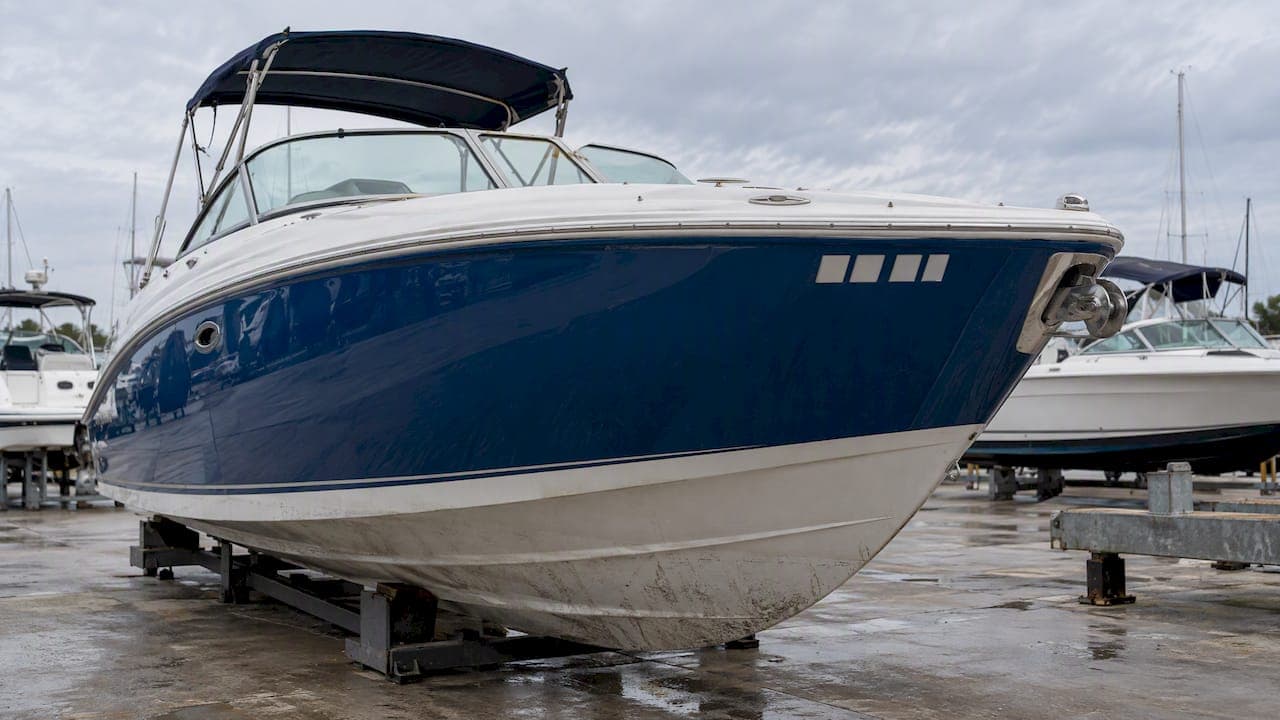
For official registration numbers, order marine-grade, state-compliant vinyl decals made to the exact registration string. Decals meet the federal visibility and permanence rules that a painted finish or a decorative wrap cannot reliably guarantee over time. Before you order anything, proof the registration string against your certificate of number so you avoid a costly re-cut or a failed dock inspection.
TL;DR:
- Federal rules require plain, vertical block characters at least 3 inches high on both sides of the forward hull, with contrast and correct spacing.
- Validation stickers go within 6 inches; Texas requires placement three inches aft, while Florida allows placement before or after the number on the port side.
- Overlaminated decals can keep numbers legible for 7 to 10 years; ask vendors to specify the film, adhesive, and expected lifespan in writing.
- Documented vessels use a different numbering scheme, and a hull identification number cannot replace state registration numbers; confirm status before ordering.
- Inspect decals at least once a year and replace them when any character becomes hard to read; clean them with mild soap, not abrasives.
Table of Contents
- Regulatory baseline: federal requirements and state variations you must know
- Why marine-grade vinyl matters: materials, overlaminates, and realistic lifespan
- Pre-order checklist for marinas, dealerships, and owners
- Installation and maintenance: correct application, upkeep, and when to replace decals
- Comparison of boat wraps vs decals: pros and cons specific to displaying registration numbers
- Cost comparison for boat wraps and decals related to registration compliance
- Visibility and readability considerations under different lighting and water conditions
- Legal consequences of non-compliance or improper display using wraps or decals
- Lessons from processing registration decal orders
- Ordering compliant decals through our design tool
- FAQ
- Sources
Regulatory baseline: federal requirements and state variations you must know
Federal rules set the floor every state builds on. Under 33 CFR 173.27, registration numbers must appear as plain vertical block characters at least 3 inches high, contrasting with the hull color, reading left to right, with proper spacing or hyphens separating the letter and number groupings. They must be painted on or permanently attached to each side of the forward half of the vessel, and a backing plate is allowed when the hull shape makes direct application impractical.
Validation stickers add a second layer of rules. Under 33 CFR Part 174 Subpart B, a validation sticker runs about 3 inches square and must sit within 6 inches of the registration number, but individual states decide the exact placement.
- Washington requires the number on both sides of the bow with the decal placed within 6 inches and in line with the number, detailed on the Washington State Department of Licensing site.
- Texas requires the validation decal affixed in line and three inches toward the rear of the boat from the number, per Texas Parks & Wildlife Department guidance.
- Florida places its decal immediately before or after the registration number on the port side, according to the Florida Department of Highway Safety and Motor Vehicles.
Documented vessels follow a different numbering scheme entirely, and a hull identification number is not interchangeable with a state registration number. Always check your certificate of number for the state of principal operation before ordering, and consult our regulation hub by state if you manage vessels across more than one jurisdiction.
Why marine-grade vinyl matters: materials, overlaminates, and realistic lifespan
"Marine-grade" describes a construction, not a marketing label. A proper registration decal combines a UV-stable face film, an adhesive rated for continuous saltwater or freshwater contact, and in most cases a clear overlaminate that shields the printed characters from abrasion and sun exposure. Each layer does a different job: the face film holds color, the adhesive keeps the decal bonded through vibration and spray, and the overlaminate slows the fading and edge lift that eventually make a number illegible.
Fading and lifting are the two failure modes that actually threaten compliance, since an illegible number defeats the entire point of the display rule. Sun exposure, repeated saltwater contact, and routine washing all accelerate wear, which is why the best vinyl for boats resists all three rather than just one.
- Ask any vendor for the specific face film, adhesive type, and overlaminate used before you buy.
- Confirm whether the overlaminate is included or sold separately, since it drives most of the lifespan difference.
- Get a stated expected lifespan in writing rather than a vague durability claim.
Pro Tip: Choose an overlaminated decal whenever your vessel sits in saltwater or sees heavy sun, since overlaminate is what typically pushes legible life toward the 7 to 10 year range.
Pre-order checklist for marinas, dealerships, and owners
Bulk buyers and single owners share the same risk: an order that does not match the certificate of number. Work through this sequence before you submit anything to production.
- Pull the certificate of number and copy the registration string exactly, including prefix, number, suffix, spacing, and hyphens.
- Confirm the state of principal operation and check whether the vessel qualifies as documented, since documented vessels use a different numbering approach.
- Decide which side or sides need the number and measure the unobstructed forward-half space available on each.
- Determine whether the hull shape requires a backing plate for proper visibility, and order one sized to contrast with the hull.
- Route the finished order text through a second person for a line-by-line check against the certificate before approving production.
- Flag any exceptions, such as antique vessel registrations or documented-vessel status, in the order notes so production does not default to a standard template.
Pro Tip: For fleet or dealership orders, build a simple approval step into your workflow, a second set of eyes on the certificate catches transposed digits before they become a batch of unusable decals.
A rushed order is the single most common source of rework. Our sizing, font, and placement answers page covers the edge cases, like unusual hull shapes or multi-vessel fleets, that a standard checklist might miss.
Installation and maintenance: correct application, upkeep, and when to replace decals
Surface prep decides how long a decal holds up, regardless of material quality. Clean the application area with soap and water, then degrease it to remove wax or polish residue, and let the hull dry completely before you start. Any wax left under the adhesive shortens bond life dramatically.
- Apply the decal straight and level, reading left to right, with consistent spacing between characters as the federal rule requires.
- Place the validation sticker within your state's specified tolerance, whether that is in line with the number or offset a set distance.
- Mount a backing plate first if your hull curvature or color makes direct application unreadable from a normal viewing distance.
- Press out air bubbles from the center outward and avoid flexing the vinyl in cold temperatures, which can crack the face film.
Maintenance after installation is light but necessary. Clean decals with mild soap rather than abrasive cleaners or high-pressure solvents, and inspect them at least once a year for edge lift, cracking, or fading. Replace a decal as soon as any character becomes difficult to read at a normal dock distance, since a worn decal creates the same compliance problem as never installing one.
Comparison of boat wraps vs decals: pros and cons specific to displaying registration numbers
A full vinyl wrap covers the hull for appearance and branding, but it is not built around the precise character height, spacing, and contrast rules that registration numbers require. Wraps are cut to a design template, and fitting an exact registration string into that template invites spacing errors or characters that fall below the 3 inch minimum once the wrap is trimmed around hull contours.
A dedicated registration decal is produced to the exact string on the certificate, sized and spaced to the federal block-character standard from the start. It goes on independently of any larger graphics decision, so a hull that already carries a wrap or paint scheme still gets a number that meets display rules without redesigning the whole exterior.
Wraps also complicate replacement. If a number needs updating, for instance after a title transfer or a state reassignment, pulling a section of wrap to redo the registration area risks damaging the surrounding graphic. A standalone decal can be removed and replaced without touching anything else on the hull. For the one job that matters here, legible, properly sized, properly placed registration numbers, a purpose-built decal is the more direct and more reliably compliant choice.

Cost comparison for boat wraps and decals related to registration compliance
A set of Custom Boat Registration Numbers & Decals runs $35.99 as a one-time purchase, covering the registration string sized and formatted to meet federal and state display rules. That price reflects a single-purpose product made for one job: compliant identification.
A full boat wrap is priced as a much larger project, since it covers most or all of the hull and is typically quoted per square foot of coverage plus installation labor. Even when a wrap includes a registration number as part of its design, the cost of producing and fitting the entire graphic package is not something you would take on just to satisfy a display requirement. For marinas or dealerships registering multiple vessels, ordering individual decal sets per boat keeps the compliance cost predictable and separate from any cosmetic decisions about hull graphics.
Visibility and readability considerations under different lighting and water conditions
Registration numbers have to read from a normal viewing distance in daylight, at dusk, and against glare off the water, which is why contrast matters as much as character height. A dark number on a light hull, or the reverse, holds up better under direct sun than a color combination with low contrast, even if both technically meet the 3 inch minimum from 33 CFR 173.27.
Glossy overlaminates can introduce glare at certain sun angles, so a matte or satin finish sometimes reads more consistently on vessels that spend most of their time on open water. Hull curvature also affects legibility: a number applied across a tight curve can distort and become harder to read from directly ahead or astern, which is one reason a flat backing plate is worth considering on rounded or heavily contoured bows.
For vessels that operate near dusk or in low-visibility conditions, reflective or high-contrast backing materials improve how quickly a number is spotted by marine patrol or other boaters. Reflective conspicuity materials, like the kind used on trailer and vehicle marking, can supplement a backing plate on vessels that are frequently underway near sunset or in low-light marina traffic, though the registration decal itself still has to meet the core size and contrast rules on its own.

Legal consequences of non-compliance or improper display using wraps or decals
An improperly displayed registration number is a compliance failure regardless of whether the underlying material is a decal, paint, or part of a larger wrap. Undersized characters, poor contrast, incorrect spacing, or a validation sticker placed outside the state's required distance can all trigger a citation during a routine marine patrol stop or a dockside inspection.
Beyond the immediate citation, an unreadable number slows or blocks identification in situations where speed matters, including accident investigation, theft recovery, or a basic ownership check at a marina. Dealerships and marinas that hand over vessels with non-compliant numbering also carry reputational exposure if a customer gets stopped shortly after taking delivery. The safest path is confirming placement against your state's own published guidance, such as the Washington State Department of Licensing or Texas Parks & Wildlife Department pages, before the vessel ever leaves the lot or the slip.
Lessons from processing registration decal orders
The most frequent ordering mistake we see is a mismatch between the submitted text and the certificate of number, usually a transposed digit or a missing hyphen in the prefix and suffix. Confusion over documented-vessel status is a close second, since those vessels follow a different numbering approach entirely. Proofing the exact string against the certificate before production, and choosing a vinyl built for UV and saltwater exposure rather than a generic adhesive film, prevents most of the rework and premature fading we hear about from marinas and dealerships placing repeat orders.
— Taylor
Ordering compliant decals through our design tool
We build every registration decal from marine-grade vinyl selected specifically for UV resistance and saltwater exposure, so the number you install today still reads clearly years later. Our online design tool lets you enter your exact registration string, pick a font and color combination that meets contrast requirements, and see a proof before you ever submit the order.
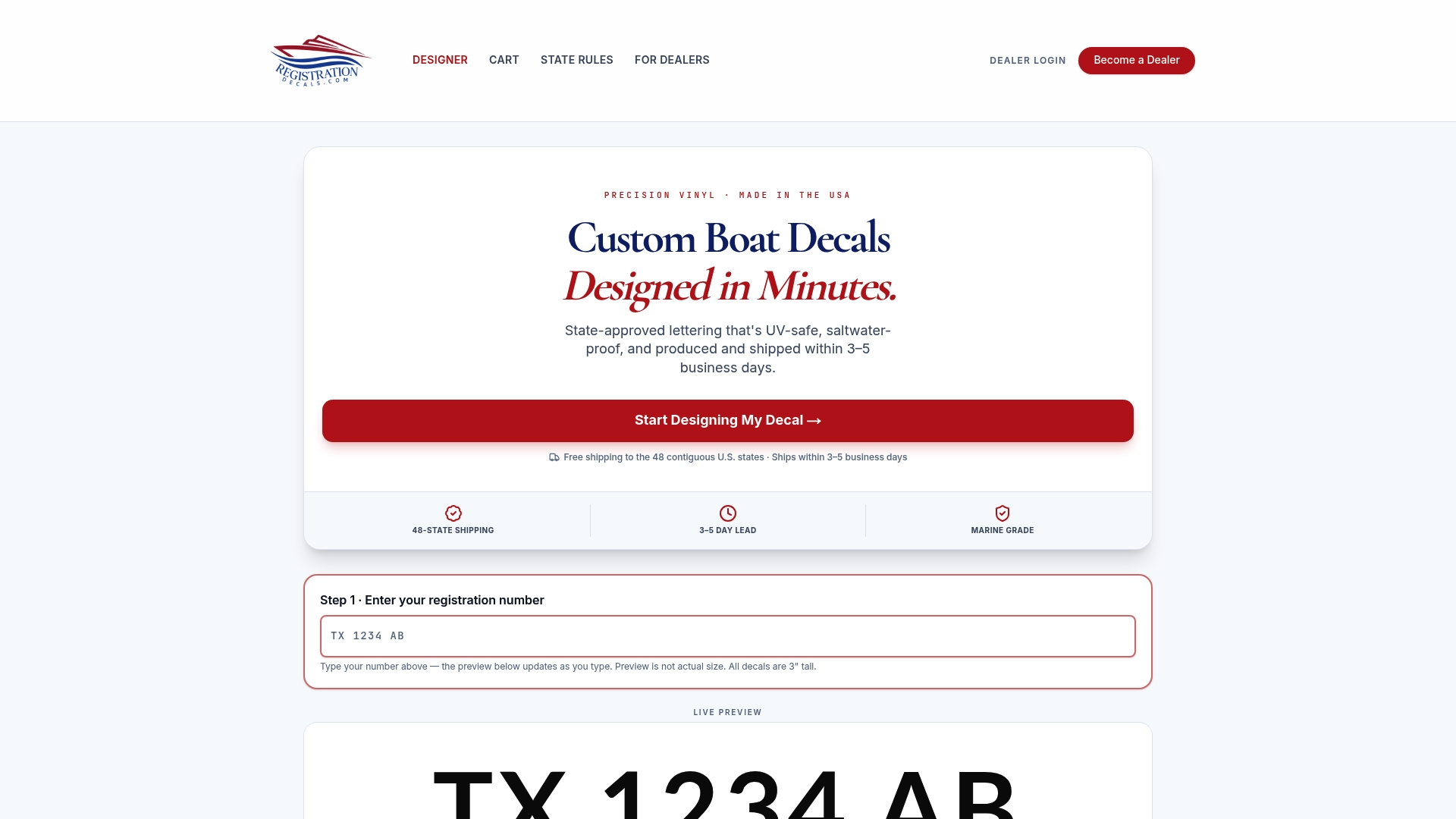
- Enter your registration number, state, and vessel type directly into the design tool for an instant proof.
- Choose from compliant block-style fonts and contrasting color combinations built around display rules.
- Receive your finished decal set within a few business days with shipping to locations within the contiguous United States.
Whether you are outfitting a single boat or placing a bulk order for a marina or dealership lot, start with Custom Boat Registration Numbers & Decals and have your proof ready before you check out. Pontoon, jet ski, bass boat, aluminum, and center console owners can find sizing specifics on our dedicated pontoon numbers and jet ski numbers pages.
FAQ
Is a vinyl decal or a full wrap better for registration numbers?
A dedicated vinyl decal is the better choice, since it is sized and spaced to the federal 3 inch block-character standard from the start rather than fitted into a larger graphic template. A decal can also be replaced on its own if a registration number changes, without disturbing any surrounding hull graphics.
How long do marine-grade registration decals last?
Lifespan depends on the material and exposure, but a properly overlaminated decal typically holds up for several years of regular sun and saltwater exposure before fading or edge lift affects legibility. Inspect decals annually and replace them as soon as any character becomes hard to read.
Where exactly does the validation sticker go?
Federal rules place the validation sticker within about 6 inches of the registration number, but your state sets the exact spacing and side. Check our validation sticker placement guide or your state's boating authority page for the specific distance and orientation.
Do registration numbers need to go on both sides of the boat?
Yes, federal rules require the registration number on each side of the forward half of the hull, and most states enforce the same both-sides requirement. Our placement answer page covers exceptions for unusual hull configurations.
What happens if my registration numbers don't meet the size or spacing rules?
An undersized, poorly spaced, or low-contrast registration number can result in a citation during a marine patrol stop or dockside inspection. Correcting the display before you're on the water, by checking the federal display requirements against your decal, avoids the issue entirely.
Sources
- eCFR :: 33 CFR 173.27 -- Numbers: Display; size; color.
- eCFR :: 33 CFR Part 174 Subpart B -- Numbering System Requirements
- Boat registration and hull identification numbers | Washington State Department of Licensing
- Numbers and Decals on Vessels — Texas Parks & Wildlife Department