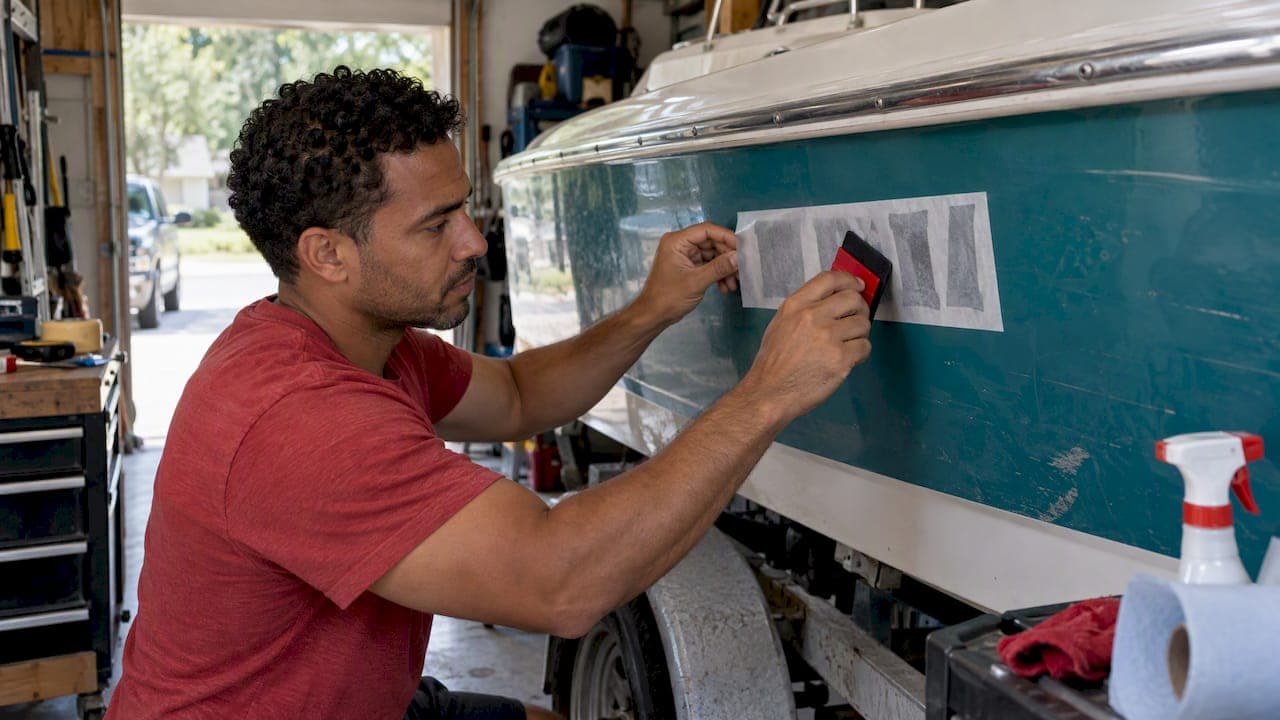
Most vinyl boat decals need about 24 to 48 hours before the boat touches water, and about 72 hours before you pressure wash it. Two separate clocks matter: the surface under the decal (new paint, clearcoat or gelcoat repair) has to finish curing first, and then the decal's adhesive has to bond. Rush either one and you get lifted corners, bubbles or a decal that comes off in the first season.
This guide covers both clocks, what changes them, and how to tell when you can launch.
TL;DR
- Adhesive cure: Plan on 24 to 48 hours after application before launching. One boating magazine guide recommends 48 hours before you go boating again.
- Surface cure: Fresh paint or clearcoat outgasses and can attack decal adhesive. Wait the full time on the coating maker's data sheet, not just until it feels dry.
- Weather: Apply in calm conditions above 65°F. Cold slows the bond, and wind and dust ruin the finish.
- Washing: Hold off on pressure washers and harsh cleaners for at least 72 hours, and keep them away from decal edges for good.
- Registration decals: Numbers must be legible whenever the boat is on the water, so schedule the install a couple of days before your trip.
Table of Contents
- The two cure clocks
- How long until the boat can go in the water
- What speeds up or slows down curing
- Fresh paint, clearcoat and gelcoat repairs
- Curing time versus ink drying time
- A step-by-step install that shortens the risk
- Perspective: what we see on real hulls
- Registration numbers have rules your timing has to respect
- Caring for decals after they cure
- Order decals built for the job
- FAQ
- Sources
The two cure clocks
When boaters search for "curing time," they usually mean one of two different things.
Clock one: the surface. If you have just painted the hull, applied a clearcoat or repaired the gelcoat, that coating is still releasing solvents as it cures. Those fumes can attack the adhesive backing of a decal. Boaters in the forums that rank for this topic disagree wildly, from a few days to a few months, because coatings differ. The only answer that holds is the one on your product's technical data sheet. One clearcoating guideline that ranks for this query advises allowing at least a week before installing decals, and that is a floor, not a ceiling, for many two-part systems.
Clock two: the adhesive. Once the decal is on a fully cured, clean surface, the pressure-sensitive adhesive needs time to flow into the microscopic texture of the gelcoat and build bond strength. This is the 24 to 72 hour window most people mean.

If you are applying to bare, sound, long-cured gelcoat or aluminum, only clock two applies.
How long until the boat can go in the water
The adhesive does not reach full strength the moment you squeegee it down. It builds over hours and keeps strengthening for days. Here is a practical schedule for a typical set of registration numbers on clean gelcoat in mild weather.
| Time after application | What you can do | What to avoid |
|---|---|---|
| First hour | Remove transfer tape, press edges | Touching or rubbing edges |
| Up to 24 hours | Keep the boat dry and out of rain if possible | Launching, hosing, wiping with cleaners |
| 24 to 48 hours | Launch in calm conditions; rinse gently | Pressure washing, high speed on a trailer in heavy rain |
| 72 hours | Normal washing with a soft mitt | Washer wands aimed at edges |
| About 1 week | Treat as fully bonded | Harsh solvents, always |
The 48-hour figure comes from a Boating magazine how-to, which also notes that a colorless edge sealer pen dries in 15 minutes but that the vinyl's own adhesive still needs those 48 hours to fully cure before the next outing. Our own take on the same rule, including what the adhesive maker's guidance says, is in our post on the 24 to 48 hour rule for boat decals.
If you must launch sooner, say a tournament is in the morning, apply the decals the weekend before. A decal that has had a day on a dry hull is far better off than one that goes into the water in an hour.
What speeds up or slows down curing
Temperature
The same Boating magazine guide tells you to choose a calm, windless day with air temperatures above 65°F. Adhesives get stiff when it is cold, which slows the wet-out onto the surface. If you are in Michigan, Minnesota or Maine in October, do the install in a heated garage and let the boat sit inside for the full window rather than rolling it into the cold the same afternoon.
Surface cleanliness
Adhesion depends more on prep than on waiting. Installers specify a surface free of wax, dirt and old adhesive residue, because anything left behind keeps the adhesive from wetting out. Wash off salt and scum, rinse, dry, then wipe with a 70 percent isopropyl alcohol solution and a clean microfiber towel, as the Boating magazine steps describe. Do not use wax or polish with silicone on the spot right before applying.
Dry versus wet application
For large overlaminated graphics, one marine film maker's installation tip sheet recommends a dry application because a wet application risks later adhesive failure from the surfactant left under the film. Wet application leaves moisture that has to escape before the bond can complete, which stretches your wait. For small registration numbers, dry application with a squeegee is simple and gets you to the cure window faster.
Humidity and shade
Humid, shaded conditions slow the release of moisture and solvents. Direct sun helps the bond, but a black hull in July can get hot enough to make the vinyl stretch and grab before you position it. Work in open shade on a warm day.
Fresh paint, clearcoat and gelcoat repairs
This is where most real damage happens. A hull that looks dry can still be gassing off.
- Read the data sheet. It lists a recoat window, a full cure time and often a note about vinyl graphics.
- Add margin in cool weather. Stated cure times assume a temperature range. Below it, the clock stretches.
- Do a test patch. Stick a small scrap of vinyl in an inconspicuous spot for a few days. If it bubbles or lifts, the surface is not ready.
- Do not seal the decal under new clearcoat unless the decal maker says to. Registration numbers should sit on the finished surface and remain removable at renewal or when you sell.
If you are restoring an oxidized hull first, the surface condition matters as much as the wait. A Florida marine service notes that light oxidation affects only the top 1 to 3 mils of gelcoat, so compounding often solves it, while severely degraded gelcoat needs repainting. Decals do not stick well to chalky, oxidized gelcoat, because the adhesive grips the loose layer and not the hull. Restore first, let the product cure, then apply.
One more thing: sun-faded hulls often show a ghost where an old decal sat, since the covered gelcoat stayed glossy while the rest eroded. Removing old decals and residue completely before installing new ones gives the new adhesive a clean base, though the shade difference may remain until you polish.
Curing time versus ink drying time
There is a third clock that you cannot control as a buyer but should know about. For digitally printed graphics, one cast PVC print media data sheet tells the printer to let solvent-based inks dry at least 24 hours, 48 to 72 hours preferred, at 70°F before cutting or laminating. That is a production step, not something that happens on your boat. It is one reason well-made graphics do not arrive tacky, and why a decal that arrives smelling strongly of solvent is a red flag.
A step-by-step install that shortens the risk
- Check the forecast: calm, dry, above 65°F.
- Confirm any paint or clearcoat has fully cured per its data sheet.
- Wash, rinse, dry and wipe with isopropyl alcohol.
- Measure and mark placement with masking tape. Registration numbers go on the forward half of the boat, so check where boat registration numbers go before sticking anything.
- Apply with a squeegee from the center out, then peel the transfer tape slowly at a shallow angle.
- Press the edges down, pop any bubbles with a pin, and press again.
- Let the boat sit, ideally indoors or covered, for 24 to 48 hours.
- Launch, and hold off on the pressure washer for 72 hours.
Perspective: what we see on real hulls
We produce our decals in-house from marine-grade vinyl chosen for UV and saltwater resistance, and the pattern we hear about is rarely a bad decal. It is a good decal applied too soon: to a hull that was waxed last week, to paint that was still gassing off, or to a boat that went down the ramp an hour later.

Our advice is simple. Treat the install like a two-day job even though the application takes minutes. Do the prep properly, apply on a mild day, and give the adhesive a full day or two before water. If you are renewing a validation sticker or numbers right before a trip, order early; with 3 to 5 business day production and free shipping in the contiguous United States, you can have the decals in hand and cured well before the weekend.
And read your state's rules before you place the decal. Numbers must be legible, and getting them in the wrong spot means peeling a freshly cured decal, which is the worst way to learn about adhesive strength.
— Taylor
Registration numbers have rules your timing has to respect
Because registration decals are legal markings, cure time interacts with compliance. Federal guidance says numbers must be painted or permanently attached to each side of the forward half of the vessel, read left to right, and be in a color that contrasts with the background. States such as Kansas add that characters should be plain vertical block at least 3 inches tall, with the validation decal placed near the numbers, so check your state rules and your registration card.
For the practical side, see our guides on where the validation sticker goes and on state-by-state sticker placement. Florida boaters can read the Florida registration number requirements, and Alabama owners can check the Alabama decal requirements.
The takeaway on timing: renew early, install a few days before your first outing, and never leave the dock with numbers that are peeling or half-bonded.
Caring for decals after they cure
Once bonded, vinyl needs gentle maintenance. A marine decal guide recommends avoiding washers aimed at decal edges, acetone, bleach and petroleum-based cleaners, and checking edges for lifting about every 90 days. Press down any loose corner with a squeegee, using low heat if needed.
How long should it last? One boat graphics shop puts a high-quality marine-grade vinyl decal at 5 to 7 years when properly installed and maintained, with UV, salt and washing habits driving the result. Our answer on how long marine vinyl decals last goes deeper. A proper cure is the first step toward that number.
Order decals built for the job
If you need a new set, our custom boat registration numbers and decals are 35.99 USD per set. You enter your registration number, pick color and font in the online design tool, and we produce the set from UV-safe, saltwater-proof marine-grade vinyl in 3 to 5 business days, with free shipping in the contiguous United States. We also have dedicated pages for pontoon, center console, bass boat, aluminum boat and jet ski numbers. Marinas and dealerships can order in bulk.
FAQ
Can I launch my boat right after applying decals?
It is better not to. Give the adhesive at least 24 hours, and ideally 48, before the boat goes in the water. If you have no choice, apply them to a clean, dry, fully cured surface and keep speed and spray low on the first trip.
How long should I wait to apply decals on new paint or gelcoat?
Until the coating is fully cured, not just dry to the touch. Clearcoat can outgas and attack decal adhesive, so follow the data sheet for your paint or gelcoat product, and allow extra time in cold weather. When in doubt, test a scrap of vinyl first.
When can I pressure wash a boat with new decals?
Wait about 72 hours. Even after that, keep the wand well back from decal edges, since water aimed at an edge is the most common way to lift a corner.
Does cold weather change curing time?
Yes. Cold slows the adhesive bond, which is why installers suggest air temperatures above 65°F. If it is cooler, apply indoors and let the boat sit inside for the full window.
Sources
- Applying Boat Decals, Boating Magazine
- Installation Instructions, Outboard Decal Set
- Application Tips for Marine Marking, Arlon
- Boat Oxidation Removal and Gelcoat Restoration, JG Coastal Marine Services
- ORAJET 3951 technical data sheet, ORAFOL
- A Boater's Guide to the Federal Requirements for Recreational Boats, U.S. Coast Guard
- Kansas Department of Wildlife and Parks
- Waterproof Branded Decals for Saltwater Tours, 2026 Guide
- Top Fishing Boat Wrap Ideas for Anglers in 2026