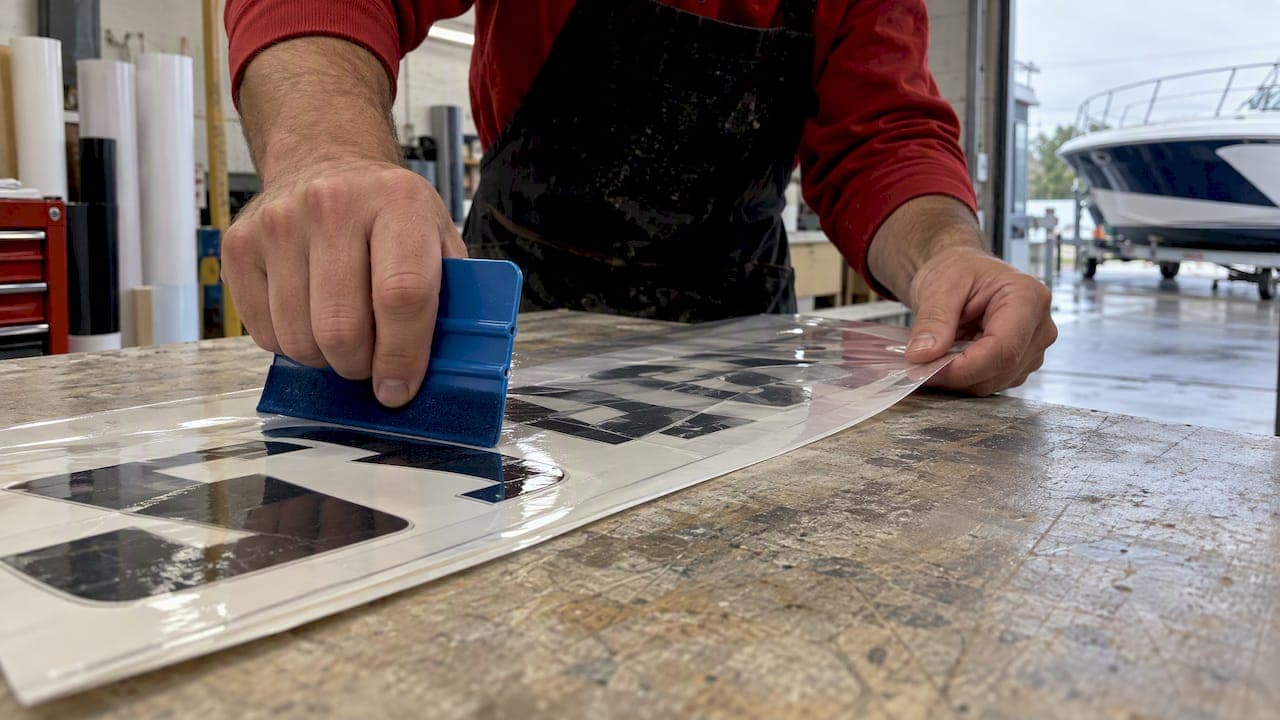
For decals that survive sun, salt, and spray, choose a UV-stable cast overlaminate or a polyurethane (TPU) marine overlaminate, and pair either one with manufacturer-specified surface prep. The laminate family matters, but surface preparation and following the manufacturer's recommended film list and installation bulletin determine whether that protection actually holds up on the water.
TL;DR:
- Match cast PVC to curved surfaces and UV exposure, while TPU suits abrasion and clarity; use thicker films in high wear areas and thinner films around compound curves.
- Verify compatibility with base vinyl, stated UV inhibitors, resistance to fuel, oil, and salt spray, and the warranty's approved film list.
- Record surface condition before application, remove wax, fuel residue, silicone, and moisture, and follow manufacturer guidance on curing, bonding windows, heating, and stretching.
- Rinse with fresh water after saltwater trips, use mild detergent without abrasives or solvents, and repair lifting edges before water or fuel reaches adhesive.
Table of Contents
- Which laminate families work best for marine decals?
- How do you choose the right marine laminate?
- What surface prep makes a laminated decal last?
- How long should a laminated decal last, and how do you maintain it?
- Why practical, manufacturer-backed guidance matters more than theory
- Order marine-grade decals built for saltwater and sun
- FAQ
- Sources
Which laminate families work best for marine decals?
Two laminate families dominate marine graphics for good reason: cast PVC overlaminates and polyurethane (TPU) overlaminates. Cast PVC films, the kind found in manufacturer marine-rated product lines, offer strong UV and fade resistance along with the conformability needed to wrap curved hulls and transoms without lifting at the edges. TPU overlaminates trade a bit of that conformability for higher abrasion resistance and exceptional optical clarity, which makes them a strong match for printed decals that need to stay vivid after repeated washdowns and dock contact.
MACtac's product literature describes both types side by side: cast PVC and PVC-free polyurethane overlaminates built for outdoor, marine, and fleet use, with UV protection and moisture resistance built into the film rather than added as a coating, and with heavier mil options available for high-wear applications like LF4600 and LF5600 series overlaminates.
- Cast PVC overlaminates conform well to curves and deliver long-term UV and fade protection on hulls and transoms.
- TPU overlaminates resist abrasion and scuffing better, with high clarity that keeps printed colors sharp.
- Thicker films can be considered for high-abrasion zones like swim platforms and gunwales.
- Thinner films flex more easily around compound curves without stretching or tearing.
- Application tape keeps multi-piece graphics aligned during installation and is worth using any time a decal spans more than a few inches.
MACtac's literature notes that its overlaminate lines include options of varying thickness, giving installers a choice between conformability and toughness depending on where the graphic sits on the boat.
An overlaminate is worth considering when a decal will see direct sun, splash, or repeated handling. Skipping it on a printed decal shortens its working life considerably, since the ink layer has no protection against UV breakdown or fuel splash.
How do you choose the right marine laminate?
Picking a laminate is less about brand loyalty and more about matching the film to your vinyl, your climate, and how the boat gets used. A short checklist keeps the decision simple.
- Confirm compatibility with your base vinyl. A laminate built for cast film will not perform the same over calendered or budget printed vinyl.
- Match thickness to location. Consider thicker films on high-contact areas like swim platforms, and thinner cast films on compound curves near the bow.
- Check UV stabilization claims in the product datasheet, not just marketing copy. A film without stated UV inhibitors will fade faster regardless of mil thickness.
- Verify chemical resistance to fuel, oil, and salt spray, since these are the contaminants most likely to degrade an unprotected adhesive layer.
- Read the warranty terms. Manufacturer warranties may specify an approved film list and required installation steps; check the warranty terms to understand how deviations may affect coverage.
Pro Tip: Call the laminate manufacturer's technical line before buying in bulk. A conversation about your hull material and climate can help you avoid peeling graphics.
Technical bulletins and product datasheets are the most reliable place to confirm marine suitability, since general vinyl literature does not always specify saltwater or fuel exposure testing. When a product page does not mention marine or exterior-rated use explicitly, treat that as a gap rather than an assumption of compatibility.

What surface prep makes a laminated decal last?
Industry application guidance consistently points to one conclusion: bond failure to the hull surface, not the laminate itself, is the most common reason marine graphics fail. Surface prep is where most of that risk gets eliminated or created.
- Inspect and document the surface before installation. Most manufacturer warranties require a pre-installation inspection record, and damage or contamination found later may not be covered if that record is missing.
- Clean thoroughly to remove wax, fuel residue, and silicone, then allow the surface to dry completely before applying any film.
- Respect cure and bonding windows. Follow the installer's and film manufacturer's guidance on when the boat can return to heavy water exposure.
- Use heat and stretch techniques appropriate to the film. 3M's watercraft bulletin discusses film choice and explains how heating and stretching vary with hull curvature and climate.
3M's bulletin states that proper substrate preparation is the single most important factor in decal longevity, ahead of laminate choice itself. Skipping cleaning steps or rushing the bonding window undoes the benefit of even the best overlaminate on the market.
How long should a laminated decal last, and how do you maintain it?
A UV-stable cast or TPU overlaminate, installed over properly prepped cast vinyl, can support extended exterior service when manufacturer guidance is followed, as described in marine film guidance. Our own breakdown of how long marine vinyl decals last walks through the variables that stretch or shorten that window in real-world use.
- Rinse with fresh water regularly, especially after saltwater trips, to clear salt crystals before they sit against the laminate edge.
- Wash with mild detergent, never abrasive pads or solvent-based cleaners that can dull the laminate surface or lift edges over time.
- Inspect edges periodically and re-seal any lifting corners before water or fuel works underneath the film.
- Address abrasion or fuel contact immediately, since both are common entry points for moisture that leads to adhesive failure.
Constant salt spray, fuel vapor exposure, and repeated abrasion from docking are the three factors most likely to cut a laminate's working life short, even on a well-installed graphic. Our guide on protecting boat decals with overlaminate covers the maintenance routine in more detail.
Why practical, manufacturer-backed guidance matters more than theory
Marine decal failures almost always trace back to skipped steps, not bad luck or inferior film. We build our guidance around manufacturer installation bulletins and real surface-prep requirements rather than generic vinyl advice, because the gap between a decal that lasts years and one that peels in months usually comes down to preparation, not product choice.
— Taylor
Order marine-grade decals built for saltwater and sun
For boat owners who would rather skip the laminate sourcing and installation guesswork, we build custom boat registration decals from marine-grade vinyl selected specifically for UV and saltwater resistance. Our online design tool lets you set your registration numbers, colors, and fonts in minutes, and orders are produced in 3 to 5 business days with free shipping across the contiguous United States.
- Ready-made decals make sense when compliance deadlines or time matter more than a DIY lamination project.
- Browse options for jet skis, pontoons, bass boats, aluminum boats, and center consoles.
- Our installation guide walks through placement and application once your decals arrive.
FAQ
Can you laminate vinyl?
Yes, most cast and calendered vinyl films accept an overlaminate, provided the laminate is listed as compatible with that vinyl type in the manufacturer's datasheet. Cast vinyl generally pairs best with cast overlaminates for long-term outdoor durability.
How do you place decals on a boat?
Our guide on where registration numbers go covers placement rules by state.
What is the best marine-grade vinyl for boat seats?
Marine upholstery vinyl is a different product from exterior decal vinyl and is chosen for flexibility, mildew resistance, and UV stability rather than adhesive bonding to a hull. For registration decals specifically, cast vinyl built for marine exteriors is the more relevant comparison.
What material are waterproof stickers?
Waterproof stickers are generally made from cast or calendered vinyl with a pressure-sensitive adhesive, often finished with a protective laminate to block moisture and UV exposure. The laminate, not the base vinyl alone, is what makes the sticker fully water-resistant over time.