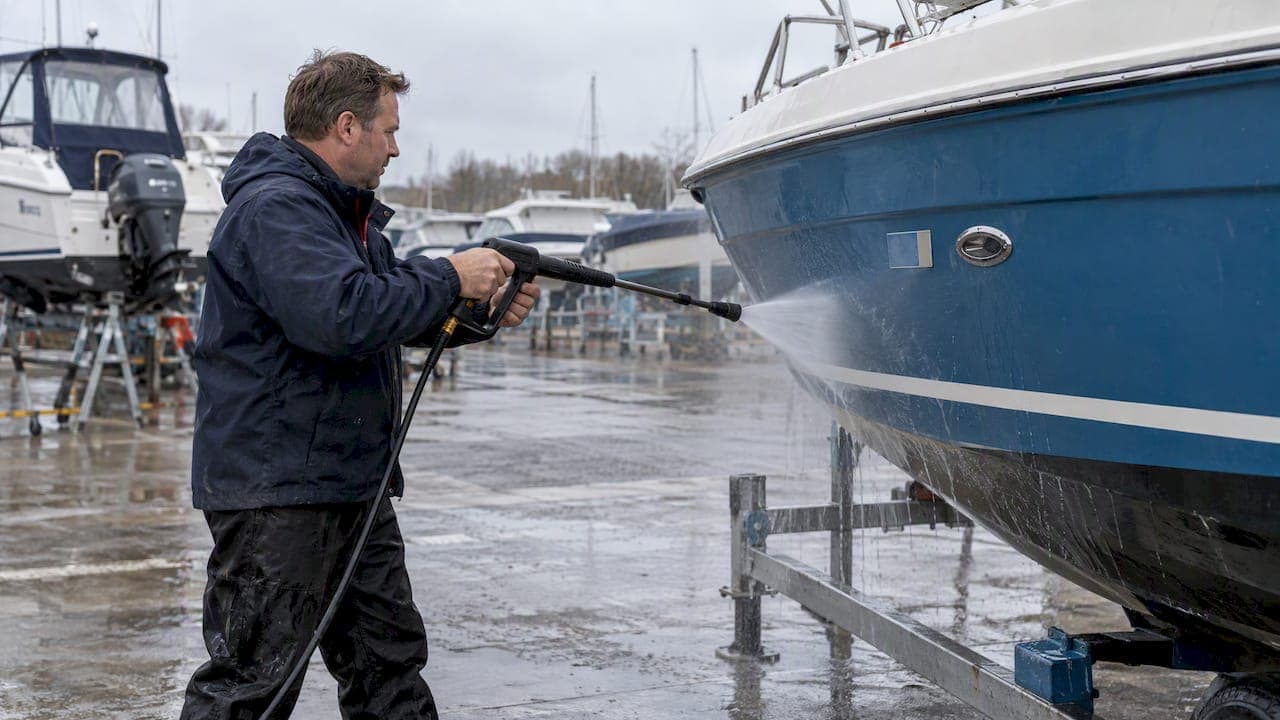
Yes, you can pressure wash over boat decals safely, as long as you use a wide 40-degree nozzle, keep the wand 18 to 24 inches from the surface, and start on the lowest effective pressure. Heat and pressure together can also remove decals on purpose, but that takes the right equipment and a careful hand. Before you start any job, test a hidden corner first and watch for lifting edges.
TL;DR:
- Keep pressure below about 2,000 PSI near graphics, sweep continuously with spray parallel to decal edges, and stop immediately if any edge lifts.
- For removal, use water below 180°F with a washer rated for heated water; start at low pressure about a foot away, then use a plastic scraper.
- Heat and pressure suit thicker gelcoat or metal; stop if the finish dulls or scratches, and leave delicate or complex jobs to a professional.
- A heat gun with a plastic scraper avoids water pressure, while an eraser wheel requires low speed because abrasion can dull gelcoat.
- An overlaminate can protect decals from UV damage and abrasion for 7 to 10 years, and new adhesive should fully cure before heavy cleaning.
Table of Contents
- Fast safety checklist before you pressure wash
- How to pressure wash safely over decals: settings, motion, and verification
- How to remove decals using a hot-water pressure washer
- Other effective removal methods: heat gun, eraser wheel, scraping, solvents
- Client-backed care and replacement advice
- Author perspective: practical guidance and final cautions
- Replace or order marine-grade registration decals
- FAQ
- Sources
Fast safety checklist before you pressure wash
A few seconds of prep saves hours of touch-up work later. Run through this list before you pull the trigger on your pressure washer.
- Start with the gentlest pressure setting that still cleans, and avoid going above roughly 2,000 PSI near any decal or graphic.
- Fit a 40-degree white nozzle for decal areas; never use a 0-degree red or 15-degree yellow nozzle on vinyl or gelcoat edges, as industry wrap specialists recommend.
- Hold the wand 18 to 24 inches away and spray at a shallow or perpendicular angle rather than straight into a decal edge.
- Confirm whether your unit has hot-water capability before relying on heat, and wear eye protection and gloves.
- Test an inconspicuous spot first and stop immediately if you notice any lifting.
How to pressure wash safely over decals: settings, motion, and verification
Different parts of your boat tolerate different amounts of pressure, and matching the nozzle and PSI to the surface is what keeps a routine wash from turning into a repair job.
Before you start, decide whether you need cold water or a mild cleaning solution, and confirm your machine supports hot water if you plan to use it. Mask off decal edges with painter's tape if you're worried about a seam catching the spray.
- Load the 40-degree nozzle and set your pressure washer to its lowest working setting.
- Stand 18 to 24 inches from the hull and test an inconspicuous section away from any decal.
- Work in smooth, sweeping motions across the surface rather than holding the wand still in one spot
- Move from the center of dirty areas outward, keeping the spray parallel to decal edges instead of aimed directly at them.
- Watch closely for any sign of the decal edge lifting as you pass over it.
- If you see lifting, stop immediately, switch to a soft brush or hand wash for that section, and finish the rest with the pressure washer.
- Rinse the full area at a lower pressure to clear residue, then let it air dry or wipe with a soft towel.
Pro Tip: Keep the wand moving at all times over decals. A sweeping pass lifts grime without giving water a chance to wedge under the edge, and testing a small area first catches problems before they spread.
How to remove decals using a hot-water pressure washer
Hot water softens both the vinyl and the adhesive underneath it, which makes peeling far easier than cold water alone and is one reason hot-water pressure washing shows up repeatedly as an effective removal method in boat care guides. It only works well, though, if your machine is actually rated for heated output.
Before you begin, gather:
- A hot-water-capable pressure washer
- A mild, vinyl-safe detergent
- A plastic putty scraper (never metal)
- An adhesive remover for leftover residue
To remove a decal with heat and pressure:
- Heat the water to under 180°F and test a small corner of the decal first.
- Stand about a foot back and start at low pressure, watching how the vinyl responds.
- Work from the center of the decal outward rather than attacking one edge repeatedly.
- Once edges start to soften and lift, use the plastic scraper to peel the vinyl away gently.
- Repeat the heat and scrape pattern until the decal is fully removed, then clean remaining adhesive with a solvent made for marine surfaces.
- Finish with a low-pressure rinse to clear any residue.
This method works best on hulls with thicker gelcoat or metal surfaces. If you notice the finish dulling or scratching, stop and either hand-clean the rest or bring in a professional instead of pushing further with the pressure washer.
Other effective removal methods: heat gun, eraser wheel, scraping, solvents
Pressure washing isn't the only route to a clean hull, and several other methods show up consistently across boat care guides for owners who prefer not to use water pressure at all.
- Heat gun or hair dryer: Warm the decal edge until it's pliable, then peel slowly with a plastic scraper, keeping the heat moving so you don't scorch the gelcoat underneath.
- Eraser wheel: Attach one to a drill, keep the RPM low, and test a small area first since the mechanical abrasion can dull gelcoat if you press too hard or linger too long.
- Adhesive solvents: Choose a product labeled safe for marine vinyl and gelcoat, apply it to the residue after the decal is off, and test on a hidden spot before covering the whole area.
- Professional help: Complex graphics, older or thinner hulls, and boats with delicate finishes are often better left to a pro who removes decals regularly.
Pro Tip: Combine methods when one alone isn't enough: a quick pass with a heat gun followed by a plastic scraper often finishes what a hot-water wash started.
Client-backed care and replacement advice

Marine-grade vinyl is built differently than the sign-shop vinyl you'd find on a storefront window. It resists UV fading and saltwater exposure far better, which matters once you understand how much salt and sun stress ordinary vinyl over a single season on the water. Our registration decals are made from this marine-grade material specifically because it holds up to the conditions boats actually face.
A few habits extend the life of any decal set:
- Add an overlaminate layer to protect against UV and abrasion for 7 to 10 years.
- Let new decal adhesive cure fully before heavy cleaning or applying a ceramic coating nearby.
- Reference our guidance on cleaning and maintaining decals between washes to catch wear early.
- For UV protection on other vinyl surfaces around your boat, installer-grade practices from NJ Vinyl Wrapz apply the same core principles.
When a decal does need to come off entirely, our own removal guidance walks through the same careful approach covered above.
Author perspective: practical guidance and final cautions
Technique beats raw power every time with boat decals. A gentle, moving spray at the right distance will outperform a high-PSI blast aimed too close, and patience is cheaper than a replacement decal set. Before you remove anything, photograph your current registration numbers and write them down so you're not guessing later. If you're not confident about how your decal will react, test a corner, stop at the first sign of trouble, and call in a professional rather than forcing it.
— Taylor
Replace or order marine-grade registration decals
If your old decals came off during cleaning, or you just decided it's time for a refresh, we make replacing them simple. Our online design tool lets you enter your registration numbers and pick colors and fonts in minutes, and every set ships from marine-grade vinyl built to resist UV fading and saltwater wear.
Production takes just a few business days, with shipping included across many U.S. locations. Whether you're outfitting a pontoon, a jet ski, or an aluminum boat, you can get a compliant, durable decal set ordered today and back on the water within days.
FAQ
How do I remove decals from an aluminum boat?
Aluminum hulls tolerate most of the same methods as gelcoat: a hot-water pressure wash, a heat gun with a plastic scraper, or an eraser wheel on low speed. Test a small spot first since some aluminum finishes scratch more easily than gelcoat, and switch to hand tools if you see any marring.
Can I use a pressure washer to clean my boat?
Yes, a pressure washer is a safe and common way to clean a boat when you match the nozzle and pressure to the surface. Use a wide 40-degree nozzle and stay under about 2,000 PSI near decals and graphics, and never aim a narrow 0-degree or 15-degree nozzle at vinyl.
What is the best vinyl decal restorer?
Vinyl care tests favor mild, vinyl-safe cleaners for routine upkeep, followed by a protectant or overlaminate to guard against UV damage after cleaning. Always test any restorer on a small, hidden area before treating the full decal.
What kind of vinyl is used for boat decals?
Boat registration decals are typically made from marine-grade cast vinyl engineered to resist saltwater and UV exposure, unlike standard sign-shop vinyl. Our own decals use this marine-grade material specifically for that durability, and an overlaminate layer can extend the life even further.
Sources
- Power Wash Boat: Your DIY Guide to a Pro-Level Clean – Boat Juice
- Remove Boat Vinyl Decals with Hot Water Pressure – Pontooners
- Summer Care Tips for Your Vinyl Boat Wrap – National Fleet Graphics
- Boat Pressure Washing Tips | Safe & Effective Cleaning Guide – BoatLoversTowel