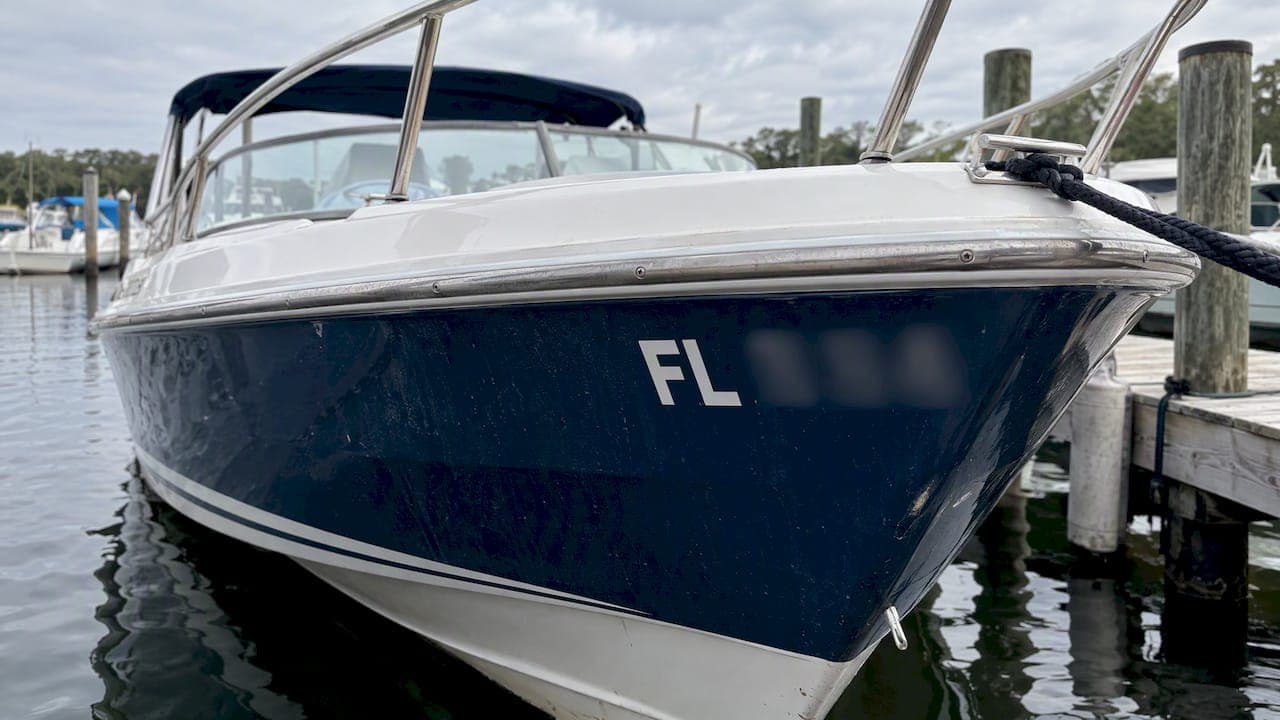
A boat registration number starts with two letters that identify the state that issued it, followed by four digits and a two-letter suffix. Texas boats start with TX, Florida boats with FL, and California boats with CF. For most states the prefix matches the postal abbreviation. A handful don't, so check your state's boating agency before you order anything printed.
This guide explains where the prefixes come from, how the full number is built, which special prefixes you may see on dealer and government boats, and how to display the number so a patrol officer can read it at a glance.
TL;DR
- The prefix is a two-letter code for the state that issued the number. The U.S. Coast Guard developed these abbreviations after the Federal Boating Act of 1958.
- 39 states and the District of Columbia use the same letters for the Coast Guard and the Postal Service. The rest differ, and California's CF is one example.
- A standard number has three parts, prefix, numerals and suffix, separated by spaces or hyphens. Federal rules require characters at least 3 inches tall in plain block letters on the forward half of the hull.
- Dealers, manufacturers and government vessels can carry special prefixes such as DA, MA, XS or XF.
- Always copy the number exactly from your Certificate of Number. Don't guess the prefix from the state name.
Table of Contents
- Why boat numbers start with a state code
- How a full boat number is built
- Prefixes that don't match the state abbreviation
- Special prefixes for dealers, manufacturers and government boats
- Where the number goes and how big it must be
- Where the validation decal goes relative to the prefix
- Which states have the most boats
- Our perspective: get the letters right before you worry about style
- Order a compliant set in minutes
- A quick checklist before you apply your number
- FAQ
- Sources
Why boat numbers start with a state code
The federal numbering system lets each state issue and track its own registrations while keeping every vessel identifiable nationwide. The prefix tells an officer where the boat was registered. The numerals and suffix tell the state which boat it is.
That design has a safety purpose. The NASBLA Vessel Identification, Registration & Titling Committee describes accurate vessel information as the backbone of recreational boating safety data. A marine patrol can read your number from another boat, check the state, and look up the registration without boarding you.
The prefix is also the quickest answer to a common question: how do you tell what state a boat is registered in? Read the first two letters on the bow. If they don't match the state where the owner lives, the boat may be registered elsewhere, or the owner may have moved and not updated the registration.

How a full boat number is built
A standard recreational number follows a fixed pattern:
| Part | What it is | Example (Texas) |
|---|---|---|
| Prefix | Two letters for the issuing state | TX |
| Numerals | Usually four digits | 0001 |
| Suffix | Two letters | GG |
Texas Parks & Wildlife gives the format as TX 0001 GG or TX-0001-GG. Florida's agency describes its own standard spacing in the same way, and its guidance on numbering and decals notes that a Florida registration number is permanent for the vessel.
California is a good example of a prefix that doesn't match the postal code. The California DMV says its numbers are prefixed with CF, followed by four numbers and a two-letter suffix. In California, suffixes containing I, O or Q are never issued, which avoids confusion with the digits 1 and 0.
The spacing rule most people get wrong
The space or hyphen between groups is not decoration. Under 33 CFR 173.27, spaces or hyphens must equal the width of a letter other than I, or a number other than 1. A thin gap or a narrow dash can read as a continuous string from a distance, and it is an easy thing for an officer to flag.
When you design a number, check the gap against a wide character such as a 4 or an H at the same size. If the gap is visibly narrower, widen it.
Prefixes that don't match the state abbreviation
Most states are straightforward. Texas is TX, Florida is FL, Ohio is OH. The exceptions are the reason this keyword gets searched at all, because owners assume the postal code and find the number rejected or misread.
We don't reprint a full table here because state agencies can change their rules and a stale list does more harm than none. Two reliable ways to get your prefix right:
- Read your Certificate of Number. The number printed there is the one you must display, prefix included.
- Check the state's own page. The NASBLA registration and titling resources list the official two-letter vessel numbering abbreviations, and our state-by-state regulations page covers display rules for each state we serve.
If you're buying a used boat, the same applies. The old owner's number may carry another state's prefix. When a boat moves between states, the new state generally issues its own number, so the old prefix should come off.
Special prefixes for dealers, manufacturers and government boats
Not every number on the water is a standard owner registration. The California DMV notes that special numbers are issued for specific cases: DA for dealers, MA for manufacturers, and XS or XF for government-owned vessels.
This matters if you run a dealership or a marina:
- A demo or inventory boat under a dealer number may have different display and renewal obligations than a customer's boat.
- A boat that transfers from dealer inventory to a buyer needs the buyer's own registration number, so the dealer prefix shouldn't stay on the hull.
- Government and agency boats follow their own rules, and you should confirm them with the issuing agency before anything is applied.
If you handle a lot of boats, our dealer program is built for that volume.
Where the number goes and how big it must be
The prefix is only useful if people can read it. Federal rules set the basics:
- Display the number on both sides of the forward half of the vessel.
- Use plain block characters at least 3 inches high.
- Choose a color that contrasts with the hull.
- Read left to right.
Those points come straight from 33 CFR 173.27. For a closer look at the two-sided requirement, see our answer on whether numbers go on both sides, and for the layout itself, where registration numbers go on a boat.
Borders and outlines don't count
If you like a custom look, keep the character itself at full height. California's boating agency says border, trim, outlining or shading are ignored when judging character height and contrast. A 3-inch character with a decorative outline is still a 3-inch character. A 2.5-inch character with an outline that brings it to 3 is not compliant. Our boat number design guide walks through how to check this before you order.
Don't move the numbers back for looks
Owners sometimes push the number aft because the bow looks cleaner. California's boating guidance treats the forward half as the required position, and placing numbers elsewhere can invite a stop and a possible fine. Style your boat with color and font choices, not with placement.
Where the validation decal goes relative to the prefix
The registration decal (validation sticker) is separate from the number. In Texas, it must be placed in line with and 3 inches toward the rear of the TX number. Other states may allow it just before or after the number, so follow your own state's rule.
Expired decals should come off so that current ones are easy to verify. For the details, read our guides on where the validation sticker goes and state rules for sticker placement.
Documented vessels are a separate case. A USCG-documented vessel may be exempt from displaying the state registration number, but state rules on the validation decal can still apply, so check with your state agency.
Which states have the most boats
If you wondered why FL shows up so often, the numbers explain it. The NMMA reports that Florida leads the country with 1.2 million registered vessels, roughly 10% of the national total, out of 11.67 million recreational vessels registered across the states in 2024. For Florida owners, we cover the specifics in our Florida boat registration number requirements guide.
The Coast Guard's 2024 Recreational Boating Statistics are built from the data of the states and territories that have federally approved numbering and casualty reporting systems, which is exactly what the prefix system supports.
Our perspective: get the letters right before you worry about style
We make registration decals every day, and the most common mistakes we see have nothing to do with fancy fonts. They are small errors in the number itself: a postal abbreviation typed in place of the state's vessel prefix, a gap too narrow to count as a space, or a number printed from an old registration.

Our advice is simple. Take the Certificate of Number, not the old hull lettering, as the single source of truth. Type the number exactly as printed. Then pick the color and font for contrast first and personality second. Dark vinyl on a light hull, or white on a dark one, makes the prefix readable from a patrol boat, which is the whole point.
And if your bow has steep rake or sharp curvature, the vinyl matters as much as the letters. Flexible marine-grade vinyl conforms to compound curves without lifting, which keeps the characters whole in salt spray. Our decals are produced in-house from marine-grade vinyl chosen for UV and saltwater resistance, so the number you apply this season is still legible the next.
— Taylor
Order a compliant set in minutes
Our online design tool lets you enter your registration number, choose colors and a font, and see the layout before you pay. A custom set costs $35.99. Production takes 3 to 5 business days, and shipping is free in the contiguous United States.
If you own a specific type of boat, start from the page built for it: jet skis, pontoons, bass boats, aluminum boats or center consoles. When your decals arrive, our installation guide shows how to apply them cleanly.
A quick checklist before you apply your number
- Compare the prefix, numerals and suffix against your Certificate of Number, character by character.
- Confirm each character is at least 3 inches tall, excluding any outline.
- Make sure the spaces or hyphens are as wide as a standard letter or number, not a thin sliver.
- Pick a color that contrasts with the hull in sun and shade.
- Apply to the forward half of both sides, reading left to right.
- Place the validation decal where your state requires, and remove expired ones.
FAQ
How can I tell what state a boat is registered in?
Look at the first two letters of the registration number on the bow. They are the state's vessel numbering prefix, such as TX for Texas, FL for Florida or CF for California. If you need to confirm ownership or status, contact that state's boating or motor vehicle agency.
Is a boat prefix always the same as the state's postal abbreviation?
No. 39 states and the District of Columbia share the same letters for both systems, but the remaining states use a different Coast Guard prefix. California's CF is the best-known example. Copy the prefix from your Certificate of Number rather than assuming.
Do jet skis and kayaks use the same prefixes?
Motorized craft such as personal watercraft are numbered under the same system, so the prefix works the same way. Rules for paddlecraft vary by state. See our answers on jet ski numbers and kayaks and canoes before you buy.
What do DA, MA, XS and XF mean on a boat?
These are special numbers. The California DMV lists DA for dealers, MA for manufacturers, and XS or XF for government-owned vessels. They are not standard owner registrations, so display and renewal rules can differ from those for a typical private boat.
What state has the most boat registrations?
Florida, with about 1.2 million registered vessels in 2024, according to the NMMA. That is roughly 10% of all recreational boats registered in the country.
Sources
- Numbers and Decals on Vessels, Texas Parks & Wildlife Department
- Numbering and Decals, Florida Department of Highway Safety and Motor Vehicles
- 33 CFR 173.27, Numbers: Display; size; color, eCFR
- Vessel Numbers, California DMV
- ABC's of Registration, California Division of Boating and Waterways
- 2024 Recreational Boating Statistics, U.S. Coast Guard
- Boat Registrations Report, NMMA
- Registration & Titling Resources, NASBLA
- Vessel Identification, Registration & Titling, NASBLA
- List of U.S. state and territory abbreviations, Wikipedia