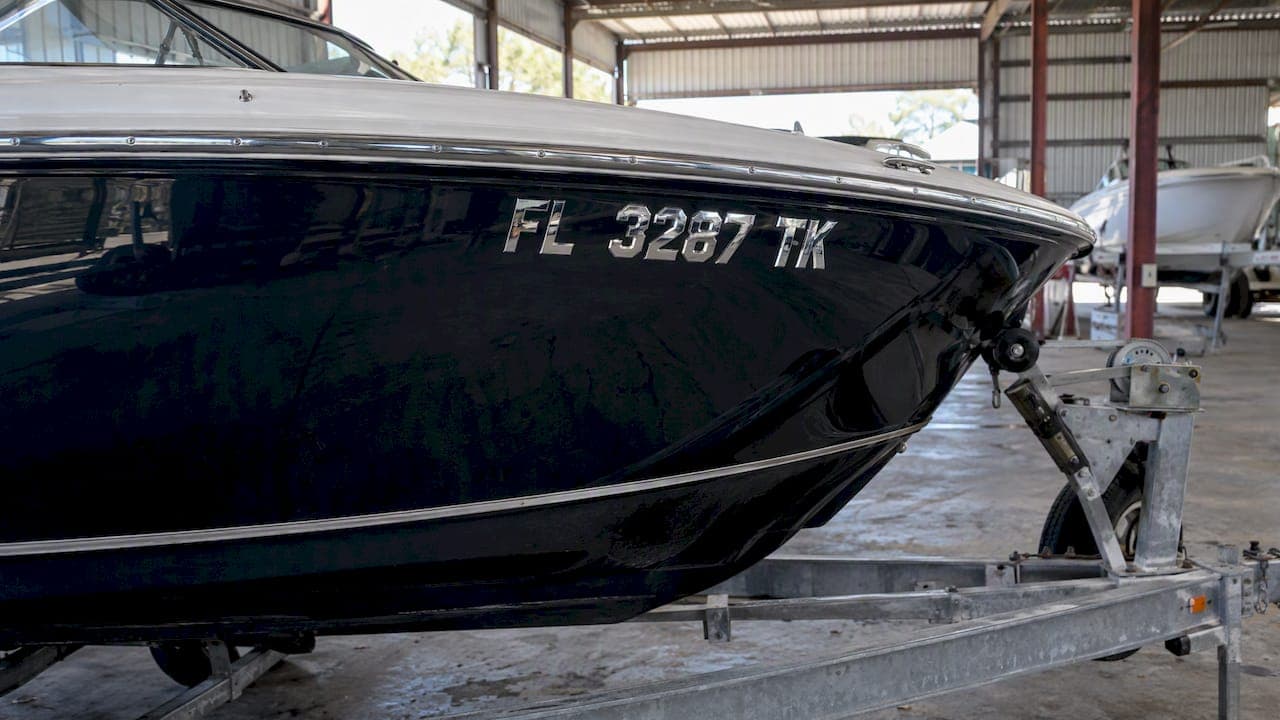
Chrome boat registration numbers can be legal, but the finish is not what makes them legal or illegal. Federal and state rules judge the numbers on height, shape, spacing, placement and contrast with the surface behind them. A chrome set that meets those tests passes. A chrome set on a silver or white hull, or one that turns into a mirror in the sun, can fail even if every character is the right size.
This guide walks through what the rules say, where chrome causes trouble, and how to check your own boat before an officer does.
TL;DR
- No rule we found bans chrome by name. 33 CFR 173.27 requires plain vertical block characters at least 3 inches high that contrast with the background and read left to right.
- Contrast is the weak point. Chrome on a dark hull usually reads well. Chrome on a white, gray or silver hull often does not.
- States add their own details, such as validation decal placement and, in Washington, letters you cannot use.
- Before you buy any finish, hold a sample against your hull in sun and shade and ask whether a stranger could read it from a distance.
- If you want zero doubt, a solid, high-contrast color in a block font is the safest choice.
Table of Contents
- What the federal rule actually says
- So are chrome numbers legal?
- Where chrome goes wrong
- Chrome and contrast: a practical check
- Hull color and number finish at a glance
- Do the rules change by state?
- Where the numbers must go
- Our perspective
- A compliant set, made to order
- Before you buy any chrome set
- FAQ
- Sources
What the federal rule actually says
The baseline for recreational boats is 33 CFR 173.27. Under it, the numbers must be painted on or permanently attached to each side of the forward half of the vessel. They must be in plain vertical block characters of not less than 3 inches in height, and they must contrast with the background so they are distinctly visible and legible. They read from left to right.

Spacing is part of the rule too. Groups of letters and numbers must be separated by a space or a hyphen equal to the width of a letter other than "I" or a number other than "1". If you want the detail, see our answer on how much space goes between boat registration numbers.
Notice what is missing from that list: a required material and a required color. The rule describes outcomes. Numbers must be seen and read. That is why chrome is a gray area rather than a banned product.
So are chrome numbers legal?
In plain terms: yes, when they meet every outcome the rule sets. Chrome is a finish, not an exemption. Think of it as a color choice that happens to come with extra risk.
The question an officer or marine patrol deputy asks is simple. Can I read this number, from a reasonable distance, on this hull? If the answer is yes, the finish is rarely the issue. If the answer is no, the finish is the likely cause.
We should be honest about one limit. Enforcement is local, and each state agency interprets "distinctly visible and legible" in its own way. No page we found gives a blanket federal ruling on chrome. When your state's boating agency says something different from this article, follow the agency.
Where chrome goes wrong
Low contrast against light hulls
Chrome is a light, silvery tone. On a white gelcoat, a gray aluminum hull or a metallic silver paint job, it can almost disappear. Contrast against the background is the federal test, so this is the most common way chrome fails.
A quick test: take a photo of your hull with the numbers on it, convert it to black and white on your phone and look at it. If the characters blur into the hull, they are not contrasting enough.
Glare and reflection
A mirror finish reflects the sky, the water and the dock. On a bright day, parts of a character can pick up the color of whatever sits behind the boat and look broken or washed out. Brushed or satin chrome-look finishes reduce this, but the same contrast test still applies.
Raised and domed styles
Many chrome sets are raised or domed. The rule says numbers must be painted on or permanently attached, so a firmly bonded raised set is not a problem in itself. The things to check are that the characters are still plain block shapes, still at least 3 inches tall, and still readable from an angle. A heavy bevel can cast shadows that blur the edges of the character.
Fancy fonts
Chrome sets are often sold in sporty or stylized fonts. The federal rule asks for plain vertical block characters. Hawaii's boating division, for example, says slanted or script numbers do not meet U.S. Coast Guard standards and recommends avoiding shaded numbers. Stylized fonts are a bigger legal risk than the chrome itself.
Chrome and contrast: a practical check
The contrast requirement is the same whatever the finish. A guide to how registration number decals meet contrast and legibility requirements is a good companion if you want to see how the rules apply on larger vessels.
Here is how we suggest you judge your own boat:
- Stand 25 to 30 feet away. Look at the hull side as another boater or a patrol boat would. Can you read every character without squinting?
- Check at different times of day. Morning sun, midday glare and late-afternoon shade change how chrome behaves.
- Check both sides. Hulls weather and fade unevenly, and the rule applies to each side. Our page on whether registration numbers go on both sides of the boat covers it.
- Measure. Each character must be at least 3 inches tall. Our guide to number height explains how to measure it.
- Ask your state agency. A short email to your boating law administrator or a call to a local marine patrol office settles it for your waters.
Hawaii's agency also notes that the number is used for search and rescue, safety control and theft prevention. That is a useful way to think about contrast. The number is not decoration. Someone may need to read it in a hurry.
Hull color and number finish at a glance
These are our practical rules of thumb, not regulations. The legal test is still contrast and legibility on your actual boat.
| Hull color | Chrome numbers | Safer choice |
|---|---|---|
| Black, navy, dark green | Usually reads well | Chrome is a reasonable pick |
| Red, dark blue | Usually reads well, check in glare | Chrome or white |
| White, off-white | Often weak contrast | Black or dark blue |
| Gray, silver, bare aluminum | Often weak contrast | Black or a deep solid color |
| Light metallic paint | Very risky | Black |
Do the rules change by state?
The federal rule is the floor. States set the rest, and most follow it closely.
- Florida. Statute 328.48 says numbers must be block characters at least 3 inches high, in a solid color that contrasts with the background, and kept clearly visible and legible. Our Florida registration number guide and Florida decal requirements page go further. Note the words "solid color": a multicolor or textured chrome pattern is something to confirm with the agency.
- Washington. State rules mirror the federal text: plain vertical block characters, at least 3 inches high, contrasting, reading left to right. Washington also prohibits the letters I, O and Q in the number configuration, to avoid confusion with numerals. See our Washington decal requirements.
- Texas. The state's rules cover where validation decals sit relative to the number, with a typical gap of 3 to 6 inches aft. Our guide to where the validation sticker goes explains the idea.
For every other state, our state-by-state decal regulations page is the place to start, and your state agency has the final word.
Documented vessels are different
If your boat is federally documented rather than state registered, the number rules differ. In Washington, for instance, documented vessels may not display the state registration number but must still show state decals as state law requires. Check your own state before ordering anything.
Where the numbers must go
Whatever the finish, placement is fixed. Numbers go on each side of the forward half of the vessel, on the hull or superstructure, or on a backing plate if they would not be easily visible otherwise. That matters for chrome. A raised chrome set bonded to a curved flare, or one tucked behind a rub rail, can lose legibility. See where registration numbers go on a boat for placement examples.
Our perspective
We make registration decals every day, and the same pattern shows up in the questions we get. Owners rarely fail because of the material. They fail because of contrast, a font that is not plain block, or spacing that is off.

Our decals are produced in-house from marine-grade vinyl chosen for UV and saltwater resistance. We designed our online tool around the rules: you enter your number, pick the color and font, and see it before you order. A solid, high-contrast color in a block font is the lowest-risk way to meet the contrast test, and it does not rely on how sunlight hits a reflective surface.
That is not a knock on chrome. On a dark hull, a clean block chrome set can look sharp and read well. Our advice is to decide based on your hull, not on the finish's reputation. Vinyl is also an accepted way to display numbers on many boats, which we cover in can registration numbers be vinyl decals. If you are unsure whether your state accepts it, ask first.
— Taylor
A compliant set, made to order
If you want numbers that remove the guesswork, we make custom registration decals in the color and block font you choose. You type in your registration number, preview it on screen and order. Production takes 3 to 5 business days, and shipping is free in the contiguous United States. A set starts at $35.99 on our custom boat registration numbers page.
We also have pages built for specific hulls: center console, pontoon, bass boat, aluminum boat and jet ski numbers. Marinas and dealerships can order in bulk. And if you are curious about wear, read how long marine vinyl decals last.
Before you buy any chrome set
- Confirm the character height is at least 3 inches, measured on the character, not the whole decal.
- Confirm the font is plain block, not italic, script or shaded. Our guides on required fonts and 3 inch block letters show what to look for.
- Confirm the color works on your hull. Our page on number color explains the contrast idea.
- Check the design on the screen against your hull color. Our boat number design guide walks through it.
- Confirm your state's rule for validation decals and for any banned letters.
- When installing, follow our step-by-step installation guide.
FAQ
Are chrome boat registration numbers legal in every state?
No state rule we reviewed bans chrome by name, but each state enforces the same core tests: height, block shape and contrast. A chrome set that is legible on your hull is generally fine. Confirm with your state boating agency, because local interpretation varies.
Can chrome numbers fail because of glare?
They can, indirectly. The rule requires numbers to be distinctly visible and legible, and a mirror finish can pick up reflections that break up the characters. If they are hard to read in bright sun, treat that as a warning sign.
Are raised 3D chrome numbers allowed?
The federal rule allows numbers that are painted on or permanently attached. A firmly bonded raised set can qualify if it is still plain block characters, at least 3 inches tall and readable. Avoid stylized fonts, and check with your state if you are unsure.
What is the safest color for registration numbers?
The safest option is a solid color that strongly contrasts with your hull, such as black on a white hull or white on a dark hull. Contrast is the federal test, and a solid color is the easiest way to pass it.
Do chrome numbers work on a jet ski?
Personal watercraft need numbers too, and the same block, size and contrast tests apply. Small, curved hulls make legibility harder, so read our page on whether jet skis need registration numbers before choosing a finish.
Sources
- eCFR: 33 CFR 173.27, Numbers: Display; size; color
- Florida Statutes 328.48 (2023), Florida House of Representatives
- Washington DOL: Boat registration and hull identification numbers
- WAC 308-93-145
- Texas Parks & Wildlife: Numbers and decals on vessels
- Hawaii DLNR: Numbering your vessel