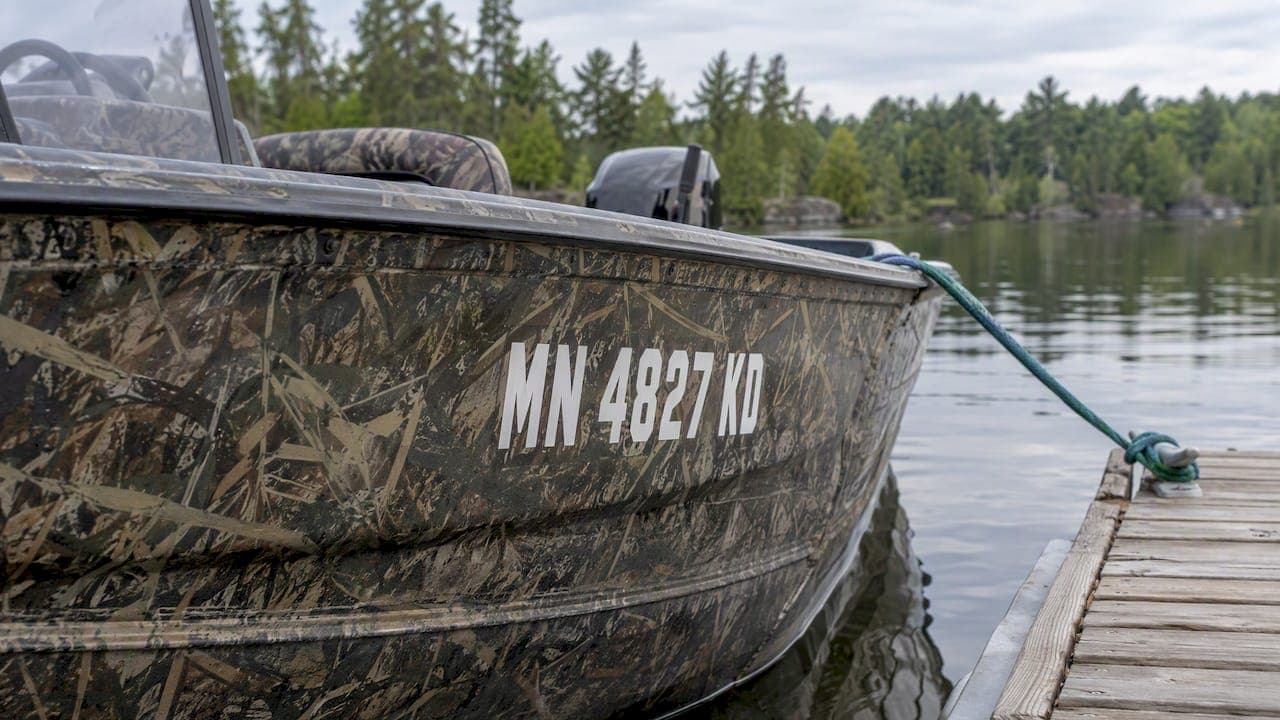
No, camo-patterned registration numbers are generally not legal. Federal rules call for plain, solid-color block characters that contrast with the hull, and a camouflage pattern defeats both requirements. A camo boat can still be fully legal, though. The numbers just have to be solid, and they have to stand out from whatever is behind them.
Below we cover the rule itself, why camo fails, how to number a camouflage hull so you pass a dockside stop, and where the decals go.
TL;DR
- Camo, multi-tone and patterned registration numbers do not meet the federal standard of plain, solid-color block characters, and state agencies such as the Wisconsin DNR tell boaters not to use them.
- Numbers must be at least 3 inches high, vertical block characters, on both sides of the forward half of the boat, in a color that contrasts with the hull.
- On a camo hull, use one solid contrasting color for the numbers, and consider a solid-color backing panel so the background is uniform.
- Validation decals are separate from the numbers and must be current. Expired ones come off.
- Camo is fine on the boat. It is not fine on the numbers.
Table of Contents
- What the federal rule actually says
- Why camo numbers fail the test
- "Close enough" is the usual excuse, and it does not hold
- How to number a camo boat legally
- Quick comparison: what passes and what does not
- Where the numbers and decals go
- Perspective: what we see with camo boats
- Material matters on a hull that lives outside
- Order solid-color numbers for a camo boat
- Rules that surprise boat owners
- Before you put the boat in the water: a checklist
- FAQ
- Sources
What the federal rule actually says
The governing text is 33 CFR 173.27. In plain terms, your numbers must be painted on or permanently attached to each side of the forward half of the vessel. They must be plain, vertical block characters, at least 3 inches tall, in a solid color that contrasts with the background. They read left to right, and the letter and number groups are separated by a space or hyphen.
The Coast Guard's boaters guide to federal requirements covers numbering alongside the other equipment and compliance items a recreational boat carries. States then add their own details on top. Federal law sets the floor. A state can be stricter about placement, decals and fees, but none can sensibly relax what a number must look like.
That last point matters for camo. You will not find a state where a camouflage-pattern number is clearly allowed under the solid-color standard. Wisconsin's guidance is explicit that camouflage and two-toned numbers should not be used.

Why camo numbers fail the test
There are three separate problems, and any one is enough to fail.
1. Not a solid color. The rule says solid color. A woodland, timber or marsh pattern is, by definition, several colors printed in one character. Outlining and shading have the same weakness: our own explainer on outlined boat registration numbers walks through why extra tones tend to run into trouble.
2. No reliable contrast. Contrast is judged against the background. Camo numbers are designed to blend in. Put them on a camo hull and you have done the opposite of what the regulation wants, which is a number that separates cleanly from the surface behind it.
3. Legibility at distance. Numbering exists so the boat can be identified for search and rescue and law enforcement. Pennsylvania's rule on display of registration numbers is one of many state versions of that standard. Hawaii's boating division describes the goal as numbers legible from at least 100 feet, with dark on light or light on dark being the safe approach. A pattern breaks up the edges of each character, which is exactly what camo is built to do.

The pattern is the problem, not the hobby. Duck boats, bass boats and johnboats in camo are everywhere. The number is the one part of the boat that has to behave like a sign.
"Close enough" is the usual excuse, and it does not hold
Most non-compliance does not come from people who want to break the law. It comes from people who think a design is close enough. A pattern with a black outline, a script font, a slight slant, letters packed tight: each one feels harmless on the garage floor. Under the federal wording they are all departures from plain, vertical block characters.
If you are choosing a typeface, the short answer is simple. Pick a straightforward block font. We cover the options in what font is required for boat registration numbers and in do boat registration numbers have to be block letters. Our boat number fonts guide shows what reads well from a distance.
How to number a camo boat legally
You have a camo hull and you want the boat to look right. Here is the approach that keeps both goals intact.
Step 1: Choose one solid color
Pick a single color with the strongest possible contrast against the darkest and lightest parts of the camo around the numbers. On a mixed pattern, that usually means white or a bright light color if the area behind the numbers is mostly dark. If it is mostly light, go with black or another dark color. Our page on what color boat registration numbers have to be goes through the logic.
Step 2: Check the background where the numbers will sit
Camo is busy. A white number can disappear across a pale patch of the pattern. Stand 100 feet away from the finished boat, or have a friend look from that distance, and ask whether you can read every character on both sides. If one corner of a letter fades, the contrast is not good enough.
Step 3: Consider a solid backing panel
A plain solid-color panel behind the numbers gives you a uniform background, so the contrast question goes away. Hawaii's boating division notes that a removable backing plate is a sensible choice for boats that get refinished often, because heating and peeling adhesive off a hull can damage gelcoat or paint. For a camo wrap or painted camo, it also protects the finish you paid for. Confirm with your state boating agency that a panel is acceptable where you boat, since numbers must be painted on or permanently attached to the boat.
Step 4: Size and space the characters
Numbers must be at least 3 inches tall. Taller is fine and often smarter on a large hull. Do not shrink them to keep the look tidy. Our boat number design guide and our explainer on how tall boat registration numbers need to be cover spacing and measuring.
Step 5: Keep the bow clean
No other numbers belong on the forward half of the vessel. Our answer on other numbers on a boat's bow explains what counts. A hull identification number or a sponsor graphic with digits can cause confusion, so keep them off the bow.
Quick comparison: what passes and what does not
| Style | Likely to pass? | Why |
|---|---|---|
| Solid white block numbers on a dark hull | Yes | Single color, strong contrast |
| Solid black block numbers on a light hull | Yes | Single color, strong contrast |
| Solid color numbers on a solid backing panel over camo | Generally yes, confirm with your state | Uniform background, clear contrast |
| Camo-patterned numbers on any hull | No | Pattern, not a solid color |
| Solid green numbers on a green camo hull | Risky | Contrast depends on the spot, often fails |
| Outlined or shaded numbers | Risky | Extra tones, see the outline guidance above |
| Script or slanted lettering | No | Not plain, vertical block characters |
Where the numbers and decals go
Once the look is settled, placement is simple but easy to get wrong.
- Numbers: both sides of the forward half of the boat, reading left to right. See where boat registration numbers go and whether they go on both sides.
- Validation decals: Florida's statute, for example, places the decal near the number, and the usual standard is within about 6 inches, in line with the number. Only the current decal should show. Our page on where the validation sticker goes explains it.
- Pontoons: the flat fence and rail layout makes placement a question of its own. We cover it in pontoon registration number placement.
A word on language that trips people up: the numbers and the validation decal are two different things. The number is issued once and stays with the boat. The validation decal is what shows the registration is current.
Perspective: what we see with camo boats
We make registration numbers all day, and camo boats are one of the questions we hear most. The conversation tends to go the same way. The owner has a beautiful hull finish and does not want a bright white sticker in the middle of it. We understand that. But the number is the one feature on your boat that exists for other people, not for you. It is for the officer, the marina attendant and, in the worst case, the rescuer scanning the shoreline.
So our advice is not to hide the number in the pattern. Make it quiet by making it tidy: a good block font, even spacing, a single color chosen deliberately, and sized to the minimum or a little above. A crisp number on a camo boat looks intentional. A patterned one looks like a citation waiting to happen.
We also push back on the idea that customization has no limits. You can personalize color, size above the minimum and which supplier you trust. You cannot personalize the character shape. Functionality comes before aesthetics here, and the owners who accept that early save themselves a reorder.
— Taylor
Material matters on a hull that lives outside
Decals on a duck boat or bass boat see spray, sun and scraping through reeds. A legal number that peels or fades stops being legal in practice. Our guide to the best vinyl for boats explains what to look for, and how long marine vinyl decals last sets realistic expectations. Whether vinyl is acceptable at all is answered in can registration numbers be vinyl decals instead of painted.
Hull care affects the surface your numbers sit on. If you are weighing a marine ceramic coating for boats, plan the coating and the decals together, so the numbers stay clean and readable afterward.
Order solid-color numbers for a camo boat
Our online design tool lets you enter your registration number, then choose a solid color and a block font in minutes. Numbers are cut from marine-grade vinyl that is UV-safe and saltwater-proof. A set is $35.99, production takes 3 to 5 business days, and shipping is free across the contiguous United States. Design your boat numbers now, or go straight to the page for your hull type: bass boats, aluminum boats, pontoons, center consoles or jet skis. Check your state's specific rules in our state-by-state decal regulations.
Rules that surprise boat owners
Documented boats
A vessel documented with the Coast Guard is often exempt from displaying the state registration number, but it still carries the state validation decal. Washington State Parks spells out how documented vessels and decals work in that state.
Numbers stay with the boat
Registration numbers do not transfer between vessels. If you sell, the number stays with the boat and the buyer registers it. Washington's rule on vessel registration numbers also bars the letters I, O and Q from the number, to avoid confusion with 1 and 0.
Small and unusual craft
Whether a small craft needs numbers depends on propulsion. In Washington, a manually propelled boat is generally exempt, but a boat with a motor, even a small trolling motor, must be registered and display its numbers. Utah's boating guide takes a similar view of motors. For paddle craft see kayaks and canoes, and for personal watercraft see jet ski numbering rules.
Before you put the boat in the water: a checklist
- The numbers are one solid color, in a plain block font.
- Each character is at least 3 inches tall and vertical.
- The color stands out against the exact area behind it, checked from a distance.
- Numbers appear on both sides of the forward half, reading left to right.
- Groups are separated by a space or hyphen.
- The current validation decal sits near the number, and old ones are removed.
- No other numbers are on the forward half of the hull.
- You have checked your own state agency's page for any local detail.
FAQ
Are camo boat registration numbers legal?
Generally no. Federal rules require solid-color, plain block characters that contrast with the hull, and camouflage patterns are neither solid nor reliably contrasting. Use a solid color instead.
Can I put solid numbers on a camo boat?
Yes. Choose one solid color with strong contrast against the area where the numbers sit. If the pattern is busy enough that contrast varies, a solid-color backing panel gives you a uniform background, but confirm with your state boating agency first.
Do inflatable boats need registration numbers?
It depends on propulsion. In Washington, for example, an inflatable with a motor, even a small trolling motor, must be registered and display numbers and decals on the bow. A manually propelled one is exempt.
Where must registration numbers be on a boat?
On both sides of the forward half of the vessel, reading left to right, in characters at least 3 inches tall. The validation decal goes near the number, typically within about 6 inches.
Sources
- 33 CFR 173.27, Numbers: Display; size; color (eCFR)
- A Boater's Guide to the Federal Requirements for Recreational Boats (U.S. Coast Guard)
- What you should know before you operate your boat (Wisconsin DNR)
- 58 Pa. Code § 93.5, Display of registration number and validation decal
- Numbering Your Vessel (Hawaii Division of Boating and Ocean Recreation)
- Chapter 328, Section 48, 2026 Florida Statutes
- Boat Registration (Washington State Parks)
- WAC 308-93-145, Vessel registration numbers (Washington)