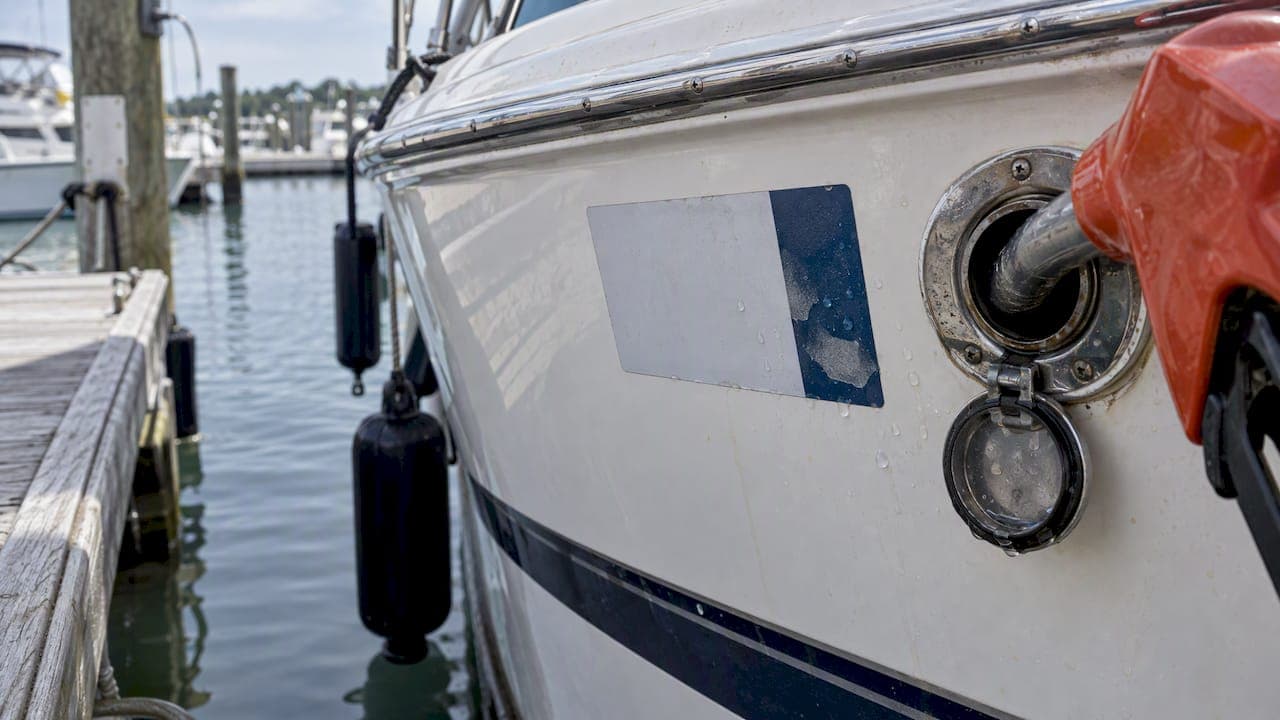
Gasoline and boat decals are a bad mix, but not a hopeless one. A quick drip of fuel that you wipe off right away usually does nothing to a quality marine vinyl decal. Fuel that sits, soaks in or runs down from a vent every time you fill up can bubble, stain and soften cheap vinyl. This guide covers what gasoline does to decals, what to do the moment you spill, which materials hold up, and how to tell a fuel-tank label from the registration numbers on your bow.
TL;DR
- Occasional fuel contact is survivable for good cast marine vinyl. Fuel left sitting on the surface is what causes bubbling, staining and lifting.
- Wipe a small spill off the decal quickly, but never try to clean up a large gasoline spill yourself. Gasoline is highly flammable, and spills in the water must be reported.
- A clear cast laminate over the vinyl adds a barrier against petroleum vapors, salt spray and UV.
- Registration numbers and fuel-tank labels are different things with different rules. Do not mix them up when you order or replace decals.
- If a decal is already damaged, heat and a plastic scraper remove it without harming the gelcoat. A razor blade does not.
Table of Contents
- Three things people mean by "gasoline on boat decals"
- Can gasoline damage boat decals?
- What to do when gasoline spills on a decal
- Which vinyl and finish stand up to fuel
- Registration numbers versus fuel-tank labels
- Do boats use unleaded gasoline?
- Removing a gasoline-damaged decal without harming the finish
- Our perspective: plan for the splash
- Replacing registration decals that fuel has damaged
- A practical routine for fueling around decals
- FAQ
- Sources
Three things people mean by "gasoline on boat decals"
The search brings up very different pages, and it helps to sort them first.
- Fuel damaging your decals. Boaters complain that vinyl below a fuel vent bubbles and discolors after a few fill-ups. This is the main subject of this article.
- Gasoline warning decals. Small stickers that read "GAS" or "fuel tank," sold as round or rectangular marine labels. They help identify a fill or a fuel line.
- Fuel-tank labels. Permanent labels that a tank manufacturer applies to meet federal rules. You do not make these yourself.
We cover all three, because the same boat owner often runs into each one in the same season.
Can gasoline damage boat decals?
Yes, it can, and how fast depends on a handful of factors: the type of vinyl, whether it is laminated, how long the fuel stays in contact, and how much sun is cooking the surface at the time.
Manufacturers of graphic films are consistent on the basic point. Orafol's care guidance says owners should avoid letting fuels remain in contact with vinyl graphics for extended periods and should clean spills as soon as possible to prevent damage. The product bulletin for 3M Series 1080 says that film resists occasional fuel spills. Notice the word "occasional." No film is rated to be soaked in gasoline.
What speeds up the damage
- Cheap calendered vinyl. Thin, low-cost film shrinks and softens more readily than cast film. Its adhesive also tends to creep at the edges.
- Location below a fuel vent or fill. Gasoline expands in a warm tank and can weep out of a vent. A decal placed right under it takes the hit every time. Boaters on forums describe vinyl bubbling and discoloring after a single drip they were not there to wipe off.
- Heat and sun. A hot hull accelerates the solvent action and dries the fuel into the film's surface.
- Cut edges. Gasoline gets under an edge that is already lifting from UV or pressure washing, and from there it dissolves adhesive.
- No laminate. Unprotected film has nothing between it and the fuel.
What damage looks like
Expect one of these. First, a dull or yellowish stain that may fade in the sun. Second, small bubbles where fuel has migrated under the film. Third, a tacky, soft surface. Fourth, edges that curl and collect dirt. Stains sometimes recover. Bubbles and tackiness usually mean the decal needs replacing.
What to do when gasoline spills on a decal
Safety comes first, and the decal comes second.
Small drips during fueling
For a few drops on the hull, stop fueling, wipe the drops with an absorbent rag or pad, and let the area air out. Keep ignition sources away, and dispose of the rag safely, not in a closed bin on the boat. Gasoline vapors are heavier than air and collect in low spaces, so ventilate before starting the engine.
Then rinse the area with fresh water. Orafol's guidance is to clean up quickly, so do not wait until the end of the day when the sun has baked it in.

Bigger spills, or any spill reaching the water
Do not try to clean up spilled gasoline yourself. Clean-boating guidance from Georgia Strait Alliance warns against containing or cleaning spilled gasoline because it is highly flammable. The BoatUS Foundation explains the rest of the procedure in its page on what to do after a fuel spill:
- Do not use soaps or detergents on a spill in the water. Federal law prohibits using soaps, detergents, emulsifying agents or other chemicals to disperse a spill in U.S. waters.
- Contain what you can only with oil-absorbent pads or booms, when it is safe to do so.
- Call the U.S. Coast Guard National Response Center.
That point about soap matters for decals too. Many people reach for dish soap to cut gasoline on the hull. On the hull above the water, a mild wash is fine once the fuel is gone. Never use it to break up fuel that is floating on the water.
Which vinyl and finish stand up to fuel
The best answer is a combination of a cast marine vinyl and a clear laminate on top.
Cast vinyl. Cast film is made as a thin liquid layer and cured, so it stays dimensionally stable and conforms to curves without shrinking back. The 3M cast film mentioned above is described as resisting mild alkalis, mild acids, salt and occasional fuel spills.
Clear cast laminate. Avery Dennison's DOL 1000Z series is a clear cast laminate that the manufacturer lists for marine and watercraft use. Its data sheet says it resists UV, temperature, humidity, salt spray, mild chemicals and petroleum vapors. That is the kind of protection you want on any graphic that lives near a fuel fill.
A useful comparison for your own decisions:
| Factor | Basic calendered vinyl | Marine-grade cast vinyl | Cast vinyl with clear laminate |
|---|---|---|---|
| Occasional fuel splash | Stains, may soften | Generally tolerates if wiped promptly | Best protection of the three |
| Salt and UV | Fades, shrinks | Built for it | Built for it, plus a wear layer |
| Prolonged fuel contact | Poor | Still poor | Still not recommended |
| Best use | Short-term indoor or dry use | Registration numbers, names | Graphics near fuel vents or fills |
The last row of the "prolonged contact" line is honest: nothing is made for soaking. Material choice buys you time to wipe, not immunity.
Our own page on how long marine vinyl decals last goes into lifespan more broadly.
Placement can matter more than material
If you have a choice, keep decals away from fuel vents and fill plates. A few inches of separation turns a repeated problem into a rare one. For registration numbers you rarely have much choice, since the numbers must go on the forward half of the hull. See where registration numbers go on a boat before you move anything.
Registration numbers versus fuel-tank labels
This is the section that clears up the most confusion.
Registration numbers and validation decals
These identify your boat. According to the Coast Guard's Boater's Guide to Federal Requirements (revised November 2023):
- Registration numbers appear on both sides of the forward half of the boat.
- State validation decals go within six inches of the numbers.
- Numbers are at least 3 inches high, in plain vertical block characters, and contrast with the hull color.
None of that is a fuel label. A "GAS" sticker or a fuel-line warning never substitutes for your registration numbers. If you want to check details, we have short answers on numbers on both sides of the boat, block letters and the validation sticker, and a guide to checking that numbers stand three inches tall.
Fuel-tank labels
A fuel-tank label is the manufacturer's identification of the tank. Under 33 CFR 183.514, it must identify:
- the manufacturer and address
- the manufacture month or lot and year
- capacity
- material
- test pressure
- other applicable information
The Coast Guard's guidance document on labeling adds that letters and numbers must be at least 1/16 inch high, roughly 8-point type, and must contrast with the background or be embossed. Labels should stay legible for the equipment's intended life, given as 10 years, and any effort to remove or alter the information should be apparent.
More broadly, 33 CFR 181.19 says required labels must withstand water, oil, salt spray, direct sunlight, heat, cold and normal wear without losing legibility.
What that means for you: if a tank label is worn or unreadable, a homemade sticker does not replace it. Talk to the tank's manufacturer or a marine mechanic about the correct fix. Do not peel or alter a tank label.
Optional "GAS" and warning decals
Small stickers marked "GAS" or warning of fuel lines are widely sold as convenience labels. They can help a crew or a marina attendant find the right fill. Choose ones printed on outdoor-rated vinyl, and apply them where fuel will not routinely run over them.
Do boats use unleaded gasoline?
Most owners ask this because they see "gasoline" and wonder about the fuel itself. The short answer: most gasoline-powered boats run on regular pump gasoline, but your manual decides.
Discover Boating notes that current outboard, sterndrive and inboard gasoline engines are designed to run safely on fuel with no more than 10% ethanol, known as E10. It also tells owners to read the owner's manual for fuel and oil requirements, since the manual may specify a minimum octane rating. Two-stroke outboards may also need oil mixed in or injected, so check before you fill.
Removing a gasoline-damaged decal without harming the finish
When fuel has ruined a decal, replace it. Taking it off carefully protects the gelcoat or paint underneath.
- Wash and dry the area. Remove salt and grit first so you do not drag them across the hull.
- Warm the vinyl. A heat gun on low or a hair dryer softens the adhesive. Keep it moving. Overheating can mark gelcoat.
- Lift an edge with a plastic scraper. A boat-care guide from Boat Juice advises against metal scrapers or razor blades on gelcoat, since they leave deep scratches. Use plastic tools.
- Peel slowly at a low angle. Reheat as you go. Brittle decals come off in pieces, which is normal.
- Deal with the adhesive residue. Use a remover made for marine finishes, tested on a small hidden spot first. The same guide warns that aggressive industrial solvents can dull or damage gelcoat. For stubborn, brittle leftovers, a rubber eraser wheel can lift adhesive by friction.
- Wash, then polish or wax. Clean off all remover before you apply anything new. A faint outline of the old decal is common on faded hulls, since the covered area did not fade with the rest.
Wait until the surface is fully clean and dry before installing new numbers. Our installation guide walks through the process.
Our perspective: plan for the splash
We make registration decals from marine-grade vinyl chosen for UV and saltwater resistance, and we produce them in-house. We hear the fuel question mostly from owners whose numbers sit near a vent or fill on the forward half of the hull. That is simply where the law puts them.

Here is how we think about it. The first defense is habit: fill slowly, do not top off to the brim in the heat, and carry a rag. The second is material: cast marine vinyl holds up to the occasional drip far better than bargain film. The third is replacement: registration decals are meant to be replaced when they wear out, and a fresh set costs far less than the fine for unreadable numbers. We would rather you reorder than drive around with a stained, peeling set that an officer cannot read.
We also want to be clear about what we do not claim. Nobody should promise that vinyl survives repeated fuel soaking. We recommend wiping spills early and keeping non-required graphics away from vents.
— Taylor
Replacing registration decals that fuel has damaged
If gasoline stained, softened or lifted your registration numbers, you can order a new set from us. Use our design tool to enter your numbers, pick colors and a font, and see the layout before you pay. A custom set of boat registration numbers and decals is $35.99 per set, with production in 3 to 5 business days and free shipping in the contiguous United States.
Design your registration decals and check the result against your state's rules. We also have dedicated pages for center console, pontoon, bass boat, aluminum boat and jet ski numbers. Your state's requirements are listed in our state-by-state regulations, and placement rules are explained in our sticker placement guide.
A practical routine for fueling around decals
A few habits cut fuel damage more than any material upgrade.
- Fuel with the boat level. A boat that leans lets fuel run back toward the vent.
- Stop before the tank is full. Gasoline expands when it warms. A tank filled to the top in the morning may weep at the vent by afternoon.
- Keep a rag in the same spot every time. If it is easy to grab, you will use it.
- Rinse after fueling in summer. A quick splash of fresh water on the hull near the vent clears vapors and drips.
- Check edges each season. Lifting corners are an early warning. Press them down or replace the decal before fuel gets under.
- Store with a sensible tank level. Storage advice varies by engine maker, so follow your manual.
If you must place a name or hailing port near a vent, consider moving it, or at least choose a laminated cast film so you have more time to react.
FAQ
Will gasoline remove vinyl boat decals?
A single quick splash that you wipe up usually will not, particularly on quality cast marine vinyl. Fuel left in contact for a long period can soften the film, bubble it and weaken the adhesive. Low-grade vinyl suffers sooner.
Can I clean a gasoline spill off the boat myself?
You can wipe small drops off the hull with an absorbent rag while keeping ignition sources away. For anything larger, or any fuel reaching the water, do not try to clean it up yourself. Gasoline is highly flammable, and spills in U.S. waters should be reported to the National Response Center. Never use soap or detergent to disperse fuel on the water.
Do I need a gasoline decal on my boat?
Your registration numbers and state validation decal are what you must display, and they are not fuel labels. A fuel tank carries its own manufacturer label under federal rules. Extra "GAS" stickers are optional conveniences.
What vinyl is best for boat decals near fuel?
Choose cast marine vinyl with a clear cast laminate. Avery Dennison lists its DOL 1000Z laminate as resistant to petroleum vapors, salt spray and UV. It improves your odds, but it does not make decals safe for long fuel contact.
How do I get decal residue off a boat?
Warm the old vinyl, peel it with a plastic scraper, then remove leftover adhesive with a marine-safe remover tested on a hidden spot. Avoid metal blades and harsh solvents, which can scratch or dull gelcoat.
Sources
- Orafol Americas: care and maintenance of graphics
- 3M Series 1080 product bulletin
- BoatUS Foundation: In case of a spill
- Georgia Strait Alliance: fuel and oil spills
- Avery Dennison DOL 1000Z series data sheet
- U.S. Coast Guard: Boater's Guide to Federal Requirements
- 33 CFR 183.514: Fuel tanks, labels
- U.S. Coast Guard labeling guidance (ABYC 1002.01)
- 33 CFR 181.19: Construction of labels
- Discover Boating: Choosing the right marine fuel and oil
- Boat Juice: How to remove decals from your boat