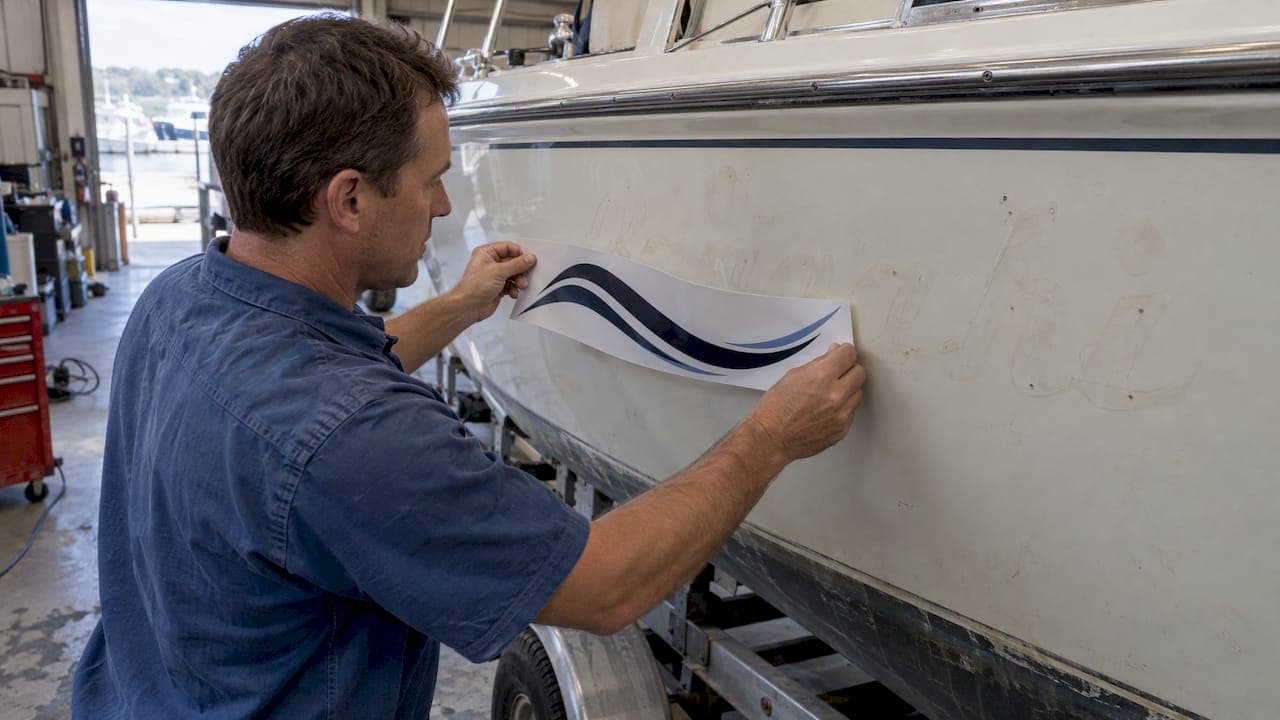
Decals can hide some boat damage: ghost shadows left by old lettering, light surface scratches and uneven fading. They can't fix cracks, blisters or soft spots, and they can't replace a legal registration number. The rule of thumb from sign makers is simple. Make the new graphics slightly larger than the old ones, and keep your registration numbers separate from any decorative cover-up.
This guide covers which damage a decal can mask, how to size and place one, and where federal rules limit you. It also covers what to do about the ghosting that shows up when you peel off old letters.
TL;DR
- Decals work on cosmetic problems: ghost outlines from old lettering, minor scuffs and patchy fading. They do nothing for structural damage.
- Ghosting is usually uneven sun damage to the gelcoat, not leftover adhesive. Sign makers often cut the new set larger to cover the transition.
- Registration numbers have to stay plain block characters, at least 3 inches high, in a contrasting color. Don't turn them into decoration.
- Never use acetone or paint thinner to prep or clean a fiberglass hull.
- Our custom registration decal sets start at $35.99 per set, made from marine-grade vinyl.
Table of Contents
- What "covering damage" with decals really means
- Why old decals leave a shadow
- Removing the old decal first, without making things worse
- Sizing a new decal to hide the outline
- Covering scratches and blemishes
- Choosing vinyl that survives the water
- The line you can't cross: registration numbers
- Our perspective: fix the finish, then decorate
- Ordering a clean replacement set
- A quick decision guide
- Common mistakes to avoid
- FAQ
- Sources
What "covering damage" with decals really means
The phrase covers three different jobs, and the right answer differs for each.
- Hiding a ghost. You removed old letters or stripes and left a glossy outline on chalky gelcoat.
- Hiding cosmetic blemishes. Small scratches, scuffs or stained spots that a graphic can sit over.
- Hiding real damage. Cracks, gouges, blisters, delamination. This is repair work, and a decal over it is a bad idea. It hides a problem you need to see and monitor.
Only the first two are decal jobs. If you can press on a spot and feel flex, or you see spider cracks radiating from an impact, see a fiberglass repair shop first. A decal can go over the finished repair later.
Why old decals leave a shadow
Most "damage" people want to cover is ghosting. It looks like a defect in the vinyl or adhesive, but it's rarely that. Practitioners on one sign-maker forum describe the same pattern: the gelcoat under the letters stayed glossy and new, while the surrounding area turned chalky from sun damage. The decal protected the finish beneath it for years.
That has a few practical consequences:
- Scrubbing the outline harder won't help. You'd be polishing a finish that is already in good shape.
- The real fix is to bring the surrounding gelcoat back up. Buffing the dull area can restore its shine so it matches the protected part, and that work is normally done by a detailer, a fiberglass repair person or a paint shop.
- Some boat owners try fine-grit wet sanding. One iboats forum thread shows an owner whose ghost survived acetone, adhesive remover and denatured alcohol, which tells you solvents are the wrong tool and can also hurt the finish.
If you want to see what proper removal looks like before you decide, read our walkthrough on removing boat decals without wrecking the finish.
Removing the old decal first, without making things worse
The best cover-up starts with a clean surface. Damage you cause during removal is the damage you'll end up covering.
West Marine's removal guidance recommends the following order:
- Wash the area with boat soap.
- Soften the vinyl with gentle heat, such as a hair dryer on a low setting, or use a pneumatic eraser wheel at roughly 2,000 RPM.
- Lift slowly from a corner, working small sections.
- Keep acetone and paint thinners away from painted or clear-coated fiberglass. They act as paint strippers.
Heat is both your best tool and your biggest risk. Too much heat makes vinyl brittle so it tears, and it can permanently damage gelcoat and paint underneath. Slow and steady on small areas beats speed every time.
Older decals are the hardest. UV exposure hardens the vinyl and makes the adhesive stubborn, so expect more time on a decal that has been in the sun for a decade than on one that is three years old.
Sizing a new decal to hide the outline
This is the cheapest and least risky cover-up, and sign professionals reach for it often. Rather than aggressive compounding or sanding, experienced sign makers simply design the new graphics larger than the original so the edge of the new vinyl lands on weathered gelcoat, not on the ghost line. A separate iboats discussion lands in the same place.
A practical way to do it
- After removal, wash and dry the hull, then take a photo with the sun at a low angle. Ghosting shows best in raking light.
- Measure the full outline of the ghost, not just the letters. Include the spaces between characters.
- Add margin on every side. How much depends on how pronounced the ghost is, so mark the new edges with painter's tape and step back before ordering.
- Check the larger size still fits the space on the hull. Bow flare, hull ribs and fittings limit how big you can go.
Where this works and where it doesn't
It works well for boat names, hull stripes and decorative graphics. It's harder for registration numbers, because those carry specific size and spacing rules, covered below. A reminder from the sign-maker side: some shops don't do the buffing and restoration part at all. They send customers to detailers, fiberglass repair people or paint shops. Expect to coordinate the two trades yourself.
Covering scratches and blemishes
A decal on top of a light surface scratch can look fine from the dock, but a few rules keep it from looking worse in a year.
- Fill and smooth first. Vinyl follows the surface under it. A groove deeper than a fingernail catch will show as a line through the graphic.
- Don't decal over loose material. Flaking paint, chalk and wax all weaken adhesion. Surfaces should be thoroughly cleaned of dust, grease and contamination, and freshly painted surfaces should be fully cured, as vinyl makers say in their data sheets. See the Oracal 651 technical data sheet.
- Pick a shape that suits the blemish. A wide stripe or a larger graphic hides a scratch better than a small sticker with hard edges beside it.
- Skip waterline and splash-zone cover-ups. Constant immersion and spray are hard on any adhesive.
Choosing vinyl that survives the water
The cheapest material is a common reason cover-ups fail. A decal that lifts at the edges lets water underneath, and you end up with a bigger problem than the one you hid.
Oracal 651 is a popular sign-making film. Its data sheet lists an outdoor service life of up to 5 years for black and white, 4 years for transparent and colored films, and 3 years for brilliant blue, measured in normal vertical outdoor conditions in Central Europe. That is a medium-term product. For a hull that sits in salt water and strong sun, marine-grade vinyl chosen for UV and saltwater resistance is the safer pick.

Our own sets use marine-grade vinyl that is UV-safe and saltwater-proof, produced in-house. For more on the material question, see our guide to the best vinyl for boats, and for lifespan numbers, how long marine vinyl decals last. If your current graphics are fading rather than damaged, preventing boat decal fading may save you a replacement.
The line you can't cross: registration numbers
This is where "cover the damage" can get you in trouble. Federal rules set the standard for how registration numbers look, and a decorative cover-up can't override them.
Under 33 CFR 173.27, numbers must be painted on or permanently attached to each side of the forward half of the vessel. The Coast Guard's boater guide summarizes the rest:
- Plain vertical block characters, at least 3 inches high.
- Read left to right, in a color that contrasts with the hull.
- Validation decals within 6 inches of the number on each side.
- "Permanently attached" means removal or alteration would be obvious.
- No other numbers or letters displayed nearby on the forward half of the hull.
Practical consequences for damage cover-ups:
- Don't place a decorative graphic, stripe or name so close to the numbers that it crowds or obscures them.
- Don't use a script, shadowed or outlined font for the numbers to mask a ghost. Stick to block characters.
- If you're covering ghosting where old numbers used to be, the new numbers still need to be at least 3 inches tall and contrast with the hull.
- Be careful with extra numbers. See our answer on other numbers on the bow.
Vinyl is generally accepted for the numbers themselves. Our page on whether registration numbers can be vinyl decals goes through it. State rules can add to the federal baseline, so check your state's page in our state-by-state decal regulations before ordering. For layout details, see where registration numbers go, whether they go on both sides, and where the validation sticker goes.
If a number is hard to read because the hull behind it is chalky, ghosted or patchy, replacing it with a fresh high-contrast set is a legitimate fix. Our boat number design guide shows how to check that your characters really stand three inches tall.
Our perspective: fix the finish, then decorate
We make registration decals every day, and the most common call we hear after a removal is some version of "the old numbers left a shadow." Our view is that the shadow isn't a flaw in the decal. It is a record of how much sun the rest of your hull has taken.

We'd rather you hear that before you order than after. If the surrounding gelcoat is badly oxidized, no vinyl will make it look uniform. A good decal can hide a transition line, but it can't make chalky gelcoat shine. When the ghost is mild, a slightly larger set often does the job. When the hull is dull overall, a polish by a professional, followed by new graphics, gives a result you'll still like in three seasons.
For registration numbers specifically, keep them boring. Plain block characters, strong contrast, correct size. That is what keeps you legal and keeps law enforcement from having to squint. Put the creativity into everything else on the hull.
— Taylor
Ordering a clean replacement set
If your numbers are faded, damaged or sitting on a ghosted patch, you can build a new set in minutes with our custom boat registration numbers and decals. Enter your registration number, choose colors and fonts, and order. Sets are $35.99 each, production takes 3 to 5 business days, and shipping is free in the contiguous United States.
We also have pages by hull type, so sizing and placement fit your boat: pontoon, bass boat, aluminum boat, center console and jet ski. When the set arrives, our installation steps cover surface prep and application.
A quick decision guide
| Situation | Decal fix? | Better first step |
|---|---|---|
| Ghost outline after removing old letters | Yes, with a larger graphic | Photograph in raking light and measure the full outline |
| Mildly chalky hull, patchy fade | Partly | Buff the whole area, then apply |
| Light surface scratches | Yes, if smooth | Clean, fill if needed, cure fully |
| Cracks, gouges, soft spots | No | Fiberglass repair shop |
| Faded or unreadable registration numbers | Yes, replace the set | Check the 3-inch rule and your state page |
Common mistakes to avoid
- Using acetone or thinner to clean the surface. It can strip paint and clear coat.
- Overheating the old vinyl or the hull while removing it.
- Hiding structural damage under vinyl, where you can no longer inspect it.
- Applying to uncured paint or a dirty, waxy surface.
- Using fancy fonts on registration numbers.
- Placing decorative lettering or numbers next to your registration on the forward hull.
FAQ
Can I put a decal over a crack or hole in my boat?
No. A decal only hides a problem, and cracks in fiberglass can let water into the laminate. Have a fiberglass repair shop fix it, and apply graphics after the repair has been finished and cured.
Will the ghost from old decals ever fade on its own?
Not much. The ghost comes from the surrounding gelcoat weathering while the area under the decal stayed protected. Buffing the whole area can even out the finish, and a slightly larger new decal can cover the edge.
Can a decal cover old registration numbers?
It's better to remove old numbers first. Registration numbers must be permanently attached, and nothing else should confuse the display. Stacking layers can leave edges that lift and make the numbers harder to read.
Is Oracal 651 good enough for a boat?
It's an intermediate-term film, rated for up to 5 years for black and white outdoors in the manufacturer's test conditions. For long-term saltwater use, marine-grade vinyl is usually the better choice.
Sources
- eCFR: 33 CFR 173.27, Numbers: Display; size; color
- A Boater's Guide to the Federal Requirements for Recreational Boats (USCG)
- How to Remove Vinyl Decals (West Marine)
- Need Help! Deleting old graphics ghost letters (Signs101)
- Boat letter ghosting (Signs101)
- decal "ghost shadow" (iboats forums)
- ORACAL 651 technical data sheet (Orafol)