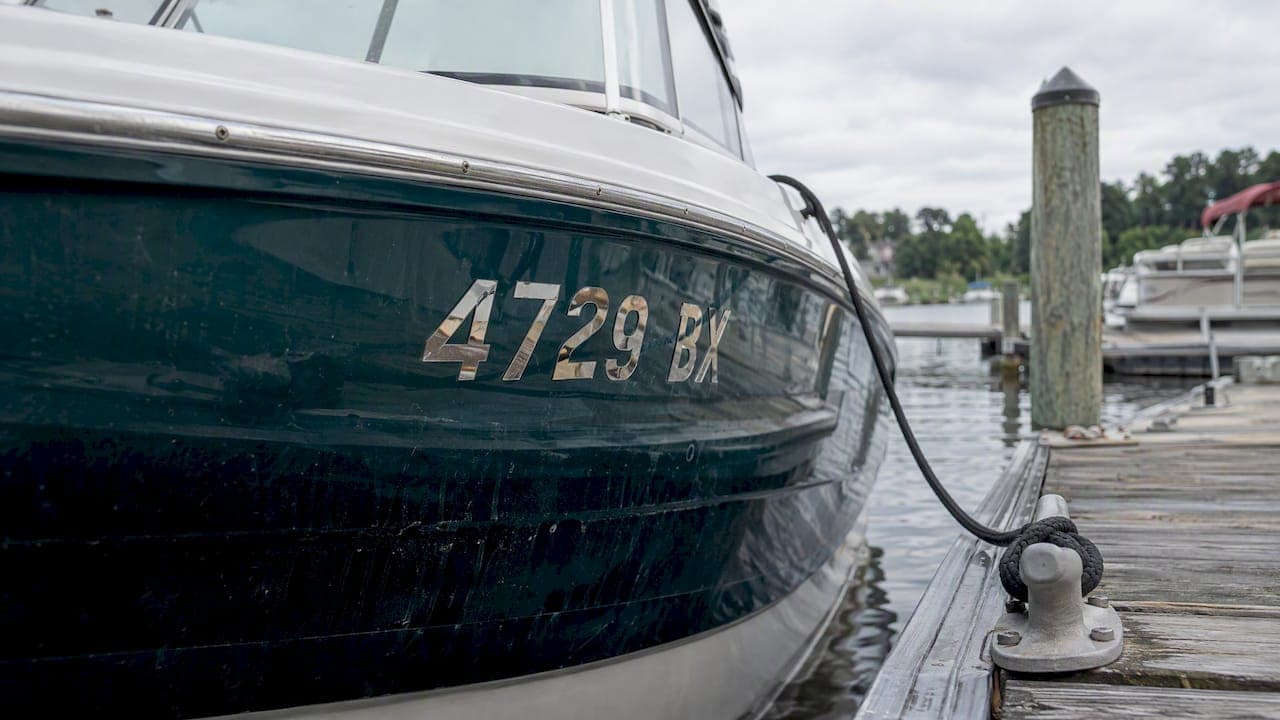
Yes, in most cases. Metallic boat registration numbers are legal as long as they meet the same rules as painted ones: plain block characters at least 3 inches tall, a color that contrasts with the hull, correct spacing, and permanent attachment to both sides of the forward half of the boat. The federal rule does not ban a finish. It bans numbers that are hard to see or read. A mirror-chrome set on a silver hull fails. Gold on a dark navy hull usually passes. Your state may add its own limits, so check them before you order.
TL;DR
- Federal rules regulate size, shape, contrast, spacing and placement. They do not name a finish, so metallic numbers are allowed when they pass those tests.
- Contrast is where metallic numbers fail. Silver, chrome and brushed aluminum on a white or light gray hull are a poor choice.
- Some states add rules. Wisconsin says two-toned numbers are not legal, and California wants the validation sticker 3 inches aft of the number.
- Fancy styles such as beveled, domed or script lettering risk breaking the "plain vertical block characters" requirement.
- A non-compliant display can bring a fine. Oregon lists $110 for a Class D violation.
Table of Contents
- What federal law actually requires
- The four tests a metallic number has to pass
- Where the numbers go
- State rules that change the answer
- What happens if your numbers don't pass
- Metallic options compared
- Our view: legibility first, style second
- Preparing the hull and applying the numbers
- Order a compliant set
- FAQ
- Sources
What federal law actually requires
The federal rule is 33 CFR 173.27. It says the number must be painted on or permanently attached to each side of the forward half of the vessel. It must use plain vertical block characters at least 3 inches high. It must contrast with the background and be distinctly visible and legible. It must read from left to right. A hyphen or a space equal to the width of a letter (other than I) or a number (other than 1) must separate the letter and number groups.
Read that list again and look for a material or a finish. There isn't one. The rule cares about what a Coast Guard officer, a marine patrol officer or a game warden sees from the water. That is why "metallic" is neither automatically legal nor automatically illegal. The finish is fine. What the finish does to visibility is the issue.
Two other federal points matter here. Under 33 CFR 173.15 and 173.19, a covered vessel may not be used without a number issued by its state of principal operation, displayed as 173.27 requires, and no other number may sit on the forward half. And if your vessel is documented with the Coast Guard, Washington's licensing agency notes that federal rules prohibit displaying the state registration number on it.

The four tests a metallic number has to pass
It helps to treat the rule as four separate tests. A set that clears all four is legal in virtually any state. A set that fails one invites a ticket.
1. Contrast with the hull
This is the test metallic numbers fail most often. Contrast means the number stands out from the surface it sits on, from a distance, in changing light. Metal finishes reflect their surroundings. A polished or mirror finish picks up sky, water and the hull color, and the characters can blur into the background.
A practical way to judge it:
- Dark hulls (black, navy, dark green, deep red): gold, silver, brushed aluminum and chrome all read well.
- Mid-tone hulls: gold and bright silver usually work. Check them in sun and in shade.
- White, cream and light gray hulls: silver, chrome and brushed aluminum are risky. Gold can work on white but looks weak on cream or tan. Black or dark blue is the safer choice.
- Metal flake or glitter gel coats: the busy background cuts contrast for any metallic number. A solid dark or solid light number with a clean edge works better.
Take a photo from 20 to 30 feet away with your phone before you commit. If you squint to read it, an officer will too. For more on color choices, see our guide on what color boat registration numbers have to be.
2. Plain block characters
The rule asks for plain vertical block characters. Beveled edges, drop shadows, scripts, italic slants and decorative serifs all move away from that. A subtle bevel that keeps the letter shape clean is a gray area. A swirly font is not. Raised 3D and domed numbers are popular in metallic finishes. Their problem is rarely the dome itself. It is the shadow and highlight effect, which can make a number harder to read at an angle.
When in doubt, choose a plain sans-serif block font and let the finish provide the look. We explain what fonts pass in what font is required for boat registration numbers and in our guide to 3 inch block letters that pass inspection.
3. Height and spacing
The minimum is 3 inches, and that is measured on the character, not on the decal backing. A decal sold as "3 inch" that includes a border in that measurement can leave you with letters under the limit. Measure the actual letter height. Our page on how tall boat registration numbers need to be walks through it, and the boat number design guide shows how to check it before you apply.
On spacing, use a hyphen or a space the width of a letter between groups. For example, a number written FL 1234 AB or FL-1234-AB. Metallic sets that cram groups together to fit a design fail here.
4. Permanent attachment
The federal rule says painted on or permanently attached. Vinyl decals are the common way to meet it. Our explainer on whether registration numbers can be vinyl decals instead of painted covers that. Metal-look vinyl is attached in the same way. Real metal letters or thick raised pieces need to be bonded firmly and not peel, rattle or catch on gear.
Where the numbers go
The numbers belong on both sides of the forward half of the boat. If the boat's shape means numbers on the hull or superstructure would not be easily visible, they must go on a backing plate attached to the forward half so they can be seen from each side, per 33 CFR 173.27. Pontoon owners meet this often. We cover it in pontoon registration number placement. For the basics, read where boat registration numbers go and whether numbers go on both sides.

Remember also that no other number may appear on the forward half. A decorative metallic hull number, a dealer number or a tournament number on the bow can break that rule. Pennsylvania, for instance, prohibits any other number on either side of the bow.
State rules that change the answer
The federal floor is the same everywhere, but your state issues the number and enforces display. Some examples from official sources:
| State | What it says | Why it matters for metallic numbers |
|---|---|---|
| Wisconsin | Numbers must contrast with the boat and be clearly visible and legible. Two-toned and camouflage numbers are not legal. | A two-tone metallic effect, such as a gold fill with a black outline in a different tone, may be treated as two-toned. |
| South Dakota | Numbers may be painted, applied as a decal or otherwise affixed. They must be at least 3 inches high, in block letters, contrast clearly and be readable from 100 feet. | A distance test is a tougher standard than a close-up photo. Low-contrast chrome can fail. |
| Pennsylvania | No other number on either side of the bow. | Skip decorative hull numbers or racing numbers on the bow. |
| California | Registration stickers go 3 inches aft of and in line with the number. | Leave room in your layout and don't let a raised or wide metallic design crowd that spot. |
| Oregon | Failure to properly display numbers or current decals is a Class D violation with a $110 fine. | A non-compliant display is a cost, not just a style choice. |
This is a sample, not a full list. State rules and forms change, so confirm them with your state boating agency. Our state-by-state decal regulations page collects the details in one place.
What happens if your numbers don't pass
In South Dakota, operating a boat that requires registration and numbering is illegal unless it is registered and numbered properly. Numbers that don't meet specifications can bring fines, and illegible numbers may need immediate replacement. Oregon's $110 fine is one concrete figure. Other states differ, and some officers will give a warning first. Nobody can promise you leniency, so build your set to pass without relying on it.
The cost goes beyond fines. A stop for illegible numbers can delay your day on the water, and it can bring more scrutiny to the rest of your gear.
Metallic options compared
These are general guidelines for how common finishes behave, not legal rulings. The same finish can pass on one hull and fail on another.
| Finish | Best on | Watch out for |
|---|---|---|
| Gold | Dark blue, black, green, dark red hulls | Weak contrast on cream, tan or light yellow |
| Silver | Black, navy, dark hulls | Fails on white and light gray hulls |
| Brushed aluminum | Dark hulls | Soft edges and low contrast in glare |
| Mirror chrome | Dark hulls only | Reflects surroundings, blurs the characters |
| Reflective vinyl | Any hull, with a contrasting color | Still must be block characters, correct size and spacing |
| Raised or domed 3D | Smooth, flat hull areas | Shadows can break up the shape. Check the fonts and the "no other characters" rule |
If you want a metallic look but safe legibility, a good compromise is a dark hull with gold or bright silver numbers, or a light hull with a dark metallic number such as a gunmetal tone. If you are weighing alternatives such as hand-applied gold leaf, see our look at boat lettering gold leaf options and boat vinyl lettering alternatives.
Our view: legibility first, style second
We make registration decals every day, and the most common reason a custom set causes trouble is not the finish. It is a design decision made before anyone checked the hull color or the state rule. A beautiful chrome set that nobody can read at 50 feet is a failure, however good it looks in the product photo.
Here is what we tell customers. Decide the hull contrast first. Pick a plain block font. Measure actual letter height. Check the spacing between the letter and number groups. Then choose a finish that supports those four things. Marine-grade vinyl that resists UV and saltwater matters too, because a faded number is an illegible number. Our guide on how long marine vinyl decals last explains what affects lifespan.
The best-looking boats we see are not the ones with the flashiest numbers. They are the ones where the numbers are crisp, evenly spaced and easy to read, and where the finish is a quiet detail.
— Taylor
Preparing the hull and applying the numbers
Metallic vinyl shows every bump, so surface prep matters more than usual. Clean the area, remove wax and residue, and let it dry. If the gel coat is chalky or dull, a boat detailing professional can restore the surface before you apply. Then follow the steps in our installation guide: mark a level line, measure the position, and apply from the center outward to avoid bubbles. Check the final placement against your state's rules before you press everything down.
Order a compliant set
Our custom boat registration numbers and decals are made in-house from marine-grade vinyl that resists UV and saltwater. You enter your registration number, then pick colors and fonts in the online design tool, and the set is $35.99. Production takes 3 to 5 business days, and shipping is free in the contiguous United States. We also have pages for jet ski numbers, pontoon numbers, bass boat numbers, aluminum boat numbers and center console numbers. Marinas and dealerships can order in bulk.
FAQ
Are chrome or gold boat registration numbers legal?
Yes, if they meet the federal and state rules. The finish is not regulated, but the numbers must be plain block characters at least 3 inches tall and must contrast with the hull. Gold on a dark hull usually works, while chrome on a white hull usually does not.
Can I use raised 3D or domed numbers?
Often, yes, because the rule allows numbers that are painted on or permanently attached. They must still be plain vertical block characters with the right spacing and contrast. Avoid heavy bevels, shadows or decorative fonts that change the letter shape, and check your state's rules.
Do reflective numbers count as legal registration numbers?
They can. Reflective material doesn't change what the rule asks for: block characters, 3-inch height, contrast, spacing and placement on both sides of the forward half. Choose a color that contrasts with your hull.
Can I add a second metallic color or outline?
Be careful. Wisconsin says two-toned numbers are not legal, and other states may have similar views. A single solid color that contrasts with the hull is the safest choice. If you want an outline, confirm with your state boating agency first.
Where do I check my state's exact rules?
Start with your state boating or natural resources agency, which issues your number and sets the display rules. Our state regulations page is a quick starting point, and the answers library covers sizing, fonts and placement.
Sources
- eCFR: 33 CFR 173.27, Numbers: Display; size; color
- eCFR: 33 CFR Part 173, Vessel Numbering
- Washington DOL: Boat registration and hull identification numbers
- Wisconsin DNR: What you should know before you operate your boat
- Pennsylvania Code: 58 Pa. Code § 93.5
- California Division of Boating and Waterways: Registration guide
- South Dakota Game, Fish and Parks: Licensing your boat
- Oregon State Marine Board: Number placement and spacing