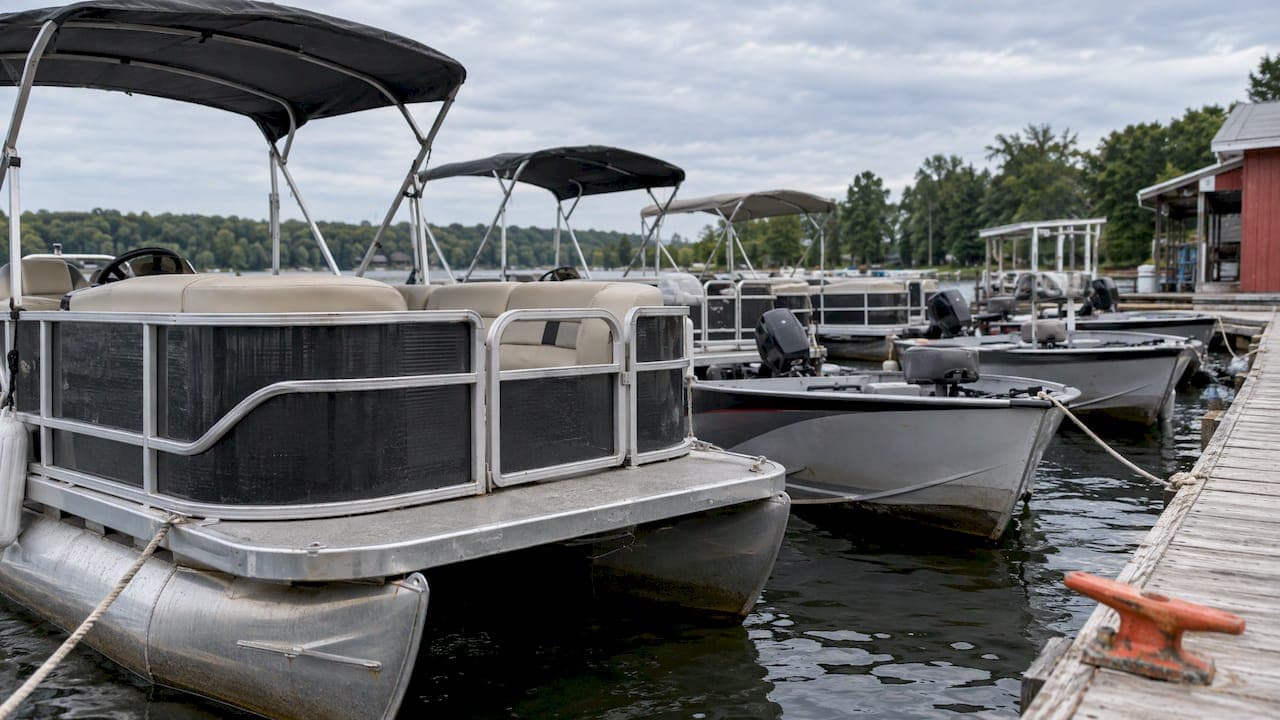
A rental boat is numbered the same way as any other state-registered boat. The number goes on both sides of the forward half of the hull, in plain block characters at least 3 inches tall, in a color that contrasts with the hull. What changes for rentals is the paperwork around the boat: the rental agreement, the certificate of number and, in some states, a reserved number suffix for livery vessels. This guide covers all of it, so you can number a fleet correctly and keep it legible season after season.
TL;DR
- Rental boats follow the same federal display rule as private boats: 33 CFR 173.27 requires numbers on each side of the forward half, in block characters at least 3 inches high, contrasting with the background.
- The rental difference is paperwork. For short noncommercial rentals under 26 feet, the certificate of number can stay on shore, and the renter carries a signed rental agreement showing the vessel number.
- Some states reserve number suffixes for livery boats. California, for example, reserves LA, LB, LD and LE.
- The state validation decal sits within a few inches of the number, and the exact spacing depends on your state.
- Plan for wear: a fleet sees sun, salt, scrubbing and docking contact, so replace faded or peeling numbers promptly.
Table of Contents
- What "rental boat numbering" actually covers
- The federal display rule that applies to every rental
- What a registration number looks like
- Livery suffixes: where rentals can differ
- Paperwork for renters: the certificate and the rental agreement
- How states handle placement and the validation decal
- Color and contrast on a rental fleet
- Different boat types, different placement problems
- Documented rental boats are a different system
- Keeping fleet numbers legible
- Ordering lettering for a rental fleet
- Our perspective
- FAQ
- Sources
What "rental boat numbering" actually covers
People searching this phrase usually mean one of three things. A marina or livery operator wants every boat in the fleet marked correctly. A dealership or charter-style business needs a repeatable process for new units. Or a renter wants to know where the number is, because the rental agreement asks for it.
All three come down to the same two items:
- The registration number, issued by the state for an undocumented vessel, which must be displayed on the hull.
- The validation decal (sticker), which shows the registration is current and is placed next to the number.
The number is permanent and tied to the vessel. The decal is renewed on the state's schedule. For a fleet, that means the hull numbers should rarely change, while the stickers are a recurring task.
The federal display rule that applies to every rental
The Coast Guard rule for state-numbered boats is 33 CFR 173.27. In plain words:
- The number is painted on or permanently attached to each side of the forward half of the vessel.
- Characters are plain, vertical block letters and numbers, not less than 3 inches high.
- The color contrasts with the background.
- Letter and number groups are separated by a space or hyphen of the specified width.
- The number reads from left to right.
The Coast Guard's Boater's Guide to the Federal Requirements adds that the state validation decal must be affixed within six inches of the registration number. Some states set a tighter or different position, which we cover below.
Nothing in these rules gives a rental boat an exemption. A pontoon at a lake livery, a jet ski on a resort dock and a fishing skiff rented by the day all need the same compliant markings as the owner's own boat.
What a registration number looks like
For state-registered boats, the number is typically a state prefix, four digits and a two-letter suffix. California's DMV, for instance, issues undocumented-vessel numbers that start with CF, then four numbers and a two-letter suffix, such as CF 1234 AB. Alabama's marine police describe the same three-part structure and require a space or hyphen between each part. Texas requires the TX number to be separated from the prefix and suffix by hyphens or equivalent spaces.

The grouping matters because a number run together without gaps is harder to read and can fail an inspection. When you order lettering, enter the number exactly as it appears on the certificate and keep the group spacing.
Livery suffixes: where rentals can differ
Federal rules do not give rental boats a special number format, but a state can. California is the clear example: the DMV reserves the suffixes LA, LB, LD and LE for livery (rental) vessels and vessels carrying passengers, and it does not issue suffixes containing I, O or Q. A California rental fleet may therefore have numbers ending in one of those letter pairs.
If you operate in another state, ask your state boating agency whether it assigns a livery class or a special number series. Whatever the state issues, the display rule stays the same: copy the number as issued and mark it to the federal size and contrast standard.
Paperwork for renters: the certificate and the rental agreement
This is the part that most separates a rental from a private boat. Under 33 CFR Part 173, for a vessel less than 26 feet long that is leased or rented for noncommercial operation for less than 7 days, the certificate of number may be kept on shore, at the place the vessel departs from or returns to. The renter must then have a copy of the lease or rental agreement, signed by the owner or authorized representative and the renter, containing the vessel number and the rental period.
Separately, 33 CFR 173.25 says no one may operate a vessel unless the certificate of number or the rental agreement is on board in a way that can be handed to an authorized inspector.
For an operator, this suggests a simple routine:
- Print the vessel number on every rental agreement exactly as it appears on the hull.
- Fill in the rental start and end.
- Collect both signatures.
- Give the renter a copy to keep in a dry pouch aboard.
A mismatch between the number on the agreement and the number on the bow is the kind of small error that causes trouble on the water. It is also why the hull lettering should always be clean and unambiguous.
How states handle placement and the validation decal
The federal rule sets the floor. States add detail, mostly about where the sticker sits. Here is what several official sources say.
| State | Number | Validation decal |
|---|---|---|
| Florida | Both sides of the bow, block characters at least 3 inches high, per FLHSMV | Port side, immediately before or after the number |
| Washington | Both sides of the bow, at least 3 inches high, BLOCK style, per the Department of Licensing | Within 6 inches of the number, both sides of the bow, aft of and in line with it |
| Texas | BLOCK characters at least 3 inches high | In line with the number and 3 inches toward the rear of the boat |
| Hawaii | Legible at 100 feet or more, per DOBOR | Each side, 3 inches aft of the number and directly in line |
| District of Columbia | At least 3 inches high, bold block letters, as high above the waterline as practical, per MPD | Within 6 inches of the number |
| Montana | Each outboard side of the bow, vertical block letters at least 3 inches, per 2025 boating laws | Permanent decal 3 inches aft and in line on the left side |
| Alabama | Both sides of the bow, BLOCK characters at least 3 inches high | In line with the number, within 6 inches before or after |
Two takeaways for fleets. First, the decal position is not the same everywhere, so a template that works for a Texas fleet can be wrong for Florida. Second, some states want the decal on both sides and others on one, so read your own state's page before you apply anything. Our state-by-state decal regulations page and our guide to boat registration sticker placement collect these details in one place, and our validation sticker answer covers the common cases.
Texas also lets antique boats put the decal on the left part of the windshield, a reminder that unusual hulls can have their own provisions.
Color and contrast on a rental fleet
The federal wording is simply "contrasting." Hawaii's boating division gives practical advice: a very dark color on a light background, or the reverse, gives the best visibility. If you use a backing plate in a different color than the hull, the plate must extend far enough beyond the number to give enough background.
For a fleet of mixed hulls, that means choosing color per boat, not per fleet:
- White or light hulls: black or dark navy lettering.
- Dark or black hulls: white or bright lettering.
- Two-tone hulls: pick the color for the panel where the number sits, forward on the hull.
Our answer on what color registration numbers have to be goes through more combinations. Avoid script or italic fonts. Our page on block letter requirements explains why plain block characters are the safe choice.
Different boat types, different placement problems
Rental fleets are rarely one type of boat, and placement is where the type shows.
- Pontoons: the bow is often a rail or a curved gate with little flat surface. Mounting is usually on the forward side of the toon or on a panel. See our guide to pontoon number placement and our pontoon numbers.
- Jet skis: personal watercraft have small hull areas, but the same number rule applies. Read do jet skis need registration numbers and see our jet ski numbers.
- Aluminum and bass boats: smooth side panels suit decals well. We make aluminum boat numbers and bass boat numbers.
- Center consoles: a flared bow can be tricky, so place numbers on the flattest section of the forward half. See center console numbers.
- Kayaks and canoes: whether they need numbers depends on propulsion and the state. Our answer on kayaks and canoes and the kayak registration numbers guide explain it.
The rule that unites them: both sides, forward half, readable from the side. Our page on numbers on both sides of the boat covers the "why both sides" question, and where registration numbers go shows the layout.
Documented rental boats are a different system
If a boat is federally documented rather than state-numbered, the markings change. The Coast Guard guide says documented recreational vessels display the name and hailing port together on the hull, usually on the stern, in letters at least 4 inches high. The official number is permanently affixed in block-type Arabic numerals at least 3 inches high, preceded by "NO," on a clearly visible interior structural part. A documented vessel may also owe a state fee and need a state validation sticker.
So if a fleet includes a documented boat, do not treat it like the rest. Its name and hailing port need their own lettering, and the official number goes inside, not on the bow. Our boat name signs guide helps with the name side.
Keeping fleet numbers legible
Rental boats work harder than private ones. They get sun all day, are rinsed hard, and bump docks. A number that has faded or peeled is not "maintained in readable condition," which Florida's rules specifically require. Build a short check into your turnaround:
- Look at both bow sides at the start of each season.
- Replace any character that is lifting, cracked or faded.
- Check that the validation decal is current and still within the specified distance of the number.
- Keep spare sets for your busiest boats, because a damaged hull panel can be repaired fast.
Good hull care protects lettering as well. Regular rinsing and a sensible cleaning schedule, such as the hull cleaning steps and timing boaters use to avoid costly haul-outs, keep the area around your numbers clean enough to read.
When applying new lettering, follow our installation guide and read our answer on whether numbers can be vinyl decals instead of painted. Federal rules allow numbers to be painted or permanently attached, and good marine vinyl is a common way to attach them.
Ordering lettering for a rental fleet
Our custom boat registration numbers and decals are made from marine-grade vinyl chosen for UV and saltwater resistance. You enter the registration number, choose colors and fonts in the online design tool, and order. A set is priced at $35.99, and production takes 3 to 5 business days, with free shipping in the contiguous United States. We also take bulk orders for marinas and dealerships.
To start, design your boat's number set or go straight to the page for your hull type, such as pontoon numbers. For a larger fleet, put the vessel numbers into one list first, so each set matches its certificate exactly.
Our perspective
Fleets rarely fail on the big rule. They fail on small things: a number set in a decorative font, a decal on the wrong side, a character that peeled off in July. We built our design tool around that. You type the number exactly as issued, pick a contrasting color, and get plain block characters sized for the 3-inch standard.
We also think durability is a compliance issue, not a cosmetic one. A rental boat sits in the sun and salt for months, so we make our decals from marine-grade vinyl selected for UV and saltwater resistance, and we produce them in-house. When a set is damaged, a replacement ships in 3 to 5 business days, so a boat is not out of service for long.
Our advice to operators: standardize. One process for ordering, one template for placement per boat type, one check each spring. It is the cheapest way to keep every hull in your fleet inspection-ready.
Taylor
FAQ
Do rental boats need registration numbers on the hull?
Yes. A rental boat that requires state numbering displays its number like any other boat: on each side of the forward half, in block characters at least 3 inches high, in a contrasting color. The rental status does not change the display rule. It changes only what paperwork the renter carries.
Can the certificate of number stay on shore for a rental?
For a boat under 26 feet rented noncommercially for less than 7 days, federal rules let the certificate stay at the place the boat departs from or returns to. The renter must carry a signed rental agreement that includes the vessel number and rental period. Check your state's rules for anything stricter.
Do livery boats get special registration numbers?
It depends on the state. California reserves the suffixes LA, LB, LD and LE for livery and passenger-carrying vessels. Ask your state boating agency whether it does something similar, and display whatever number it issues.
Where does the validation sticker go on a rental boat?
Near the registration number. Federal guidance says within six inches, while states set their own position: Texas and Hawaii say 3 inches aft and in line, and Florida says port side directly before or after the number. Use your state's rule.
How often should rental boat numbers be replaced?
There is no fixed schedule. The number must stay readable, so replace any lettering that is faded, cracked or peeling. Checking both bow sides at the start of each season catches most problems.
Sources
- eCFR: 33 CFR 173.27, Numbers: Display; size; color
- eCFR: 33 CFR Part 173, Vessel Numbering
- 33 CFR 173.25, Location of Certificate of Number
- A Boater's Guide to the Federal Requirements for Recreational Boats
- California DMV: Vessel Numbers
- Florida FLHSMV: Numbering and Decals
- Washington Department of Licensing: Boat registration and hull identification numbers
- Texas Parks & Wildlife: Numbers and Decals on Vessels
- Hawaii DOBOR: Numbering Your Vessel
- DC Metropolitan Police Department: Harbor Legal Requirements
- Montana Boating Laws 2025
- Alabama ALEA: Boat Registration and Operator License