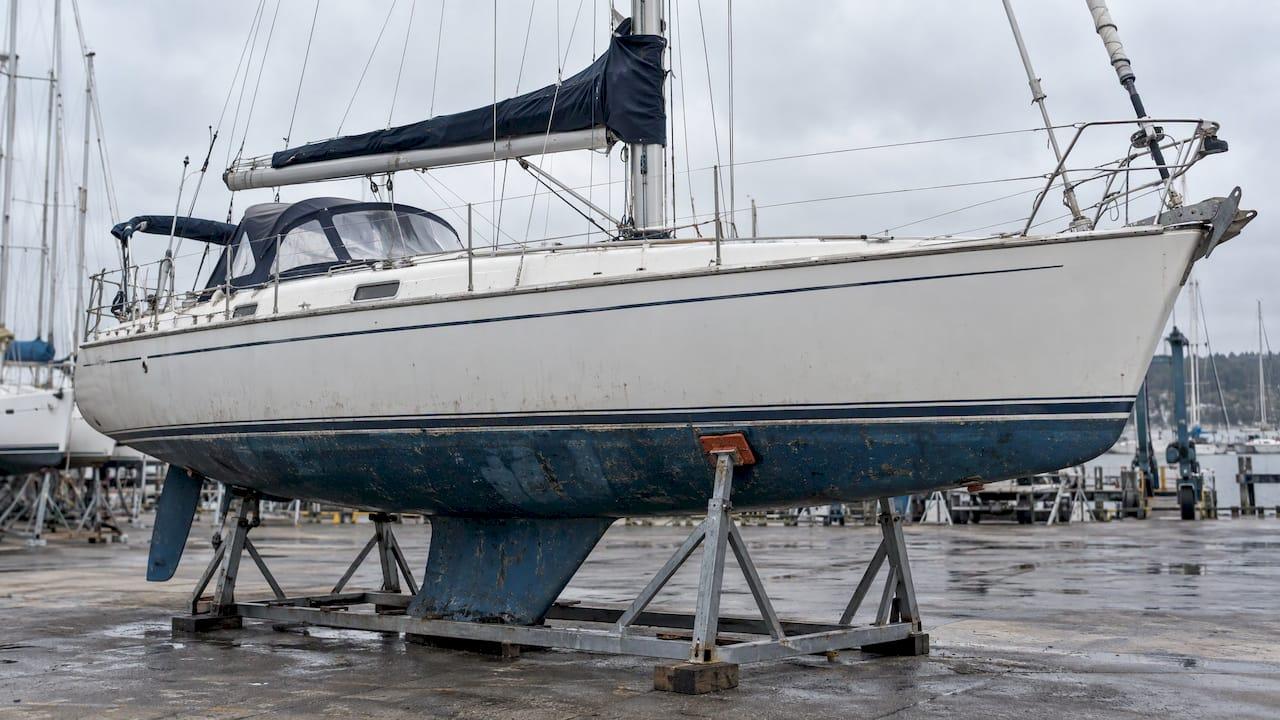
Sailboat registration numbers go on both sides of the forward half of the hull. They must be plain, vertical block characters at least 3 inches tall, in a color that contrasts sharply with the hull, and read from left to right. Letters and numbers are separated by a hyphen or a space. That is the federal rule, and your state issues the number itself. This guide covers placement on a sailboat, sizing, spacing, font, state differences, decal application and how to look up a registered boat.
TL;DR
- Put the state-issued number on each side of the forward half of the hull, where another vessel or someone on shore can read it (33 CFR 173.27).
- Use plain vertical block characters at least 3 inches high, in a color that contrasts with the hull, with a hyphen or space between each group.
- Whether your sailboat needs a number depends on your state. Rules often turn on length and on whether the boat carries a motor.
- Skip italic, script, shaded or decorative lettering. Plain sans-serif block characters are the safe choice.
- We make state-compliant sailboat number decals in marine-grade vinyl. Our custom set is $35.99, and you build it online in minutes.
Table of Contents
- Where sailboat registration numbers go
- Size, color and spacing
- What font to use
- Does your sailboat need a number at all?
- Registration number, HIN and documentation: three different marks
- How to apply sailboat number decals
- Why vinyl material matters on a sailboat
- Can other numbers be on the bow?
- How to look up a boat by registration number
- Our perspective: get the numbers right once
- Order sailboat registration number decals
- Common mistakes on sailboat numbers
- FAQ
- Sources
Where sailboat registration numbers go
The federal rule is short. The registration number must be painted on or permanently attached to each side of the forward half of the vessel. That wording comes from 33 CFR 173.27, the Coast Guard regulation that every state's numbering system follows.
On a sailboat, "forward half" means the front half of the hull, measured along the length of the boat. The bow is the obvious spot, but a few layout questions come up again and again on sail designs:
- Flared or raked bows. Hawaii's boating division points out that the number should not sit on the underside of a flared bow where the angle hides it from another vessel or from the shore (Hawaii DOBOR). Many sailboats have a sheer line that sweeps up toward the bow. Pick a flat, vertical stretch of topsides where the numbers read straight on.
- Hull graphics and cove stripes. Do not run numbers across a stripe, a seam or a hardware plate. A broken character is harder to read, and readability is the point of the rule.
- Toe rails, rubrails and chainplates. Keep the characters clear of fittings that cast shadows or interrupt the line.
- Both sides. The rule says each side. A single number on one side leaves the other side of the boat unmarked. We cover this in more detail in our answer on whether registration numbers go on both sides.
For a broader walk-through of placement on any hull type, see where boat registration numbers go.
Size, color and spacing
The same federal section sets the look of the number. Read together with the state guidance, the checklist is simple:
| Element | What the rule asks for |
|---|---|
| Character style | Plain, vertical block characters |
| Height | At least 3 inches |
| Color | Contrasts sharply with the background |
| Reading direction | Left to right |
| Grouping | Hyphen or space between the state prefix, the digits and the letter suffix |
| Location | Each side of the forward half |
The format reads like XX 1234 AB or XX-1234-AB, where XX is your state prefix. The spaces or hyphens are part of the number's legal presentation, so do not run the groups together.
Color on a sailboat hull
The number has to contrast with what is behind it. White numbers on a white gelcoat fail, and so do dark blue numbers on a navy hull. Contrast is the whole test. On a white hull, black or dark blue works. On a dark hull, white is the common answer. If your hull has two tones or a metallic stripe at the forward topsides, measure where the number will sit and choose against that specific surface, not the hull color you remember.

Spacing
Spacing is where inspectors and marine patrol officers find most faults. Groups that sit too close together read as one string. Space them clearly and evenly. Our guides on boat number spacing and on checking that numbers stand three inches tall show how to measure it before you stick anything down.
Readability is the real test
A guide from BoatRegistrationUSA makes a point worth keeping in mind: even characters that meet the 3-inch minimum can fail if they cannot be read from a reasonable distance (BoatRegistrationUSA). If your hull has heavy texture, a shiny reflective finish or a low-contrast color scheme, going taller than 3 inches can help. Check your state's rules first, because some states set their own limits on top of the federal floor.
What font to use
The regulation asks for plain, vertical block characters. In practice, that means a simple sans-serif block face. Italic, script and decorative faces do not belong on a registration number. Hawaii's guidance specifically advises against shaded numbers and says slanted or script numbers do not meet Coast Guard standards (Hawaii DOBOR).
Our design tool defaults to block lettering so you do not have to think about it. We explain the reasoning in what font is required for boat registration numbers and in our piece on 3-inch block letters that pass inspection.
A note for owners who like a classic look: a boat's name is a place for style. Fancy script lettering belongs there, not on the registration number.

Does your sailboat need a number at all?
This is the question behind many searches, and the honest answer is that it depends on where you sail. Federal law sets how numbers are displayed. States decide which boats must carry one.
Two examples show how much it varies:
- Wisconsin. The DNR says a boat on Wisconsin waters must be covered by a certificate of number, a registration certificate and registration expiration decals. Sailboats 12 feet or less without a motor are exempt from registration, while sailboats 16 feet or longer need a Wisconsin certificate of title or a federal Certificate of Documentation (Wisconsin DNR).
- Louisiana. The LDWF requires registration of motorized vessels, including sailboats 12 feet or longer used in Louisiana waters (Louisiana LDWF).
A small dinghy that rides on your deck may have different rules from your main boat, and an auxiliary engine can change the answer for a sailboat. Rather than guess, check your own state. The NASBLA Registration Dashboard gives standardized summaries of registration and titling standards for each state and territory, with official contact information for the issuing agency. If the dashboard leaves a question open, call that agency.
What stays constant across states is the basic numbering approach. Registration fees, exemptions, insurance and operator licensing are where states differ, according to MarineTitle.com.
Registration number, HIN and documentation: three different marks
Sailboat owners often mix these up, especially when buying a used boat.
- State registration number. Issued by your state, displayed on the forward hull, and the number this article is about.
- Hull Identification Number (HIN). A 12-character identifier assigned by the manufacturer. It stays on the hull for good and is different from your registration number (LegalClarity). Decals do not replace it.
- Federal documentation. An optional route for recreational vessels over five net tons (LegalClarity). Documented vessels carry their own markings.
The documented case deserves care. Washington's Department of Licensing notes that federal rules prohibit showing the state's WN registration number on a vessel documented with the Coast Guard, while the owner must still meet state registration requirements and display state decals on the forward half (Washington DOL). If your sailboat is documented, confirm with your state agency exactly what to display before ordering anything.
How to apply sailboat number decals
Good application is half the job. A crooked or bubbled decal looks careless and can be hard to read. The steps below follow the method in our installation guide.
- Check the numbers first. Compare the decal against your state certificate, character by character, before you peel anything.
- Clean the hull. Remove wax, oil and salt film from the spot. A clean, dry surface gives the vinyl a base to hold.
- Mark your line. Use painter's tape and a level or a string line so both sides sit at the same height. Measure from a fixed point, such as the bow stem, so port and starboard match.
- Position and press. Set the decal in place, then work from the center outward with a squeegee to push out air.
- Peel the transfer tape slowly. Pull it back at a low angle so the characters stay on the hull.
- Check both sides. Step back and look from a distance, as another boat would.
If you prefer to place numbers by hand before committing, our write-up on aligning boat numbers with wet or dry methods explains both approaches.
The registration expiration decals your state issues are a separate item. Hawaii's guidance places them on each side three inches aft of the number and in line with it (Hawaii DOBOR). Your state may do it differently, so follow the instructions that come with your validation stickers.
Why vinyl material matters on a sailboat
Sailboats live in sun, spray and salt. Gelcoat reflects heat, hulls flex and decks get washed down. A decal here needs to hold its color and its edges in all of it. Vinyl longevity in general depends on the film itself, the surface and how well it is maintained, and this guide to how long vinyl lasts explains those factors for vinyl in general.
For registration numbers, we use marine-grade vinyl chosen for UV and saltwater resistance, and we produce the decals in-house. Our longer guide to the best vinyl for boats goes into what to look for. Domed numbers are another option some owners consider, and we compare them in our piece on domed registration number alternatives.
Can other numbers be on the bow?
Sailboats often carry class numbers or sail-related graphics. Keep anything near the registration number from confusing the reading of it. Our answer on other numbers on a boat's bow covers the details. The safe approach is to leave clear space around the registration number and keep it the only thing in its zone.
How to look up a boat by registration number
Lookup is handled state by state. There is no single national search for state registration numbers. BoatRegistrationUSA notes that, depending on the state, you may use an online portal, call the agency or visit an office with the registration number, HIN and registration documents (BoatRegistrationUSA lookup guide). The number's two-letter prefix tells you which state issued it, so start with that state's boating agency. Owner details may not be public, so a call to the agency is often the way to confirm a record.
The NASBLA dashboard mentioned above lists official contact information for each issuing agency and is a good place to find the right office.
Our perspective: get the numbers right once
We hear the same story from sailboat owners. The boat passed every other check, and then the numbers were the problem: too small, too close together, a script face someone liked, or white characters on a light hull.
Our view is simple. Registration numbers are not decoration, so the decal should take the guesswork out. That is why our design tool is built around the number itself: you enter your registration, pick a color that contrasts with your hull and choose a font, and the result is built for plain block-style numbers.
We also think material matters more on a sailboat than on most boats. Sun on the topsides, salt on the bow and constant washing are daily conditions. Our decals use marine-grade vinyl selected for UV and saltwater resistance, produced in-house, so what arrives is made for that environment.
Finally, state rules differ, and we publish detailed compliance guidance so you can check your own state before you order. A good decal set should be something you install once, check once and then forget about.
Taylor
Order sailboat registration number decals
Our custom boat registration number set is $35.99 per set. Enter your registration number, choose a color and font, preview it and order. Production takes 3 to 5 business days, and shipping is free across the contiguous United States.
Start on our custom boat registration numbers page, or browse the full set of boat number answers first. Marinas and dealerships can use the same tool for bulk orders. If you also own a tender, pontoon, center console or personal watercraft, we have dedicated pages for pontoon numbers, center console numbers and jet ski numbers.
Common mistakes on sailboat numbers
A short list of what goes wrong most often:
- Numbers on one side only. The rule covers each side of the forward half.
- Characters under 3 inches. Measure the finished height, not the size of the sheet.
- Low contrast. Check the color against the exact patch of hull where the number will go.
- Run-together groups. Leave a hyphen or clear space between the prefix, digits and letters.
- Placement on a curve. Put the number where it reads flat from the side.
- Decorative fonts. Stay with plain block characters.
- Wrong number order. Copy the number exactly as your certificate shows it.
FAQ
Where do registration numbers go on a sailboat?
They go on each side of the forward half of the hull. Federal rules say the number must be painted or permanently attached there. Keep it on a surface where another boat or someone on shore can see it, not on a hidden underside of a flared bow.
What font is recommended for boat registration numbers?
Use plain, vertical block characters, in a simple sans-serif style. Italic, script and decorative faces are not appropriate, and Hawaii advises against shaded numbers. Our design tool is set up around block lettering for this reason.
Do all sailboats need registration numbers?
Not always. Federal law sets how numbers are displayed, and each state decides which boats must be registered. Some states exempt small unpowered sailboats, and a motor or a longer hull can change the answer. Check your state agency or the NASBLA dashboard.
How do I look up a boat by its registration number?
Lookup is run by each state, so begin with the state shown in the number's prefix. Many agencies offer an online portal or a phone line, and you may need the registration number, the HIN or other documents. Owner details may not be available to the public.
What if my boat does not have a HIN?
The HIN is a 12-character identifier the manufacturer assigns to the hull. If yours is missing or unreadable, contact your state boating agency to learn how it handles the situation. A registration decal does not replace a HIN.
Sources
- eCFR, 33 CFR 173.27: Numbers, display, size, color
- Hawaii DOBOR: Numbering Your Vessel
- NASBLA Registration Dashboard
- Wisconsin DNR: What you should know before you operate your boat
- Louisiana LDWF: Title or Register Your Boat
- Washington DOL: Boat registration and hull identification numbers
- MarineTitle.com: Boat Registration Laws
- LegalClarity: What Is a Vessel Number?
- BoatRegistrationUSA: Boat Registration Number Display Rules
- BoatRegistrationUSA: Boat Registration Lookup by State